
SAFETY COMES FIRST!
By John Preston
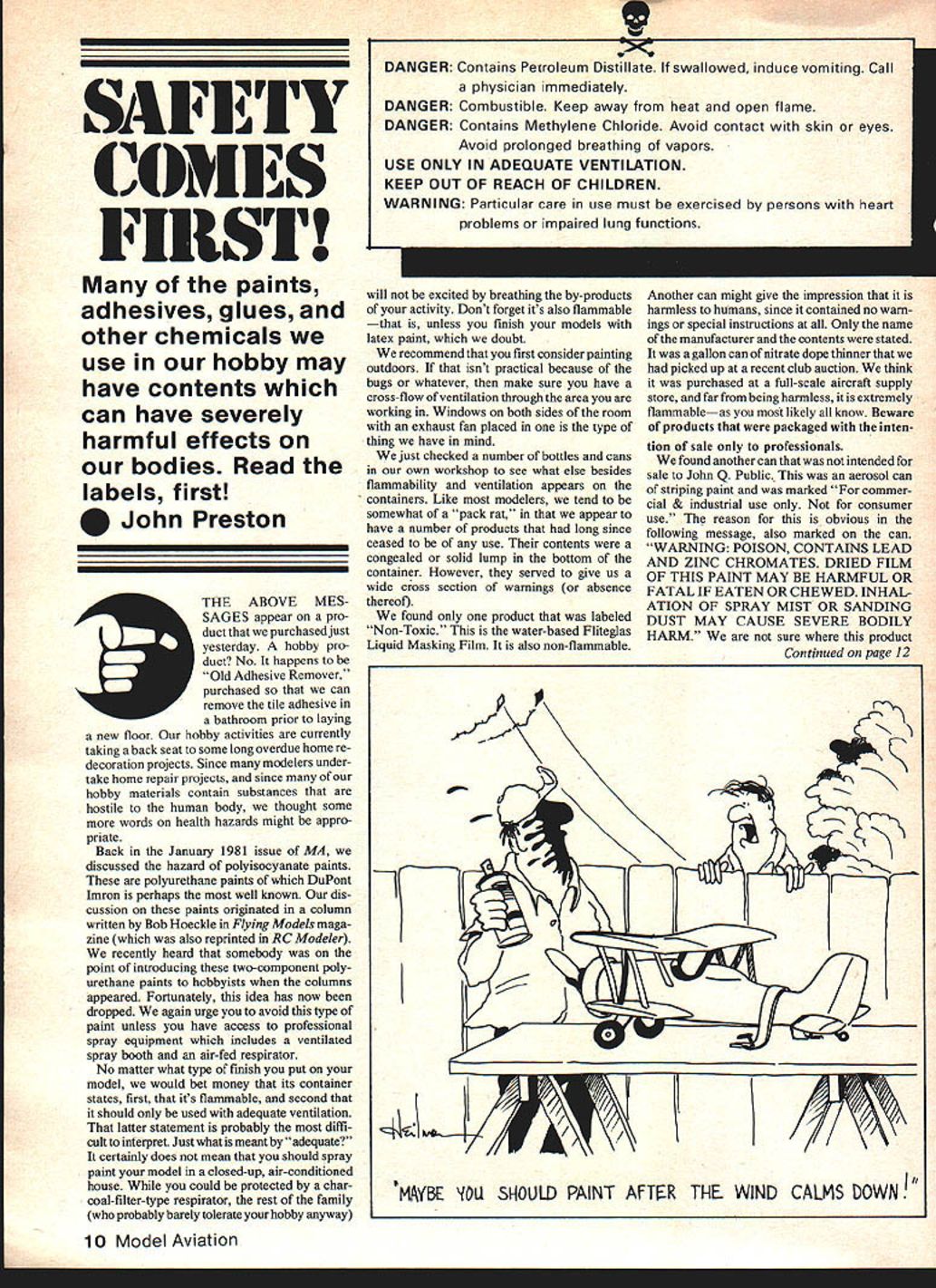
Many of the paints, adhesives, glues, and other chemicals we use in our hobby may contain substances that can have severely harmful effects on our bodies. Read the labels first!
The above message appeared on a product we purchased recently: "Old Adhesive Remover," bought to remove tile adhesive in a bathroom prior to laying a new floor. Our hobby activities are currently taking a back seat to some long-overdue home redecoration projects. Since many modelers undertake home repair projects, and since many hobby materials contain substances hostile to the human body, a few more words on health hazards seem appropriate.
Back in the January 1981 issue of MA, we discussed the hazard of polyisocyanate paints. These are polyurethane paints of which DuPont Imron is perhaps the best known. Our discussion originated in a column by Bob Hoeckle in Flying Models magazine (also reprinted in RC Modeler). We recently heard that someone was about to introduce these two-component polyurethane paints to hobbyists when those columns appeared. Fortunately, that idea has been dropped. We again urge you to avoid this type of paint unless you have access to professional spray equipment that includes a ventilated spray booth and an air-fed respirator.
No matter what type of finish you put on your model, we would bet the container states, first, that it's flammable, and second, that it should only be used with adequate ventilation. That latter statement is probably the most difficult to interpret. Just what is meant by "adequate"? It certainly does not mean you should spray paint your model in a closed-up, air-conditioned house. While you could be protected by a charcoal-filter-type respirator, the rest of the family (who probably barely tolerate your hobby anyway) will not be excited by breathing the by-products of your activity. Don't forget it's also flammable — that is, unless you finish your models with latex paint, which we doubt.
We recommend you first consider painting outdoors. If that isn't practical because of bugs or weather, then make sure you have a cross-flow of ventilation through the area in which you are working. Windows on both sides of the room with an exhaust fan placed in one is the type of setup we have in mind.
We checked a number of bottles and cans in our workshop to see what warnings appear on containers besides flammability and ventilation. Like most modelers, we're something of a pack rat and have many products that had long since ceased to be of any use — contents congealed or solid in the bottom of the container. However, they gave us a wide cross section of warnings (or the absence of warnings).
We found only one product labeled "Non-Toxic": the water-based Fliteglas Liquid Masking Film. It is also non-flammable.
Another can gave the impression it was harmless because it contained no warnings or special instructions at all — only the manufacturer and the contents were stated. It was a gallon can of nitrate dope thinner that we picked up at a recent club auction. We think it was purchased at a full-scale aircraft supply store, and far from being harmless, it is extremely flammable — as you most likely know. Beware of products packaged for sale only to professionals.
Example: Aerosol striping paint warnings
We found an aerosol can of striping paint marked "For commercial & industrial use only. Not for consumer use." Its label included the following warnings:
- WARNING: POISON. CONTAINS LEAD AND ZINC CHROMATES. DRIED FILM OF THIS PAINT MAY BE HARMFUL OR FATAL IF EATEN OR CHEWED. INHALATION OF SPRAY MIST OR SANDING DUST MAY CAUSE SEVERE BODILY HARM.
- DANGER: Contains Petroleum Distillate. If swallowed, induce vomiting. Call a physician immediately.
- DANGER: Combustible. Keep away from heat and open flame.
- DANGER: Contains Methylene Chloride. Avoid contact with skin or eyes. Avoid prolonged breathing of vapors.
- USE ONLY IN ADEQUATE VENTILATION.
- KEEP OUT OF REACH OF CHILDREN.
- WARNING: Particular care in use must be exercised by persons with heart problems or impaired lung functions.
We are not sure where this product came from, but it's now in the trash.
Most of you are aware there is a federal regulation controlling the content of lead in paint: it limits lead in the dried film to 0.06%. However, paints intended solely for painting RC model aircraft are exempt from these requirements. We are not sure how many hobby paint manufacturers sell paint containing lead. In our workshop, only a bottle of Pactra Aero Gloss "Military Flats" stated on the label that it contained lead. We understand the lead is used to match full-scale aircraft colors. If you use this paint, do not use leftovers to retouch your kids' toys. We doubt you or your children will chew on your model, but young children do sometimes try to eat their toys. (For the record, we own a cat that ate part of the rudder on one of our scale aircraft — it was not painted with Aero Gloss.)
One thing we did not find in our workshop was any product that contained benzene. It is not long since benzene was commonly used as a solvent in consumer products; its link to leukemia has caused its disappearance from the marketplace. Two other solvents, toluene and xylene (sometimes listed as toluol and xylol), are chemically closely related to benzene and are found in many finishing materials.
To the best of our knowledge, toluene and xylene have not been flagged as carcinogens, but, according to an article in Family Health magazine (sent to us by Russell Knetzger of the Milwaukee Flying Electrons), they "can cause narcosis—dizziness, nausea, loss of coordination, even coma—if they are absorbed in sufficient concentration." Toluene was listed as an ingredient in our butyrate dope thinner, retarder, and two different brands of epoxy paint. Xylene is also found in epoxy paint. This is why we generally do all our spraying outdoors and sand or buff off the bugs later. Maybe we're not known as the club's best painter, but we're still in control of our faculties.
The Family Health article mentions another chemical that appears in at least one hobby product: n-hexane, found in some spray adhesives which some use to attach wing skins to foam cores. We have used it to mount photographs in our office.
According to a toxicologist at the Consumer Product Safety Commission, the following may occur to those exposed to n-hexane: "Symmetrical progressive weakness and sensory loss in the extremities; unsteady gait; difficulty in grasping; severely exposed subjects may experience paralysis of legs and arms." On the consoling side, n-hexane is not a known carcinogen. Our can of spray adhesive did not list ingredients by name but stated only that they were petroleum distillates. As we understand it, a person would have to have "prolonged exposure" to n-hexane before neurological impairment would result. Nevertheless, we recommend you spray foam cores — or whatever — outdoors whenever possible.
We assume all modelers know the dire consequences if the hardener used with polyester resin (MEKP) gets into an eye: it takes only seconds to lose one's sight in such an incident. While on the subject of eyes, users of cyanoacrylate glues have likely experienced eye irritation from fumes given off as the glue cures. We were unable to find out if these fumes are potentially harmful; if any readers can shed light on this, we would welcome a letter.
Finally, in case you think only hobby paints can cause bodily harm, consider this story (also from Family Health):
For weeks a man had been dragging around feeling unwell, chalking it up to allergy. Weeks later he felt worse: a distinct pain at the bottom of his spine, increasing difficulty urinating, and aching legs. One evening he felt seriously ill and called his doctor. The diagnosis was toxic exposure to paint used by professional painters who had painted a bedroom. The paint was apparently just run-of-the-mill oil-based enamel. So whether you're spray painting your latest pattern or scale creation, or merely doing home renovations, be alert to allergy-like symptoms after exposure — you could be having a toxic reaction to the paint.
Time to leave you for another month and get back to the bathroom redecorating. While writing this, we decided to return the methylene-chloride-containing "Old Tile Remover" to the store. Consider this account from Family Health:
"Consider the case of a 64-year-old Wisconsin man who took up furniture refinishing in his basement. After a three-hour session using a paint stripper containing METHYLENE CHLORIDE to remove paint and varnish from a chest of drawers, he suffered a heart attack and was rushed to the hospital. Though he mentioned his hobby to the attending physicians, the doctors made no connection. Soon after being released from the hospital, the man returned to his project. He suffered another heart attack, convalesced more slowly the second time, and once again returned to his hobby. A third heart attack, however, was fatal."
John Preston 7012 Elvira Court Falls Church, VA 22042
Transcribed from original scans by AI. Minor OCR errors may remain.

