
SAFETY COMES FIRST!
John Preston
Is it ever safe to knowingly fly a model over other persons? Also, watch out for whirling props and shorted batteries!
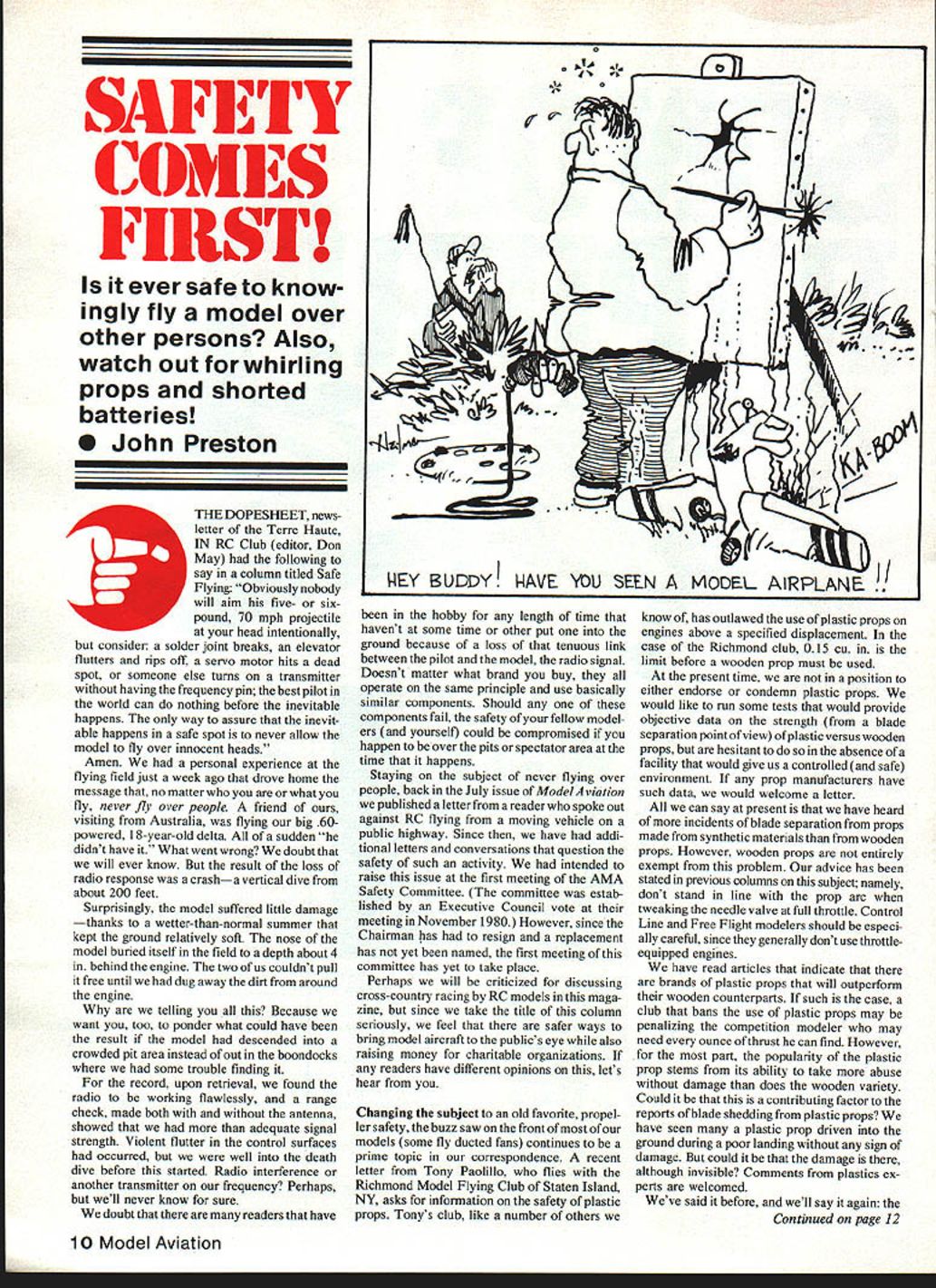
Never fly over people
The DOPESHEET (Terre Haute, IN RC Club) had this to say in a column titled "Safe Flying": "Obviously nobody will aim his five- or six-pound, 70 mph projectile at your head intentionally, but consider: a solder joint breaks, an elevator flutters and rips off, a servo motor hits a dead spot, or someone else turns on a transmitter without having the frequency pin; the best pilot in the world can do nothing before the inevitable happens. The only way to assure that the inevitable happens in a safe spot is to never allow the model to fly over innocent heads."
Consider how quickly things can go wrong:
- A solder joint breaks.
- An elevator flutters and rips off.
- A servo motor hits a dead spot.
- Someone else turns on a transmitter on your frequency.
The only reliable way to reduce risk is to pick a safe flying area and never fly over pits or spectators.
Personal experience
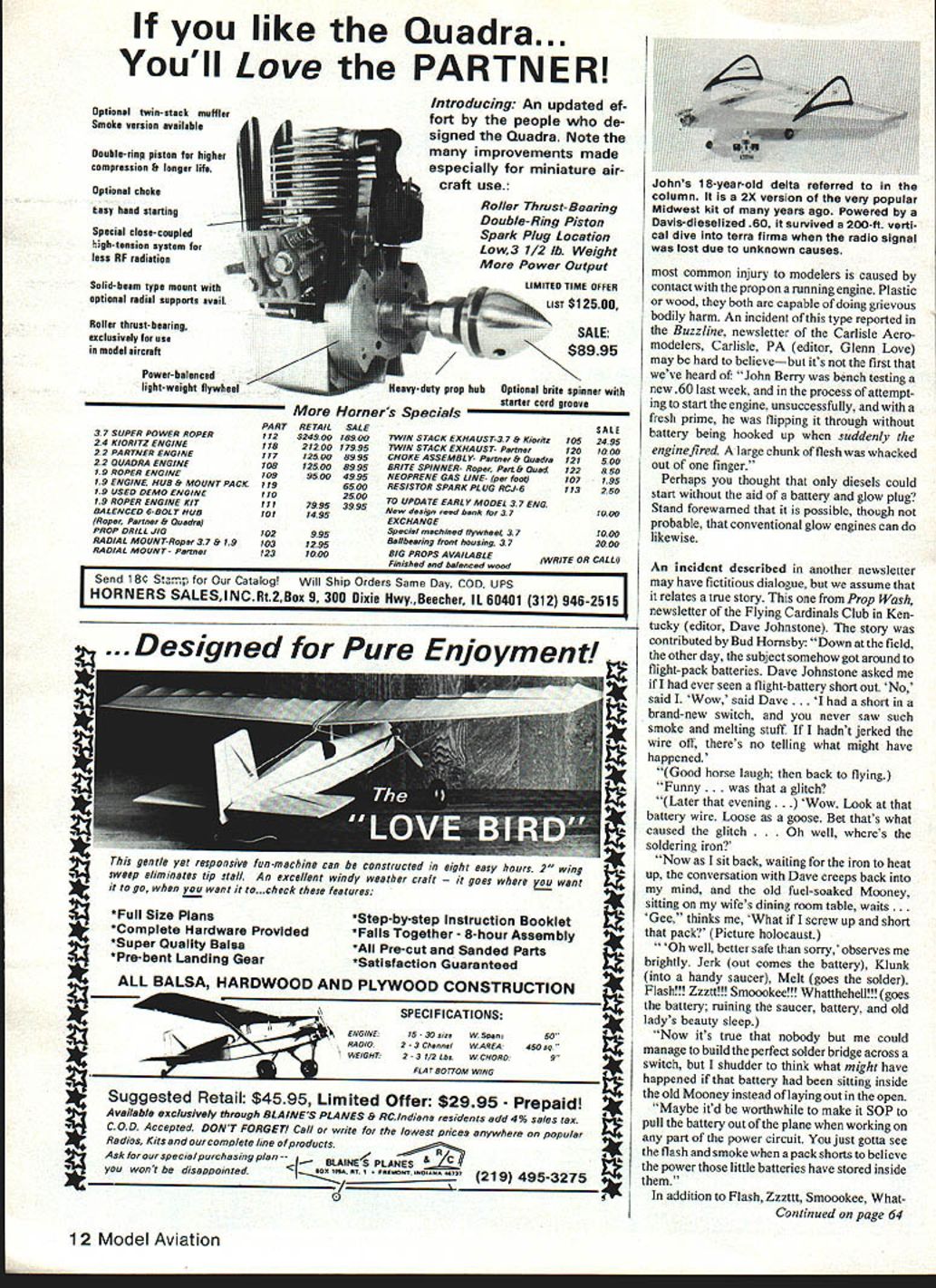
A friend visiting from Australia was flying our big .60‑powered, 18‑year‑old delta. Suddenly he "didn't have it" — the radio response was lost and the model went into a vertical dive from about 200 feet. Fortunately, the ground was unusually soft from a wet summer; the nose buried about 4 inches behind the engine and the model suffered little damage. We had to dig dirt away from around the engine to free it.
Upon retrieval the radio tested flawlessly. Range checks, with and without the antenna, showed adequate signal strength. Violent flutter of control surfaces occurred, and there may have been radio interference or another transmitter on the same frequency — we'll never know for sure.
We tell this story to highlight what could have happened if the model had descended into a crowded pit area instead of the boondocks.
Radios and inevitability
All radio systems operate on the same basic principles and use similar components. Any component failure can sever the tenuous link between pilot and model. It doesn't matter what brand you buy — a failure can compromise the safety of fellow modelers and spectators. Expect that failures will happen someday; plan your flying operations to minimize exposure of people to that risk.
Flying from moving vehicles and public displays
We received letters questioning the safety of RC flying from moving vehicles on public highways and other cross‑country racing ideas. We planned to raise the issue with the AMA Safety Committee, but that committee has not yet met. We feel there are safer ways to showcase model aircraft and raise charity money than activities that put the public at risk. We welcome differing opinions from readers.
Propeller safety
Propellers (or ducted fans) remain a prime safety topic. A number of clubs have outlawed plastic props above a certain engine displacement. For example, the Richmond Model Flying Club of Staten Island, NY, bans plastic props on engines above 0.15 cu. in.
At present we cannot categorically endorse or condemn plastic props. We would like objective testing on blade separation strength for plastic vs wooden props, but need a controlled, safe facility to run such tests. Prop manufacturers with test data are invited to contact us.
Observations so far:
- We have heard more incidents of blade separation from synthetic props than from wooden props, though wood is not exempt.
- Plastic props often take more visible abuse without showing damage — invisible internal damage after a hard strike is a concern.
- Some plastic props may outperform wooden counterparts; blanket bans could disadvantage competition modelers who need maximum thrust.
General safety advice for prop handling:
- Don't stand in the prop arc when adjusting needle valves at full throttle.
- Control Line and Free Flight modelers should be especially careful, since many of their engines lack throttles.
Comments from plastics experts are welcome.
Battery shorts and bench‑testing hazards
Prop contact is a common source of injury, but battery shorts are also extremely hazardous. Examples from club newsletters:
- John Berry was bench testing a new .60. While flipping the prop (without the battery hooked up) the engine unexpectedly fired and took a large chunk out of one finger. Conventional glow engines can, though rarely, start without a battery or glow plug.
- A flight battery shorted inside a switch, producing smoke and melting components. If the wire hadn't been jerked off quickly the result could have been much worse.
Practical recommendations:
- Make it standard operating procedure (SOP) to remove the battery from the plane when performing work on any part of the power circuit.
- Be aware that NiCd (and other) batteries heat up extremely fast under dead-short conditions and may explode or produce severe burns. Shorting a single 600 mAh cell for a few seconds can cause burns.
You have to see the flash and smoke when a pack shorts to appreciate the stored power and danger inside small batteries.
Final advice
Never knowingly fly your model over other persons. Also watch out for whirling props and shorted batteries.
Maybe you've never experienced total loss of control, blade separation, an engine that starts without a battery, or a shorted pack — but perhaps your turn is next. Plan and practice safe procedures.
Have a safe month.
John Preston 7012 Elvira Court, Falls Church, VA 22042
SAFE FLYING IS NO ACCIDENT
Transcribed from original scans by AI. Minor OCR errors may remain.

