

SAFETY COMES FIRST!
Exploding fuel cans. Allergic reactions to epoxy glues. RC glitches due to poor connections in the plug for a detachable antenna. Read on!
- John Preston
Futaba advertisement and reader reactions
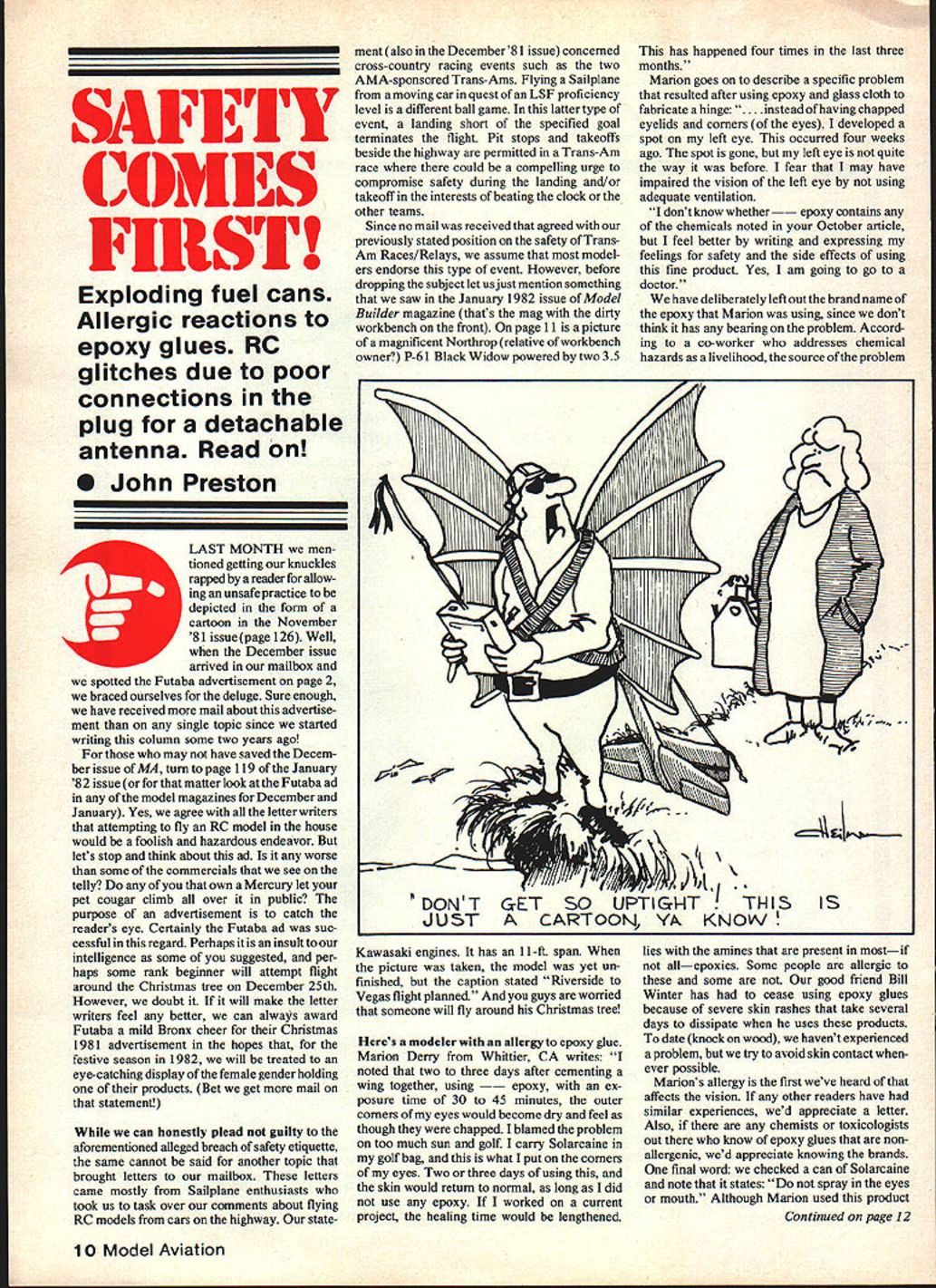
Last month we mentioned getting our knuckles rapped by a reader for allowing an unsafe practice to be depicted in a cartoon in the November 1981 issue (page 126). When the December issue arrived and we spotted the Futaba advertisement, we braced ourselves for the deluge. Sure enough, we have received more mail about that advertisement than on any single topic since we started this column two years ago.
For those who may not have saved the December issue, see page 119 of the January 1982 issue (or look at the Futaba ad in any of the model magazines for December and January). We agree with all the letter writers that attempting to fly an RC model in the house would be foolish and hazardous. But consider the purpose of an advertisement: to catch the reader's eye. The Futaba ad was certainly successful in that regard.
Perhaps it insults our intelligence, and perhaps some rank beginner will attempt flight around the Christmas tree on December 25. We doubt it. If it will make the letter writers feel better, we can always award Futaba a mild Bronx cheer for their Christmas 1981 advertisement and hope that for the festive season in 1982 we will be treated to an eye-catching display of the female gender holding one of their products. (Bet we get more mail on that statement!)
Flying from cars and Trans-Am races
While we can honestly plead not guilty to the alleged breach of safety etiquette regarding the cartoon, the same cannot be said for another topic that brought letters to our mailbox: flying RC models from cars on the highway. Those letters came mostly from sailplane enthusiasts who took us to task over our comments about cross-country racing events such as the AMA-sponsored Trans-Ams.
Flying a sailplane from a moving car in quest of an LSF proficiency level is a different ball game. In that type of event, a landing short of the specified goal terminates the flight. Pit stops and takeoffs beside the highway are permitted in a Trans-Am race, where there could be a compelling urge to compromise safety during landing and/or takeoff in the interests of beating the clock or the other teams.
Since we received no mail that agreed with our previously stated position on the safety of Trans-Am races/relays, we assume that most modelers endorse this type of event. Before dropping the subject, let us mention something we saw in the January 1982 issue of Model Builder magazine (the mag with the dirty workbench on the front). On page 11 is a picture of a magnificent Northrop P-61 Black Widow model powered by two 3.5 Kawasaki engines with an 11-ft span. The caption stated "Riverside to Vegas flight planned." And you guys are worried that someone will fly around his Christmas tree!
Epoxy allergy — Marion Derry
Marion Derry, Whittier, CA, writes:
"I noted that two to three days after cementing a wing together using epoxy with an exposure time of 30 to 45 minutes, the outer corners of my eyes would become dry and feel chapped. I blamed the problem on too much sun and golf. I carry Solarcaine in my golf bag, and this is what I put on the corners of my eyes. Two or three days of using this and the skin would return to normal, as long as I did not use any epoxy. If I worked on a current project, the healing time would be lengthened. This has happened four times in the last three months.
"After using epoxy and glass cloth to fabricate a hinge, instead of having chapped eyelids and corners of the eyes, I developed a spot on my left eye. This occurred four weeks ago. The spot is gone, but my left eye is not quite the way it was before. I fear that I may have impaired the vision of the left eye by not using adequate ventilation.
"I don't know whether the epoxy contains any of the chemicals noted in your October article, but I feel better by writing and expressing my feelings for safety and the side effects of using this fine product. Yes, I am going to go to a doctor."
We have deliberately left out the brand name of the epoxy Marion was using, since we don't think it has any bearing on the problem. According to a co-worker who addresses chemical hazards as a livelihood, the source of the problem lies with the amines present in most, if not all, epoxies. Some people are allergic to these and some are not. Our friend Bill Winter has had to cease using epoxy glues because of severe skin rashes that take several days to dissipate after use. To date (knock on wood), we haven't experienced a problem, but we try to avoid skin contact whenever possible.
Marion's allergy is the first we've heard of that affects vision. If other readers have had similar experiences, we'd appreciate a letter. Also, if any chemists or toxicologists know of nonallergenic epoxy glues, we'd like to know the brands. One final word: we checked a can of Solarcaine and note that it states "Do not spray in the eyes or mouth." Although Marion used this product for some relief from eye irritation, he didn't spray it in his eyes, and we cannot vouch for its safety for that use.
Detachable antenna plug — Kraft radios
A letter from Art Arno, NMPRA VP, enclosed a safety tip that appeared in the NMPRA News Release. Art experienced glitches while flying a Formula 500 racer and, upon investigation, found that the receiver antenna was in the process of pulling itself out of the Kraft detachable plug. The antenna wire had not broken but had merely pulled loose from the plug.
Kraft radio owners (myself included), take note: do not use this detachable antenna plug as a strain relief. In Art's case, proper strain relief was used, and the problem was attributed to high "g" forces causing the unsupported plug to flop around in the fuselage.
The solution comes from Pete Waters (Kraft, Midwest). Build a small fillet of room-temperature vulcanizing compound (RTV) at both ends of the wire-to-plug junction to mechanically secure the connection. For added security, slip a length of heat-shrink tubing over the joint after the RTV cures in a day or two. Be sure to use an RTV compatible with electronic circuitry — Dow Corning #3145 or equivalent is recommended. The common household variety has an acetic acid base which can cause problems; the recommended electronic variety does not have the vinegar odor. Also, tape the two halves of the antenna connector to prevent disconnection due to vibration.
According to Pete Waters, Kraft is dropping the detachable antenna connector from future production. Unless you have a vital need for a detachable antenna, consider having yours removed and replaced by a single piece of antenna wire when you next have your radio serviced.
Fuel-can explosion — Kansas City RC Contacts
The following account of a potentially disastrous fuel-can explosion was taken from the Kansas City RC Contacts newsletter. Its original source is unknown, but Michael Knight was its author.
"Gentlemen: Just a note about safety with special regards to our model airplane fuel. It seems that this stuff is far more volatile than I ever realized. Last July 14, I was out flying with Larry Laureto, Frank Madi and his son, and Don Chesney. After my last flight, while sitting on the grass talking to Larry and admiring my newly-recovered Aeromaster, we had the misfortune of watching (and hearing) the half-gallon of fuel that I had remaining explode, sending the can some 300 feet in the air, more than halfway across the flying field. The fuel also set fire to my plane, Larry's P-51, and me. That's right — me.
"My family and I want to personally thank Don Chesney, Frank Madi, Larry, and the others for their quick reactions and unselfish assistance. Don pulled off his shirt and helped put out the fire on my legs, then proceeded to put out the fire on my plane. You're never quite sure how people will react in situations like that. I'll tell you one thing: I'd have those guys in my corner any time of the week. Once again, my most sincere thank you to these men.
"We later figured that a short in my power panel may have set fire to some fuel in the bottom of the flight box. You can't see alcohol burning, so it just burned along, heating up the fuel can which eventually resulted in a tremendous explosion. I don't hesitate to say that the explosion could have been extremely serious, possibly even fatal to someone in direct line of the can and liquid fire (unseeable yet) that resulted. If something like this were to happen on a crowded Sunday with children around, or by one's self, the consequences could have been far more tragic."
Amen. This is not the first time we have reported on a fuel can exploding. We hope that yours will not be the next. If you have a field box that has both fuel and electrical power, take the time to look at it and ask yourself: "Could it happen to me?" Maybe some minor changes in layout could make it safer.
Radio interference — future investigation
Finally for this month, we are about to embark on an effort to investigate the causes of a number of glitches that seem to be occurring in ever-increasing number at our local flying field. We strongly suspect outside interference, such as from pocket pagers. Even if the FCC grants the AMA petition and we get the choice of 50 frequencies in the 72 MHz band, we will still be sharing the band with other users. It seems like every club should be aware of these other users, and a frequency scanner may be one way to track them down. More on this in a future column.
Have a safe month.
John Preston 7012 Elvira Court, Falls Church, VA 22042.
Transcribed from original scans by AI. Minor OCR errors may remain.

