
Safety Comes First!
Cross-country RC flying: a flier's view on safety
- John Preston
We had not planned any further discussion on the subject of cross-country flying of RC model aircraft. However, we received several more letters on this subject during the past month, and we note in the February 1982 issue of Model Aviation that the VP for District IV, Chuck Foreman, has a request for comments on the future of Trans-Am Rallies. Since we appear to be alone in questioning the safety of cross-country flying, we thought you should have the benefit of seeing a letter that "presents the other side of the coin." This letter comes from Rick Helmke, who flew in the 1981 Trans-Am with a team from the Auburn Planesmen RC Club.
Letter from Rick Helmke (participant in the 1981 Trans-Am Rally)
As a participant in the 1981 Trans-Am Rally, I feel I must take exception to the manner in which such events are being treated by the AMA in general and by John Preston in particular.
Mr. Preston printed a letter in his July 1981 "Safety Comes First" column opposing cross-country RC flying along public highways. The writer of that letter, Paul Smith, claims that such activity endangers innocent bystanders in such a manner that it should not be undertaken for any reason. He goes on to say that such activity could also endanger the rights of modelers to fly "anywhere in this country." Mr. Preston takes somewhat the same position in his December column saying there are better ways of bringing model aircraft to the public eye.
I'm afraid both gentlemen have gone too far in their condemnation of such activities.
It has been my experience in recent months that flying from a moving vehicle entails relatively little danger when compared to other RC activities. It is just a little different. Thanks to cooperation from the local police, we had an escort during all of our local practice sessions for the rally. Whenever a potential conflict with traffic developed we either waited until things were clear or the officer directed traffic away.
At no time during the practice or the rally did we fly over densely populated areas. The practice sessions were carried out in rural areas in situations tougher than the rally itself. Any time during the rally we passed through a town, the planes were carried through.
Safety was a primary concern in all we did. Contest Directors were instructed not to allow any plane to fly unless it was in good flying condition, something not always observed at local flying fields. Pilots were instructed to sacrifice airplanes in favor of safety should the situation require it, and I don't think any pilot would have done otherwise had it been necessary.
As to equipment failures, anyone using a little sense had his plane and radio in top condition for both the rally and practice sessions. Mr. Smith professes to have over 20 years of modeling experience and says he is an active competitor. As such, he must realize that people who participate in events such as the Trans-Am Rally are serious modelers and competent and safe pilots who take great care to ensure that their models are in perfect condition.
Both Mr. Preston and Mr. Smith operate under the erroneous assumption that when a radio fails, the airplane will crash immediately. Of the last two radio failures I witnessed, one plane flew across the field and crashed just behind the pit area, and the other wound up two miles away. Neither aircraft was seriously damaged. Nevertheless, the radio link between plane and pilot is not as tenuous as Mr. Preston would have us believe. The only radio failure along our route was the loss of one servo.
As I returned home, I reviewed the route the Rally took, and I noticed that there were very few homes or towns along the way. The entire route was planned by Bob and Doris Rich so as to avoid as many towns and busy highways (except interstates) as possible, and I thought they did an excellent job.
As to Mr. Preston's contention that there are better ways to bring this sport to the public eye, I can't think of many. There was substantial media coverage in Meridian, MS, probably more than we have ever gotten locally.
I have often felt that, had the attitudes shown by Mr. Preston and Mr. Smith been prevalent in the early days of RC, we would not have come nearly as far as we have. No one will disagree that safety is of foremost concern in model aviation. But like anything in the rapid stages of development RC has witnessed, there must be a spirit of adventure and a desire to do something new. Mr. Preston and Mr. Smith seem lacking in both.
Cross-country flying can and is being done in as safe a manner as any RC activity, and it deserves much better treatment than it is getting. Instead of eliminating this activity, we need to weed out those who are making it unsafe. The same is true for any modeling activity. If Mr. Smith is worried about being able to keep flying, he needs to look at unsafe fliers, because they are what make anything unsafe. It's not events that are safe or unsafe. It's the people flying that bring about a safety record.
If you have any comments on Rick's letter or on the subject of cross-country flying in general, we are still interested in hearing from you. Also, you might take the time to read Chuck Foreman's column on page 82 of the February issue and let your District VP know your feelings.
Respirators and finishing safety
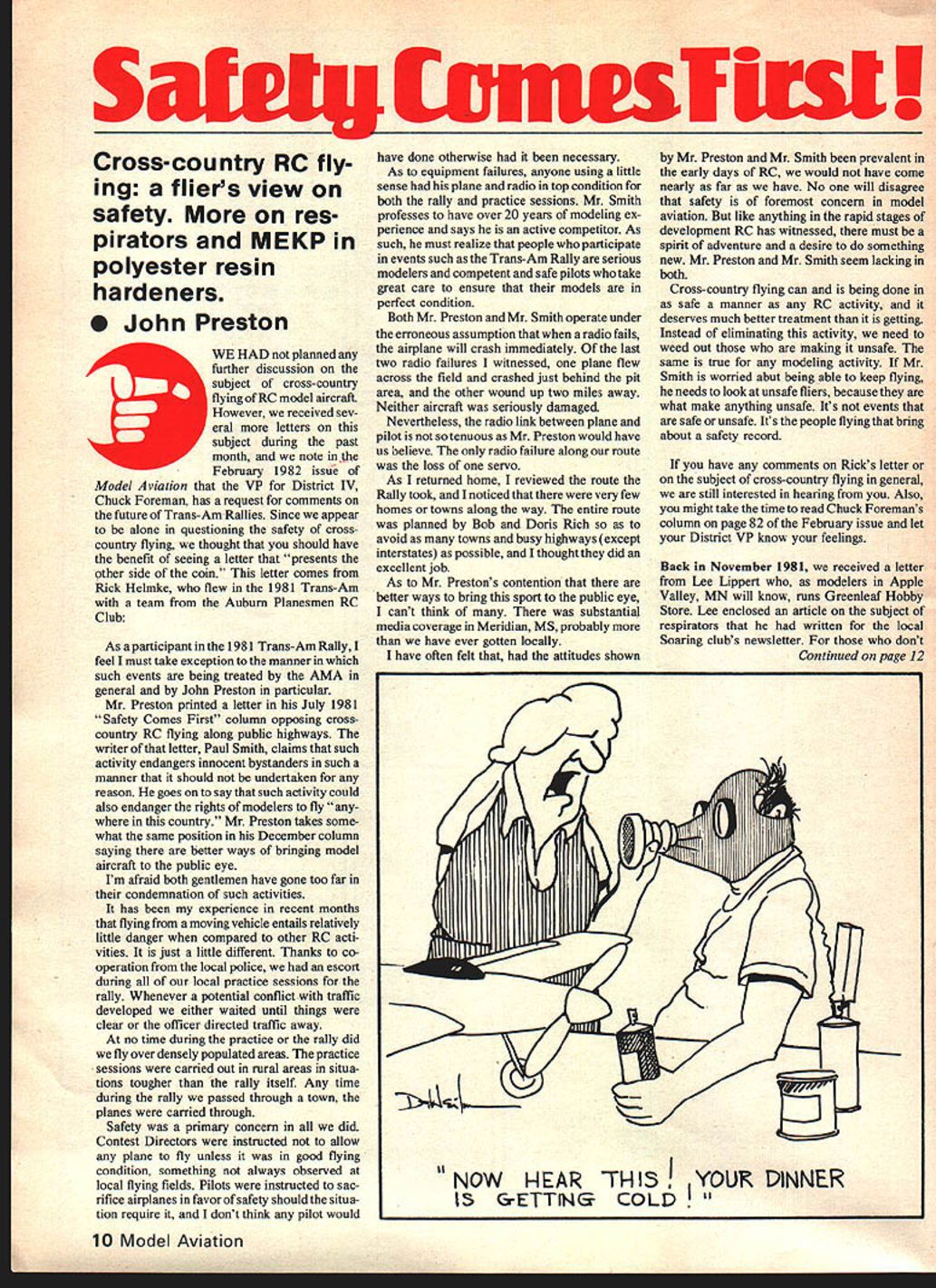
Back in November 1981, we received a letter from Lee Lippert who, as modelers in Apple Valley, MN will know, runs Greenleaf Hobby Store. Lee enclosed an article on the subject of respirators that he had written for the local Soaring Club's newsletter. For those who don't already have a respirator for use when spraying models or for those who may have an allergy to dust, we think the following article by Lee is worth reading.
While we sailplane addicts don't paint our models as much as the power fliers do, we do encounter some of the materials which have caused severe problems for those who don't use proper equipment. These chemicals include epoxies, polyesters, urethanes, and their various thinners and catalysts. Common elements in many of our finishing products are xylene, naphtha, toluene, and toluol.
These chemicals are all aromatic hydrocarbons and are generally considered to be of low hazard value. However, a recent incident came to my attention in which a man died as a result of using an epoxy paint in the open air. The official cause of death was acute xylene poisoning. As a result of this incident, a search for an effective, readily available, light, and inexpensive mask was made by another organization, "Practical Sailor." Their findings were products made by the 3M Company. The specific models recommended are as follows.
Recommended 3M respirators
- 3M No. 8709 Easi Spray Paint Respirator: $7.95 plus tax.
- This simple, inexpensive respirator should give the user adequate protection from both organic vapors and particles encountered in normal finishing work outdoors, including protection while spraying. One mask should last a year or more, provided it is kept in a sealed bag between uses. It should be discarded when the user can detect the odor or taste of the vapor, or when breathing through it becomes difficult. The exhalation valve makes breathing easier than through a typical particle mask. The respirator is affixed with dual adjustable elastic bands, and a flexible metal stiffener over the nose permits bending for a close fit.
- 3M No. 8741 Spray Paint Respirator Assembly: $13.00 plus tax.
- This two-part respirator-filter is NIOSH/MSHA approved for use with paints that give off organic vapors as well as protection from mists and dusts. The active respirant is charcoal. The respirator body is semi-rigid plastic that attaches with double adjustable elastic straps. It is only moderately comfortable to wear and takes some getting used to. Goggles and/or glasses fit easily above it. The respirator gives warning of high concentrations of vapors by allowing the user to smell them. How long the device lasts depends upon breathing rate and vapor concentration; when vapors can be smelled, or at the first sign of irritation, the respirator is saturated and the filtering element should be changed. This mask is recommended for anyone working with polyurethane coatings and polyester and epoxy resins as well as hydrocarbons whenever vapor concentrations could cause discomfort or toxic reactions, including use in confined areas.
- 3M No. 9920 Dust/Fume/Mist Respirator: $2.90 plus tax.
- This mask is similar in appearance to the No. 8709. It is recommended for those who are sensitive to dusts or other particulates encountered during model building. This mask is not designed to give protection from paint thinners.
The prices quoted for these masks were current as of November 1, 1981 and, given our economic conditions, are subject to change.
Isocyanates and ventilation
When Lee sent us the article he enclosed the 3M bulletins that describe these respirators. In the one describing the No. 8709, we noted the following statement preceded by the word IMPORTANT: "3M Brand Easi-Air Paint Respirator No. 8709 is designed for protection against airborne concentrations of paints and coatings containing not more than two-tenths part per million (0.2 ppm) free isocyanate in the spray. Areas should be adequately ventilated (containing at least 19.5% oxygen). Respirator must not be worn where atmospheric concentrations of contaminants are unknown or immediately dangerous to life or health. Not for use by individuals who have known respiratory problems or have ever had a reaction to isocyanates."
We wrote to 3M and asked for their recommendation on a respirator to use when spraying paints containing polyisocyanates. In a telephone response, we learned that the No. 8709 may be used for such purposes when the spray area is well ventilated. So be aware that in addition to wearing a respirator, if you must use paints containing isocyanate curing agents, do so in a room with an effective exhaust fan—or outdoors if you can. Also be aware that when the spraying operation is finished, harmful vapors will continue to be present as the paint is curing.
We recently attended a meeting at which a presentation on finishing models was given by Dave Pearce, a well-known North Carolina modeler. After spraying the color coats and adding the trim, Dave uses a clear final coat containing isocyanate curing agents. After experiencing flu-like symptoms and breathing problems which stemmed from being present in the room with the model after it had been sprayed with this final coating, Dave now uses a spare bathroom equipped with an exhaust fan as a drying room.
A final note on the 3M respirators: the No. 8709 model is available through industrial safety equipment distributors. It is also sold through auto parts stores as model No. 6986, and in hardware stores it is known as model No. 8655.
MEKP and polyester resin hardeners
In the January 1982 safety column we printed a letter received from Jack Kinney that stated that the peroxide level in MEKP (the hardener used with polyester resin) had been lowered, apparently by a government regulation to protect the user. We stated that we were puzzled by Jack's statement, because we could not find this regulation. A further letter from Jack produced an industry source with which to check, and it turns out that it was a Department of Transportation regulation that set November 20, 1980, as the official date whereby it would be illegal to transport any MEKP exceeding 9% active oxygen. Suppliers of MEKP have no control over this ruling and are required to comply.
We thank Jack for his information and would suggest that you check the instructions when using recently purchased polyester resin and hardener, rather than relying on past experience for the correct amounts to use. Jack's industry source was the Pennwalt Corporation which, in a bulletin dated July 1980, had this to say to its users: "If, after formulation and use conditions are unchanged, about 20–25% more of the 9%-active-oxygen peroxide, i.e., Lupersol DDM-9, will be required to yield equivalent gel/cure times to those shown with the now familiar 11% active oxygen material." Despite its reduction in "strength," we still urge you to be extremely cautious when using MEKP. It can still cause blindness if contact with the eye occurs.
Closing reminders
This column is being written on New Year's Day but will be read by you in late February or early March. Let us remind RCers that, if they haven't already done so, now would be a good time to have their radios serviced before the contest season is upon us. Maybe it was working OK when you hung it up last year, but maybe it won't work so well today. An ounce of prevention is worth a pound of cure.
Have a safe month.
John Preston 7012 Elvira Court Falls Church, VA 22042
Transcribed from original scans by AI. Minor OCR errors may remain.

