
Safety Comes First!
• John Preston
Electrocution at Bluff Park
We start this month's column on a somber note. On Sunday, January 3, a 19-year-old RC sailplane flier from Lakewood, CA was electrocuted after he climbed a utility pole supporting a power line to retrieve his model that had become entangled in the wires. A number of readers sent newspaper clippings reporting this incident through an Associated Press news release. A more detailed account appeared in the Long Beach Press-Telegram, which ran the story on the front page.
This column has reported previous electrocution deaths associated with model flying, all of which were caused when a Control Line model or its control lines either struck or came into close proximity with overhead power lines. The Lakewood incident is the first we've heard of involving a modeler climbing a utility pole to retrieve a model. Whether you fly CL, RC, or FF models, we urge you to never attempt to retrieve an entangled model yourself. Both the telephone and power companies will respond to your call for assistance, and even though it may take them longer to arrive than you may like, no model is worth the risk of your life.
Photographs that accompanied newspaper articles showed that the utility pole and the crossbar supporting the lines were wooden. This, together with the very small insulators attaching the lines to the crossbar, causes us to wonder if perhaps the victim assumed the lines were telephone wires rather than high-voltage (2,330 V) power lines. The site of the incident, Bluff Park, is apparently a favorite among Slope Soaring enthusiasts in the area. However, at the time it happened most of the regular fliers were not at the park because light winds were producing only marginal slope lift. Presumably, those experienced fliers were well aware of the hazard presented by the overhead power lines, since one was quoted in the newspaper as saying: "If there had been more of the regular fliers there, there would have been no way he (the victim) would have been allowed to go up the pole." Another flier stated: "We usually just throw something at them to get them down. Normally, rocks work best—or an occasional shake of the pole. Usually, they are just hanging on up there by a few threads."
We doubt the power company would appreciate having rocks thrown at their lines and poles. As we previously stated, we encourage anyone experiencing model entanglement in overhead lines to call the utility company immediately. Never under any circumstances attempt to climb a utility pole or a ladder in an attempt to release an entangled model yourself. For the record, the victim was not an AMA member; however, by all accounts he was an experienced modeler rather than a beginner. We hope that by relating the account of this death we can help avert a future incident of this type.
Dangers in winding rubber models
We had a letter during January from George Batiuk, Sr., a well-known Free Flight modeler from Huntsville, AL. Prior to receiving George's letter, we would have expressed much skepticism that a Peanut Scale model could cause bodily injury. Maybe the following account by George will give you some appreciation of the energy that can be stored in a piece of twisted rubber.
"I have been reading your Safety Comes First column since its inception, and have benefited from it, even when the discussion did not involve one of my areas of interest. One of these areas is the flying of rubber-powered models from Peanut to Mulvihill. One would think that this apparently benign phase of our hobby could not contain potential danger. And I was one of the complacent ones, too—until I woke up and observed what was going on around me at FF contests.
"What is going on is that ever-increasing numbers of fliers are using some form of protection for the model while winding the rubber motor. This procedure requires some means of removing the protective device, usually some form of tube, from inside the fuselage after winding the motor and before hooking up the prop. The means usually employed is a wire, tubing, or rod of sufficient length to accept the blast tube from inside the fuselage.
"The potential danger arises from the winding technique wherein this wire, tubing, or rod extension is retained between the winder and the motor during the winding process. Can you imagine the destructive power transmitted to a 3/16-in. diameter aluminum rod, 42 in. long (which is what I use on my Mulvihill) that is still attached to a 16-strand motor with upwards of 700 winds on it, when the motor breaks? If you think this is an extreme case, consider the incident I witnessed at one of the Coffee Airfoilers' annuals in Tullahoma, TN. A Peanut was being wound with a small extension rod (somewhere on the order of 10 in. long and 1/32 in. in diameter). The motor broke, the rod flew down to the runway, rebounding high enough to strike the flier in the mouth, chipping a tooth.
"How often does this happen, you ask? As with most 'accidents'—once is enough, if you are the recipient."
We think we might go one step further than George and say that, with Mulvihill or Wakefield motors, once might be too much. So, to you Free Flighters who employ the twisted-rubber form of energy to derive your motive power: be careful.
Field safety and frequency control
Another letter received in January came from Tom Brink of Kentwood, MI. Tom is a member of the Western Michigan Radio Aircraft Fliers Club and was recently elected Field Safety Officer. (We wonder if your club has such an officer? If not, you should give it some thought. At the very least, your field committee chairman—the person responsible for getting the grass mowed—should be charged with ensuring safe operations at your field.)
Among other things, Tom asked us for ideas on a workable frequency control system for an RC flying field. While responding to Tom's letter, we thought there might be readers who belong to clubs already using the system we think will have to be used if and when we are granted additional RC frequencies by the FCC. (We hope that an FCC proposal will have appeared in the Federal Register by the time you read this.)
At present, the most universal frequency control system in use by RC clubs is the "clothespin" system. A board or box in the pit area of the flying field contains clothespins that are color-coded and/or marked with specific RC frequency values, and you don't turn on your transmitter unless you have obtained the pin designating your particular frequency. Both clubs to which we belong use this system and it works—provided members remember to never turn on unless they have the pin. Most of the time they do, but like anything dependent on human input, occasionally a lapse of memory occurs and an RC model is reduced to rubble. We don't know of any frequency control system that is infallible to the degree that human error is impossible. If anyone knows of such a system, we'd appreciate a letter.
In our opinion, there are two basic problems with the commonly used clothespin system:
- Missing pins
- The first problem occurs when you go to get the pin for your frequency and it's missing from the board or box. A check of all pilots at the field may determine that nobody else has equipment on your frequency. Is it safe to assume the last guy to fly on your frequency the previous day went home with the pin still on his antenna? This is usually the case, and for that reason the Field Committee Chairman or Field Safety Officer often carries blank pins to serve as replacements for the lost ones.
- There could, however, be another reason the pin is missing. Suppose that just before you arrived, someone using your frequency lost control of his model and it went down behind the trees on the far side of the field. This flier may have gone off carrying his transmitter with him. We've seen it happen on many occasions. Usually one of the other fliers will alert you to this fact, but don't count on it. Missing pins could result in a frequency conflict, so check carefully before assuming the pin went home clipped to someone's antenna.
- Locating who has the pin
- This shortcoming happens when there are a lot of fliers at the field. Let's assume you've not flown during the past 30 minutes because you've been helping a beginner. Now you want to fly. Who has your frequency clothespin? It's not on the board, and none of the pilots on the flight line are displaying antenna flags denoting your frequency's color code. Now you have to make a systematic search through the pit area asking everyone if they have orange and white.
- In theory this shouldn't happen because yours is an organized club and all transmitters are immediately returned to the impound after use. You don't permit people to tinker with engines in the pit area (you have a special area for this), right? The search for the pin should only take a couple of seconds. Even if all your fellow fliers follow the rules, the elusive pin might be in use by someone adjusting control throws—or whatever.
One way to solve the "who's got the pin" problem is to have your pit area subdivided according to frequency. We know clubs that have adopted this approach, and we feel it is a definite plus in minimizing accidental "shoot-downs" due to human error. We find it reassuring when flying at such a field that one can see at a glance all the other users of one's frequency. It's also a safety benefit to have the transmitter-impound area coded by frequency. It then becomes a simple task to run one's eyes over the transmitters on one's own frequency to check that they are all turned off. Maybe a transmitter left with its switch on but with its antenna collapsed wouldn't radiate enough power to cause interference; we'd rather not take that chance.
All this leads to the frequency control system we think will be most appropriate if we are to successfully control the use of some 50 or so RC frequencies. Perhaps the AMA Frequency Committee already has a system figured out. If so, we'd like to hear about the details.
The frequency control system we have in mind is a board, rack, or tray prominently displayed in the pit area close to the transmitter impound. A club member wishing to fly would place his personal frequency marker on the board before turning on his transmitter. For current RC frequencies, the person's marker would be color-coded to his frequency and would contain his name. Anyone else wishing to fly on this frequency would easily see, by the presence of the color-coded marker, that it is already in use and, by the name on the marker, who is using it. If that person cannot be seen on the flight line, one could quickly check his presence in the pits to see if he really is preparing to fly—or if he just forgot and left his marker on the board after his last flight. We know some clubs already use a variation of this system, and we'd appreciate information about its success.
When permission is granted by the FCC for use of additional frequencies, the current color-code method of frequency identification will be replaced by channel numbers on a colored background. If we add the number of new frequencies to the existing 72 MHz and 6-meter frequencies, we arrive at a large number that, under the old clothespin system, could be quite a nightmare. Somebody in the club might have a full-time job just replacing missing clothespins. We think a system that requires each flier to provide his own frequency marker is superior. There could be some problems effecting an orderly changeover to the new system, but we don't think these would be insurmountable.
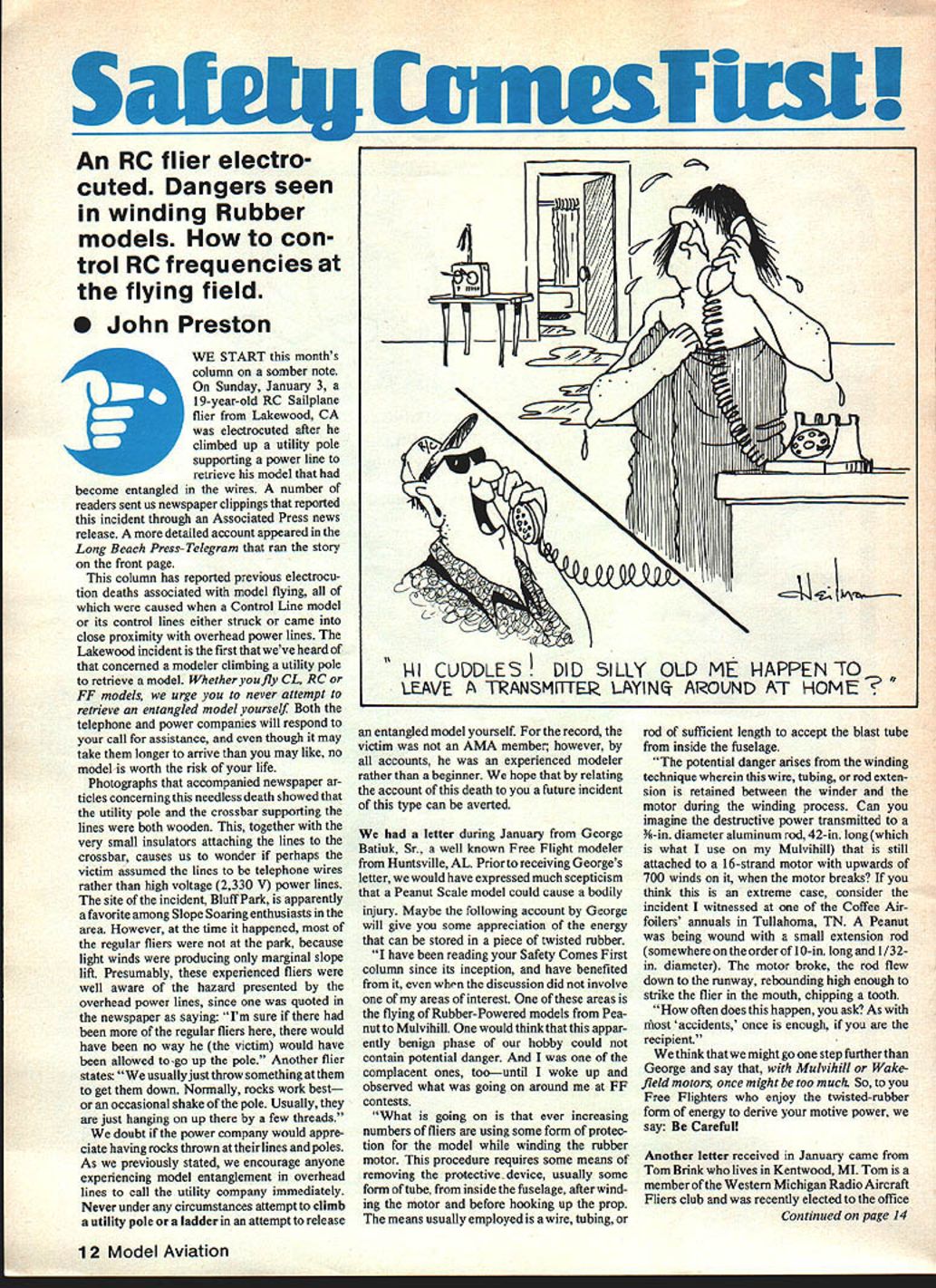
We have been asked what happens under the new system if a member arrives at the club field to fly only to find he has left his marker at home. Our response has been another question: what happens when a flier arrives and finds he has left his transmitter at home? The answer is simple. You go to the nearest telephone booth and call your wife, and she brings the missing item out to the field. Right?
Any comments on this suggested frequency control system would be appreciated, especially from clubs already using it or a similar system.
Have a safe month.
John Preston 7012 Elvira Court Falls Church, VA 22042.
Transcribed from original scans by AI. Minor OCR errors may remain.

