

Safety Comes First!
We start this month's column by quoting the editorial by Ed Fitzwater from the February issue of the DCRC Newsletter. Its title was the same as this column—"Safety Comes First."
"When John Preston first started writing a safety article for Model Aviation magazine, I thought it would last about three months then die for lack of copy. Boy! Was I wrong! Funny thing though—the more I read John's articles, the more I remembered about similar things that happened to me or around me over the years.
"Safety has become a big deal... and it should be. I wouldn't want to get hit by a 1/2-A plane—let alone even think about hitting or being hit by a Pattern or Giant Scale plane... I think it goes without saying that you don't fly over people.
"How many 'near misses' have you seen? Yeah, me too.
"I can talk about safety... you can talk about safety... but until you and I think and act in a safe and careful manner, not only with our airplanes, but in all the things that we do each day... then and only then will we be safe. Most accidents can be avoided when we really try to do things in a safe manner.
"Please remember: — SAFETY IS AN ATTITUDE — Fitz"
The main reason that we used Ed's editorial to open this month's column can be found in his first sentence. Like Ed, we thought that the column would die for lack of material during the first year. Thanks to our readers, we have managed to find something to say in 28 issues of the magazine. However, this morning when we sat down at the typewriter for the 29th time, we had a hard time coming up with an opening paragraph until we remembered Ed's DCRC Newsletter editorial.
Ed's comments about not wanting to be hit by a 1/2-A plane, let alone a bigger one, brings us to a letter recently received by Publisher Carl Wheeley from John Burdick of New Paltz, N.Y. John's letter complimented the publisher on the quality of the magazine by stating: "... I feel that Model Aviation has grown immensely and is now the best of all. It presents a fine balance of articles. Among my favorites have been: the historical articles... the technical articles... the monthly columns... the articles on 'unconventional' modeling..." At this point we turned to page two of John's letter hoping to see this column specifically listed as one of the favorites (most of us like to receive a "warm fuzzy" once in a while). However, page 2 began as follows:
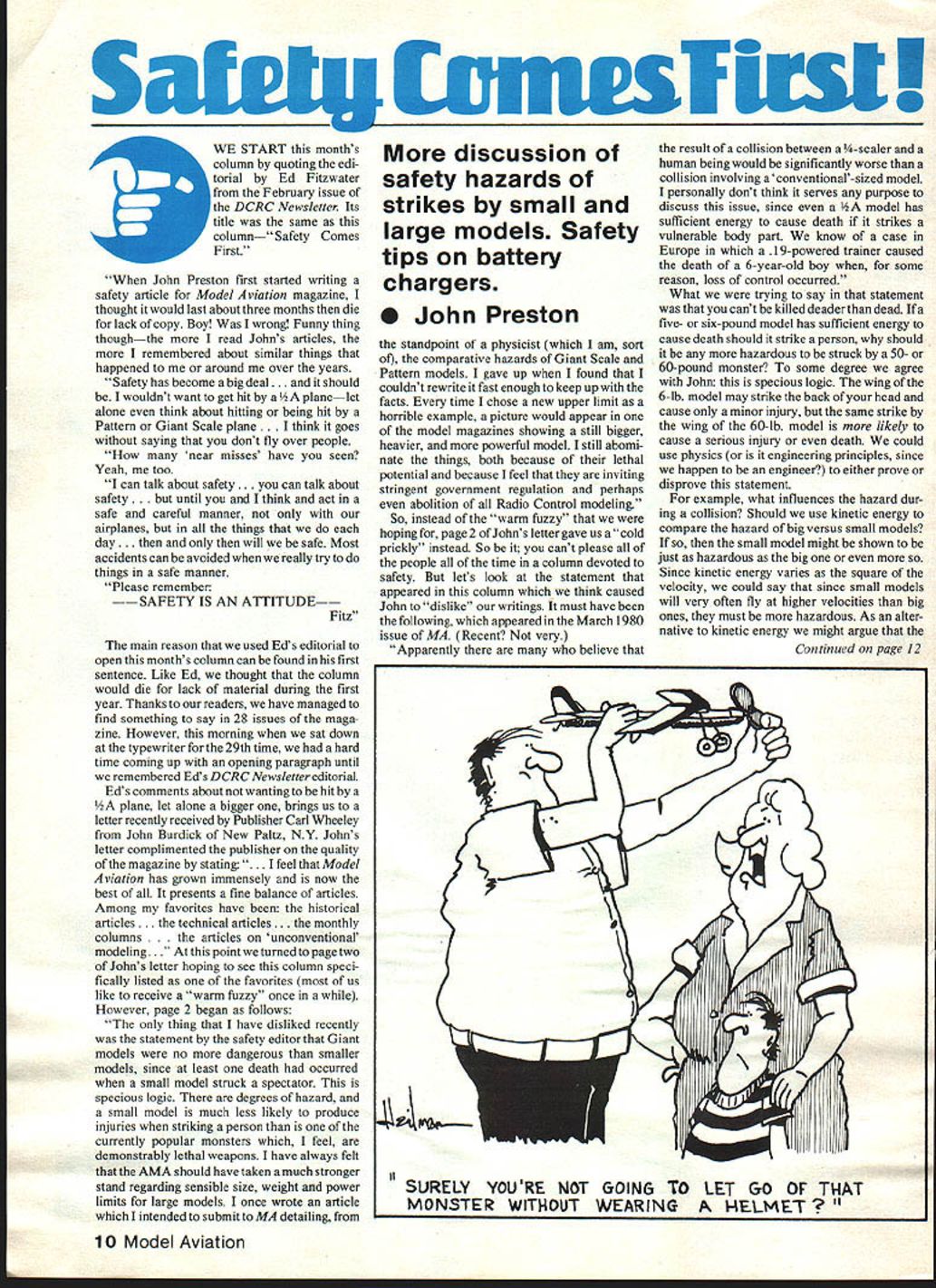
"The only thing that I have disliked recently was the statement by the safety editor that Giant models were no more dangerous than smaller models, since at least one death had occurred when a small model struck a spectator. This is specious logic. There are degrees of hazard, and a small model is much less likely to produce injuries when striking a person than is one of the currently popular monsters which, I feel, are demonstrably lethal weapons. I have always felt that the AMA should have taken a much stronger stand regarding sensible size, weight and power limits for large models. I once wrote an article which I intended to submit to MA detailing, from
More discussion of safety hazards of strikes by small and large models. Safety tips on battery chargers.
- John Preston
the standpoint of a physicist (which I am, sort of), the comparative hazards of Giant Scale and Pattern models. I gave up when I found that I couldn't rewrite fast enough to keep up with the facts. Every time I chose a new upper limit as a horrible example, a picture would appear in one of the model magazines showing a still bigger, heavier, and more powerful model. I still abominate the things, both because of their lethal potential and because I feel they are inviting stringent government regulation and perhaps even abolition of all Radio Control modeling."
So, instead of the "warm fuzzy" that we were hoping for, page 2 of John's letter gave us a "cold prickly"—instead. So be it; you can't please all of the people all of the time in a column devoted to safety. But, let's look at the statement that appeared in this column which we think caused John to "dislike" our writings. It must have been the following, which appeared in the March 1980 issue of MA. (Recent? Not very.)
"Apparently there are many who believe that the result of a collision between a 1/4-scale and a human being would be significantly worse than the collision involving a 'conventional'-sized model. I personally don't think it serves any purpose to discuss this issue, since even a 1/4-A model has sufficient energy to cause death if it strikes a vulnerable body part. We know of a case in Europe in which a .19-powered trainer caused the death of a 6-year-old boy when, for some reason, loss of control occurred."
What we were trying to say in that statement was that you can't be killed deader than dead. If a five- or six-pound model has sufficient energy to cause death should it strike a person, why should it be any more hazardous to be struck by a 50- or 60-pound monster? To some degree we agree with John: this is specious logic. The wing of the 6-lb. model may strike the back of your head and cause only a minor injury, but the same strike by the wing of the 60-lb. model is more likely to cause a serious injury or even death. We could use physics (or as it is engineering principles, since we happen to be an engineer) to either prove or disprove this statement.
For example, what influences the hazard during a collision? Should we use kinetic energy to compare the hazard of big versus small models? If so, then the small model might be shown to be just as hazardous as the big one or even more so. Since kinetic energy varies as the square of the velocity, we could say that since small models will very often fly at higher velocities than big ones, they must be more hazardous. As an alternative to kinetic energy we might argue that the damage which occurs during a collision is the result of the force generated at the point of impact: higher force equals more damage. Since this force is a function of the mass and the deceleration of the moving object, we could say that when the big model collides with something, both the mass and the deceleration will be higher than in the same collision involving a small model.
Before you write and tell us we've flipped our wig, because deceleration of the small model will be higher due to its higher speed, let's consider the distance over which the two models are brought to a halt. Deceleration is inversely proportional to the distance over which the velocity is reduced to zero. More distance equals less deceleration. Since the components of the big model are likely to be more rigid than those on the small model, they are less likely to collapse (crush) during the impact and will, therefore, produce a higher force since they must stop in a shorter distance. Being hit by a wing that will collapse during impact is preferable to being hit by one that has high strength and doesn't collapse. (Automobiles with crushable front ends are safer in collisions than those with rigid front ends.) This is the whole principle behind the energy-absorbing bumpers that are required by the Federal Government on currently manufactured cars.
There is another factor that might be considered when assessing the hazard of different types of model aircraft: the probability of being struck. At the risk of being criticized by one segment of our hobby, let us say that the only time we have felt uncomfortable when watching models in flight was at a pylon race. If a model is going to get away from its pilot, we'd rather it were a slow one than a fast one. Cries of "I ain't got it" are not infrequent at your average RC field on any weekend. If it's a slow model that the pilot "ain't got," his cry might provide sufficient warning for bystanders to get a bead on it and take cover if necessary.
None of this discussion really "proves" anything in regard to the safety of big versus small models. However, before getting onto another topic, we would like to have your opinion on a recent change to the AMA Safety Code. At their meeting on November 7–8, 1981 the AMA Executive Council deleted the 40-lb. weight limit that had been in effect since July 1, 1979 and which applied to any model if it were to be covered by the AMA liability insurance policy. We would like to know how members feel about this change. We ask that you drop us a card or a letter stating your opinion and include your major area of interest in the hobby, i.e., FF, Rubber, CL Combat, RC Pattern, etc. We feel that with sufficient response to this request, we will publish the results in a future column.
Battery chargers
As we sat down to write this column, a friend called to tell us about how he had just "zapped" one of the chargers for his RC equipment. We also know of a fellow who allegedly set fire to his house when trying to charge some Ni-Cds at too high a rate. A similar experience could have resulted when, a few years back, we made an error in hooking up a Ni-Cd starter pack to a charger. In most cases, errors in the correct procedure in charging batteries will only result in damaged equipment. However, if your paycheck has shrunk in terms of its former buying power as much as mine, I'm sure you'd rather not have to lay out the bucks for a new charger just because you weren't paying attention when you hooked up the old one.
For the most part, the chargers that accompany a new RC system are essentially foolproof. Polarized plugs prevent hooking up the charger to the batteries backwards and zapping the charger as our friend did. In his case, hooking up the batteries to the charger caused the red charging indicator light to glow before the power cord on the charger was inserted into the wall outlet. This should have alerted him that something was amiss, since the light is there to tell you that the batteries are, indeed, being charged when you think they are and glows only after the unit is plugged into an AC source. Failure of this indicator to glow could mean that you plugged into a switched outlet but didn't turn on the wall switch, or it could mean a blown fuse. You also might have left the transmitter or receiver switch on, thereby connecting the batteries to the Tx or Rx circuitry instead of to the charger. Our friend thinks that his son, to whom the charger had been recently loaned, may have reversed the polarity of the output plug to match a different brand of radio. Whatever the reason, the result was a defunct charger.
Our story is somewhat different and occurred at least eight years ago. We purchased some "wet cell" Ni-Cds at a club auction for use as starting batteries. Our automotive battery charger, while cumbersome, was equipped with a Variac and was pressed into service to charge up these batteries. Some time later, at another club auction, we purchased a small, plug-in-the-wall charger of the Brand X variety that had a paper sticker marked "12V." We wanted to charge the 12-volt gel cell in our field box, and it worked perfectly for some time. Then came the night of the error. Not thinking, we tried to charge the two wet-cell starting Ni-Cds (connected in series) using the small 12V charger. This charger is the kind which is equipped with an indicator light covered by an amber lens that lets you know that all is well when it's in use. We guess the light also serves as a fuse, since there isn't any other fuse in the circuitry.
When connected to the two starting Ni-Cds, it did appear that the indicator was somewhat brighter than normal, but late at night, our brain didn't register that anything was amiss. For some reason, we had occasion to return to the workshop before turning in for the night. It was immediately apparent that there was a problem of some kind, since there was a strong odor of burning insulation. A glance at the charger was all it took to diagnose the source, since a brown sticky substance was exuding from its bottom. Why the indicator light bulb didn't blow, we don't know. Presumably, though the current was too much for the charger's transformer to handle, it was still below the rating for the bulb. The charger's metal case was too hot to pull out of the wall socket without the protection of a rag or an oven mitt. We often break out in goose bumps when we think what might have happened if we hadn't made that return trip to the workshop prior to hitting the sack. It's possible that you might have ended up with a different author for these pages!
The moral of these stories: unless you know what you're doing, don't mess around with your electrical equipment. We now have a decent VOM that we think is a must for any serious modeler. Ours is a Micronta (Radio Shack brand) Cat. No. 22-207A that isn't their cheapest model. (A Radio Shack sale catalog that arrived just yesterday has a Micronta VOM, No. 22-204 that is plenty good enough for anybody other than the pros in the electronics hobbyist, and its sale price is $24.88.) They have a number of cheaper models, too, most of which periodically will go on sale.
In closing this month's column, we'd like to thank all who responded to our request for information on allergic reactions to epoxy glues that appeared in the March 1982 issue. We will talk more about this after we have run down some leads that were provided by readers. Meanwhile, if you have experienced an allergic reaction to an epoxy, buy a small fan for your workshop, and keep the glue off your hands.
Have a safe month.
John Preston 7012 Elvira Ct. Falls Church, VA 22042.
Transcribed from original scans by AI. Minor OCR errors may remain.

