
Safety Comes First!
By John Preston
A new epoxy holds the promise of reduced skin irritation to users. We want modeler opinion on weight limitations for Giant Scale RC ships!
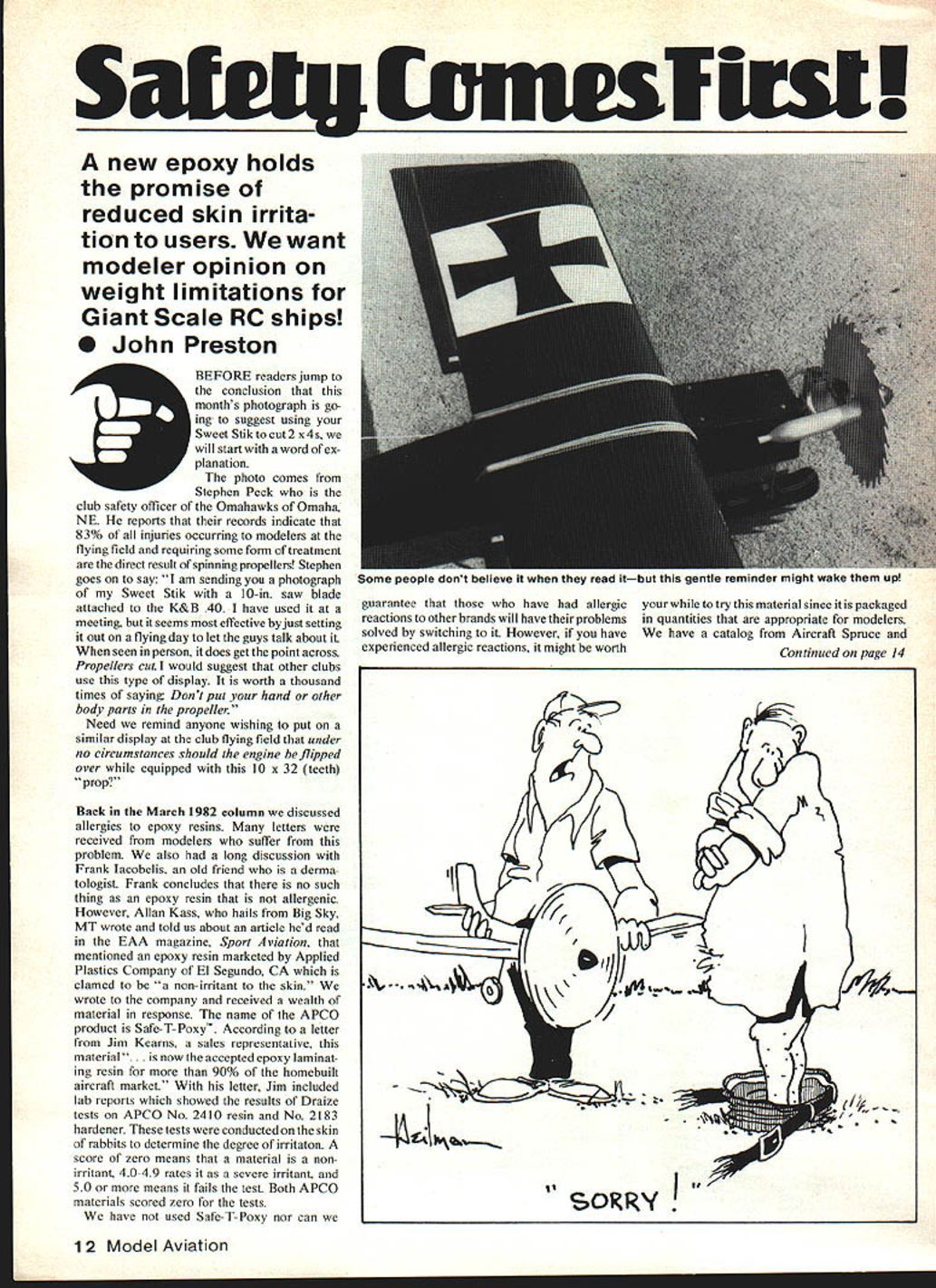
Propeller safety display
Before readers jump to the conclusion that this month's photograph is going to suggest using your Sweet Stik to cut 2 x 4s, we will start with a word of explanation.
The photo comes from Stephen Peck, who is the club safety officer of the Omahawks of Omaha, NE. He reports that their records indicate that 83% of all injuries occurring to modelers at the flying field and requiring some form of treatment are the direct result of spinning propellers. Stephen goes on to say: "I am sending you a photograph of my Sweet Stik with a 10-in. saw blade attached to the K&B .40. I have used it at a meeting, but it seems most effective by just setting it out on a flying day to let the guys talk about it. When seen in person, it does get the point across. Propellers cut. I would suggest that other clubs use this type of display. It is worth a thousand times of saying, 'Don't put your hand or other body parts in the propeller.'"
Need we remind anyone wishing to put on a similar display at the club flying field that under no circumstances should the engine be flipped over while equipped with this 10 x 32 (teeth) "prop."
Epoxy allergies and Safe-T-Poxy
Back in the March 1982 column we discussed allergies to epoxy resins. Many letters were received from modelers who suffer from this problem. We also had a long discussion with Frank Iacobellis, an old friend who is a dermatologist. Frank concludes that there is no such thing as an epoxy resin that is not allergenic.
However, Allan Kass of Big Sky, MT wrote and told us about an article he'd read in the EAA magazine Sport Aviation that mentioned an epoxy resin marketed by Applied Plastics Company (APCO) of El Segundo, CA which is claimed to be "non-irritant to the skin." We wrote to the company and received a wealth of material in response. The name of the APCO product is Safe-T-Poxy.
According to a letter from Jim Kearns, a sales representative, "this material" is now the accepted epoxy laminating resin for more than 90% of the homebuilt aircraft market. With his letter, Jim included lab reports showing the results of Draize tests on APCO No. 2410 resin and No. 2183 hardener. These tests were conducted on the skin of rabbits to determine the degree of irritation. A score of zero means that a material is non-irritant, 4.0–4.9 rates it as a severe irritant, and 5.0 or more means it fails the test. Both APCO materials scored zero for the tests.
We have not used Safe-T-Poxy nor can we guarantee that those who have had allergic reactions to other brands will have their problems solved by switching to it. However, if you have experienced allergic reactions, it might be worth your while to try this material since it is packaged in quantities that are appropriate for modelers.
We have a catalog from Aircraft Spruce and Specialty Company, Box 424, Fullerton, CA 92632, in which Safe-T-Poxy is listed as follows:
- 1/2-pint kit (1/4 pint resin and 1/4 pint hardener), $6.50
- 1-pint kit (1 pint resin and 1/2 pint hardener), $8.75
- 1-quart kit (1 quart resin and 1 pint hardener), $14.20
The catalog also lists five-minute Safe-T-Poxy in plastic squeeze bottles containing 4 oz. of Part A and 4 oz. of Part B for $6.35.
Another distributor of APCO products is Wicks Aircraft Supply, 410 Pine St., Highland, IL 62249. We don't have a Wicks catalog, so we cannot quote their prices.
As stated before, we are not endorsing Safe-T-Poxy but merely suggesting that modelers who have experienced reactions to other brands might want to give it a try. We would be interested in hearing from anyone who follows this suggestion.
Safe handling of resins (APCO booklet tips)
APCO also sent a booklet titled Safe Handling of Resins for Laminating. The booklet contains the following tips:
- Avoid excessive skin contact with resins.
- Wear and use disposable protective gloves in preference to barrier creams when contact with resin is probable.
- Wear eye protection at all times when dispensing, mixing and using laminating resins.
- Do not work with large areas of the body exposed to resins, i.e., short pants or short-sleeved shirts.
- Work in well-ventilated areas, especially when workplace temperatures are higher than normal.
- Use a dust mask.
- Clean up of tools—If tools must be cleaned with a solvent, use mineral spirits. Never contact the skin with solvents contaminated with resin. Acetone and MEK and/or chlorinated solvent are unnecessary, hazardous, and should not be used.
- Preparation of work area—Cover all work areas with disposable papers and discard after each work session.
- Clean up of large spills—Cover with sand or other absorbent material and dispose. Clean contaminated area with mineral spirits.
Needless to say, these tips are appropriate when using any brand of resin and, if followed, should be significant in reducing or preventing allergic reactions in the user.
RC frequency control and club flags
We previously discussed RC frequency control (this was featured in the safety column in the May 1982 issue). Incidentally, just for the record, the concluding remark in that column (about calling your wife from the flying field and asking her to bring you your forgotten transmitter) was meant to be tongue-in-cheek. It was also a chauvinistic remark—something we didn't realize at the time it was written. Sue Kayton, who lives in Los Angeles, wrote and wound up her letter by saying: "Oh, by the way, there is an even better system for getting your transmitter delivered to the field when you forget it. I call my husband on the phone, and he brings it to me." To the many ladies who fly R/C, we apologize.
Sue also stated that the "bring-your-own-flag" frequency-control system has been in use for years at the Sepulveda Model Airport in L.A. They also have segregated pit areas (we assume by frequency rather than by sex—sorry Sue, I just couldn't resist). A number of other readers reported similar success with this system at their flying fields. Most pointed out its advantage in identifying who is flying rather than just that somebody is flying.
A letter from James Preston (no relative) had an interesting suggestion: we have 50 channels in the 72 MHz band for model aircraft operation; clubs with 50 or fewer members could assign frequencies such that each member is on a different channel. This may not be quite as simple as it sounds since, in some areas of the country, some of these channels may not be usable. However, it is a good idea for any RC club to keep a tally of who's on which and try to distribute the frequencies as evenly as possible among the members.
Finally, a word of caution about the "bring-your-own-flag" system comes to us from Ray Garceau of Laval, Canada. A flier in Ray's club mislaid his frequency-control flag (a wooden dowel, about 3/8-in. diameter split at one end to receive a color-coded flag). For about three weeks, this flier showed up at the field without his flag. In order to fly, he borrowed one from a friend on the same frequency. One day, Ray's son Richard was helping this flier put his model away after a day in the field and discovered the missing flag stowed in the rear of the fuselage where it had been all the time! Maybe we should all check our fuselages once in a while. Who knows, perhaps squirrels built a nest in there last winter.
Giant Scale models and spectator safety
It seems that most of the letters we receive concern the subject depicted by Dewey Heilman's cartoon. Could it be that he has the knack for knowing which topic is going to ring the chimes of our readers, or is it that the written words in this column are superfluous, and it's only the cartoon and its caption that are the meat of this column? Whatever the reason, the topic in June was big models, and we asked how our readers felt about the deletion of the 40-lb. weight limit on models covered by the AMA liability insurance policy. Letters began arriving on this subject last week.
The controversy over the hazard of very large models (over 40 lb.) was returned to our attention not only through our mailbox but also by our attendance at an RC Scale contest over the weekend of April 24–25. During a break between rounds at this contest, an attempt was made to put on a demonstration flight of the B-29 that was displayed at this year's Toledo show (a photograph of which appeared in this magazine's Giant Scale column, also in the June issue). The model spans 16 1/2 feet, has a total engine displacement of almost 100 cu. in. with its four Kioritz engines, and is reported to weigh around 150 lb. Like our Giant Scale column writer, Bob Beckman, we admire the imagination and perseverance of its creator, but we have some grave reservations about the prudence of flying such a model airplane in front of an audience.
At the contest where we witnessed the attempted flight, the model B-29 accelerated down a full-scale aircraft runway and reached a speed that appeared to be sufficient for flight. After about 200 yards of travel, and still firmly in contact with terra firma, it wandered off the edge of the runway (to the side away from spectators) and demolished a runway marker light. In the process, the nose gear collapsed and some or all of the props were wiped out.
Subsequent to our return home from this contest, we learned that the model failed to respond to the radio used to control the engine throttle. A second radio used for flight control functions did operate, and the model was deliberately steered off the runway by the pilot (who could not see the location of the runway light with which the model collided).
While it may seem that we are being critical of big models in general, we hasten to say that we merely want to point out that a model the size of the B-29 appears to require some special safety rules concerning the separation of the flying area from the spectator area. We understand that the IMAA has stated that there should be at least 100 feet between the spectators and the edge of the flight line. We hope that this organization always abides by its own recommendations!
By now, most of you must have seen the AMA Voluntary Flying Site Specifications Standard (pages 78 and 82 of the June issue) which suggests 65 ft. as the minimum distance from the edge of the spectator area to the edge of the flight line at an RC club's flying field. The question in our mind is: Does this apply to anything that may be flown so long as it falls within the definition of "Model Aircraft" as stated in the Official AMA Safety Code (page 133 of the 1982/83 rule book)? It would appear to us that the answer to this question would have to be yes, so long as, if the model is over 20 lb., one also follows the rules in Paragraph 5 of the Safety Code.
We think that there needs to be a special section in the Safety Code that addresses the separation of spectators from the flying area whenever models over 20 lb. are to be flown. Should it be the 100 ft. recommended by IMAA — or something more? Let's have your thoughts on this subject.
Closing
Before signing off for this month, you may be interested to know that all of the letters received to date that addressed the removal of the weight limit for big models expressed concern about this AMA Executive Council action. At the time this column was being written (May 1), there may have been modelers in Districts X and XI who had not received their June issues of MA. We intend to wait a couple of weeks to see what else the mailman brings on this subject before dropping a line to our District VP with a summary of your responses. We think the Executive Council may want to reconsider its action if your response to date is a true reflection of the opinion of the AMA membership.
Have a safe month.
John Preston 7012 Elvira Ct. Falls Church, VA 22042
Transcribed from original scans by AI. Minor OCR errors may remain.

