

Safety Comes First!
Safety tip: Follow your club's safety rules! Also, what are the most common modeling accidents?
- John Preston
Background
Earlier this year we had a letter from Col. Art Johnson, a good friend and a well-known scale modeler from Delray Beach, FL. Art suggested that this column should consider publishing a tabulation of accidents involving model aircraft for which insurance claims were submitted to AMA HQ. The suggestion was triggered by an accident that occurred at Art's club flying field, in which the wing dowels on an Ugly Stik broke and the fuselage went through the hood of a club member's car in the parking lot.
Art stated: "The model was flying in the right place when the wing came off, but I assume the fuselage was on a trajectory towards the parking lot when the wing parted company. It appeared to be one of those accidents preventable by better construction techniques or by moving the parking lot farther from the runway." He went on to say: "In any event, I got to wondering if our club of 140 members is better or worse than the average club when it comes to accidents, or if there are any statistics collected by AMA on accidents each year."
We forwarded a copy of Art's letter to AMA HQ, together with a request for a summary of incidents for which insurance claims had been submitted. In response to our letter, we received a computerized summary of claims submitted in 1981. There were a total of 47 claims on the printout which can be organized as follows:
- Model hit vehicle: 25
- Model hit building: 8
- Model hit person: 12
- Miscellaneous: 2
It isn't possible from the computer printout to deduce the cause of the accidents. Neither is it possible to determine if the models involved were RC, CL, or FF. However, we think that the fact that 53% of the claims involved collisions with vehicles is a worthwhile piece of information. It tells us that if your model is going to be involved in a property damage claim, the likelihood is that it will be the claimant's vehicle that sustained the damage.
Vehicle collisions and field layout
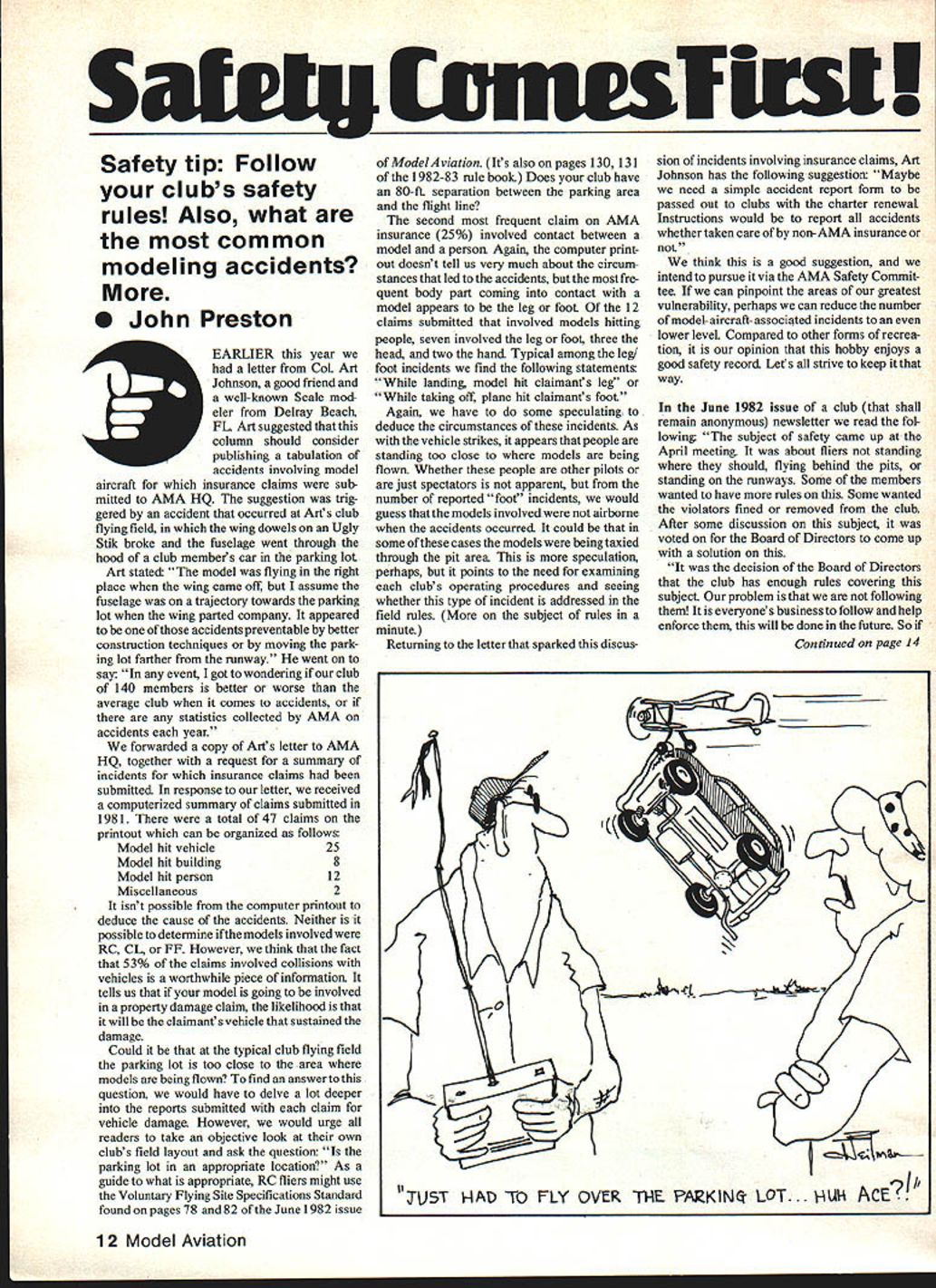
Could it be that at the typical club flying field the parking lot is too close to the area where models are being flown? To find an answer to this question, we would have to delve a lot deeper into the reports submitted with each claim for vehicle damage. However, we would urge all readers to take an objective look at their own club's field layout and ask the question: "Is the parking lot in an appropriate location?"
As a guide to what is appropriate, RC fliers might use the Voluntary Flying Site Specifications Standard found on pages 78 and 82 of the June 1982 issue of Model Aviation. (It's also on pages 130–131 of the 1982–83 rule book.) Does your club have an 80-ft. separation between the parking area and the flight line?
Injuries to people
The second most frequent claim on AMA insurance (25%) involved contact between a model and a person. Again, the computer printout doesn't tell us very much about the circumstances that led to the accidents, but the most frequent body part coming into contact with a model appears to be the leg or foot. Of the 12 claims submitted that involved models hitting people, seven involved the leg or foot, three the head, and two the hand.
Typical among the leg/foot incidents we find the following statements: "While landing, model hit claimant's leg" or "While taking off, plane hit claimant's foot."
We have to do some speculating to deduce the circumstances of these incidents. As with the vehicle strikes, it appears that people are standing too close to where models are being flown. Whether these people are other pilots or just spectators is not apparent, but from the number of reported "foot" incidents, we would guess that the models involved were not airborne when the accidents occurred. It could be that in some of these cases the models were being taxied through the pit area. This points to the need for examining each club's operating procedures and seeing whether this type of incident is addressed in the field rules.
Reporting and prevention
Returning to the letter that sparked this discussion of incidents involving insurance claims, Art Johnson has the following suggestion: "Maybe we need a simple accident report form to be passed out to clubs with the charter renewal. Instructions would be to report all accidents whether taken care of by non-AMA insurance or not."
We think this is a good suggestion, and we intend to pursue it via the AMA Safety Committee. If we can pinpoint the areas of our greatest vulnerability, perhaps we can reduce the number of model-aircraft-associated incidents to an even lower level. Compared to other forms of recreation, it is our opinion that this hobby enjoys a good safety record. Let's all strive to keep it that way.
Club rules and enforcement
In the June 1982 issue of a club (that shall remain anonymous) newsletter we read the following: "The subject of safety came up at the April meeting. It was about fliers not standing where they should, flying behind the pits, or standing on the runways. Some of the members wanted to have more rules on this. Some wanted the violators fined or removed from the club. After some discussion on this subject, it was voted on for the Board of Directors to come up with a solution on this."
"It was the decision of the Board of Directors that the club has enough rules covering this subject. Our problem is that we are not following them. It is everyone's business to follow and help enforce them; this will be done in the future. So if you goof, don't get all bent out of shape when you are told about it! Read the club rule numbers 7 and 8, and you can't go wrong — we hope.
"For the pilots who hand-launch planes: As rule No. 7 states, 'Takeoffs will be accomplished only from designated runways.' This means not from the pit area or the grass. Rule No. 8 states, 'After takeoff, fliers will move off the runway area and join any other flier who has a plane in the air at the same time.' This is to allow communication between fliers to prevent accidents from radio malfunction or engine failures requiring dead-stick landing procedures."
This club is far from unique in having a problem enforcing its field rules. Both of the clubs to which we belong have similar difficulty in urging their members to follow established procedures that address both safety and courtesy to one's fellow club members. At a recent meeting of one of these clubs, there was a discussion of where the pilots should stand and which runway should be used during certain wind conditions, and it became apparent that the "old-timer" (and usually more respected) club members were more often guilty of rules violations than the newcomers. Rules affect everyone and shouldn't require someone with a big stick (or hammer) to enforce them.
Let us end this discussion by saying to those who stand on the runway; fly over the spectators; take off from the pits; etc.: Watch out! You might be a part of the next insurance claim to be filed with AMA HQ!
Hazardous chemicals
Hazardous chemicals are the subject of a letter from Art Holtzman of Woodside, NY. He sent us a Safety Alert Bulletin put out by Binks Manufacturing Company — a publication directed to operators of paint spray equipment. Although it appears to be mainly for those who use airless paint spray equipment — which is probably not commonly found in a modeler's workshop — there may be some among us that have access to such equipment. The bulletin states: "Halogenated hydrocarbon solvents can cause an explosion when in contact with aluminum components of a pressurized or closed fluid system (pumps, heaters, filters, etc.)."
"The same possibility of an explosion is possible with the galvanized coatings in pressure tanks. The possibility of a non-flammable explosion increases greatly at high operating temperatures."
The bulletin goes on to state that of the solvents in question, the most likely to be used will be methylene chloride, 1,1,1-trichloroethane, and perchloroethylene. Anyone wanting a copy of the entire bulletin should drop us a line.
Contact-type tachometers and prop safety
Another letter containing a safety tip came from Israel Dubin, a member of the Atlanta Drone Society. "I've noticed lately an increasing number of ads and product release notices in the various modeling publications for a product whose operational requirements scare the heck out of me. I'm speaking of the 'new' contact-type tachometers that appear to be cropping up everywhere. With all the concern voiced about standing in front of a running engine, or anywhere within 180° of the forward side of the prop arc, it seems to defy the imagination to require someone to place himself directly in front of an engine running at full bore and attempt to apply a small rubber cone to the tip of the spinner or shaft. I have been in the hobby long enough to have seen prop blades separate themselves from the hub... and I have driven more than one fellow modeler to the hospital to sew up a hand that got in the way of a spinning propeller."
We have not used the type of tachometer that is the subject of this letter. As with the commonly used electric starters that also have a (larger) rubber cup that is applied to the spinner or prop nut, we would guess that it's entirely possible to have the cup slip off the spinner with perhaps dire results. Has anyone had this happen? Write and tell us about it!
We also agree with Israel that standing in front of a prop on an engine running at full bore isn't the safest place to be. We were surprised that there weren't more incidents involving hands in the computer printout of AMA insurance claims. On the other hand (pun intended), since most of us have health insurance that would cover the cost of repairs to our own hands, we probably would not notify AMA in the case of a personal injury incident. Be aware that in letters from readers and in the many club newsletters that we read, it appears that if you are going to be injured by a model airplane, it's most likely that it will be your own model and it will be the prop that gets you.
Frequency control incident
Our closing story for this month comes from the newsletter of the Tidewater R/C Club of Virginia Beach, VA (editor: Don Bruce). It causes us some anguish since the incident may have been the result of a suggestion that we made in this column in the May 1982 issue. Read on for details.
"We had a problem arise at the field a few weekends ago concerning the new frequency control system. We are going to describe it so that it won't happen again in the future (we hope!). As everyone should know by now, we are using a new system. You now put your frequency pin on the board when you are flying — and not on your transmitter.
"We had a case where a man came to the board and saw no pin on it, so he took his transmitter to his plane and prepared to start the engine. He then noticed he had his pin on his transmitter, so he returned to the board. During his time at his plane, another flier came to the board and saw it was clear, so he put his pin on the board and went to start his plane. When the first person got back to the board, he saw the second flier's pin on it, but since it was empty the first time he was there, he assumed it was his and removed it. He then hurriedly returned to his plane and started it. His plane broke loose, ran into the pits and struck the other fellow who was kneeling by his plane and had a hand on the model. The other fellow received some cuts and required stitches in his hand.
"Our feeling is that this incident might have been avoided if the second man had checked his pin to be sure it was his, or if pilots always kept their pins on their transmitters, as the older system required.
"We are not sure if we will revert back to the old method, but in the meantime we are reminding everyone to be careful and to make sure their pins belong to them before starting their engines."
Final note
Let us just add a final word to members of any other clubs who may be engaged in changing their frequency control systems. Please be very careful during the initial change-over period. The safety of other people's models and lives rests in your hands.
Have a safe month.
John Preston 7012 Elvira Ct., Falls Church, VA 22042.
Transcribed from original scans by AI. Minor OCR errors may remain.

