
Safety Comes First!
The new weight, distance-to-spectators, and general safety guidelines for Giant Scale models. Watch out for the props! CL models and tall grass/weeds don't go together well.
John Preston
Giant Scale
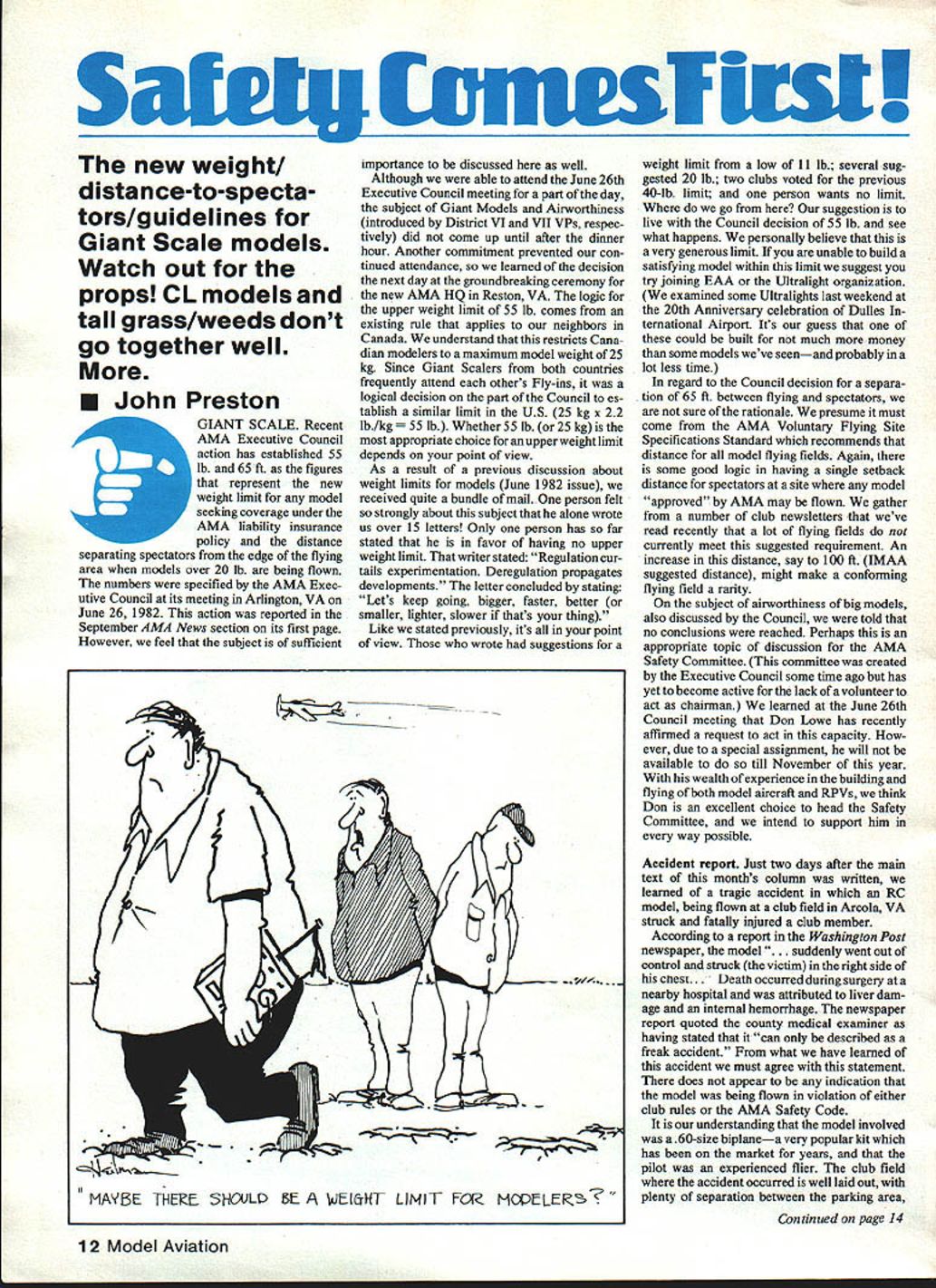
Recent AMA Executive Council action established 55 lb and 65 ft as the figures representing the new weight limit for any model seeking coverage under the AMA liability insurance policy and the distance separating spectators from the edge of the flying area when models over 20 lb are being flown. The numbers were specified by the AMA Executive Council at its meeting in Arlington, VA, on June 26, 1982, and were reported in the September AMA News. The subject is of sufficient importance to be discussed here as well.
The logic for the 55 lb upper weight limit comes from an existing rule that applies in Canada, which restricts Canadian modelers to a maximum model weight of 25 kg. Since Giant Scalers from both countries frequently attend each other's fly-ins, it was logical for the Council to establish a similar limit in the U.S. (25 kg × 2.2 lb/kg = 55 lb). Whether 55 lb (25 kg) is the most appropriate choice depends on your point of view.
We received a bundle of mail after the previous discussion about weight limits. Suggestions ranged from:
- 11 lb (low)
- several suggested 20 lb
- two clubs voted for the previous 40 lb limit
- one person wants no limit
One correspondent argued against any upper weight limit: "Regulation curtails experimentation. Deregulation propagates developments." Our suggestion is to live with the Council decision of 55 lb and see what happens. Personally, we believe this is a generous limit. If you cannot build a satisfying model within it, consider joining EAA or the Ultralight organization — some ultralights can be built cheaply and quickly and may suit your interest.
Regarding the Council decision for a 65 ft separation between flying and spectators, the rationale likely comes from the AMA Voluntary Flying Site Specifications Standard, which recommends setback distances for all model flying fields. Having a single setback distance for spectators at a site where any AMA-approved model may be flown makes sense. However, many club fields do not currently meet that suggested requirement, and increasing the distance to 100 ft (the IMAA suggested distance) might make conforming flying fields rare.
Airworthiness and the AMA Safety Committee
On the subject of airworthiness of big models, no conclusions were reached by the Council. This is an appropriate topic for the AMA Safety Committee. The committee was created by the Executive Council but has been inactive for lack of a volunteer chairman. At the June 26 meeting, Don Lowe affirmed willingness to act as chairman, though due to a special assignment he will not be available until November. With his experience in building and flying both model aircraft and RPVs, Don is an excellent choice to head the Safety Committee.
Accident report
Two days after the main text of this column was written we learned of a tragic accident at a club field in Arcola, VA. An RC model suddenly went out of control and struck a club member in the right side of his chest. Death occurred during surgery and was attributed to liver damage and internal hemorrhage. The county medical examiner described it as "a freak accident." From what we have learned, we must agree; there appears to be no indication that the model was being flown in violation of club rules or the AMA Safety Code.
The model involved was reportedly a .60-size biplane — a very popular kit — and the pilot was experienced. The club field was well laid out, with ample separation between parking, pits, and the flight line. The accident happened despite these positive factors, which underlines the need for all clubs and fliers to exercise utmost care and caution and to use the best possible safety considerations in field layout to reduce the possibility or severity of accidents.
Accident reports are being compiled by several groups, but because of legal and insurance factors we are not in a position to discuss them in this column for now. The subject is not being ignored — it is awaiting further developments.
Propeller hazards
It is hard to discuss safety without mentioning the propeller. In a previous column we asked readers who had witnessed propeller-blade-shedding incidents to write. We received only about half a dozen letters — not enough for statistically valid conclusions — but a consistent warning emerged:
- Be particularly careful with a piped .60 engine running an 11 × 7 narrow-blade prop. Several incidents were reported with this combination.
- Such engine/pipe/prop setups can reach 13–14,000 rpm, which may exceed what the prop can tolerate.
- An 11 × 7½ prop appears to be more reliable in these reports.
Safety recommendations:
- Be careful which direction you point your model when running it up on the ground. Even if you are behind the prop arc, others in the pit area may not be.
- Be alert when flying; a blade departing the hub in the air can quickly destroy a model and injure bystanders.
A story from the Gold Coast Radio Controllers' newsletter offers a darkly humorous example: one winter flier has been to the Boca hospital so often to get sewed up that he told them he had stuck his hand in an air-conditioner fan rather than admit another model-prop injury, fearing insurance cancellation. He now has scars that "will look like he stuck it in a pool full of piranhas."
Control-Line (CL) hazards and tall grass
We received reports from CL fliers, both builders of Scale models, highlighting the hazard of flying CL models from areas with high grass and weeds.
From Bill Zimmer, Varna, IL:
- High grass can snag CL lines. In Bill's case, lines snagged and the airplane turned into the circle, narrowly missing his head. The airplane then flew across the circle and, at the end of the lines, ripped the control system out of the airplane. After two such incidents he "wised up."
- Fields with grass not cut short and with weeds (dandelions, etc.) sticking up are safety hazards for CL flying.
Another correspondent described a model turning into the circle, allowing lines to go slack. He had not used a safety thong to attach the handle to his wrist; when the lines went tight again the handle was jerked completely out of his hand. The model flew off like an RC model and ended up in a tree — better a tree than a house, vehicle, or spectator.
Recommendations for CL fliers:
- Keep grass and weeds cut short in CL flying areas.
- Always use a safety thong to attach the handle to your wrist when flying.
Two lessons from mistakes
Two final tales underscore how easily mistakes can lead to accidents.
- Yucaipa Valley RC Flyers — anonymous confession:
- The flier attempted a second full-flap takeoff with a recently rebuilt Ugly Stik and attempted an early, aggressive climb. High drag, torque, and lack of control led to a high angle-of-attack stall and a left turn into the pits. He reacted with full aileron and belated rudder; the pilot called his action "pretty dumb" and hoped others would learn from it.
- "How to Destroy Your Battery Pack" — author confession:
- While checking flight packs, one pack of four 550 mAh quick-charge cells was nearly dead. The author gave it a quick boost on "high rate," then left it overnight on "low rate" before planned discharger testing. After a trip away he returned to find the pack extremely hot. Fortunately no fire, but the cells were ruined and later disposed of. The discharger had cut off after six minutes.
- Lessons: always use the low-rate charge when possible, set alarms when using high-rate charging, and handle quick-charge cells with care.
If anyone else wishes to share in "True Confessions of a Modeler," letters are welcome; name and address can be withheld by request.
John Preston 7012 Elvira Ct. Falls Church, VA 22042
SAFE FLYING IS NO ACCIDENT
Transcribed from original scans by AI. Minor OCR errors may remain.

