
Safety Comes First!
Crop duster buzzes RCers. — John Preston
Any readers who have tried to attract the attention of the press or media to publicize a forthcoming contest or model airshow will probably agree that it's a tough job. Favorable articles about model aviation in any newspaper or periodical (other than the model magazines themselves) are not frequently seen. However, let something happen that puts modelers in an unfavorable spotlight, and all of a sudden we hit the headlines. Incidents involving the safety of model airplane flying are the most usual of such stories.
A couple of months ago, RC modeling was the subject of a traffic helicopter report broadcast by a Chicago news station. It came to our attention via the Rock Valley RC Fliers' newsletter (editor Ed Fowler) which reported it as follows:
"Boy, it's sometimes difficult to figure out why people do some of the things they do! A couple of days ago (May 27th) while I was driving home from work on Newburg Road, I turned on radio station WGN to find out what was going on in the world. After a few minutes they switched over to their traffic copter to get a report on traffic conditions. The first thing the traffic officer said was: 'Boy, you people driving down there, think it's hazardous where you are! Well, one of those guys flying one of those radio controlled model airplanes just aimed his at us and came within about five feet of us before he turned away!'"
Evidently there was a story about this incident on a TV network news bulletin a few days later, and Earl Levine, editor of the Sierra Madre, CA Radio Control Modelers newsletter, had the following to say about it:
"After a lapse of about eight years, the news of a model-to-full-scale near miss has hit the media again. Channel 4 news (June 3) reported the near miss of a 57-in. wingspan remote control model airplane and a traffic helicopter in Chicago. Both were flying at 600 ft. The TV reporter smirked that of course the model pilot had a date in court. The presumption will always be that the model pilot was wrong unless he takes the stand."
This case went to court, and the result was that the charges were dismissed—perhaps the helicopter was flying in an area where it should not have been; near a well-known model flying site. Even so, this incident pointed up an old lesson: if you fly models in an area where there may be full-scale aircraft traffic, have an assistant with you whose sole job is to warn you and any other fliers of the proximity of full-scale aircraft. The facts of life are that, right or wrong, any modelers involved in this sort of incident will be presumed guilty. In any case, being right is not enough—giving way is vital in avoiding accidents.
Another report involving modelers and a full-scale aircraft has an unusual twist. It came to us by a report in the Quincy Falcons newsletter that was written by AMA District VI AVP Loren Holm.
"You will be reading about an incident involving a full-sized crop duster airplane and a radio controlled model airplane in Iowa this May. First, please draw no judgments from this report or any newspaper reports. The incident took place at the Sibley, IA airport. Two members of the Plane Sports Club were using an area of one of the runways for model RC operations and they were forced to lie on the ground to avoid being hit by a low-flying airplane buzzing them at right angles to the runway. The pilot of the crop duster made more than one (four?) passes at the modelers before landing. The duster pilot is also the airport manager."
The Plane Sports Club has had a written agreement with the Sibley Airport Commission for the last two years to use the airport for model RC activities. After the incident, the modelers preferred charges against the duster pilot and he was arrested, jailed and later released on $2,000 bail. The exact nature of the charges is not known, but was described in newspaper reports as "aggravated assault."
The following day, a second newspaper report quoted a Des Moines FAA representative to the effect that "... the model airplanes had violated the FAA's requirement of 30 days advance notification of such activities." Later, this statement was found to be inconsistent with FAA rules and regulations—but was never corrected in the newspapers.
We think that Loren's report, especially the last paragraph, points out an undeniable fact in our existence as fliers: on the totem pole of flight, we are at the absolute bottom. Sad to say, this incident eventually led to the modelers at Sibley losing the use of the airport, even though they were not at fault in the buzzing incident.
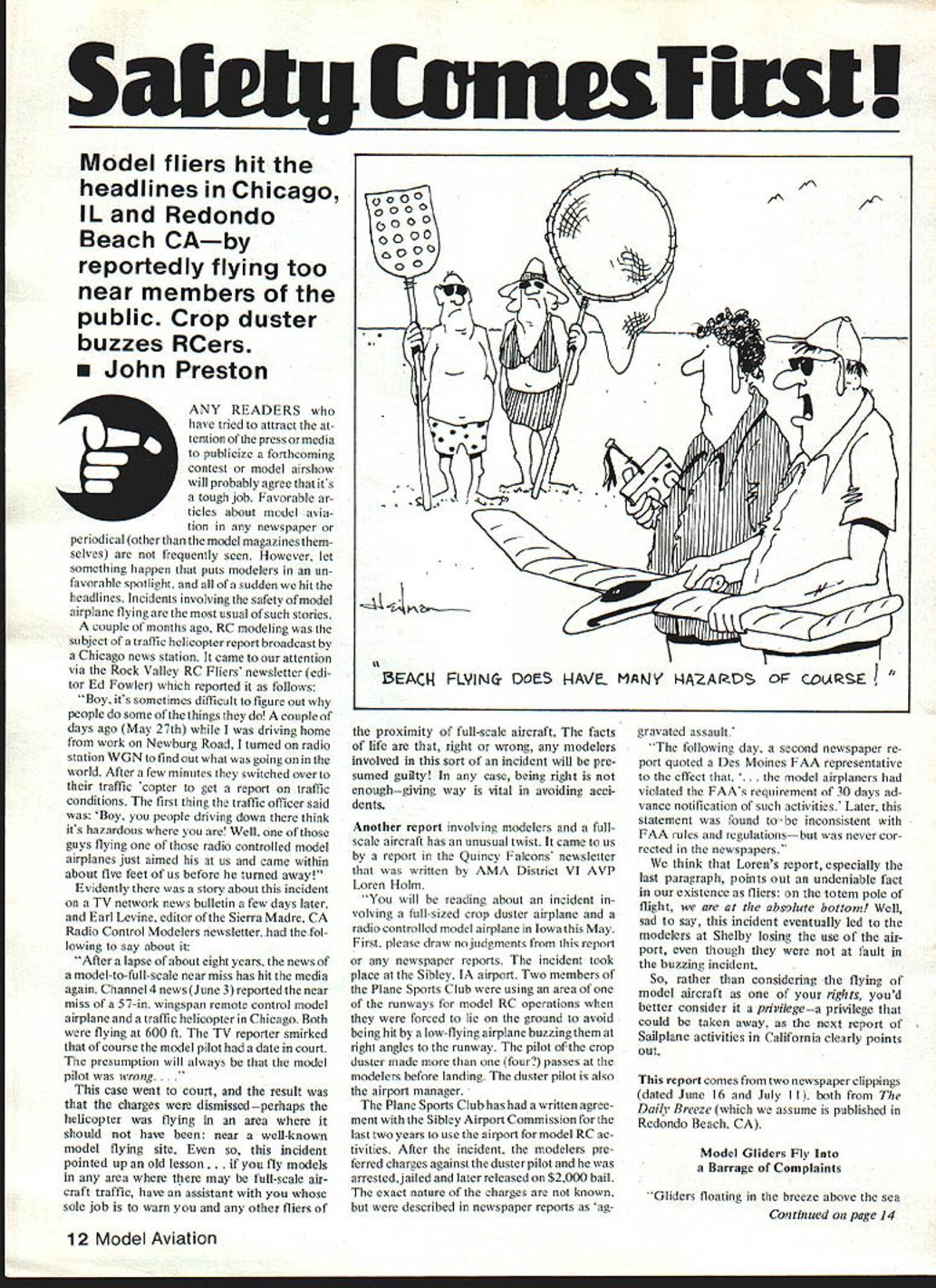
So, rather than considering the flying of model aircraft as one of your rights, you'd better consider it a privilege—a privilege that could be taken away, as the next report of sailplane activities in California clearly points out.
This report comes from two newspaper clippings (dated June 16 and July 11), both from The Daily Breeze, published in Redondo Beach, CA.
Cliffs of Redondo Beach hardly conjure up notions of the Battle of Britain. But some beach area residents are comparing them to the Luftwaffe.
"More and more letters and complaints are landing at City Hall over the radio controlled gliders that fill the sky along The Esplanade between Avenue A and Avenue C."
"What originally was considered a minor nuisance has developed into a major, dangerous, constant threat to our well-being and security," Ellinor Sculley, who lives on the west side of The Esplanade, wrote the city.
"She asked the city 'to remedy a dreadful, shocking situation that has assumed horrendous proportions.'"
"In response, the City Council has asked its staff to investigate complaints about the gliders."
Mrs. Sculley, in her letter, said: "The 900 block of The Esplanade has become infested with a motley crew of undesirables who don't give a damn about the personal safety or property damage or rights of others."
She said she has seen the planes crash into the beach, barely missing bathers, and fall on The Esplanade, causing near accidents.
In case some readers feel that the lady quoted by the newspaper is merely an alarmist, consider this account by another area resident taken from the same newspaper clipping.
Leslie Ray, who lives along the beach, said he was about 18 feet off the ground painting his house last year when a glider whizzed over his head and slammed into his house, next to a large window.
"It sounded like an explosion," he said. "I began to think how tragic it would have been if it hit me in the head."
A young man soon came into Ray's yard looking for the remains of his plane, Ray said.
When asked what would have happened if the plane smashed the plate glass window, the young man said he was insured.
"'What if it hit me and I fell 18 feet onto the cement and maybe died?' he asked the man, who answered again, 'I'm insured.'"
Redondo May Ban Radio Controlled Gliders
"Residents of The Esplanade may have succeeded in grounding radio controlled gliders, which can be seen flying most afternoons off the south Redondo Beach cliffs."
"The Redondo Beach City Council Tuesday ordered its staff to prepare an ordinance to prohibit the colorful 2 1/2-pound gliders—or any powered model airplanes—from flying near The Esplanade or the beach below."
"The ordinance would also ban the use of radio controlled model aircraft within 100 yards of any home in the city."
The newspaper article concluded by stating that the ordinance would be introduced at a future City Council meeting. We have since learned that the ordinance was indeed introduced, but the council gave the modelers a reprieve on a probationary basis; any repeat of the previous problems and complaints would result in model flying being banned at the site.
While we are sympathetic to the glider fliers of Redondo Beach and any other slope soaring site, we do believe that the activities reported by The Daily Breeze were in violation of the AMA Safety Code. Whether you fly sailplanes or powered models, overflying either people or property is contrary to the safety guidelines. We have stated previously in this column that model flying has an excellent safety record when compared to many other leisure pursuits. We would like to see it stay that way, so we urge you to take an objective look at your current flying site.
Do you frequently fly over someone else's property or over spectators or innocent bystanders? If your answer is yes, perhaps a change in operating procedures is needed. We suggest that you check a letter to AMA HQ from the offices of AMA's attorney. This appeared in a recent issue of MA, "The Flier and His/Her Neighbor" (October 1982, pp. 86, 89), and deals with the overflying of other people's property by AMA members and the consequences with respect to trespass. It appears that trespass can occur merely by invasion of the airspace above property owned by others. It's food for thought.
To wind up this month's column, we would like to thank all readers who wrote to us with their opinions on weight limits for Giant Models. We apologize for not responding to all of you with a personal letter, but our spare time has been very limited this summer. As we write this, we are preparing to leave for the Nats, and a second trip to the CL Scale World Championships in Kiev follows almost immediately. Because of this latter trip, we will miss the deadline for the December issue of the magazine. Expect us to be back in the January issue. Meanwhile, please fly safely.
John Preston 7012 Elvira Ct. Falls Church, VA 22042
Transcribed from original scans by AI. Minor OCR errors may remain.

