
Safety Comes First!
Bad news: yet another Control-Line (CL) flier electrocuted; props continue to be nasty to fliers; bad press about a big brush fire; a tale of dangerous flying activities.
TO READERS who may have been disappointed by the absence of a "Safety Comes First" column in last month's Model Aviation, we apologize. A trip to the CL Scale World Championship in Kiev, USSR, as the manager of the U.S. team interfered with our writing schedule. It may be a while before we catch up with all the mail that arrived during our month's absence.
In the last Safety column, we published extracts of some newspaper articles that did nothing to enhance our image with the non-modeling public. Letters from several readers that arrived during our absence in August contained clippings of two more incidents regarding model airplanes that made newspaper headlines. The first concerns yet another electrocution death of a Control-Line flier.
Toy Plane Hits Wire, Brings Fatal Shock
A newspaper clipping dated August 21, 1982, sent to us by Jack George of Brandon, FL, carried the following headline:
"Toy Plane Hits Wire, Brings Fatal Shock"
The accompanying brief account stated: "A 20-year-old man was electrocuted in Pinellas County Friday afternoon when his wire-guided model airplane got tangled up in a power line, authorities said.
He had been flying the model plane in an open field next to an apartment complex on Roosevelt Boulevard just east of U.S. 19 at about 4 p.m. It got caught up in the high-tension wires, sending the man a fatal shock."
At the present time we have no other details of this unfortunate accident. We can only hope that by reprinting it here, any readers who are Control-Line fliers will again be reminded that a flying site that may be close to overhead power lines should be avoided at all costs.
Model Plane Sparks Brush Fire
The second incident making newspaper headlines did not involve any bodily injury but appears to have received considerable attention. Three accounts of it were sent to AMA Headquarters by Jim Keeshan of Laguna Niguel, CA. The headlines in each newspaper read:
- "Toy Plane Crash-Lands, Sparks 250-Acre Fire"
- "Model Plane Starts Brushfire"
- "Brush Fire Blamed on Model Airplane"
One of the clippings said: "Orange County's largest brush fire this summer was ignited by the crash of a gasoline-powered, remote-controlled model airplane, officials said Monday. The operator of the model airplane — a member of an El Toro model airplane club that was in the area — has not been charged in connection with the fire."
Another account stated that the firefighting equipment included 200 firefighters, 15 engine companies, three bulldozers, two water tankers, and four air tankers.
We note that the model alleged to have started the blaze was referred to as "gasoline-powered." Since non-modelers often call any model airplane engine a "gas engine," we don't know whether the model in question had a gasoline-fueled ignition engine or a glow-fueled engine. Although we have seen some models catch fire while being started when glow fuel spilled on or around the engine was ignited, we have yet to see one catch fire as a result of a crash.
We are skeptical that this fire was started as a result of the model crashing. However, in the absence of an eye-witness account, we will have to accept the newspaper accounts as factual and caution any modelers who operate in dry, fire-prone areas to be aware of this hazard. A small fire extinguisher can be purchased for the price of a can of glow fuel. It might be a worthwhile addition to your field box.
Many times we have seen the statement that safety is not a function of what you fly but rather how you fly. An editorial in the August 1982 copy of Take-Off, the newsletter of the Columbus/Ft. Benning RC Fliers club, dramatically points out this fact. We thank Chris Joiner for the following contribution.
Fliers Pose Danger
Just this side of Atlanta, near Union City and adjacent to I-85, is a large shopping center—Shannon Mall. Behind it is a theater, and to the side of the mall are fast-food restaurants.
Imagine Bill Mitchell's surprise when he heard model airplanes in the area. He found the fliers were using an active street to the rear of the mall for a runway—and overflying the mall parking lot, full of cars, and the theater, full of people and its parking lot. Bill says that when a car was approaching on the "runway," the flier would continue his approach for landing, flying toward the car, land, then veer off to the side in a fast taxi to avoid hitting it. Or, if taking off, they would aim right for the vehicle and then pull up to fly over it.
What is even more astounding, Bill says, was the fliers' attitude toward what they were doing—it didn't seem to bother them. Furthermore, this goes on every weekend, weather permitting. When asked about permission to use the property, one flier said they had the mayor's "verbal" permission. Bill responded that "verbal" permission isn't worth the paper it's written on.
These fliers are not members of any area club and, therefore, probably don't have—or haven't even heard of—AMA insurance. It would be null and void in this case, regardless.
These weren't .049 airplanes they were flying, either, but the usual sport .40s and .60s. Bill spotted eight aircraft at the site on August 15th; they included a Telemaster, a Kadet, and a Pitts Special. The flier had already crashed the Pitts when Bill arrived — he was a new pilot, and it had been his trainer.
The modeler with the Kadet had a unique way of balancing the prop — he called for his helper to give it full throttle while he held the prop tips to the pavement and ground them off.
This public display of stupidity and casual disregard of people, property, and safety is going to get someone injured or killed! While we are 90 miles away from this madness, the repercussions of an accident aren't going to do the hobby any good. Let's hope one of the Atlanta-area clubs will hear about this and stop—or at least educate—those idiots before it is too late.
If there are any Atlanta-area club members among our readers, we suggest that you swing by Shannon Mall and see if the activity is still going on. Perhaps a word in the mayor's ear about the AMA Safety Code will help prevent a future accident.
Before leaving the subject of this newsletter editorial, a word about prop balancing. We assume that the majority of readers of this magazine, being AMA members, know better than to grind the prop tips into the pavement in an attempt to achieve a balance. Maybe it wasn't accidental that on the same page of Take-Off that contained the previous story there was an article on prop balancing attributed to either Jim Trump or Russell Knetzger, and among some useful tips it contained the following message:
"By the way, all props should be checked for balance, even though it sometimes says on the package 'balanced.' One more good rule is to never, never use the old-style flexible nylon props for anything but spreading mustard on your hot dogs. I have seen those 'training props' virtually explode in midair, throwing lethal daggers in every direction."
Propeller "explosions" or incidents in which one or more blades part company with the hub are by no means confined to nylon props. Judging from the accounts contained in letters from our readers, any prop, no matter what its material, should be regarded as a potential blade-thrower.
However, we would venture to say that the number of incidents of blades separating compared to the number of props produced is small.
Nevertheless, no manufacturer of a volume product such as a prop can be expected to inspect 100% of his production, and a few bad ones may reach the shelves of your local hobby store. A letter from Bruce Devisser points this out. Bruce was lucky in that his "defective" prop broke while he was tightening the prop nut. Had this not happened it might well have caused an injury much more serious than the one which he relates:
"Using a 4-way dogbone wrench, I started to tighten the prop nut on the new prop. I was gripping one blade, with my left hand wrapped around it, and my thumb resting on the top of the prop hub. The blade and hub suddenly separated, and the rotation of the hub, with sharp splinters exposed, tore a one-inch gash in my thumb. After first aid and serious consideration of cancelling flying for the day, I continued on. Very carefully, I attempted to loosen the prop nut, and as anticipated, the other blade snapped off.
Careful inspection revealed a remarkably clean break on the rear face of the first blade, while the front was splintered. The second blade appeared to have some sort of dry rot or fungus inside the blade. Also, the grain ran perpendicular to the span of the blade.
'Defective propeller? You betcha. And I should have at least observed the grain problem.'"
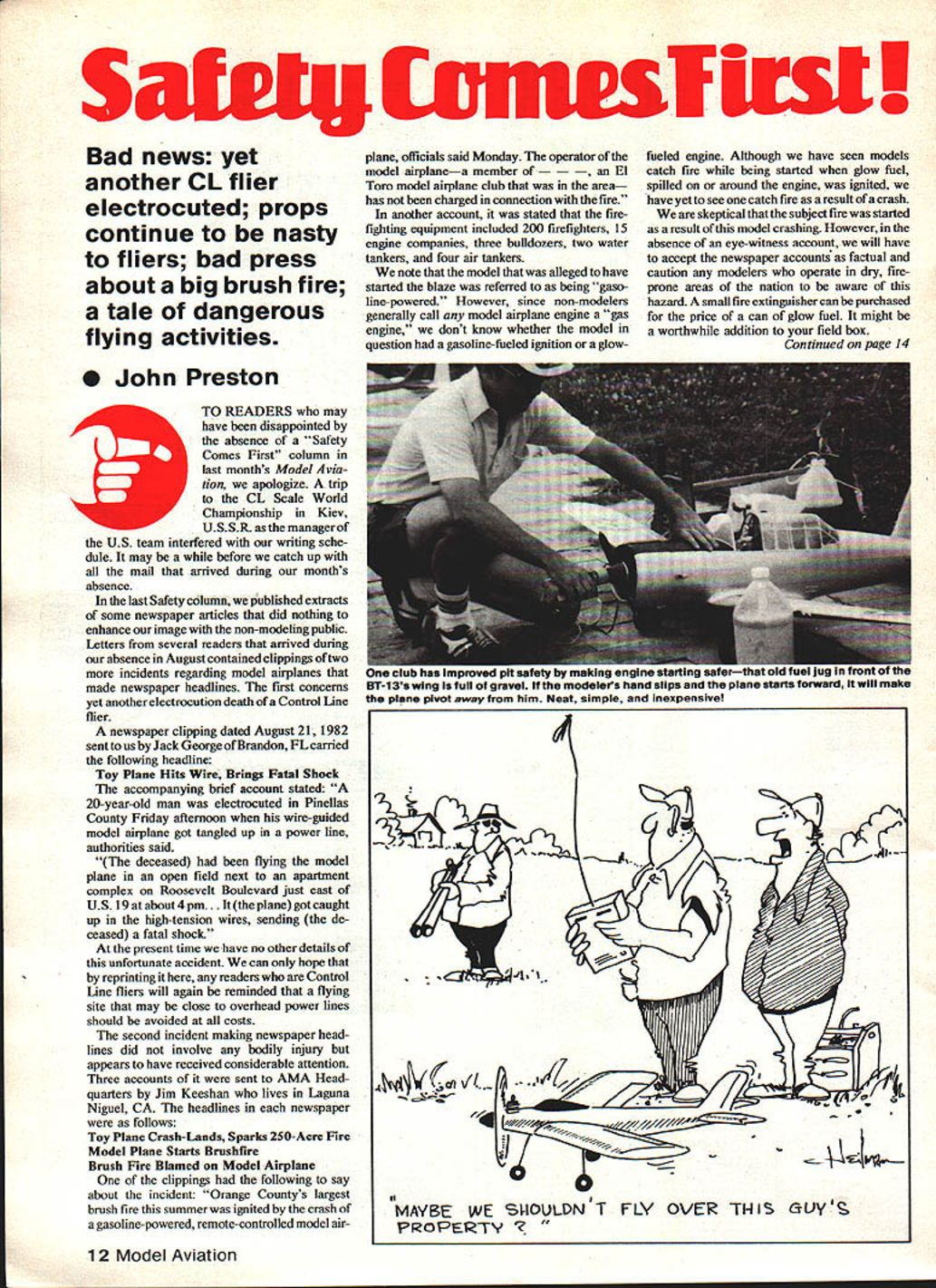
Safety Tip: Gravel-Filled Fuel Jug
To conclude this month's column, we have a safety tip from David Anderson of Burnsville, MN. David's tip also concerns avoiding injuries caused by propellers.
"Here's a simple and convenient safety device that we have been using at the Twin City Radio Controllers' field for several years.
An old fuel jug is filled with gravel and kept in the pit area. When starting an engine, the jug is placed in front of the wing opposite to the engine-starter. Should the plane slip from the flier's grasp and lurch forward, the plane will be rotated away from the pilot, preventing an unwanted vasectomy. The jug also prevents the plane from creeping forward until it is ready to be taxied out to the runway."
A photograph shows the jug placed against the wing of David's Vultee BT-13 which, with its fat fuselage, is hard to hold with one hand. We would be pleased to publish any other safety tips that readers might have.
Have a safe month.
John Preston 7012 Elvira Ct., Falls Church, VA 22042.
Transcribed from original scans by AI. Minor OCR errors may remain.

