
Safety Comes First!
By John Preston
Opening
It's spring safety-checkup time! Ni-Cd batteries and RC model wiring harnesses can be potential fire hazards. Portable safety barriers, prop safety, and a suggestion for RC clubs regarding first flights of new models are covered below.
Radio systems and batteries
If you put your equipment away for the winter, do some checks before you head to the field.
- Have your radio checked by a qualified technician if it hasn't been recently inspected.
- Cycle batteries to determine their condition. Even new radios and packs can be defective.
- Record the time it takes for a fully charged pack to discharge to the cutoff point. Use that time as a baseline for future reference.
Airframe and control checks
Give aircraft you flew last season a thorough going-over.
- Inspect control-surface hinges for looseness or fuel damage; replace them if necessary.
- Check fuel tanks and tubing.
- Clean and oil engines if you haven't already.
- RC fliers: examine servo installations and pushrods. Ensure servo mounting rails and glue joints are secure.
An ounce of prevention is worth a pound of cure—model crashes are expensive and often avoidable.
RC helicopters
We receive little mail about RC helicopters. That may mean their safety record is better or simply that fewer are flown. However, an incident reported in the District VIII column (Ted White) involved a main rotor blade separating from the hub and striking the operator, causing serious chest and arm injuries. Because helicopters are often flown closer to people than fixed-wing models, be aware of this hazard.
If you have the February issue (the one with Henry Haffke's Gee Bee R-1 on the cover), read Ted’s account on page 105.
Portable safety barriers and field layout
A Pennsylvania modeler suggested using cars as "portable safety barriers" by parking them closer to the runway than AMA guidelines recommend (80 ft back). We doubt AMA's insurance carrier would approve. Insurance claims show many incidents involve models hitting vehicles; whether those vehicles were parked at flying fields is unknown, but it suggests caution.
A safety barrier that separates the active flying area from spectators and other modelers is a good idea—provided flying never takes place behind the barrier.
A correspondent in Idaho sent photos of a 6-ft chain-link fence between runway and pits intended as a barrier. He noted it worked more as a psychological deterrent than a bulwark against low-flying models. Many members there fly in front of the pits and even practice 360-degree flying, which the correspondent and this column disagree with. Flying behind pits and parking is unsafe and violates AMA suggested field layout guidelines (and the AMA Safety Code). Don't do it.
Energy in Ni-Cd batteries and short-circuit hazards
A reader, Jesse Aronstein of Poughkeepsie, NY, reported a flight pack returned from service that had been shorted. The wiring at the switch or internal switch parts had shorted, charring and melting insulation; the battery case showed high-temperature damage at the wire exit hole. Fortunately no fire resulted, but a charged Ni-Cd pack clearly has enough energy to be an ignition source if shorted.
A similar anecdote once suggested a new RC system shorted in a buyer’s station wagon and caused a fire. We can't confirm that claim, but it reinforces the need for routine checks of wiring harnesses and switches.
Receiver switch placement
Some club newsletters advise mounting the receiver ON-OFF switch on the fuselage side but checking it methodically before each flight. In our view, the best spot is on the servo tray inside the fuselage—most switch failures occur on switches mounted in the fuselage side.
We ask readers: do you find fuselage-side-mounted switches more prone to failure than those on the servo tray? The only likely reason for premature failure of a fuselage-side switch is increased contamination of the contacts.
Propeller safety
Propellers remain a frequent hazard.
- Don’t overtighten wood prop nuts; crushing the wood at the center can cause the prop to fail and throw blades.
- Use a four-way prop wrench rather than a long open-ended wrench to avoid overtightening.
- If using an AMA-style acorn prop nut (which requires a 5/32-inch diameter rod for tightening), keep the rod length to about four or five inches.
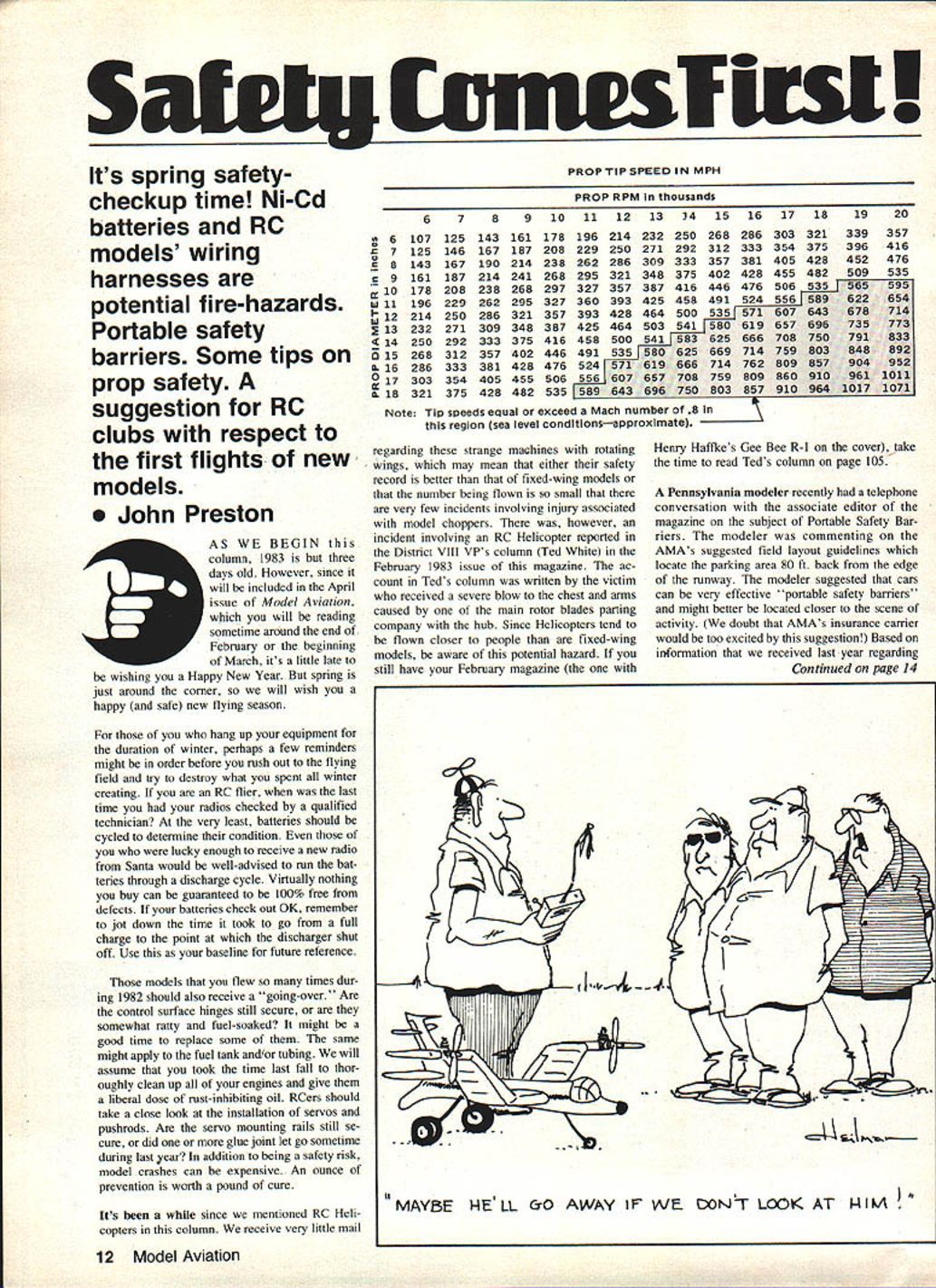
A reader, Phillip Nickell of Longmont, CO, provided charts and formulas for prop tip speed and theoretical forward speed based on prop diameter, rpm, and pitch. While forward speed for a given pitch and rpm is controversial, tip speed is straightforward—remember how fast that bit of wood or plastic is moving near your fingers when you tweak the needle valve.
Prop tip speed and noise reduction
Consider the prop as a noise source. Ed Izzo, chairman of the AMA Noise Committee, described a quiet Pattern model that uses a three-bladed prop. By reducing diameter and adding a blade you can move the same air at a lower tip speed and reduce prop noise. Engine exhaust noise is often the loudest and easiest to reduce; many “mufflers” on the market are ineffective.
In my opinion, establishing maximum sound output levels for model engines is long overdue. AMA’s committee may help in that effort.
Unsafe flying locations
A clipping sent by Ron Sebosky quoted an article in another model magazine where the author said, “In fact, I often fly it in the local supermarket parking lot.” That is poor safety practice and should not be encouraged by publishers. Even a small 38-inch wingspan model with a 1/4 A motor could cause serious injury to unsuspecting people using a parking lot.
First-flight courtesy
From Flight Line News (Conejo RC Modelers), edited by Art Addington: adopt a rule that the first flight of an aircraft be flown solo—no other aircraft in the sky. A lapse in that rule led to a series of dangerous takeoffs and near-misses when a new plane was flown with others in the air. After a dead-stick landing and attempts by others, the new model nearly hit another flier several times. The editor’s advice: leave the plane in the pits until you can fly it by itself.
Clubs should consider requiring that first flights be done when no others are in the air.
Closing
Have a safe month.
John Preston 7012 Elvira Ct. Falls Church, VA 22042
Transcribed from original scans by AI. Minor OCR errors may remain.

