
Safety Comes First
Frequency control at the RC flying field is certainly a safety consideration! Safety—check your rubber winder. Weight limits on RC models. Ether in diesel fuel. More.
- John Preston
I think most RC modelers would agree that safety at the flying field begins with a system to control the use of the various radio frequencies. In the May 1982 issue of Model Aviation this column discussed the merits of the two frequency-control systems most commonly used by RCers. These are the "Take a clothespin off a board and clip it to your antenna" system and the "Put your clothespin (or other marker) onto a board" system. For simplicity, I'll refer to these two systems respectively as the "Subtractive" and the "Additive" systems. In the first, and probably most prevalent system, you must remove (subtract) a marker from a board before turning on a transmitter, and the absence of the marker on the board indicates use of the frequency it denotes. In the second or additive system you must add a marker to a board, and its presence on the board denotes frequency use.
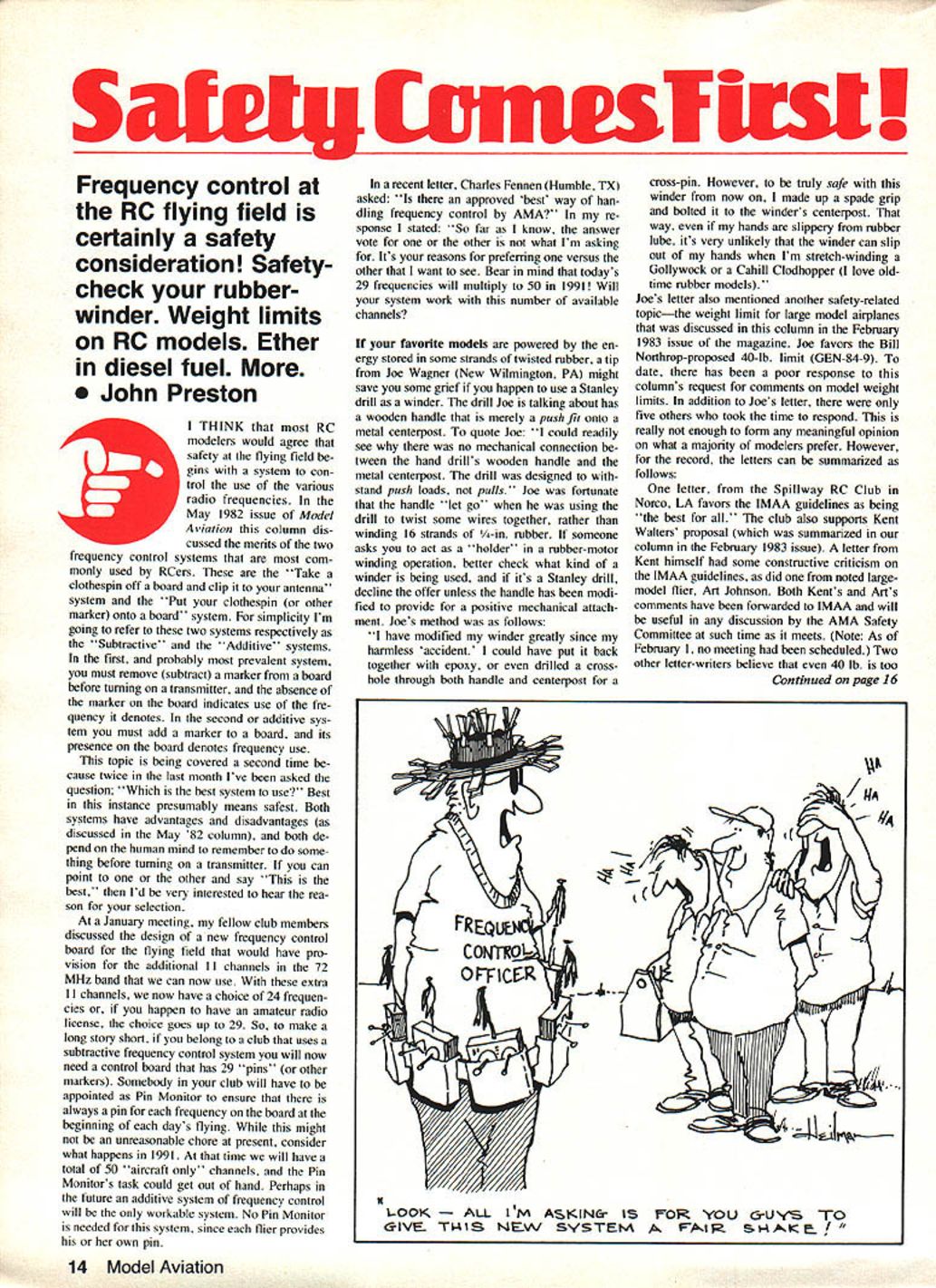
This topic is being covered a second time because twice in the last month I've been asked: "Which is the best system to use?" Best in this instance presumably means safest. Both systems have advantages and disadvantages (as discussed in the May '82 column), and both depend on the human mind to remember to do something before turning on a transmitter. If you can point to one or the other and say "This is the best," then I'd be very interested to hear the reason for your selection.
At a January meeting, my fellow club members discussed the design of a new frequency-control board for the flying field that would have provision for the additional 11 channels in the 72 MHz band that we can now use. With these extra 11 channels, we now have a choice of 24 frequencies or, if you happen to have an amateur radio license, the choice goes to 29. So, to make a long story short: if you belong to a club that uses a subtractive frequency-control system you will now need a control board that has 29 "pins" (or other markers). Somebody in your club will have to be appointed as Pin Monitor to ensure that there is always a pin for each frequency on the board at the beginning of each day's flying. While this might not be an unreasonable chore at present, consider what happens in 1991. At that time we will have a total of 50 "aircraft-only" channels, and the Pin Monitor's task could get out of hand. Perhaps in the future an additive system of frequency control will be the only workable system, since no Pin Monitor is needed for this system—each flier provides his or her own pin.
In a recent letter, Charles Fennen (Humble, TX) asked: "Is there an approved 'best' way of handling frequency control by AMA?" In my response I stated: "So far as I know, the answer—vote for one or the other—is not what I'm asking for. It's your reasons for preferring one versus the other that I want to see. Bear in mind that today's 29 frequencies will multiply to 50 in 1991! Will your system work with this number of available channels?"
If your favorite models are powered by the energy stored in some strands of twisted rubber, a tip from Joe Wagner (New Wilmington, PA) might save you some grief if you happen to use a Stanley drill as a winder. The drill Joe is talking about has a wooden handle that is merely a push fit onto a metal centerpost. To quote Joe: "I could readily see why there was no mechanical connection between the hand drill's wooden handle and the metal centerpost. The drill was designed to withstand push loads, not pulls." Joe was fortunate that the handle "let go" when he was using the drill to twist some wires together, rather than winding 16 strands of 1/4-in. rubber. If someone asks you to act as a "holder" in a rubber-motor winding operation, better check what kind of a winder is being used, and if it's a Stanley drill, decline the offer unless the handle has been modified to provide for a positive mechanical attachment. Joe's method was as follows:
- I have modified my winder greatly since my harmless "accident." I could have put it back together with epoxy, or even drilled a cross-hole through both handle and centerpost for a cross-pin. However, to be truly safe with this winder from now on, I made up a spade grip and bolted it to the winder's centerpost. That way, even if my hands are slippery from rubber lube, it's very unlikely that the winder can slip out of my hands when I'm stretch-winding a Gollywock or a Cahill Clodhopper (I love old-time rubber models).
Joe's letter also mentioned another safety-related topic—the weight limit for large model airplanes that was discussed in this column in the February 1983 issue. Joe favors the Bill Northrop-proposed 40-lb limit (GEN-84-9). To date, there has been a poor response to this column's request for comments on model weight limits. In addition to Joe's letter, there were only five others who took the time to respond. This is really not enough to form any meaningful opinion on what a majority of modelers prefer. However, for the record, the letters can be summarized as follows:
- One letter, from the Spillway RC Club in Norco, LA, favors the IMAA guidelines as being "the best for all." The club also supports Kent Walters' proposal (which was summarized in our column in the February 1983 issue).
- A letter from Kent Walters had some constructive criticism on the IMAA guidelines, as did one from noted large-model flier Art Johnson. Both Kent's and Art's comments have been forwarded to IMAA and will be useful in any discussion by the AMA Safety Committee at such time as it meets. (Note: As of February 1, no meeting had been scheduled.)
- Two other letter-writers believe that even 40 lb. is too much and favor respectively 20 lb. and 5 kg (11 lb.).
Seems like Charles Fennen was absolutely correct when he stated: "Ask 40 people, and you will get 40 answers."
I don't know where we go from here. I guess if I were asked to state my opinion, I'd question why anyone wishing to build a model that is going to tip the scales at more than 40 lb. doesn't join the EAA and construct a home-built or Ultralight. On the other hand, I can't prove that a 55-lb model presents a significantly greater hazard than one which weighs 40 lb.
Merits of additive system (presence of marker on board denotes frequency in use)
- Each flier provides his or her own marker, therefore no Pin Monitor is needed.
- If markers have the flier's name on them, a new arrival at the field can see at a glance who is using the frequency desired.
- The system lends itself well to forming a queue of fliers awaiting use of a frequency if the board has provision for waiting fliers to clip their pins in order.
Demerits of the additive system
- The system is not as commonly used as the subtractive system; a changeover could result in confusion and accidental shoot-downs.
- A flier is not in possession of "the pin" which, in the case of a shoot-down, provides irrefutable evidence of who had the right to fly. In other words, the additive system could be more easily abused if a dishonest flier elected to switch the markers on the control board.
- It does not lend itself as well as the subtractive system to use in contests at which non-club members will be present.
Merits of subtractive system (pin on antenna; absence of pin on board denotes frequency in use)
- Probably the most prevalent system currently in use.
- A flier has tangible evidence (in the form of a pin on his antenna) that he remembered to follow the rules on frequency control.
Demerits of the subtractive system
- Does not tell you who is using a frequency—only that somebody is using it.
- Requires somebody in the club to ensure that pins for all frequencies are always present.
- A pin "missing" from the board could mean either use of that frequency or that the pin "went home" still clipped to someone's antenna. It might be difficult to ascertain which has occurred at a crowded field.
- Could be prone to vandalism (theft of pins) at flying fields open to the public.
One final word on frequency control: whichever system you prefer, all RC flying fields should have a transmitter impound. If the impound and the frequency-control board are one and the same structure, that trip to the impound to obtain one's transmitter should prompt the old memory into also doing whatever is necessary to indicate use of a frequency. Transmitters scattered willy-nilly throughout the pit area are a sure-fire way of leaving oneself open to frequency abuse and the inevitable shoot-down.
Now you can get that pen and paper and drop me a line on the subject of "Which frequency control system is the most foolproof?"
Diesel fuel and model engines
A simple note on the popularity of model diesel engines suggests a word of warning on diesel fuel. The principal ingredient that makes a model diesel engine operate without benefit of a glow plug is ether. The volatility of ether greatly exceeds that of methyl alcohol. Treat ether and diesel fuel as you would gasoline. Don't keep it in the basement beside the furnace or gas hot water heater. If you mix your own diesel fuel, do it outside away from any ignition source. Remember, ether used to be used as an anesthetic back in the old days, so avoid breathing the fumes.
A suggestion for transmitter manufacturers
One last tip comes from a fellow club member, Lou Bruhn, and is really a suggestion to the makers of RC equipment. The latest crop of transmitters appear to have about exhausted the number of "whistles and bells" that can be realistically useful in making it easier to control or set up a model. Lou suggests adding a built-in frequency monitor to the transmitter for the person who already has everything else. The way it might work would be to use a three-position switch instead of the current two-position On/Off switch. Switching on a transmitter would become a two-step affair. Going from Off to the first position would turn on the frequency monitor which would indicate, either by audible tone or meter, whether the channel was clear. If no incoming signal were present, one would be comfortable in switching to the third position on the switch that would turn on the transmitter and turn off the frequency monitor. Just a thought that might further decrease the number of accidental shoot-downs.
Have a safe month.
John Preston 7012 Elvira Ct., Falls Church, VA 22042.
Transcribed from original scans by AI. Minor OCR errors may remain.

