
Safety Comes First!
John Preston
Some of you may be wondering what happened to the Safety column in the May 1983 issue of MA. I don't know. Somehow it got scrambled in the pipeline between writer and printer. I think everything that I wrote is there—but not in the same order that it was written. No prize is being offered for the first person to unscramble it, but if anyone wants the unscrambled version I'd be glad to supply it on receipt of a SASE.
I've got a mixed bag this month. The first topic is a follow-up to an item that appeared in this column in the April 1983 issue. I asked readers to comment on a statement that I had found in a club's newsletter recommending mounting the receiver switch of an RC airplane in the servo tray rather than in the side of the fuselage because "... almost always, the switch that fails is mounted in the side of the fuse." No rationale accompanied the newsletter recommendation. A letter from David Kruger (Claremont, CA) offers a plausible reason for failure of switches that are mounted in fuselage sides.
Receiver switch mounting
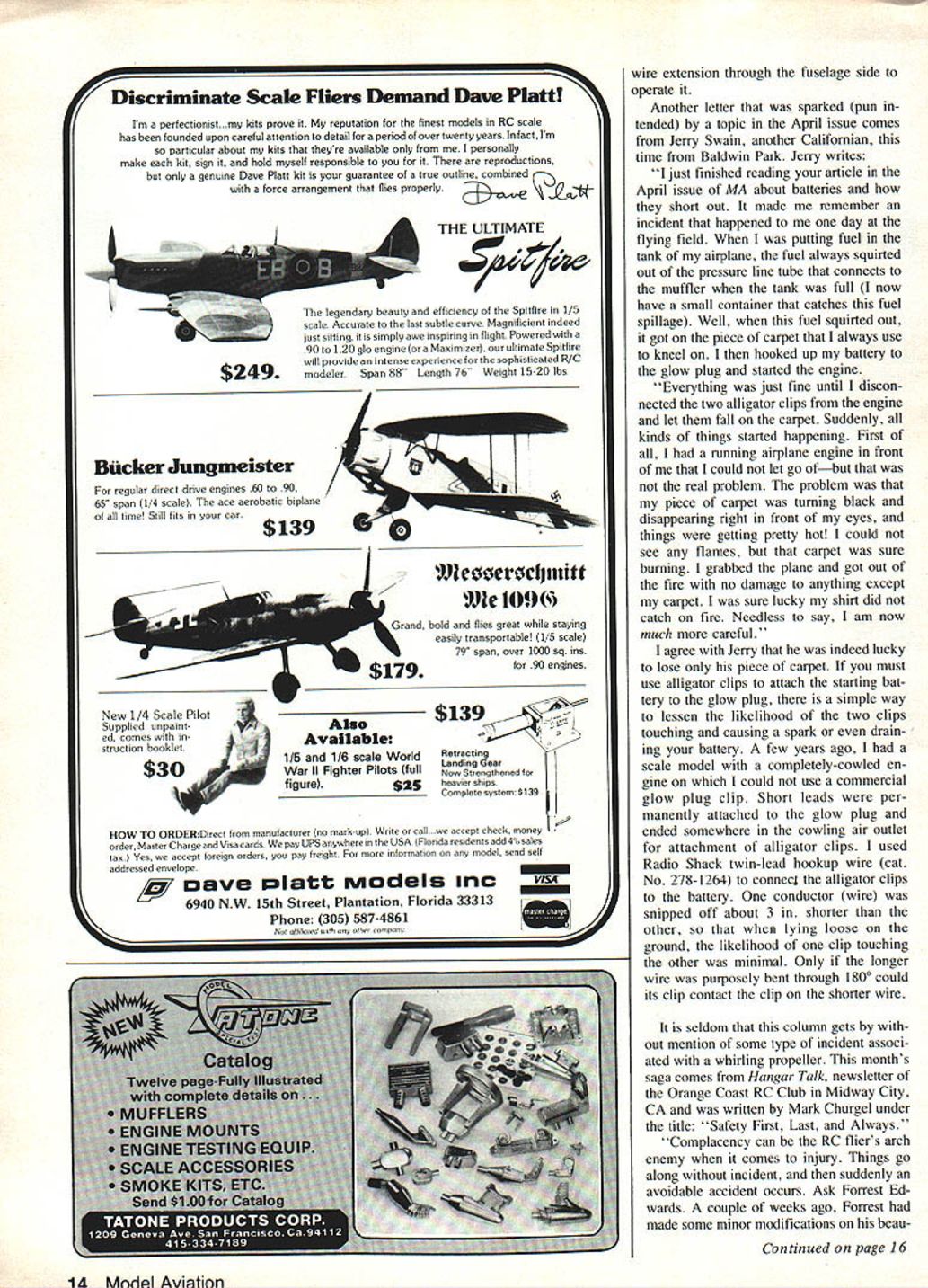
I'm writing mainly to advise anyone not to mount RC switches on fuselage sides, especially if the switch button (knob?) does not protrude very much from the fuselage (less than 1/8 in.). The reason? I have lost two aircraft because of failure of the switch to maintain contact due to gradual enlargement of the recess in the switch in which the slider moves—see the diagram. This enlargement is an inevitable result of thumb or finger pressure on the switch button when it is turned on and off. The switches I use are the ones supplied by Ace RC (Continental Wire, I believe), which are very light in construction. A Noble switch may not be as susceptible. I don't know.
In the usual internal mounting arrangement, only sideways forces are exerted on the switch knob; therefore, the switch will not fail (for this reason, anyway). I now wrap thread (followed by CA—cyanoacrylate—glue) around the wires and the switch body on each end to reinforce switches and provide strain relief on the wires.
I cannot verify that the thread/CA-glue reinforcement is the way to solve switch problems. If it works for David, maybe it will work for others. Seems like the best solution is to put the switch in the servo tray, if this is possible, and use a push-pull piano wire extension through the fuselage side to operate it.
Alligator clips and spilled fuel
Another letter, sparked (pun intended) by a topic in the April issue, comes from Jerry Swain of Baldwin Park, CA. Jerry writes:
"I just finished reading your article in the April issue of MA about batteries and how they short out. It made me remember an incident that happened to me one day at the flying field. When I was putting fuel in the tank of my airplane, the fuel always squirted out of the pressure line tube that connects to the muffler when the tank was full (I now have a small container that catches this fuel spillage). Well, when this fuel squirted out, it got on the piece of carpet that I always use to kneel on. I then hooked up my battery to the glow plug and started the engine.
"Everything was just fine until I disconnected the two alligator clips from the engine and let them fall on the carpet. Suddenly, all kinds of things started happening. First of all, I had a running airplane engine in front of me that I could not let go of—but that was not the real problem. The problem was that my piece of carpet was turning black and disappearing right in front of my eyes, and things were getting pretty hot! I could not see any flames, but that carpet was sure burning. I grabbed the plane and got out of the fire with no damage to anything except my carpet. I was sure lucky my shirt did not catch on fire. Needless to say, I am now much more careful."
I agree with Jerry that he was indeed lucky to lose only his piece of carpet. If you must use alligator clips to attach the starting battery to the glow plug, there is a simple way to lessen the likelihood of the two clips touching and causing a spark or even draining your battery. A few years ago, I had a scale model with a completely cowled engine on which I could not use a commercial glow plug clip. Short leads were permanently attached to the glow plug and ended somewhere in the cowling air outlet for attachment of alligator clips. I used Radio Shack twin-lead hookup wire (cat. No. 278-1264) to connect the alligator clips to the battery. One conductor (wire) was snipped off about 3 in. shorter than the other, so that when lying loose on the ground, the likelihood of one clip touching the other was minimal. Only if the longer wire was purposely bent through 180° could its clip contact the clip on the shorter wire.
Propeller incident
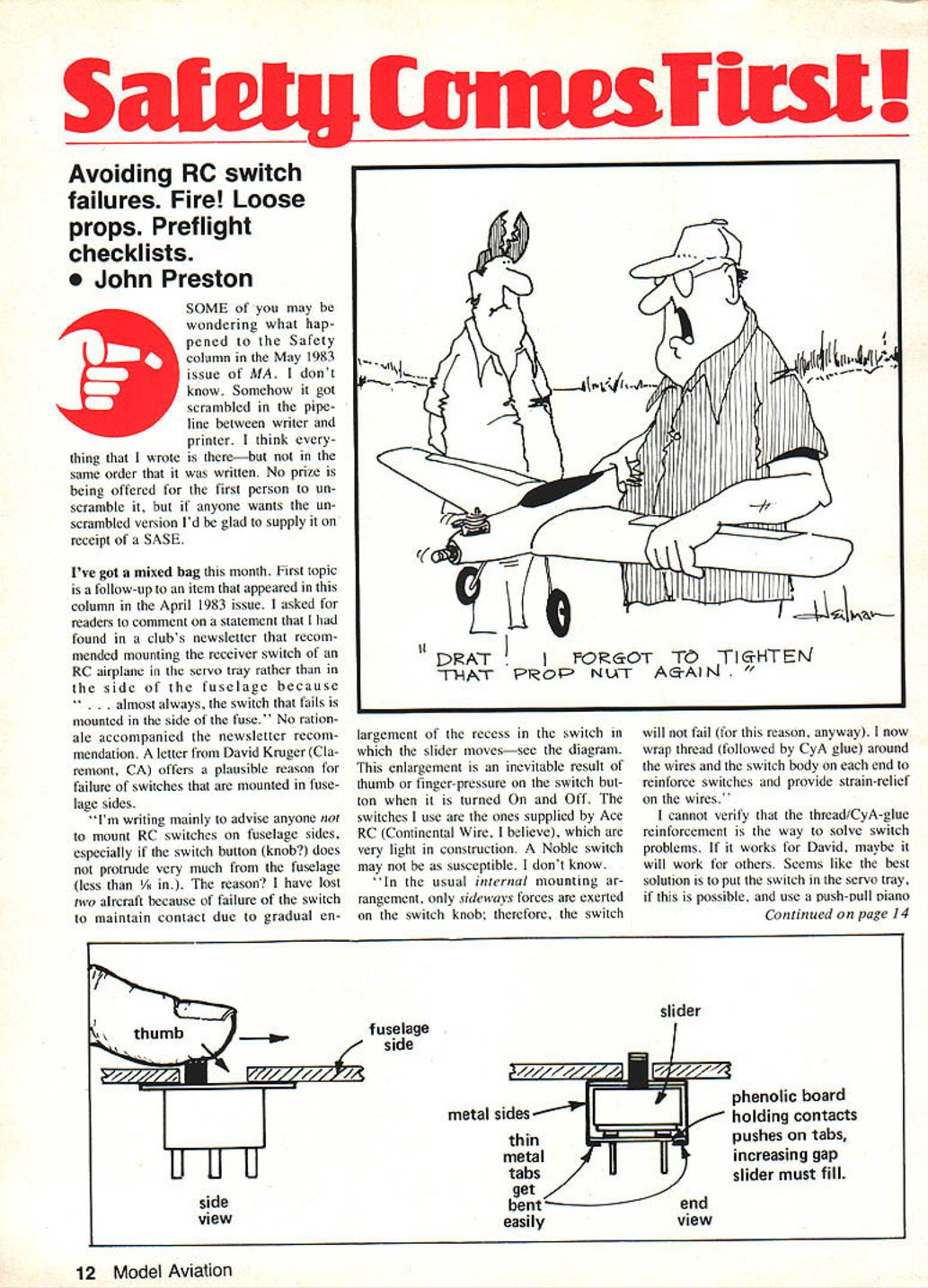
It is seldom that this column gets by without mention of some type of incident associated with a whirling propeller. This month's saga comes from Hangar Talk, newsletter of the Orange Coast RC Club in Midway City, CA, and was written by Mark Churchill under the title "Safety First, Last, and Always."
"Complacency can be the R/C flier's arch enemy when it comes to injury. Things go along without incident, and then suddenly an avoidable accident occurs. Ask Forrest Edwards. A couple of weeks ago, Forrest had made some minor modifications on his beautiful and famous five-cylinder four-stroke. The next day out at the field, he fired it up as he had done 300 or more times. Suddenly, and without warning, the large 22-in. prop flew off and struck Forrest in the nose. The result was the near loss of the nose! For better than an hour, a skilled surgeon worked on Forrest, suturing his nose back in place.
"Forrest would be the first one to say, 'It could have been avoided if I had checked the prop nut. I made two mistakes, actually. I became complacent and didn't check the nut, and, secondly, I was in front of the engine while checking it out.'
"We're all thankful that our good friend and great modeler was not hurt more seriously. His experience is an object lesson for all of us. Never take that whirling prop for granted! It's a buzz-saw out there and needs to be treated as such. For sure, check that prop nut before you fly. There are many ways in which it can loosen, and—loose and flying unattached to your airplane—it becomes a deadly missile."
Mark concluded his newsletter article by stating that in a future issue he would discuss the importance of a preflight check. This takes us back to a topic that appeared in the last column (June), a club flight training program. In that issue, parts of the Charleston (SC) RC Society's Training Guide booklet were published. Since then, two additional clubs have sent information on similar programs.
Pilot training, qualification and preflight checklists
From the Northern Virginia RC Club (NVRC) came a booklet titled Pilot Training/Qualification Guide and Preflight Inspection Checklists. The booklet was accompanied by a 6 x 4‑in. card, heat-sealed in a protective plastic cover, on which was printed "Routine Preflight Inspection" on one side and "Maiden Flight Preflight Inspection" on the other side. These checklists appear in the booklet also, but the card can be carried in members' field boxes.
The two separate preflight checklists are self-explanatory. One is for use on a brand-new model, and can be used either by its builder or, if the builder is a beginner, by one of the club's flight instructors. The other checklist is for use every time a member goes to the flying field. Although it is said that the human brain is the greatest computer ever invented, sometimes its owner forgets to punch the right key, and something unplanned happens.
In addition to prop nuts not getting tightened, models take off with receiver antennas tucked inside the fuselage, aileron or elevator servos reversed, and a host of other things that can lead to their demise when it could have been avoided had the owner had his personal computer prompted by means of a checklist. For the benefit of others who may also wish to produce a checklist for club members, the NVRC list of items to be examined during the Routine Preflight Inspection is as follows.
NVRC Routine Preflight Inspection
#### INTERNAL (Before attaching wing)
- Check servo mount, servo, servo arms secure.
- Check pushrods secure.
- Check receiver and battery secure.
- Check for loose items/wires that could foul servo arms/pushrods.
- Check for fuel leaks.
#### WING
- Check wing for breaks, warps, cracks, etc.
- Check aileron pushrods, linkage and clevises (if equipped) prior to securing wing to aircraft.
#### ENGINE AREA
- Check engine mount, engine, muffler, prop nut and/or spinner for security.
- Check prop for nicks, cracks, etc.
- Check nose steering mechanism (if equipped).
- Check cowl secure (if equipped).
#### TAIL SECTION
- Check vertical fin, rudder and rudder clevis for security.
- Check tail wheel (if equipped).
- Check horizontal stabilizer, elevator and elevator clevis for security.
#### RANGE CHECK / FLIGHT CONTROL CHECK
- When frequency pin is available, attach to antenna and range-check aircraft with antenna collapsed.
- Check that flight controls move in proper direction.
- Check flight control surfaces to be in proper trim.
I guess I can only find one fault with the NVRC list, and it may be an obvious fault to me because I came close to losing an airplane because of it some years back. Have you spotted it? Nowhere does it say "check wing attachment" (rubber bands or bolts) prior to flight! I was once taxiing onto the runway before I noticed that the wing on my Falcon 56 was attached by only two rubber bands. I'll probably get jumped on by my fellow NVRC club members for being picky, since their list did say to do the wing checks "... before securing wing to aircraft!"
While writing the latter part of this month's safety epistle, a thought comes to mind. It was probably prompted by a recent letter from Bob Neider, who flies with both the Crescent City RC Club and Delta Airlines. Bob's letter suggested that we devote a part of the AMA rule book to basic reference material for modelers and safety tips. We do already have the AMA Safety Code in the rule book, but I think Bob was suggesting something more expansive. Having some basic safety material available for beginners has been in the back of my mind for some time. The reason I haven't suggested it to our fearless leaders is that I was afraid they'd turn around and suggest that I write it.
Anyway, back to the thought prompted by Bob's letter. Would there be any interest in having a plastic‑encapsulated checklist for RC fliers (such as the one done by NVRC) available from AMA HQ as one of the basic supplies? Your thoughts on this, or any other suggestions, would be welcome.
Now back to painting. A model you say? Fat chance—it's the spare bedroom. Then follows the exterior of the house. Yes, I, too, would rather be flying. Have a safe month.
John Preston 7012 Elvira Ct. Falls Church, VA 22042.
Transcribed from original scans by AI. Minor OCR errors may remain.

