
Safety Comes First!
By John Preston
This column is being written April 30. The issue concerning a change in the weight limit for model aircraft has yet to be resolved. During the past month I received a letter and a phone call on the subject—both had suggestions worth repeating here and have been passed on to the AMA Safety Committee.
Weight-limit debate
Kent Walters: raise the limit?
Kent Walters contacted me (he submitted one of three requests to the Executive Council to change the model weight limit). Kent requested raising the limit to around 100 lb. His argument in brief: a single model weight limit (currently 55 lb.) may not be appropriate for all flying sites. Why penalize modelers who have desert flying sites with acres of open space to fly over with a limit that’s really only necessary in congested areas such as the East Coast corridor?
In a January 1983 letter Kent commented on Bill Northrop’s proposal to lower the current weight limit from 55 lb. to 40 lb.:
"Bill Northrop’s proposal apparently attempts to prevent flying any models weighing more than 40 lb. at any AMA‑sanctioned competition or event, or at any AMA‑insured site, effectively killing possibilities of flying models above 40 lb. with AMA’s blessings regardless of the size of site or conditions. Perhaps this simply indicates that we all reflect the culture in which we individually live. When residing in a congested, large metropolitan area (with few or limited sites), there is possible understanding for Bill’s viewpoint. After all, that's where most of the objections to large models originate. However, there are plenty of sites capable of safely accommodating large models in general, and the AMA should reflect this when defining insurance coverage for such models."
Kent also noted that recognizing larger site requirements and increased insurance coverage for larger models encourages the community to provide safer sites. He warned that incentives for establishing larger sites would be diminished without realistic recognition by the AMA for big models.
Insurance and site considerations
Kent’s suggestions raise some questions worth discussing:
- Should insurance premiums vary by geographical location, as auto insurers do (higher in dense cities, lower in rural areas)?
- Should insurance premiums be set according to the size of the model (larger models costing more to insure)?
- Should AMA adopt stricter site requirements for flying larger models?
Comments on these ideas are welcome.
Readers on size, safety and noise
Paul Beretta — safety, standardization, and noise
Paul Beretta of Glen Cove, NY (Long Island, clearly in the congested East Coast corridor) wrote about the size/weight controversy. His main points:
- Limits on model size should be based on safety and public relations; for competitive classes, standardization (worldwide practice) is a third consideration.
- Where world‑class competition is involved, it makes sense for the AMA to follow FAI standards to avoid forcing competitors to maintain two sets of equipment.
- Regarding safety: if there are demonstrable reasons (insurance statistics, provable interference with radar, etc.) to ban or limit models above a certain size or engine displacement, then limits are justified. Otherwise we should not limit one group’s way of enjoying the hobby simply because others perceive it as unsafe.
- On public relations: in heavily populated areas he sees noise (not size) as the greatest threat to the hobby. He urged the AMA to use its influence with manufacturers and fliers to promote effective mufflers—mandating their use for competition when available and encouraging them for all flying.
Paul described his own experience: he is learning on a Sig Kadet with a K&B .40 engine. Despite spending about $60 on mufflers, he hadn’t found one he considered quiet. Some so‑called mufflers do nothing; others only provide limited attenuation. He said he’d accept a muffler that cost some performance (e.g., an 8 oz. muffler or a 25% power loss) if it meant keeping access to nearby flying fields.
My response to Paul
On model size/weight: I suspect raw insurance claims show more incidents with "small" models (say up to 10–12 lb.) simply because they are far more numerous. If statistics were normalized to incidents per hour of flight, I would guess smaller models still show a worse record. One reason: many Giant‑model builders are experienced fliers and more likely to react correctly to in‑flight problems. Based on past records, there may be no justification to treat large models differently from small ones purely on accident rate.
On standardization: there are long debates about whether AMA should follow FAI rules for AMA‑sanctioned competition. That discussion is beyond this column, but it is worth noting that FAI limits (for R/C currently 6 kg or 12.33 lb max) can constrain Scale entries that aim to look and fly realistically.
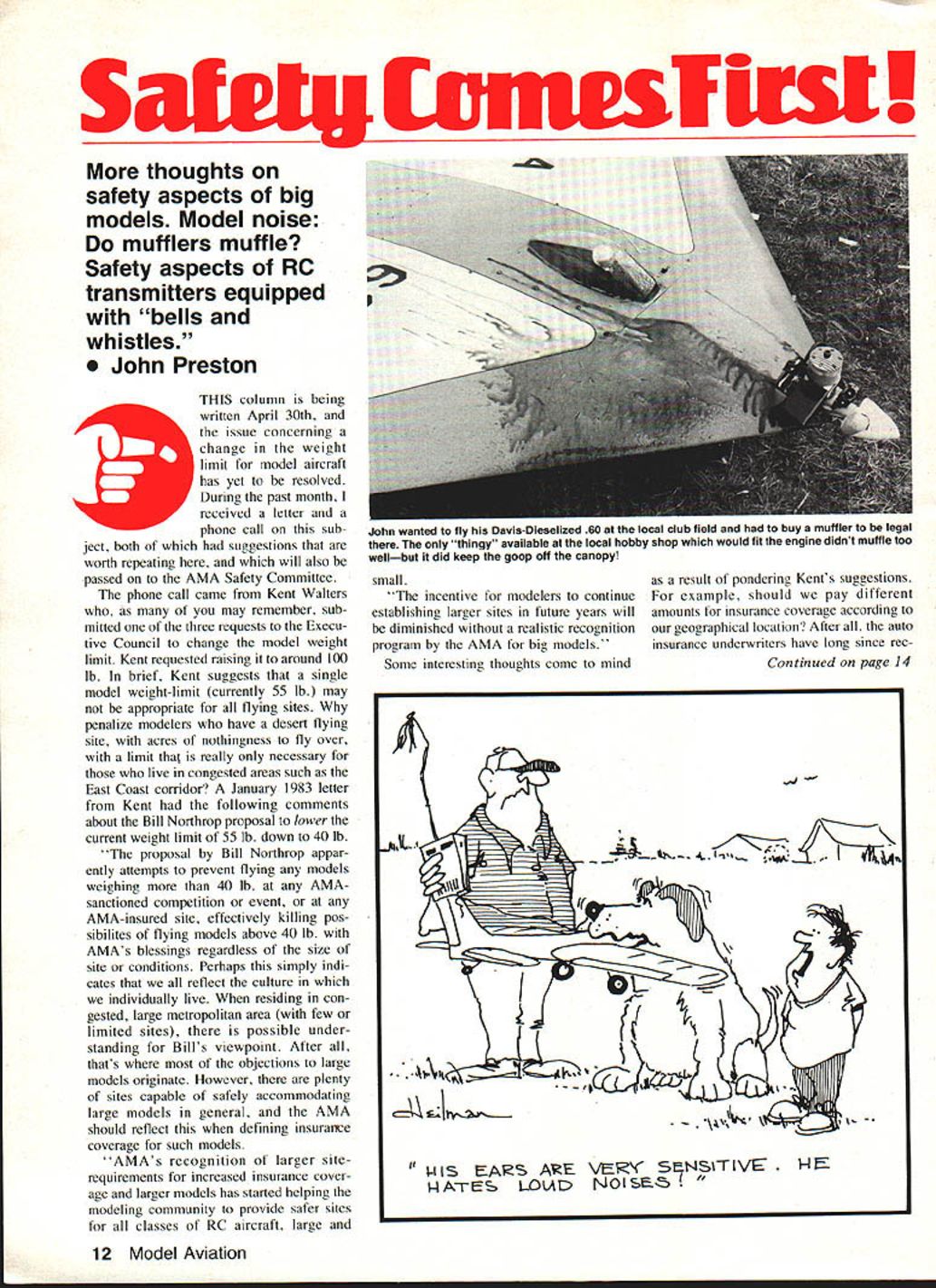
On mufflers and noise: I long ago concluded many products sold as "mufflers" are travesties. They meet a rule that says "equip the engine with a muffler" but do little to reduce noise. I own one such pseudo‑muffler and retired it after one outing because it did not attenuate noise; its only useful purpose was to route exhaust outside the cowling on a scale model.
Noise complaints can have real legal and financial consequences. For example, in Nebraska a neighbor sued the Omahawks RC Club seeking $50,000 in damages for noise complaints. If such suits succeed, the costs to clubs and members could be significant—especially for clubs not chartered by AMA.
The AMA has an active Noise Committee (chaired by District I VP Ed Izzo) examining all components that produce noise and experimenting with Pattern‑type models to reduce total sound output. I expect the committee to report progress to the Executive Council.
Subjectively, big gas burners often sound less obnoxious than screaming .60 engines. The best news is the growing crop of four‑stroke model engines: they produce more pleasant sound and, if adopted widely, could greatly reduce our noise problems. I see more four‑strokes in magazine reviews and ads; they may become the state of the art for model aircraft engines.
Transmitter features and safety
Doug MacBrien — bells and whistles can bite you
Doug MacBrien of Granby, MA (a Giant model enthusiast) wrote about hazards associated with increasingly sophisticated radio equipment. His experience:
- Modern radios are reliable and offer many features (dual rates, mixer switches, servo reversing, etc.). Reliability is good—but more complicated controls can lead to disaster.
- With dual rate set low, he nearly destroyed a new model during a split‑S; the elevator was in LO rate and he missed the ground by only about two feet. He subsequently adjusted the transmitter so the LO rate matched the HI rate when operating, to avoid accidental low‑rate deployment.
- A mixer switch on the top of his transmitter was easy to knock into the wrong position. While flying a new Giant Scale model (hundreds of hours of build time), the mixer was knocked into a rudder/elevator mix position. After two good flights the third ended in a stall followed by an uncontrolled turn; the model crashed into trees. After salvaging pieces, he found the mixer switch had been moved.
Doug’s point: don’t assume that added features are harmless. Easily bumped switches, confusing switch positions, or unexpected rate settings can make a reliable radio dangerous.
Practical safety recommendations
- Pre‑flight check: verify all rates, mixes, and servo directions before every flight.
- Secure switches: make sure all toggle switches are positioned and, where possible, locked or taped to prevent accidental movement.
- Consider simplifying transmitter setup for everyday flying (use fewer active mixes and make LO rates safe).
- When buying radios, check ergonomics—switch placement and detents matter for safe operation.
Closing
These letters raise important questions about where safety, public relations, and competition standards intersect. I welcome further comments, especially on strict site requirements for large models, insurance ideas, muffler effectiveness, and transmitter safety practices. I’ve passed these suggestions on to the AMA Safety Committee for consideration.
Transcribed from original scans by AI. Minor OCR errors may remain.

