

Safety Comes First!
- John Preston
RC frequency control; those rope-and-pulley starters for big engines; foam wing failures in flight due to creeping internal destruction from gasoline fuel; more on prop dangers—and a word of caution on some types of plastic propellers.
GREAT response! Two topics recently discussed in this column have generated more readers' letters than anything else that has been mentioned since "Safety Comes First" appeared in the January 1980 magazine.
The two topics were frequency control and flight training programs. I'm trying to respond to all who took the time to write, but now that summer is here it's difficult to keep up with the incoming mail. If you happen to be one of the writers on these subjects and you have yet to receive an acknowledgement, I apologize. Let me thank all of you here and now for providing the input that keeps this column alive!
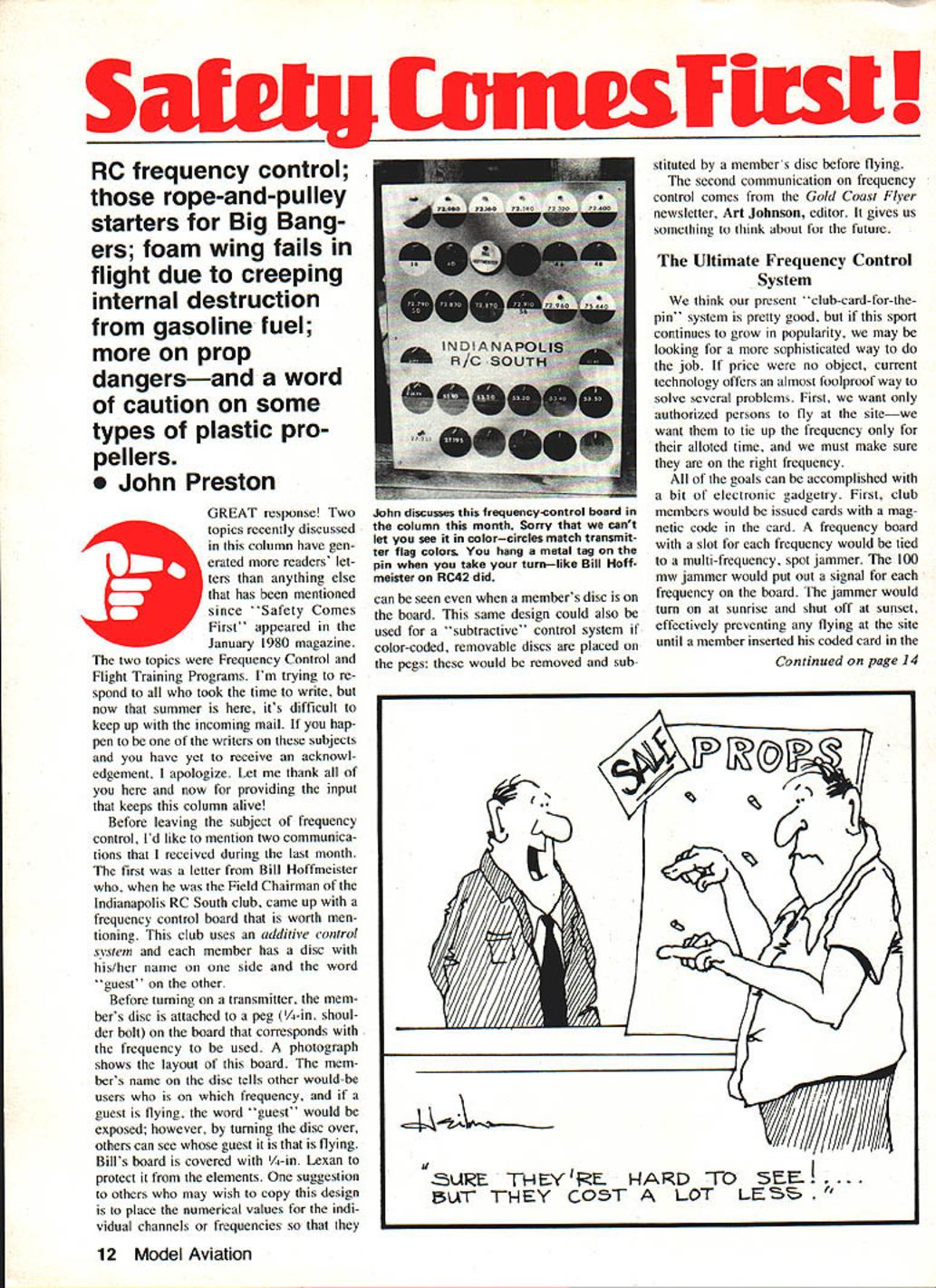
Before leaving the subject of frequency control, I'd like to mention two communications that I received during the last month. The first was a letter from Bill Hoffmeister who, when he was the Field Chairman of the Indianapolis RC South club, came up with a frequency control board that is worth mentioning. This club uses an additive control system and each member has a disc with his or her name on one side and the word "guest" on the other.
Before turning on a transmitter, the member's disc is attached to a peg (1/4-in. shoulder bolt) on the board that corresponds with the frequency to be used. A photograph shows the layout of this board. The member's name on the disc tells other would-be users who is on which frequency, and if a guest is flying the word "guest" would be exposed; however, by turning the disc over others can see whose guest it is that is flying. Bill's board is covered with 1/4-in. Lexan to protect it from the elements. One suggestion to others who may wish to copy this design is to place the numerical values for the individual channels or frequencies so that they can be seen even when a member's disc is on the board. This same design could also be used for a subtractive control system if color-coded, removable discs are placed on the pegs; these would be removed and substituted by a member's disc before flying.
John discusses this frequency-control board in the column this month. Sorry that we can't let you see it in color—circles match transmitter flag colors. You hang a metal tag on the pin when you take your turn—like Bill Hoffmeister on RC42 did.
The Ultimate Frequency Control System
The second communication on frequency control comes from the Gold Coast Flyer newsletter, Art Johnson, editor. It gives us something to think about for the future.
We think our present "club-card-for-the-pin" system is pretty good, but if this sport continues to grow in popularity we may be looking for a more sophisticated way to do the job. If price were no object, current technology offers an almost foolproof way to solve several problems. First, we want only authorized persons to fly at the site—we want them to tie up the frequency only for their allotted time, and we must make sure they are on the right frequency.
All of the goals can be accomplished with a bit of electronic gadgetry. First, club members would be issued cards with a magnetic code. A frequency board with a slot for each frequency would be tied to a multi-frequency spot jammer. The 100 mW jammer would put out a signal for each frequency on the board. The jammer would turn on at sunrise and shut off at sunset, effectively preventing any flying at the site until a member inserted his coded card in the slot. The frequency-choice code would turn off the jammer. Fifteen minutes flight time could be increased during less busy periods. A warning signal would sound two minutes before time is up; a light would flash. The frequency-in-use light would go out.
Is such a system feasible? Sure, but I do not think the club will be installing it next week. On the other hand, it would certainly keep everyone within the present site rules.
If you wish to comment on Art's futuristic system, I suggest you write to him (c/o AMA HQ) rather than me. As I said before, I'm already way behind in my responses to mail—and even if I wasn't, I wouldn't touch this one with the proverbial 10-ft. pole!
Rope-and-Pulley Starters for Big Engines
Coming back to reality and turning to the subject of giant models, a letter last month came from none other than Al "Big Bird" Alman who, according to his business card, specializes in "Gimbals Hot Stuffed; Judges Bribed; Inflight Wing Removals; Buddy Cords Cut; Batteries Drained; Schnuerle-Ported Windsocks." Al, as many of you no doubt know, also writes the "Big Bird" column in Model Builder magazine and, in the July 1983 issue, touches on the safety issue that was in his letter to me—namely, use of rope starters on large engines. Over to Al:
"Something I feel is a gross safety violation, but no one has yet mentioned (I finally did address the problem in my July column), is the practice of some, who have hard-starting (by hand) Evras and Ropers, to utilize a rope starter. The idea of having that pulley immediately in front of, or in back of, the prop, and the rope that close, sends chills up and down my spine. Someone is going to get hacked to death by the handle end of the rope, and it may very well end up being a bystander. What a weapon that rope would make, being whirled around by a spinning prop. Gad!
"Also—I feel that some of the Big Bird lovers have slacked off a bit in regards to safety and this, I think, is due to getting a swelled head from all the statements this past year about how great our safety record has been compared to other RCers. I've included a bit on this, too, in my July column."
When I first saw a magazine picture of a modeler rope-starting a big engine, I had similar thoughts to Al's. However, not being a Big Bird flier, I didn't feel qualified to make a comment. Now you have it from one of the experts in this field. If the only way to make your big engine pop is to use a pulley and rope starter, let us (Al and I) say that you are forewarned.
In regard to Al's comment about Big Bird lovers becoming somewhat lax on safety because of their past good record, I don't think that we have any data that shows what the record really is. For example, do we know how many RCers fly big models versus models of more conventional size? I'd venture to say that statistics would show that there isn't much difference in the safety record between big and small—but I doubt that we could prove it. Whatever you fly, safety should be your prime consideration.
Foam Wing Failures from Gasoline Fuel
Staying on the subject of big models (or at least those that use engines fueled by gasoline), a note from Jim Scarborough, AMA vice-president for District X, enclosed an article from the newsletter of the Orange Coast RC Club which makes interesting reading. The article is by Bob Richards and is titled "Happy Flying." After reading it, you might think that "Unhappy Flying" would have been a better title.
"Au Revoir, CAP-20L! You gave us many hours of enjoyment. This article should really be reported in Marc's column on Safety, but because of the firsthand experience, I want to pass on the details here.
"Butch Asher of the Anaheim Model Airplane Club and I were partners in a quarter-scale CAP-20 ever since Kenny Wilson let me steal it from him over two years ago. We enjoyed participating in events at Mile Square, Sepulveda Basin, Las Vegas, LTA, Tustin, desert outings, and just sport flying—over 400 flights on the big bird.
"On Saturday, April 2, 1983, old F-GAUA went to the big hangar in the sky. The right wing separated from the plane at the landing gear while flying straight and level at 200 ft. The resulting crash, I understand, was truly spectacular. I am reporting this particular demise of a model because of the object lessons that were learned, hoping they might save one of your favorite planes. No, the wing did not fail because of aileron flutter. A post-crash investigation determined the following conditions.
"A crack in the original fueling valve had allowed gasoline to leak into the fuselage over a period of time. Also, about a year ago, the smoke system tubing failed, which caused a one-time flooding of diesel fuel into the fuselage. The fuel and fumes apparently entered the wing through the servo lead wire opening and wicked out the wing spar. At the end of the spar, the foam core had turned into a soft gummy mass with no structural integrity remaining. This insidious failure mode wasn't apparent to pre-flight inspections. What was detected was a debonding of the sheeting from the core. We assumed that the glue was deteriorating when, in fact, the petroleum had completely dissolved the foam core!
"The lessons learned are that glow-plug fuel (methanol) may not cause problems with Styrofoam, but gasoline and diesel fuel will dissolve it as fast as any solvent available. Secondly, any physical change in a characteristic of a model should be investigated in depth, not just assumed to be the obvious. A look inside the wing with a mirror and light or a borescope might have saved $900 worth of airplane."
Bob's story about the soggy CAP-20 reminds me of a water-skiing expedition many years ago in a friend's boat. During refueling some drops of gasoline were spilled on a foam chest in which we had packed our lunch. Goodbye chest—it just vanished before our very eyes. So, if you have a "foanie" with a gas-fueled motor up front, take the time to do a thorough inspection on a regular basis, lest it, too, do a disappearing act because of a fuel spill.
Prop Dangers—and a Word of Caution on Some Plastic Propellers
Seldom does a month pass without my reading about an injury caused by contact with a model aircraft propeller. Most often the result is a minor laceration—usually to the hand—but sometimes such incidents necessitate a trip to the doctor. Such was the case in an account of a prop accident that appeared in The Transmitter, newsletter of the Jersey Coast Sport Flyers. Ed Runkel related the account. As they used to say in a well-known TV show: "The names have been changed to protect the innocent."
"A disaster of a different nature recently befell Larry Modeler, and we might call this one 'lightning does strike in the same place twice.' Two weeks ago, Larry was warming up the engine of his prized new Aeromaster when he accidentally hit the throttle or something. The plane jumped at him, and the wooden prop stabbed deep into his leg a few inches above the knee. Dick Samaritan took Larry to his house to dress the wound; Bud Builder fixed the wing damaged by Larry's flailing arms; and Larry had learned a painful lesson. End of story? Not quite.
"Last Sunday, as I was turning my car into Thompson Park off Newman Springs Road, I noticed Dick Samaritan's Volvo stopping on the way out. Right behind was Larry Modeler's station wagon. I beeped the horn to say hello. Larry, distracted, bumped into the rear of Dick's car. Dick jumped out. Instead of checking for damage he ran straight back to Larry, shouting, 'Are you all right?' A couple of seconds later, Bud Builder pulled up, getting out and asking the same question. Out gets Larry, grimacing in pain and holding his knee. Auto accident injury? Nope. Bud explained that Larry had gotten another prop in the leg, only this time worse. They were taking him to Dick's — and maybe then to a doctor.
"Larry suffered considerably that night and the next day went to a doctor who took seven stitches to sew back the large flap of meat nearly chopped from his leg, only an inch or so below the earlier injury. Larry also got a tetanus shot and was told to stay off the leg for two weeks. Painfully reflecting on the occurrence, Larry remembers revving up the Webra Speed .61 engine on his Curare in the pit area. The engine let out a shrill whine, and the next thing he knew the muffler and spinner blew off and he was down with a sharp pain in his leg. His conclusion was that a blade flew off his (brand name) prop (Larry Mechanic calls these fiberglass things 'steak knives'). He will not use one of these things on his planes again."
The (brand name) and (other brand name) fiberglass props are very popular items these days. They are cheaper than wooden props, perform about as well in the air, and withstand ground impact better. The club does not ban their use, but issues a warning to sand off the sharp edges and to paint the tips in a light color to make them visible. To this, I would add a warning to carefully balance them before use and an admonition not to use them on any high-performance engine. If you are flying with Schnuerle-ported or P.D.P. engines, you are good enough not to break many props. The few pennies you save on these glass-filled props are not worth it, in my opinion.
This column has mentioned problems with fiberglass-filled plastic props before and would go further than the author of the preceding article and caution modelers not to use them on any engine larger than a .35. Balancing, sanding off sharp edges, and painting the tips in a light color is good advice—but may not have an effect on reducing the chance of blade separation. Why take the chance?
Tips to Minimize the Risk of Propeller Injury
The tips below come from the newsletter of the Thunderbolts RC Club of Schenectady, N.Y., editors Rod Priddle and Stan Devoc. Club President John Saville authored the following:
- Always move your hands slowly and deliberately near the prop when your engine is running.
- Always wear a leather glove if you're going to prop by hand. An electric starter is better.
- Black props are extremely difficult to see when running. Also, the glass-filled ones are sharp and very unforgiving (I try not to use them if possible).
- MOST IMPORTANT—Set up a standard arrangement of your equipment in front of your plane and use a standard procedure to start your engine. Work this out so you avoid awkward moves and situations.
- Last—Carry a small first aid kit in your car. You never know when you or a friend may need it. (I got caught without one when a friend gashed a finger several weeks ago. I now have one.)
Have a safe month.
John Preston 7012 Elvira Ct. Falls Church, VA 22042
(Continued on page 16)
Transcribed from original scans by AI. Minor OCR errors may remain.

