
Safety Comes First!
- John Preston
By the time most of you get around to reading this column, the Summer of '83 will be about over. However, I'm hastening to finish and get it into the mail before leaving for a long Fourth of July weekend at the beach. Those of you who know how hot and humid summers in the Washington, DC area can be, will appreciate how much I'm looking forward to this chance to get away from it all. There used to be a time when such weather didn't bother me, and I'd willingly stand in a field in 90°F (or higher) temperatures and sweat buckets over my latest RC creation. Somehow, that doesn't hold much fascination anymore—must be getting old! Anyway, on with this month's offerings.
The first one comes from Lee Taylor and was originally written for his local club's newsletter. Lee, as many of you will be well aware, was the founder of the IMAA, but the point he is making in the following article applies to the pilots of all RC models—not just the Giant Scalers. Over to Lee:
Emergency Procedure
by Lee Taylor
You know, guys, model flying is kind of a weird hobby. I guess it is much like any hobby, in that we have our old-timers, our actual experts, our "self-appointed" experts, our beginners, and so on. Probably one of the strongest things about our hobby, though, is that on virtually any subject, you can get several different opinions about how to handle a specific situation.
Personally, I have one overriding concern in anything that I do. I'm chicken! I will do just about anything that can be done with a model, but I like to approach it very carefully and easily, in stages, but most important, whenever I sense that anything even might be wrong, I want my model on the ground like now! No hesitation, no "Hmm, wonder what that was?" No "Let's check this out a little further"—L-A-N-D, NOW!
I have a very simple philosophy about this kind of situation. It is a whole lot safer to check out any potential problem on the ground than it is to try to find out what the problem is in the air. Delaying landing while you are experiencing problems may be interesting, exciting, even lifting to your macho image of yourself, but it sure is hard on airplanes and pocketbooks.
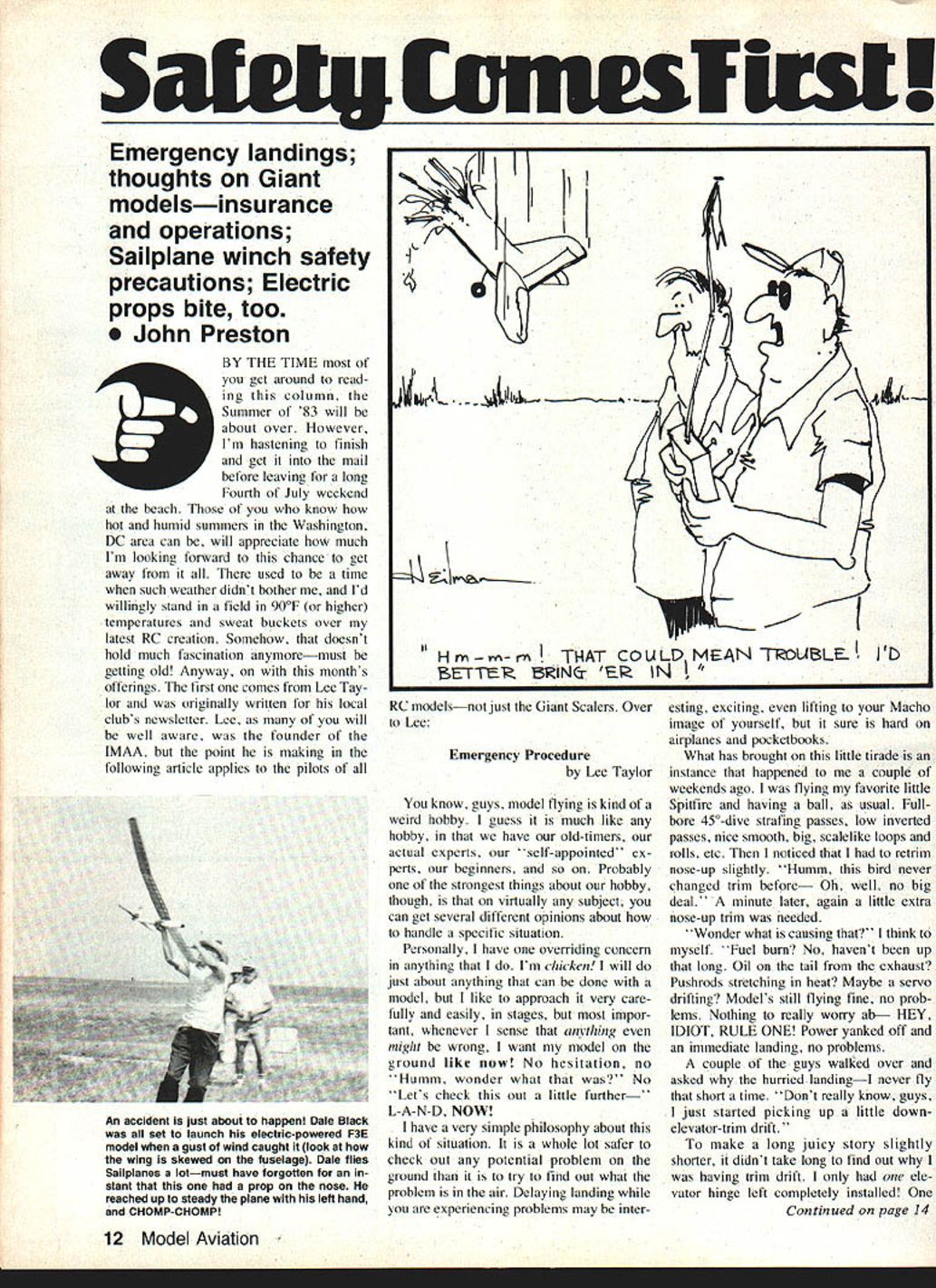
What has brought on this little tirade is an instance that happened to me a couple of weekends ago. I was flying my favorite little Spitfire and having a ball, as usual. Full-bore 45°-dive strafing passes, low inverted passes, nice smooth, big, scale-like loops and rolls, etc. Then I noticed that I had to retrim nose-up slightly. "Hmm, this bird never changed trim before—Oh, well, no big deal." A minute later, again a little extra nose-up trim was needed.
"Wonder what is causing that?" I think to myself. "Fuel burn? No, haven't been up that long. Oil on the tail from the exhaust? Pushrods stretching in heat? Maybe a servo drifting? Model's still flying fine, no problems. Nothing to really worry about—HEY, IDIOT, RULE ONE! Power yanked off and an immediate landing, no problems."
A couple of the guys walked over and asked why I had hurried landing—I never fly that short a time. "Don't really know, guys, I just started picking up a little down-elevator-trim drift."
To make a long juicy story slightly shorter, it didn't take long to find out why I was having trim drift. I only had one elevator hinge left completely installed! One had pulled completely out, the next one had lost its hinge pin, the third one was loose, and only the far outboard hinge was still intact. Thirty seconds longer and I probably wouldn't have had a plane. Cause? I probably picked up a little elevator flutter in one of those terminal, full-power dives. Didn't see it if there was, though, just noticed a little trim change is all.
Second story. Jack Strickland was up demonstrating his new Contempo Cap 21 to us all, and letting us fly it. I was flying it. (I had never landed it, while next to me was Roger Grotheer, who had done so several times), when I noticed a little sloppiness developing in the controls. I threw the transmitter at Roger, and screamed, "Land NOW! The battery's going dead!" Roger yanked off power and spun it around, lost control three ft. high in the flare, got it back just in time to straighten out for bounce-down, and got down safely. The plane rolled to a stop close by, and by the time we walked over to it, not one control would move!
Third story. A Giant Scale fly-in. A Nossen Cessna 310 is being flown for its owner by one of the more noted fliers. One engine failed. "No problem, guys, I can handle it!" "I'll fly this baby, hang in here buddy!" The plane staggered around the field three times, low altitude, plenty of room to land in virtually every direction, but Hero Pilot wasn't going to do anything but fly this bird and land it and his feet to the cheers of the crowd. Instead, the poor plane finally gave up, snap rolled, and disintegrated into a pile of splinters.
Fourth story. At the local field, a test pilot is flying a new plane for a beginner Scale builder. The plane was a Cub. Midway through the flight, the wing strut came loose, was seen dangling. "Hey, Jim, don't you know how to put on wing struts?" shouts our intrepid test pilot. "No problem, though, just a little extra dihedral, the wing tubes are holding fine," he shouts with a little laugh. Two minutes later the wing folded in level flight.
The fifth and final story concerns Jim Folline's magnificent Giant Scale PT-19. Myself flying it. Seven minutes into the flight, I attempted a loop, and couldn't get enough up elevator to pull on over. "Battery!" I screamed to myself. Yank off power and try to get down instantly. Too high and too fast for a safe downwind landing. Up to half power and try to make a pattern onto upwind for a normal landing. Halfway down the downwind leg, I lost motor control with engine at half power. "Make a power-off landing—get down!" Roll onto base: drive for the runway, roll onto final, speed pretty high. "She doesn't want to come out of the turn onto final!" Regain momentary aileron long enough to get level—"We might make it!" Halfway down the glide path at half power, the battery died completely. The plane rooted over and hit almost vertically. I needed another fifteen seconds...
My point, guys, is this. Very seldom will a plane fail catastrophically without at least some warning. That first little bobble, glitch, or failure that you notice is a WARNING. If you pay attention to that warning, as I did with the battery in Strickland's airplane the one time, and the slight trim change in my Spitfire the second time, and LAND IMMEDIATELY to check out your problem, you might have a plane to fly next weekend. If you try to macho it out, or ignore it, or even delay just a little bit, you are tightening the noose around your own neck. That first little bobble, glitch, failure is the click of the hammer on the gun being pulled back. DUCK! There aren't too many people who are fast enough to duck when they hear the click of the trigger being pulled. Many times, those who wait for that second click are DEAD DUCKS.
In the letter that accompanied this article, Lee included some comments on the weight limit for Giant Scale models. Over to Lee again:
"As the founder of IMAA, and the owner and pilot of three planes over the 55-lb. AMA weight limit, I can state very strongly that the vast majority of Giant Scale modelers strongly support the AMA standards for size as they now stand. The AMA standards are extremely fair, and very deeply appreciated by those of us heavily involved in Giant Scale. I think that the AMA leadership has kind of stuck their necks out to support the Giant Scale activity, especially since the movement, from the start, has avoided AMA affiliation (not from anti-AMA sentiment, but just so that we could avoid the political hassles). Those of us that do occasionally fly planes larger than 55 lb. do, and should, carry our own private insurance for them. There is no way that standard modeling should have to stick their necks out and accept responsibility for these exceptionally oversize, and extremely rare, models. If a person wants to build models in this size, and fly them, then he should be responsible enough to get primary insurance for them. If he isn't that responsible, then he has no business being in our hobby to begin with."
Lee's thoughts about builders of models weighing over 55 lb. carrying their own insurance may well provoke some correspondence, but they make sense to me. Although I haven't investigated the cost of individual insurance for heavy models, I would venture to say that it would be but a small portion of the total cost of such an undertaking. Meanwhile, the issue of whether to increase the AMA weight limit for models remains unresolved and continues to draw correspondence. A recent letter to AMA Executive Director John Worth contained some interesting recommendations and has been forwarded to the members of the AMA Safety Committee for their consideration. At the risk of filling my mailbox with letters from irate aficionados of big models, the recommendations can be paraphrased as follows:
- For models in excess of 20 lb. gross weight
- a) Must have two separate RC guidance systems each of which, in the event of failure of one, must be capable of controlling all major flight control surfaces and the powerplant (if so provided) at no less than 50% efficiency.
- b) Have an additional device to arrest the powerplant via each of the two RC systems.
- c) Before being flown at AMA-sanctioned events or activities, must have been flown in an isolated region away from public or populated areas for a minimum of 10 hours, which included at least 20 takeoffs and landings to be witnessed by two other AMA members.
- d) The two witnesses must be present whenever the model is flown at AMA-sanctioned events or activities.
- e) The RC systems which control the flight controls and powerplant and their electrical supply sources must be replaced after a 12-month period.
- For models in excess of 40 lb. gross weight
- a) Must be flown according to all conditions stated in items 1. a) through 1. e).
- b) Must undergo the same step-by-step inspection during construction that is required for man-carrying homebuilt aircraft and be flight-tested for airworthiness by an experienced person who has had no less than 500 hours of piloting (of models) experience during the past two years and who also holds a valid FAA pilot's license for full-scale aircraft.
Perhaps these recommendations appear to be extreme measures, but bear in mind that they do not contain a recommended model weight limit. Which is better? A reasonable weight limit, or some stringent rules to cater for the minority who seem to constantly strive to be the builder and flier of the world's biggest model airplane? I don't know the weight of the 1/2-scale Pitts S-1S that was displayed at Toledo this year, but its 18-hp Limbach engine that swings a 36-12 prop puts it into a different category from the models that you expect to see flown from your local club's flying field. Perhaps the race to be "the biggest on the block" will only stop when the Federal Government (FAA) notices such flying machines that we still call "models." Are we willing to let them intercede in settling the issue of maximum model weight and safe operating procedures? I'd rather not have this happen. How about you?
Moving right along, we haven't mentioned sailplanes in a while. It seems like the last time motorless models were the subject of this column, it was in regard to their being flown over houses and people somewhere on the West Coast, and it was our District X VP, Jim Scarborough, who sent me some newspaper clippings that told the tale. Another communication from Jim enclosed a page from the newsletter of the Santa Clarita Soaring Association (editors: Hank Schorr and Ron Lindgren), on which there was an article on winch safety by Bob Owens. If you are a sailplane enthusiast, take heed from the following.
Sailplane winch safety
by Bob Owens (Santa Clarita Soaring Association newsletter)
"Recently, one of our club members suffered significant injury to his hand from a winch line. He was attempting to untangle a backlash on one of the winches at a club contest. A spectator strolled over to observe and inadvertently stepped on the winch's pedal switch. Suddenly, the fellow working on the line had his hand entangled in the line as the winch started up at the full 12 volts. The motor stalled out when his hand jammed into the reel. Blood was spattered as three fingers were cut and badly bruised. One finger was diagnosed as broken — it wouldn't move. The accident was over almost before it began, except for the injured hand. Let's take a closer look at this accident to determine how a repeat can be prevented in the future.
- The winch's power should have been switched off or its battery disconnected before attempting to untangle the line.
- The pedal switch happened to be a small, black three-inch square unit and was almost invisible in the unmowed lawn. (No wonder the spectator didn't see it!) These pedals should be mounted to a larger base and painted a bright color to make them more conspicuous.
- Spectator control has been very lax at our flying sites. Safety is everyone's job. Spectators should be kept away from the flight line and also away from the winchline turnaround. I recommend that the member closest to an offender kindly explain the potential danger from the winches and ask him to stand back away from the flightline.
Although not involved in this accident, there are also hazards when pulling the winch lines. Keep clear of all lines while walking downfield and returning. No pilot should launch until all retrievers are clear of the lines and are aware that the model is about to be launched. This will preclude the retriever from inadvertently walking into a moving line.
Not so obvious is the potential danger to a retriever while he is pulling in a line if anyone steps on the pedal switch. It is natural to walk in with the winch line and parachute draped over the shoulder. Just imagine the line cutting into your shoulder, then being slapped in the face and eyes by the parachute and ring. Always hold the line in such a manner that if the winch starts up, the line and chute will not drag across any part of your body.
One accident is too many. Let's make those pedal switches more obvious, everyone exercise extreme care around the winches, and keep spectators out of danger."
I don't think that I need to add anything to Bob's recommendations regarding safety around winches other than to say that despite their majesty and silence, sailplanes can be hazardous, too.
Electric props bite, too
One last item to leave you with also concerns sailplanes (sort of) and came in the form of a short note and a photograph from Dale Willoughby, whom many of you will know has a vast collection of documentation photographs for scale modelers available from Scale Model Research, Orange, CA. As can be seen from the accompanying photograph, the subject of Dale's story is an electric-powered, sailplane-like model which was being launched at the recent U.S./International F3E Challenge competition.
The photo was taken at the moment that a wind gust caused the model to twist in launcher Dale Black's hand. Dale, a member of the Harbor Soaring Society and long-time RC sailplane flier, momentarily forgot that the model had a whirling prop on its nose, and the quick grab to straighten the twisting model resulted in some nasty cuts to his left hand. Moral: don't grab the business end of an F3E!
Have a safe month.
John Preston, 7012 Elvira Ct., Falls Church, VA 22042.
Transcribed from original scans by AI. Minor OCR errors may remain.

