
Safety Comes First!
- John Preston
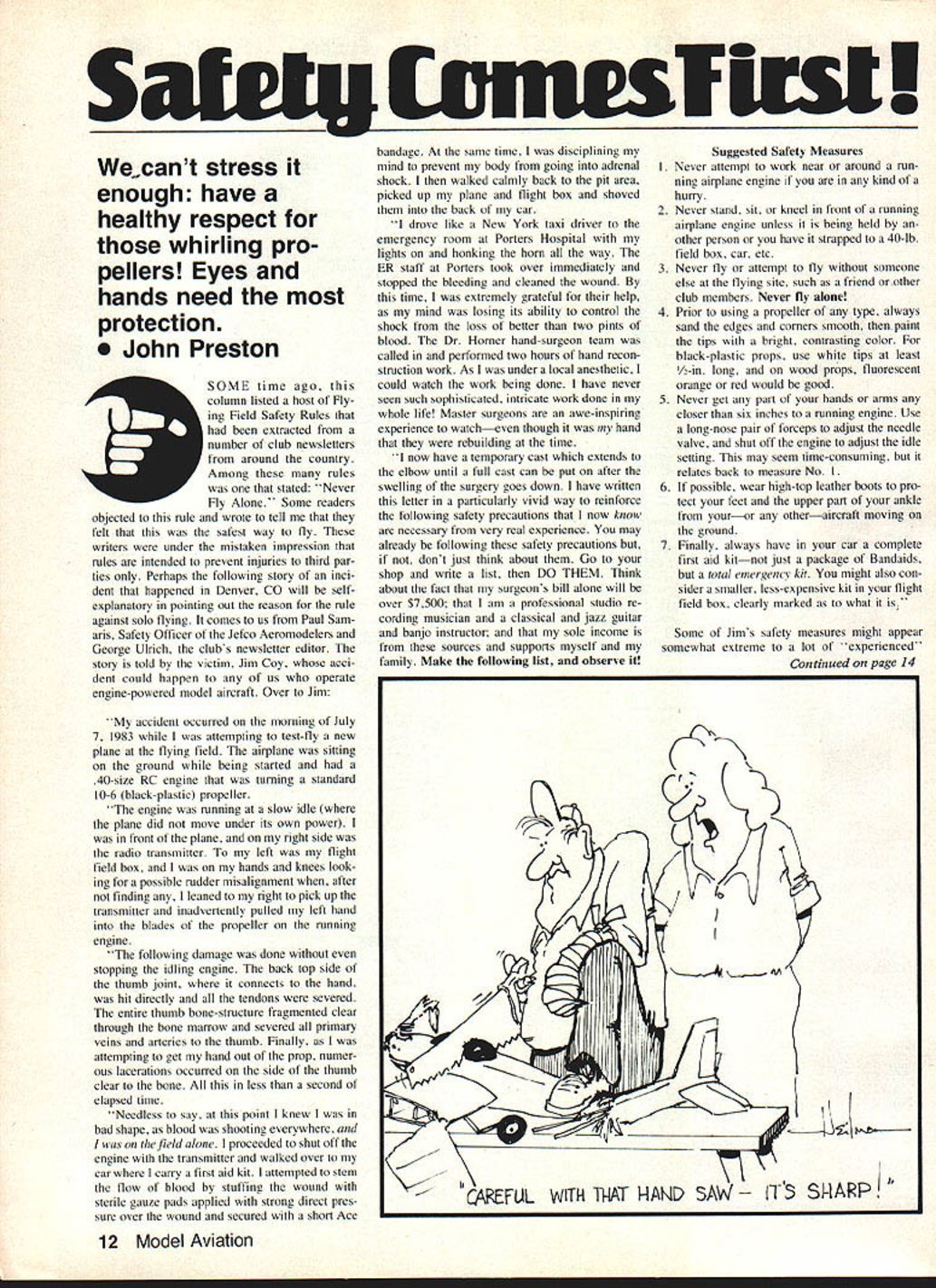
Some time ago this column listed a host of Flying Field Safety Rules that had been extracted from a number of club newsletters around the country. Among these many rules was one that stated: "Never fly alone." Some readers objected to this rule and wrote to tell me they felt flying alone was the safest way to fly. These writers were under the mistaken impression that rules are intended to prevent injuries to third parties only.
Perhaps the following story of an incident that happened in Denver, CO will be self-explanatory in pointing out the reason for the rule against solo flying. It comes to us from Paul Samaris, Safety Officer of the Jefco Aeromodellers, and George Ulrich, the club's newsletter editor. The story is told by the victim, Jim Coy, whose accident could happen to any of us who operate engine-powered model aircraft.
Accident account — Jim Coy
My accident occurred on the morning of July 7, 1983 while I was attempting to test-fly a new plane at the flying field. The airplane was sitting on the ground while being started and had a .40-size RC engine that was turning a standard 10-6 (black-plastic) propeller.
The engine was running at a slow idle (where the plane did not move under its own power). I was in front of the plane; on my right side was the radio transmitter. To my left was my flight field box, and I was on my hands and knees looking for a possible rudder misalignment when, after not finding any, I leaned to my right to pick up the transmitter and inadvertently pulled my left hand into the blades of the propeller on the running engine.
The following damage was done without even stopping the idling engine. The back top side of the thumb joint, where it connects to the hand, was hit directly and all the tendons were severed. The entire thumb bone structure fragmented clear through the bone marrow and severed all primary veins and arteries to the thumb. Finally, as I was attempting to get my hand out of the prop, numerous lacerations occurred on the side of the thumb clear to the bone. All this in less than a second of elapsed time.
Needless to say, at this point I knew I was in bad shape, as blood was shooting everywhere, and I was on the field alone. I proceeded to shut off the engine with the transmitter and walked over to my car where I carry a first aid kit. I attempted to stem the flow of blood by stuffing the wound with sterile gauze pads and applied strong direct pressure over the wound and secured it with a short Ace bandage. At the same time I was disciplining my mind to prevent my body from going into adrenal shock. I then walked calmly back to the pit area, picked up my plane and flight box and shoved them into the back of my car.
I drove like a New York taxi driver to the emergency room at Porters Hospital with my lights on and honking the horn all the way. The ER staff at Porters took over immediately and stopped the bleeding and cleaned the wound. By this time I was extremely grateful for their help, as my mind was losing its ability to control the shock from the loss of better than two pints of blood. The Dr. Horner hand-surgeon team was called in and performed two hours of hand reconstruction work. As I was under a local anesthetic, I could watch the work being done. I have never seen such sophisticated, intricate work done in my whole life! Master surgeons are an awe-inspiring experience to watch—even though it was my hand that they were rebuilding at the time.
I now have a temporary cast which extends to the elbow until a full cast can be put on after the swelling from the surgery goes down. I have written this letter in a particularly vivid way to reinforce the following safety precautions that I now know are necessary from very real experience. You may already be following these safety precautions but, if not, don't just think about them. Go to your shop and write a list, then DO THEM. Think about the fact that my surgeon's bill alone will be over $7,500; that I am a professional studio recording musician and a classical and jazz guitar and banjo instructor; and that my sole income is from these sources and supports myself and my family. Make the following list, and observe it.
Suggested Safety Measures
- Never attempt to work near or around a running airplane engine if you are in any kind of a hurry.
- Never stand, sit, or kneel in front of a running airplane engine unless it is being held by another person or you have it strapped to a 40-lb. field box, car, etc.
- Never fly or attempt to fly without someone else at the flying site, such as a friend or other club members. Never fly alone!
- Prior to using a propeller of any type, always sand the edges and corners smooth, then paint the tips with a bright, contrasting color. For black-plastic props, use white tips at least 1/2 inch long; on wood props, fluorescent orange or red would be good.
- Never get any part of your hands or arms any closer than six inches to a running engine. Use a long-nose pair of forceps to adjust the needle valve, and shut off the engine to adjust the idle setting. This may seem time-consuming, but it relates back to measure No. 1.
- If possible, wear high-top leather boots to protect your feet and the upper part of your ankle from your — or any other — aircraft moving on the ground.
- Always have in your car a complete first aid kit — not just a package of Band-Aids, but a total emergency kit. You might also consider a smaller, less-expensive kit in your flight field box, clearly marked as to what it is.
Some of Jim's safety measures might appear somewhat extreme to a lot of "experienced" modelers. However, back in the August 1982 issue of MA, this column ran a photograph of an Ugly Stik that had a circular saw blade mounted on the engine in place of a prop. Although a stationary prop doesn't look like a cutting tool, when turning at several thousand revolutions per minute it can sure behave like one.
I recently received a copy of a table from AMA HQ that listed 21 bodily-injury insurance claims involving self-injury that occurred over the period October 1982 to May 1983. Eighteen of these claims involved bodily contact with a rotating prop. As you might guess, most of these claims involved an injury to the hand, but less obvious is the fact that the injured person was most often performing a routine adjustment to the engine when the accident occurred. Since the whole purpose of this column is to publish information that will help modelers reduce injuries associated with model aircraft, I am very concerned about these propeller-injury statistics. Is there anything that can be done to reduce their frequency and/or severity? I like to think the answer is "Yes."
Jim Coy listed seven safety measures that he believes will minimize the chances for the occurrence of an accident of the type he sustained. However, I think there may be some other worthwhile tips that involve the starting and adjustment of model engines equipped with whirling propellers.
For example, how do you start your engine? Do you routinely use a glove, chicken stick, or electric starter? Any of these should be safer than using your bare fingers to flip the prop and start the engine, but it's debatable whether such aids to starting will help much in reducing injuries to fingers and hands. From the narratives of the incidents that resulted in claims on the AMA's insurance, it appears that the major problems occur after the motor is running and its owner is making some type of adjustment. I think most people would agree that it is not very practical to urge modelers to wear a leather glove when attempting to adjust the fuel mixture on a running engine.
It is unfortunate that the majority of our engines have a front-mounted carburetor which locates the mixture-adjusting screws just fractions of an inch from the propeller. In older days there were a number of engines with front-mounted carburetors that had a flexible joint in the needle valve so that mixture adjustments could be performed with relative safety. Perhaps engine manufacturers should take note and return to this practice.
Another problem that appears to result in finger lacerations due to contact with the prop is a poorly designed glow plug clip. A good clip should not come off or move towards the prop as soon as the engine starts. Reaching through the prop arc to "save" a glow plug clip from contacting a running propeller has resulted in a number of modelers taking a trip to the emergency room to have their lacerated fingers repaired. Glow plug clips that lock in place may be safer than the clothespin type.
Finally, it appears that the type of propeller you use can materially influence the severity of an injury sustained due to feeding your fingers through its arc. The black-plastic props appear to be frequently involved in incidents which result in trips to the hospital. In addition to their invisibility when running, their additional strength as compared to a wooden prop may be responsible for their lethality. This doesn't mean that contact with a wood prop will not result in an injury! It just means that those who use a black-plastic prop (for whatever reason) should exercise even more care when working with a running engine.
Eye protection
Protect your eyes, too. While lacerated fingers are to be avoided, an eye injury is generally much more serious. The Safety column in the July 1983 issue described an incident in which a modeler's nose was the target for a loose prop. This incident was noted by Stephen Risk, a modeler who is also an eye doctor, who wrote to point out the risk of blindness that could be the result of a loose prop or a shed prop blade. A method to minimize this risk was suggested by Stephen as follows:
Most fliers wear either drugstore sunglasses or prescription eyewear. Those wearing non-prescription sunglasses have little or no more protection from a runaway prop than fliers who wear no glasses at all. Non-prescription eyewear is not required by law to meet ANSI (American National Standards Institute) standards for impact resistance. In fact, most drugstore sunglasses shatter very easily, throwing fragments of glass into the eye. Therefore, I strongly suggest that fliers avoid wearing non-prescription sunglasses. At the very least, they should wear plastic shades.
The maximum eye protection available, in spectacle form, is a pair of industrial-quality specs. However, industrial spectacles are always heavy, usually ugly, and always expensive. The most sensible alternative is to wear a pair of spectacles made with the strongest available lens material, without requiring industrial lens thickness or frame strength. The material to which I refer is polycarbonate plastic, made by the Gentex Corporation. Polycarbonate lenses are used in place of the more common CR39 plastic lens material or glass at only a slight additional cost. However, the impact resistance of an equal-thickness polycarbonate lens is much greater than the impact resistance of either CR39 or tempered crown glass. When polycarbonate lenses are mounted in a frame designed for sports, the wearer can enjoy an almost impervious pair of lightweight, attractive, and relatively inexpensive spectacles. Without resorting to industrial strength standards, the flier cannot wear better protection—wearing spectacles only—than the combination of a sport frame with polycarbonate lenses.
In all fairness to Coburn Optical Industries, Inc., I must point out that a new lens has come on the market which is a lamination of glass and plastic and offers greater impact resistance than CR39 plastic or glass alone. In addition, the Coburn lens, called "C-LITE," is available in PhotoGray Extra. However, the C-Lite lens is expensive, and availability may be limited.
To wind up this month's Safety column, we have another tip on buying sunglasses. This one comes from David Hipperson, who resides in Victoria Park, Western Australia. David suggests that you check with your local welding supply store (as he did). In addition to having safety lenses, they also had side protection. In Australia such glasses cost about $15, which David states is about half the price of normal plastic glasses.
Have a safe month.
John Preston 7012 Elvira Ct., Falls Church, VA 22042.
Transcribed from original scans by AI. Minor OCR errors may remain.

