
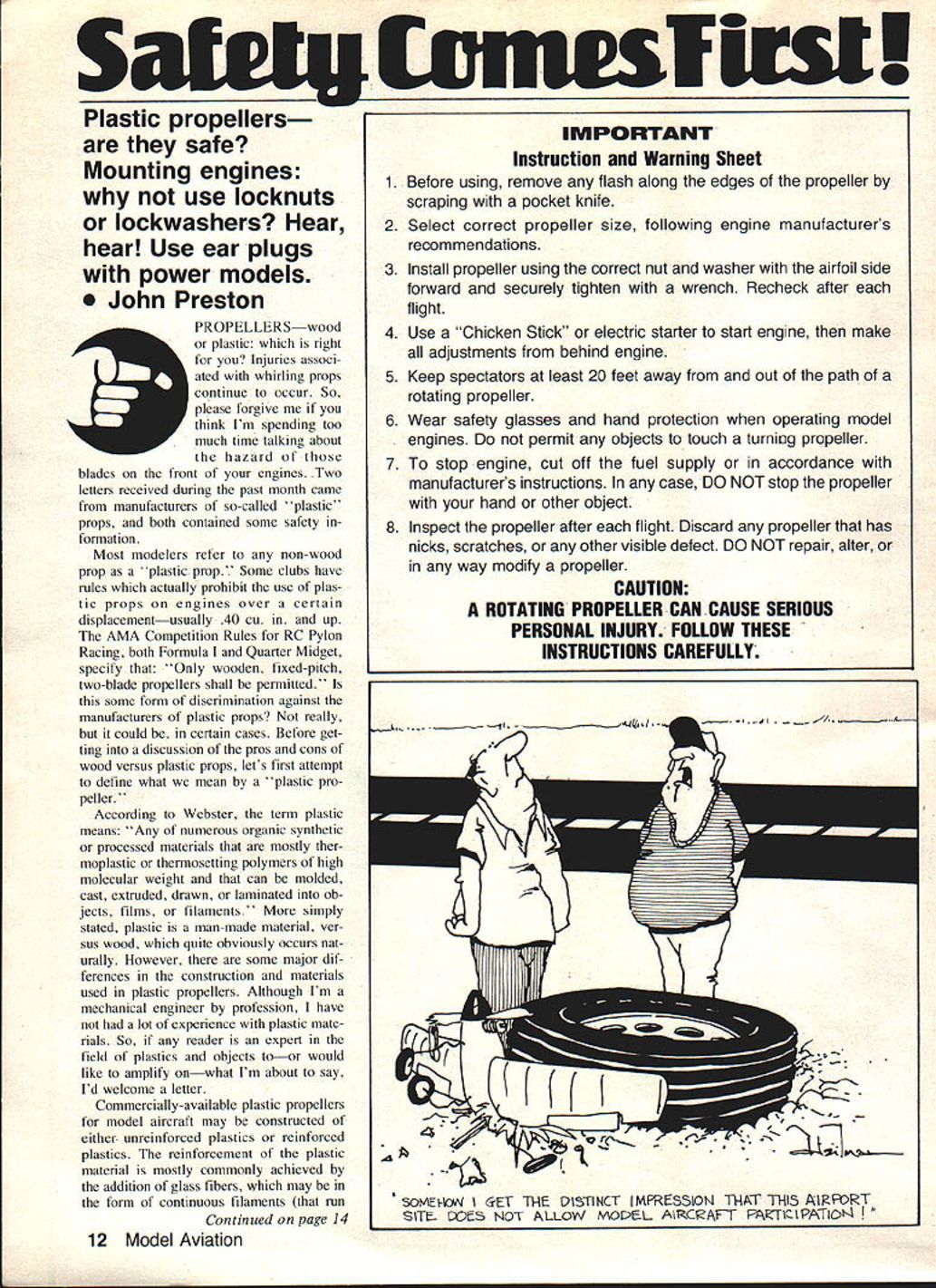


Safety Comes First!
Plastic propellers—are they safe? Mounting engines: why not use locknuts or lockwashers? Hear, hear! Use ear plugs with power models.
- John Preston
Propellers — Wood or Plastic: Which Is Right for You?
Injuries associated with whirling props continue to occur. Please forgive me if I spend a lot of time discussing the hazard of those blades on the front of your engines. Two letters received during the past month came from manufacturers of so-called "plastic" props, and both contained some safety information.
Most modelers refer to any non-wood prop as a "plastic prop." Some clubs have rules that prohibit the use of plastic props on engines over a certain displacement—usually .40 cu. in. and up. The AMA Competition Rules for RC Pylon Racing, both Formula I and Quarter Midget, specify that: "Only wooden, fixed-pitch, two-blade propellers shall be permitted." Is this discrimination against manufacturers of plastic props? Not really, but it could be in certain cases.
Before comparing wood versus plastic props, let's define what we mean by a "plastic propeller." According to Webster, "plastic" means: "Any of numerous organic synthetic or processed materials that are mostly thermoplastic or thermosetting polymers of high molecular weight and that can be molded, cast, extruded, drawn, or laminated into objects, films, or filaments." More simply, plastic is man-made, whereas wood occurs naturally. There are major differences in construction and materials used in plastic propellers. Although I'm a mechanical engineer by profession, I welcome letters from readers who are plastics experts and wish to amplify or correct what follows.
Types of Plastic Propellers
Commercially available plastic propellers for model aircraft may be constructed of either unreinforced plastics or reinforced plastics. Reinforcement is most commonly achieved by adding glass fibers, either as continuous filaments (running tip-to-tip) or as chopped fibers randomly dispersed within the plastic. Some custom-produced props are reinforced with tip-to-tip filaments of carbon fiber, a material much stronger and stiffer than glass fiber.
The most commonly seen plastic props at flying fields are the black ones fabricated from glass-filled nylon. These use chopped glass fibers to strengthen the nylon. While the glass fibers add strength, they should not be regarded as indestructible. Modern, high-revving engines in the .40–.60 cu. in. range may be safer without a glass-filled nylon prop. Blade separations can occur, which is why manufacturers (and I) tell you to avoid standing in the path of a rotating prop.
Resistance to damage caused by contact with the ground during a bad landing—afforded by the glass reinforcement—may be a factor that leads to blade separation at a later date. Similar abuse to a wooden prop generally causes breakage, which results in replacement of the propeller.
Less common are reinforced plastic props in which the reinforcing fibers run tip-to-tip. Continuous fibers give the propeller high resistance to blade separation, much the same as the grain in a wood propeller. In theory, production control over continuous-filament reinforced plastic props should make them less susceptible to blade separation on a high-revving engine. Tests would be needed to prove this theory. Currently, I know of one domestic source for continuous-filament reinforced plastic props: The Prop Shop of Broomfield, CO. Their props are manufactured from epoxy resin reinforced with fiberglass filaments and are sold in various sizes for tractor or pusher installations and in a few three-blade sizes. If ultra-high-revving engines are your preference and you've experienced blade separation with wooden props, you might consider such a propeller.
Inspection and Handling
While serious accidents can occur when blades separate from a running propeller, the most frequent incidents reported are the result of modelers feeding their fingers through the arc of a turning propeller. In such cases, the stronger the prop, the more likelihood there is for serious injury. No matter what type of prop you use, keep your fingers out of its arc!
After any ground contact, no matter how slight, always perform a close inspection for damage. Props are more expensive than they were 10 years ago, but they are still cheap compared to a trip to the hospital emergency room!
Fred Jamieson of Windsor Propeller Company (Master Airscrew) sent information noting that their glass-reinforced nylon props were tested for the effects of heat, age, and impact. Master Airscrew concluded that these props are satisfactory for the intended service but recommended discarding any prop having visible nicks, gouges, cracks, or other defects. Fred also enclosed a sheet that lists safety tips to follow regardless of prop type.
One additional tip: paint the tips a bright color. Black props tend to be less visible than wooden ones when running. Brightly colored tips can alert you to the prop's presence and reduce the chance you will feed your fingers through its arc.
An account by Don Parks, editor of the Davison Aviator News, illustrates that propeller safety is the user’s responsibility. His report, titled "Watch Those Props," describes a rapid accident in which a propeller shattered, sending fragments that injured the operator and shredded his cigar. Although the plane was in a cradle and could not run into him, something sucked into the prop may have started the sequence. The incident is a strong reminder that when something happens with a prop, it happens so fast that damage is done before one can react. Please be careful.
Engine Mounting — Locknuts and Lockwashers
I recommend using a positive locking system on engine mounting bolts. This may come from my training as an engineer; full-scale aircraft use positive locking on engine mounts. For model engine installations I favor lockwashers with toothed points (internal or external). Spring washers can also be used, but in my experience they are less likely to lock.
- For mounts with tapped holes, install the lockwashers under the bolt heads.
- For through-bolts with nuts, install the lockwashers under the nuts.
Whatever you use, periodically check the mounting bolts. Also check the muffler attachment fasteners—I've seen many mufflers disappear in flight because the attaching bolts were not checked for tightness or locking.
Preflight Transmitter Checks
A hazard exists of taking off with a transmitter mixer switch accidentally left in the wrong position. Nick Fiorentino (Edison, NJ) replaced the mixer switch with a three-position locking switch (ALCO part number MTL-106E). Most large electronics suppliers should be able to obtain it. Radio manufacturers should consider installing locking switches for mixers as standard practice. Even with a locking switch, preflight checks should include inspection of all switches and controls on the transmitter.
Noise and Hearing Protection
Consider hearing protection if you spend a lot of time around loud model aircraft engines. The E.A.R. Corporation makes ear plugs approved by various state and federal agencies, made of closed-cell polymer foam and inserted into the ear canal. I don't have a price, but if interested, write to E.A.R. Corp., 7911 Zionsville Rd., Indianapolis, IN 46268.
Have a safe month.
John Preston c/o Model Aviation 1810 Samuel Morse Dr. Reston, VA 22090
Transcribed from original scans by AI. Minor OCR errors may remain.

