
Safety Comes First!
All radio problems aren't in the airborne gear! When is the last time you cleaned your transmitter's antenna? Did you know that models have feelings, too? Plus lots of minor Think Safe — Be Safe items.
John Preston
Humor and the "Ultimate Frequency Control System"
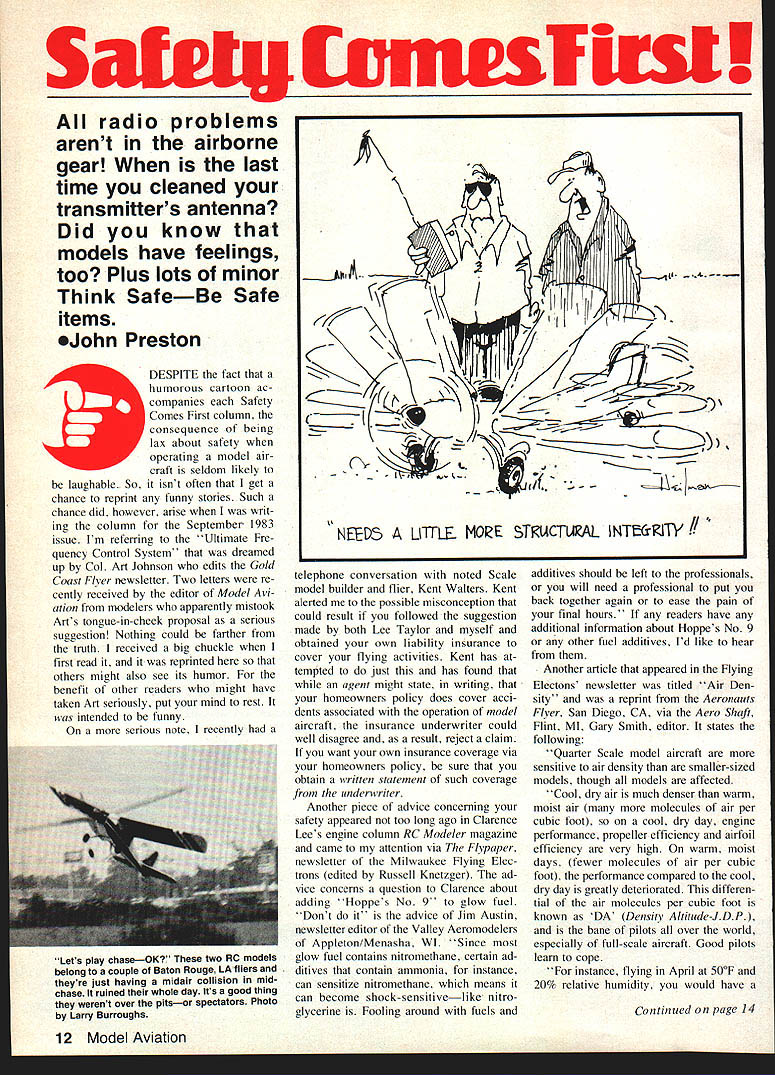
Despite the fact that a humorous cartoon accompanies each Safety Comes First column, the consequence of being lax about safety when operating a model aircraft is seldom likely to be laughable. So it isn't often that I get a chance to reprint any funny stories. Such a chance did, however, arise when I was writing the column for the September 1983 issue. I'm referring to the "Ultimate Frequency Control System" that was dreamed up by Col. Art Johnson, who edits the Gold Coast Flyer newsletter. Two letters were recently received by the editor of Model Aviation from modelers who apparently mistook Art's tongue-in-cheek proposal as a serious suggestion! Nothing could be farther from the truth. I received a big chuckle when I first read it, and it was reprinted so others might also see its humor. For the benefit of other readers who might have taken Art seriously, put your mind at rest: it was intended to be funny.
Liability insurance — check with the underwriter
On a more serious note, I recently had a telephone conversation with noted scale builder and flier Kent Walters. Kent alerted me to a possible misconception that could result if you followed the suggestion made by both Lee Taylor and myself and obtained your own liability insurance to cover your flying activities. Kent has attempted to do just this and found that while an agent might state in writing that your homeowners policy does cover accidents associated with the operation of model aircraft, the insurance underwriter could well disagree and, as a result, reject a claim. If you want your own insurance coverage via your homeowners policy, be sure you obtain a written statement of such coverage from the underwriter.
Fuel additives — Hoppe's No. 9
Another piece of advice concerning safety appeared not too long ago in Clarence Lee's engine column in R/C Modeler magazine and came to my attention via The Flypaper, newsletter of the Milwaukee Flying Electrons (edited by Russell Knetzger). The advice concerns a question to Clarence about adding "Hoppe's No. 9" to glow fuel.
"Don't do it," is the advice of Jim Austin, newsletter editor of the Valley Aeromodellers of Appleton/Menasha, WI. "Since most glow fuel contains nitromethane, certain additives that contain ammonia, for instance, can sensitize nitromethane, which means it can become shock-sensitive—like nitroglycerine is. Fooling around with fuels and additives should be left to the professionals or you will need a professional to put you back together again to ease the pain of your final hours."
If any readers have additional information about Hoppe's No. 9 or any other fuel additives, I'd like to hear from them.
Air density and model performance
Another article that appeared in the Flying Electrons' newsletter was titled "Air Density" and was a reprint from the Aeronauts Flyer, San Diego, CA, via the Aero Shaft, Flint, MI (Gary Smith, editor). It states the following:
Quarter-scale model aircraft are more sensitive to air density than are smaller-sized models, though all models are affected. Cool, dry air is much denser than warm, moist air (many more molecules of air per cubic foot), so on a cool, dry day engine performance, propeller efficiency and airfoil efficiency are very high. On warm, moist days (fewer molecules of air per cubic foot), the performance compared to the cool, dry day is greatly deteriorated. This differential in the air molecules per cubic foot is known as DA (Density Altitude). It is the bane of pilots all over the world, especially of full-scale aircraft. Good pilots learn to cope. For instance, flying in April at 50°F and 20% relative humidity would have a short ground roll and quick lift-off. In July, 90°F and 80% relative humidity, you may well need a runway available; the model would barely stagger off. When this happens, guys come back around, land, and start re-fueling the engine hoping to get power; of course they can't because the engine is not at fault. It is simply unable to get enough air molecules for best combustion. The prop is also less efficient because it doesn't have enough air molecules to get hold of.
DA is sufficiently more noticeable on quarter-scale models than on .60–.62 size and smaller. So you must compensate by anticipating poorer flying characteristics on warm, moist days.
In case some readers are questioning why an article on model flying characteristics is appearing in the safety column, the answer lies in the last sentence above. Poor flying characteristics, especially if you are not expecting them, could well lead to loss of control of your model. Since this is likely to occur during takeoff, you might well end up dumping it into the spectator area. So be forewarned, and don't try to "horse" your model off the ground on a hot and humid day. It will fly only when it is good and ready!
I do have a question regarding this article that perhaps some reader would be good enough to respond to: Why should density altitude (DA) be more of a problem for quarter-scale models? Could it be that many .60-size (and smaller) models are so overpowered that they will fly no matter how few molecules there are per cubic foot? Or does it have something to do with the Reynolds number at which the airfoil is operating?
Hearing protection and mufflers
Last month I mentioned the name of a company (E.A.R. Corporation) that manufactures ear plugs you might want to consider purchasing if you spend a lot of time "tweaking" needle valves of unmuffled model aircraft engines. The September issue of the Bomarc Flyer, newsletter of the Borger (TX) Model Airplane Club (Richard Kent, editor), had the following to say about the effects of engine noise on hearing:
"About our hearing again; one of our club members had a hearing test and the doctor said he had a 12% hearing loss from model engine noise. Something to think about, isn't it? I think it would be better if we all used mufflers on our planes, and for our own good, wear ear plugs because the mufflers do not cut out enough noise. According to Chuck Cunningham in R/C Modeler magazine, most of them are empty chambers."
I endorse the use of mufflers but agree that a number of them currently on the market have very little effect in attenuating the sound output of a model airplane engine. According to the AMA Noise Committee (chaired by Ed Izzo, District I VP), the sound produced by the engine is the easiest component to reduce when attempting to lower the overall sound output of a model. Wonder if the muffler manufacturers want to comment on that?
Safety Comes First!
CyA glues and ventilation
I've recently noted quite a number of reports in club newsletters that concern allergic reactions to the fumes generated by CyA (cyanoacrylate) glues. This column has previously mentioned CyA glues and, at the suggestion of a reader, the presence of a small fan on the workbench to disperse the fumes was recommended. An article earlier this year in the ARCS Flypaper (Jerry Fink, editor) questioned whether we will have health problems in future years caused by these glues. At the present time, I have no information that suggests CyA glues have long-term effects on a user's health. However, if you haven't yet experienced any allergic reactions to them, I suggest that you take steps to ventilate your workbench in some manner.
Transmitter antennas — two tips
We have two transmitter-antenna tips, both taken from club newsletters.
- From the Millis Model Aircraft Club newsletter, Paul Lissell is quoted: "If you crash your plane down the runway with the engine still running, don't collapse your antenna while you wait to retrieve the plane." Maybe this is obvious to some, but I've seen it happen. I will add to Paul's tip — also don't turn off the transmitter power switch! Ideally, the engine control should be set up so that the throttle trim lever can be used to kill the engine. Low throttle used with high trim gives idle, and low throttle and low trim stops the engine. Simple, but I'm constantly surprised by the number of modelers who don't take the time to set up their throttle control this way.
- Periodically clean your antenna to remove engine-exhaust gunk that makes an excellent sticking material for all the crud that lurks at the flying field. Dirt on the antenna can cause a poor (or no) connection between telescoping pieces of the antenna. Depending on which antenna section the offending connection occurs, a drastic reduction in transmitter range could result. Remember that a range check with the transmitter antenna removed won't alert you to such a problem. (Editor's note: Bob Beckman mentioned this about a year ago in his column, too. RMC.)
"Feelings" — airplanes have feelings, too
To wind up the month's safety column, we have an article by Donald J. McGovern that appeared in the Sunchasers' newsletter and was reprinted in the Smithville Dam Busters RC Club newsletter (edited by Denny Langley). The title of the article is "Feelings," and its connection to safety is obvious.
"Airplanes have feelings, too. If I lathered dope all over you until your skin shrank you'd feel itchy, too! Yet that's about the first thing we do to make an airframe uncomfortable. We shrink and stretch it just this side of splitting—and then wonder why it tries to warp."
Safety Comes First!
Pre-flight checks and structural integrity
Next, we start the engine. One cylinder banging up and down, whirling the unbalanced prop tips at a neat 500 miles per hour. If you get a chance, you might look that prop over for starting splits first, on account of your face being the one that's closest.
We start before the flight with the wings sagging the tips. Two seconds into the run the order's reversed: the wings are hauling the weight of the fuselage. Meanwhile, back in the tank, both sponges or baffles may be spongy. Lots of bubbles, any one of which can conk your engine. Do try to balance the prop the first chance you get.
Neat vertical dive over the parked cars, sharp pullout — that'll impress the coroner. Got any idea what your spar is saying at the moment? Ever uncover an old wing and find compression marks on the spar? Sometimes (about once a day), spars give up. Crack! Splat. That fast! Do think about maybe a second spar, gussets farther out, or a little less up elevator.
Before you make that crowd-thrilling low pass, do explain to the innocent spectators below that you personally pasted it all together, that the spar is still probably unfractured on this 173rd sortie, that the servos never fail, that your loose rudder hinges will most likely still hang in there, and that no interference may befall your sophisticated electronics, except for the loose antenna and the possibility of a frequency hijack.
Careful over the crowd, fellows! Those of us who have spent some pile of years on the flying field have seen some wild ones: engines flying by themselves, no longer in the airplane; wing panels floating at a thousand feet; center main panels, tip panels—five in all; engine made into 23 pieces—tough on rabbits. Stabs come off in flight, too, after the wing. Ask Olathe's runway. What's the falling object, Dick? Turned out to be the battery pack! A guy can do that. Add mufflers to the list. Also props and fuel tanks.
What we need is a little more structural integrity. Otherwise someone might get hurt. I once saw a nine-foot Custom Cavalier flying six inches beneath the wing! The loose rubber bands had stretched that much on the pullout from a loop. Think safety. Think G-forces. These models of ours are subjected to great stress in flight, and a tired spar or an undersized surface can let go when forces become too great.
Think lock nuts, seek smooth power settings, and dampen out vibration. We're not building an orange crater—we're building some sophisticated robot machinery that can cruise at 140 mph! I had one .60 engine once, of excellent manufacture. But something was wrong. It sheared almost all of the mounting bolts every time I started it up. Two extra holes were drilled, but four or more 1/8-in. bolts would snap with every bench test. A freak, but it happens. Do build with care, test run, trial fly in the boondocks, and resist the urge to do it low for the roar of the crowd—or someday maybe the roar will be the crowd coming to discuss low-level airmanship with you.
Have a safe month.
John Preston c/o Model Aviation, 1810 Samuel Morse Dr., Reston, VA 22090.
Transcribed from original scans by AI. Minor OCR errors may remain.

