

Safety Comes First!
By John Preston
Working with foam plastics as a building material poses potential health and safety hazards. From the outset, understand that "Styrofoam" is a registered trademark (not a generic name for all foamed plastics). Some readers may recall this column addressing the subject two years ago; new readers need the information, so please forgive the repetition.
Case: Jim Riggle (Gladstone, OR)
Jim Riggle described problems he encountered while cutting foam wing cores:
"I have a word of caution and also need some advice. I was very excited last week as I set out to cut my first set of 'foam' wings. I had my cutter set up in the garage, and I cut several pairs before making a 'keeper.' The problem came the next evening when I was cutting the channels for the spars with a minicutter at the dining room table. The odor of the foam was a little stronger than normal, but I didn't think too much about it. It hadn't produced any ill effects before.
About three o'clock the next morning, I awoke from a sound sleep to a spinning room and soon became very 'seasick.' I called the doctor, who told me that I should take some Dramamine to treat the symptom, and that I probably had a virus affecting my inner ear. I took the Dramamine and felt much better by late morning.
I talked with my doctor again, and he said that, based on my quick recovery, instead of a virus it was probably a toxic reaction to the fumes from the foam plastic.
I found from talking to the foam manufacturer that their product is styrene, expanded-bead foam. When it is melted, it produces phosgene gas. Phosgene is a 'nerve' gas that was used in WW II. The symptoms of phosgene poisoning are a tight chest and coughing. They don't fit my inner-ear problem, but I guess that was just the way it affected me.
I'd be most interested to know what other gases styrene may produce when melted. A fellow modeler told me the manufacturing process may use formaldehyde, which is released in the cutting process. What else is hidden in there?
Before cutting foam, I read 'Foam Wings' by J. Alexander from RCM and found no cautions about gases—nor have I seen any statements from the AMA.
I would really appreciate your comments on the subject."
Previous AMA warning (February 1982)
This column previously discussed gases released when cutting Styrofoam brand plastic foam. Styrofoam is a registered trademark of the Dow Chemical Company and is commonly sold in large sheets used for insulation or for model wing cores. A letter from Ben Brackett (Cincinnati, OH) described unpleasant symptoms after hot-wire cutting Styrofoam: dizziness, tiredness, and other flu-like effects that returned strongly after a short cutting session.
Dow's booklet explained that Styrofoam brand plastic foam is made by pushing a chemical gas into melted polystyrene. One gas associated with the process is methyl chloride. Most methyl chloride escapes before you handle the material, but some can remain locked inside; cutting, sawing or breaking the foam can release the trapped gas. Early signs of overexposure to methyl chloride include dizziness, staggering, and blurred vision. These signs can appear a day or two later, and recovery may take several days depending on exposure.
The booklet warned to avoid overexposure by operating and maintaining equipment and exhaust fans properly, practicing good housekeeping, and providing plenty of fresh air around operations. Do not work with Styrofoam brand plastic foam in small, poorly ventilated areas.
What gases may be released and recommended precautions
In response to Jim Riggle's questions: based on consultation with chemical engineers, the most likely causes of acute symptoms when cutting polystyrene-based foams are:
- Methyl chloride (associated with some manufacturing processes and sometimes trapped in foam)
- Styrene monomer vapors
- Possibly other decomposition products if temperatures are high
One engineer noted that phosgene could form during hot-wire cutting if temperatures are sufficiently high, but he felt methyl chloride or styrene monomer were more likely culprits for the kinds of symptoms described. Regardless of the exact gas, the practical bottom line is to avoid concentrations of whatever gases are released by ventilating your work area.
Safety recommendations:
- - Ensure good ventilation whenever cutting, sawing, grinding, or hot-wiring foam.
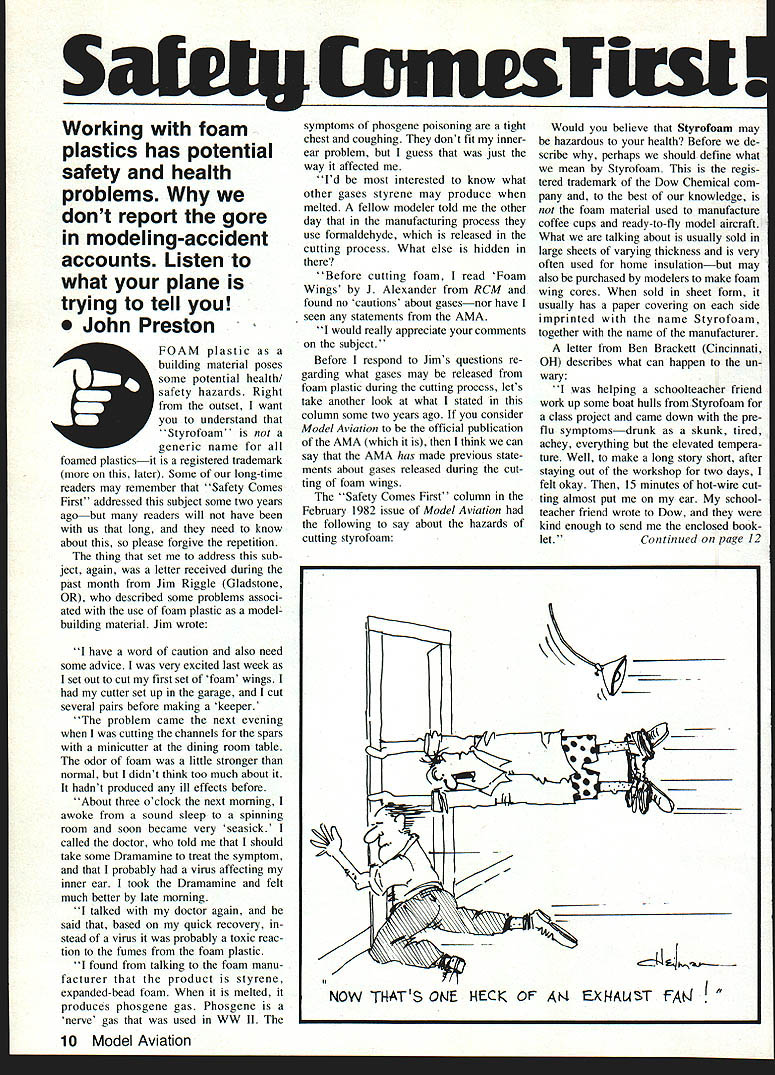
- - Use an exhaust fan and/or work outdoors when possible.
- - Keep work areas clean and remove waste and scrap promptly.
- - Do not cut foam in small, poorly ventilated rooms (e.g., at a dining room table without ventilation).
- - If you feel dizzy, nauseous, or develop respiratory symptoms after working with foam, seek fresh air and medical advice.
Urea-formaldehyde and other insulating foams
A modeler's remark that formaldehyde is released during cutting likely confuses Styrofoam with urea-formaldehyde (UF) foam. UF foam, used historically as home insulation, can give off formaldehyde after installation and may cause eye irritation, respiratory difficulties, and is listed as a carcinogen. I am not aware of formaldehyde being used during manufacture of Dow's Styrofoam brand polystyrene foam.
Note: UF foam was the subject of regulatory action in the past; a ban by the U.S. Consumer Product Safety Commission was later overturned on procedural grounds. The key point for modelers is to know what type of foam you are using and what, if any, residual gases it may emit.
Hot-wire cutting of urethane foam
Be cautious with hot-wire or other high-temperature cutting of urethane foams. Catalog warnings have advised: "Do not hot-wire urethane foam, as a hazardous gas is discharged." That gas may contain hydrogen cyanide or other toxic decomposition products. Avoid breathing these fumes.
Other hazardous modeling products
Be alert to other modeling products that can affect your health:
- Debonding agents for cured cyanoacrylate (CyA) glue: at least one product contains about 90% acetonitrile. The Merck Index warns to avoid breathing acetonitrile vapors; it may also cause skin irritation.
- Two-component polyurethane paints (e.g., Imron): there are risks associated with use; however, this column has not received documented reports of permanent damage from such paints that I can publish.
Reporting accidents and privacy
Some readers have asked for more detailed safety reporting, including insurance incident summaries and liability findings. I understand the request for explicit accounts, but much of the material I receive is short on details, and I do not have the right to publish third-party insurance claim details without permission. If someone supplies documentation of an accident and an insurance claim and grants permission to publish, I will gladly print the applicable facts. Most people prefer not to have names and personal details printed.
Closing
Work sensibly, ventilate your workspace, and take any unusual symptoms seriously. If you have specific documented incidents or safety information to share, send them in and indicate whether publication is permitted.
John Preston c/o Model Aviation 1810 Samuel Morse Dr. Reston, VA 22090
Transcribed from original scans by AI. Minor OCR errors may remain.

