
Safety Comes First!
Even sailplanes can getcha! Big RC models need heavy-duty RC system wiring. When you're running a model engine, you've got to be constantly alert. No stupidity allowed!
- John Preston
Before getting into a discussion of the contents of last month's mailbag, let me point out that my home address (which used to appear at the end of each Safety column) is no longer valid; I've moved—temporarily—to an apartment until a new home is completed sometime in the spring. Meanwhile, any mail to "Safety Comes First!" should be sent to the magazine and marked to my attention.
RC Sailplanes and Spectator Safety
Let's start this month's Safety column on the subject of RC sailplanes. Perhaps their absence of noise and generally slower flight characteristics than engine-powered RC models lead many into forgetting that being hit by a sailplane could result in an injury. Just remember that the world speed record for an RC model aircraft was established by an RC sailplane!
Two letters and a phone call during the last month were on the subject of engineless models. First, the phone call.
The caller must remain anonymous, as my notes are somewhere in a cardboard box — a victim of the recent move (and my memory for names isn't what it used to be). It seems there is a modeler in this area who competed in a number of sailplane contests during the past summer and regularly crashed his entry into areas occupied by contestants and/or spectators.
The caller asked what could be done to prevent this from happening in the future. For example, can a contestant be barred from entering a contest because of lack of flying proficiency? Good question. By whose standards do we establish an acceptable level of flying proficiency? If, after entering a contest and flying in the first round, a contestant is observed by the Contest Director (CD) to be "guilty of an infraction of good safety practice or procedure," he could be disqualified. This is stated in the AMA rule book in Section 1, Paragraph 17. However, I'm not aware of any provision that would permit a CD to exclude a contestant from a contest merely because he had crashed a model at one or more previous contests.
If models are not flown over people they are unlikely to crash into people in the event that a modeler loses control. Unfortunately, models being flown in sailplane contests will frequently pass over spectator and pit areas. It appears that this practice will only result in a disqualification if "any unsportsmanlike conduct or hazardous flying over a controlled spectator area" takes place. The rule book doesn't tell us how these are to be determined. At contests for engine-powered RC models, any flying over controlled spectator areas is defined as hazardous and will generally result in the disqualification of the flight during which it occurs. Perhaps this should also be the case at contests for RC sailplanes. Any comments from sailplane fliers will be welcomed.
In case any sailplane fliers feel that I'm being unfair in suggesting that they shouldn't fly over people, perhaps the following account (which appeared in the newsletter of the North County Clouds Sailplane Club) may illustrate what can happen:
- "One severe crash occurred in the pits. A plane experienced radio failure and dove at a very high speed straight into the ground, exploding on impact. The wing near the root struck Bob Williams on his forearm, which was resting on the arm of his chair. One foot in a different direction might have killed him. I'm not an alarmist, but this scenario must be mentioned. Flying over the pits at anything less than launch height cannot be condoned. Common sense seems to have a way of being forgotten in the heat of competition, especially when setting up a precision landing approach."
I'm not sure why the writer of the preceding tale seems to condone flying over the pits "at launch height." Is it safer to be at high altitude when your receiver batteries roll over and play dead? Not in my opinion.
A letter from Rick McCullum (Salem, IL) warns of another way you might be struck by an RC sailplane:
- Rick: "At the last contest, an incident occurred that put a scare into me. My flight was at about 5:30 and going for six minutes when I hollered 'Coming in.' I did a 15-second circle and entered my pattern. I did the downwind, base, and turned onto my final... and there—lo and behold!—were a pilot and a timer in the landing circle measuring a landing! I couldn't have had a better bead on Joe's head. Fortunately, I was able to give the plane some up and get over these people and still get 45 landing points. I did, however, utter a naughty word for which I apologize to all who were in earshot—like all of East St. Louis."
The rule book paragraph dealing with landing points in the RC sailplane event states:
- 12.5 The retrieval of a model from the landing area must be done with extreme caution and the utmost dispatch. If a measurement is required, the position of the nose of the model may be marked and the model removed. The measurement may be performed at a later, safer time.
In Rick's case, a timer who was new to the job gave no warning that there were people in the landing circle. If the sailplane pilot does not have an assistant, the timer should take on the duty of warning the pilot and/or the retrievers of other models that a conflict is developing.
WARNING: BIG MODELS REQUIRE BIG WIRES
The following warning was received from Ralph Warner of Radio Controlled Models, Inc. (RAM), makers of several safety devices for RC fliers.
Have you had unusual radio glitches as you maneuver through various stunts? Are you suspicious that your servos are sluggish when high loads are placed on them? Has your model crashed because it was unable to recover from a high-airload maneuver?
Radio and servo problems can be caused by the limited conducting ability of "standard" No. 24 and No. 26 gauge hookup wire commonly used in our radio systems. Typical high-power servos draw an amp or more at the start of their movement. Airloads from large surfaces, especially elevators, can easily double this current demand. Simultaneous servo operation places an additional load on the wires of the circuit. Distant servos automatically suffer current loss due to restriction through conducting wires. Current demand under airload can be as high as eight amps.
Our tests show the voltage available through various gauges of quality stranded hook-up wire when using a standard 4.8 volt Ni-Cd pack and a two-amp load in a servo circuit:
- Wire gauge and voltage available (4.8 V pack, 2 A load)
- No. 26: 1 ft — 4.64 V; 3 ft — 4.37 V; 6 ft — 3.84 V
- No. 24: 1 ft — 4.70 V; 3 ft — 4.50 V; 6 ft — 4.20 V
- No. 22: 1 ft — 4.73 V; 3 ft — 4.61 V; 6 ft — 4.42 V
- No. 20: 1 ft — 4.76 V; 3 ft — 4.66 V; 6 ft — 4.54 V
- No. 18: 1 ft — 4.77 V; 3 ft — 4.73 V; 6 ft — 4.65 V
Conclusion: If you expect to get sufficient current through your system so that your servos will function as designed and voltage spikes won't glitch your receiver, you must use at least No. 20 gauge wire throughout the system. This means heavy wire starting at the cells in the receiver pack, heavy-duty switch harnesses, and especially the wire going to distant servos. Don't think that a high-amp receiver pack alone will solve the problem. Only sufficiently large wire is able to conduct the current to distant locations and/or supply high demand.
If you feel that you haven't suffered from any of the described problems, don't be misled. When your model is in that critical, low-level altitude that requires full servo power, that is the time your battery and wiring circuit won't be able to deliver it.
Since I'm neither a flier of big models nor an electrical engineer, I must accept Ralph's warning as fact and pass it on for your consideration the next time you install a radio system in a big model.
Propellers and Engine Break-In: Letter from Marvin Denny
A lengthy letter was received from Marvin Denny of Wichita, KS. Some of Marvin's suggestions on procedures to prevent propeller accidents have been stated in this column previously, but it's worth repeating: rotating props are hazardous. Over to Marvin:
I have two subjects I would like to bring to your attention as serious safety hazards inherent to our hobby. Although both occurred to me in control-line activities, they are equally applicable in other fields of powered model aviation.
The first incident happened during break-in on a test bench of a glow engine of .36 size. On initial start with what I thought was a good propeller, a blade came off, either due to bad grain in the wood or because the plug leads got into the prop. It happened so fast that I don't know whether the battery clip came off and broke the prop or if the blade slung off and the resulting vibration shook the clip off. I had just started the engine and was moving from in front of it (a hazardous place) to the rear, and just at the point that I was in line with the prop arc, the accident occurred. Fortunately, I was wearing safety glasses at the time; the blade struck the lens on the left side and made a deep scratch approximately 3/8 in. long. The glass did not break and deflected the blade such that the surrounding skin was not even scratched.
The point here is that even if you are careful to avoid the front of a running engine, you can be in a more dangerous place during the transition from a dangerous place to a safe place. So, for safety's sake, always be careful and wear safety equipment — in this case, safety glasses.
Here are the results of those thoughts and the hazards Marvin lists:
- Hazard: Holding the battery clip by hand while flipping the prop.
- What if you slip or move suddenly when the engine starts? Your forearm and wrist may be in close proximity to the prop. Use a battery clip that does not require holding to stay connected.
- Hazard: Loose prop or insecure engine mount.
- Did you check prop tightness? Loose props, broken crankshafts, and engines coming out of the test mount all go forward. Don't stay in front of a running engine. Always double-check prop tightness and use an engine test stand strong enough for the engine size and firmly bolted down.
- Hazard: Transitioning from front to rear while the prop is spinning.
- Prop blades, broken blades, or items hitting the blades are thrown out to the sides with great velocity. Make the transition quickly; do not linger in line with the prop arc.
- Hazard: Invisible prop arc.
- Paint the prop tips with a contrasting visible color (bright yellow, red, or white) about 1/2 in. back from the tip so the prop arc is visible while the engine runs.
- Hazard: Debris thrown by prop blast.
- Gravel and small items can be picked up and propelled rearward with enough force to cause eye damage. Clear debris from the engine test-stand area before starting.
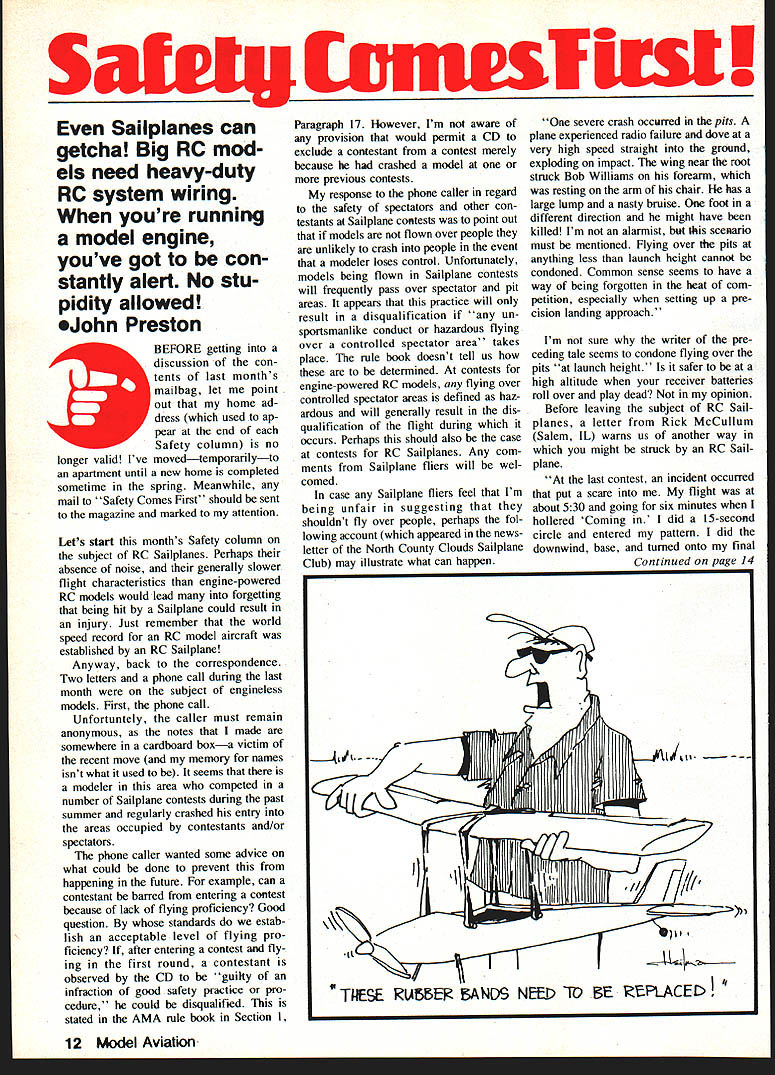
- Hazard: Adjusting needle valve on a surging engine.
- On initial break-in the engine may run erratically and surge, making it difficult to get a secure hold on the needle valve. If the needle is hard to turn, shut the engine down before making adjustments.
- Hazard: Burns after shut-down.
- The engine is often very hot after shut-down. Don't touch it immediately to see how hot it is.
- Hazard: Flipping the prop after shut-down.
- It is common to flip the prop several times after the engine quits to aid cool-down, but the engine may be hot enough to restart without the battery connected. Flip the prop with the same respect as if the engine were live.
Of the eight hazards above, only one bit me, and I was fortunate to have worn safety glasses. The two most common causes of accidents are negligence and stupidity.
P.S. A couple more items my son pointed out:
- Cut fingers when hand-cranking new engines: New engines are often tight and may seize on first starts; props have sharp trailing edges. Use only wood props during break-in and be sure blades have blunted leading and trailing edges. Blunted edges are especially necessary with plastic, nylon, or fiberglass props.
- Hearing: Ear damage is cumulative and insidious. Use mufflers, ear muffs, or ear plugs to protect your hearing.
Second accident — multi-engine hazard
The second accident happened years ago with a scale B-29 (four Enya .19 engines). I agreed to fly an exhibition and prepared the plane at the circle. Helpers: one man holding the plane by the fuselage and one man behind each wing to move the booster battery from engine to engine, and myself in front starting the engines.
All engines were running smoothly when No. 2 engine (inboard left) started to sag due to trash, cold castor, or something in the fuel. I instinctively reached around the No. 2 prop to adjust the needle — right through the No. 1 prop which was screaming full bore. I suffered extremely severe lacerations on the back of my right hand. The impact killed No. 1 and No. 2 died anyway; one helper killed Nos. 3 and 4. I completed the exhibition flight despite the injury, wrapped the hand myself, and didn't see a doctor until Monday — which was a mistake.
What caused this accident?
- I delayed getting the plane ready until the last day.
- I didn't give myself enough time on the day of the demo.
- I was too concerned with tying up the circle (preoccupied).
- I had not coordinated with my helpers on duties and timing.
- Stupidity — I made the wrong move instead of letting it die and restarting properly.
Lesson: If you are going to do something you are not used to doing regularly, prepare well in advance. Do not let the desire to finish the job cause you to hurry and forget to be careful. Coordinate with helpers so they know what to do and when. Be sure you have enough help. And if you are injured, do not self-diagnose — see a doctor if there is any doubt about the seriousness.
If hand-starting multi-engine aircraft, be constantly aware of adjacent running engines. It is best to use an electric starter on multi-engine aircraft.
Marvin included pictures of the scratched safety glasses with his letter. I couldn't find them when writing this column; those who have recently moved know how long it takes to find everything again.
Have a safe month.
John Preston c/o Model Aviation 1810 Samuel Morse Dr. Reston, VA 22090
Transcribed from original scans by AI. Minor OCR errors may remain.

