
Safety Comes First!
- John Preston
Always perform a preflight safety check before takeoff
Since I'm writing this column on New Year's Day, let's begin with a resolution for 1984. A worthwhile New Year's resolution for RC modelers came to mind after reading about an incident in a Florida club's newsletter. The club and modeler remain anonymous to save embarrassment, but similar incidents are likely not infrequent at flying sites because modelers do not always perform a Preflight Safety Check before attempting to bore holes in the sky. So, the New Year's resolution for RC modelers is simple:
Always perform a preflight safety check before takeoff.
Had this been done by a certain Florida modeler, the following account would not have appeared in the club's newsletter:
"I thought that I had made every mistake in the book at one time or another while flying RC, but I guess they are not all in the book! After checking three different radios in my old Kougar without a problem on Saturday, I reinstalled the original radio for flying on Sunday. Everything went well until I did the fastest and lowest roll ever—right on takeoff. Would you believe: the ailerons were plugged into the retract channel? At least you will never get very far into the air this way. The ailerons had to be hard-over all the way down the takeoff roll."
There was no mention of the extent of any damage, but you would much prefer to see the landing gear retract when you hit the appropriate switch rather than claim the dubious honor of performing the lowest roll in your club's history.
Preflight checklists
Back in the July 1983 issue, this column featured a Preflight Inspection Checklist that the Northern Virginia RC Club offers to members on a 4 x 6 card heat-sealed in a clear plastic cover. The card is intended to be carried in a modeler's field box for ready reference. One side contains a checklist for previously flown models; the other side is more extensive for new models that have never been flown. The NVRC checklists are available from AMA HQ (printed on 8 1/2 x 11 paper rather than the 4 x 6 card). If you are interested, call or write to Geoff Styles or Doug Pratt in AMA's PR Department and ask for the preflight checklist that will help you keep at least one New Year's resolution throughout 1984.
Preflight checklists for RC models help prevent embarrassments and crashes.
Epoxy-based paint hazards
Last month I received a phone call from our magazine editor asking whether this column had ever discussed the hazard of spraying epoxy-based paint indoors without adequate ventilation. His inquiry was prompted by a letter from the wife of a modeler who had been hospitalized for what appeared to be a heart attack that may have been precipitated by epoxy paint fumes. After searching my files, I believe the referenced article originally appeared in Model Builder magazine several years ago and more recently (May 1983) reappeared in Potomac News & Views (the newsletter of the International Association of Machinists & Aerospace Workers).
The account (originally from North Central Airlines, now Republic Airlines) described an employee who spray-painted a model glider in his heated garage. He sprayed a tack coat and stepped out. Twenty-five minutes later he stepped back in, sprayed a finish coat and stepped out. Twenty-five minutes later he stepped back in and collapsed, unconscious. His wife rushed him to the hospital where he underwent treatment for respiratory problems and a heart condition. The article warned that spraying epoxy paints indoors without adequate ventilation can be hazardous. It recommended good ventilation and, when appropriate, the use of a proper respirator.
A fuller description given by the victim: total time in the spray area during spraying was less than four minutes. He then cleaned his spray gun (no solvent specified). About one-half hour later he noticed a strong, algae-like smell. An hour-and-a-half later he experienced pains in his lower rib cage that spread throughout his chest; soon he found himself in a coronary care unit. He related the following points:
- There is no antitoxin to reverse the effects of the epoxy formula.
- If you are going to live, you live—if not, the staff watches you die.
- The resins and hardeners inflame tissues in the lungs and around the heart. The effect can mimic a coronary, but no traces may be found later.
The moral: if you are going to spray epoxy, do it outdoors or in a vented spray booth. If you dry-sand epoxy, wear a carbon-activated face mask—the dust is as dangerous as the wet spray. The effects can be cumulative and, once tolerance is exceeded, may be irreversible.
While I agree that spraying epoxy paint should be done outdoors or in a booth, I question whether the victim's symptoms were caused solely by epoxy fumes or perhaps by the solvent used to clean the spray gun. Note the short time spent spraying and the unspecified cleaning solvent, which could be highly toxic. The bottom line: if you can smell it, you are inhaling it. If the vapor is toxic, take heed—it may be hazardous to your health.
CyA (cyanoacrylate) glue warnings
Two modelers' experiences with cyanoacrylate (CyA) glue are worth passing on.
- From Davison Aviator News (Don Parks, Davison, MT), club member Ron Graham wrote:
"Do not take the cap off your Hot Stuff with your teeth. When I tried this, I somehow managed to squeeze the bottle and squirt glue all over my mouth. Thinking quickly, I held my mouth wide open so my lips wouldn't be glued together. I then wiped my mouth with a towel which was handy."
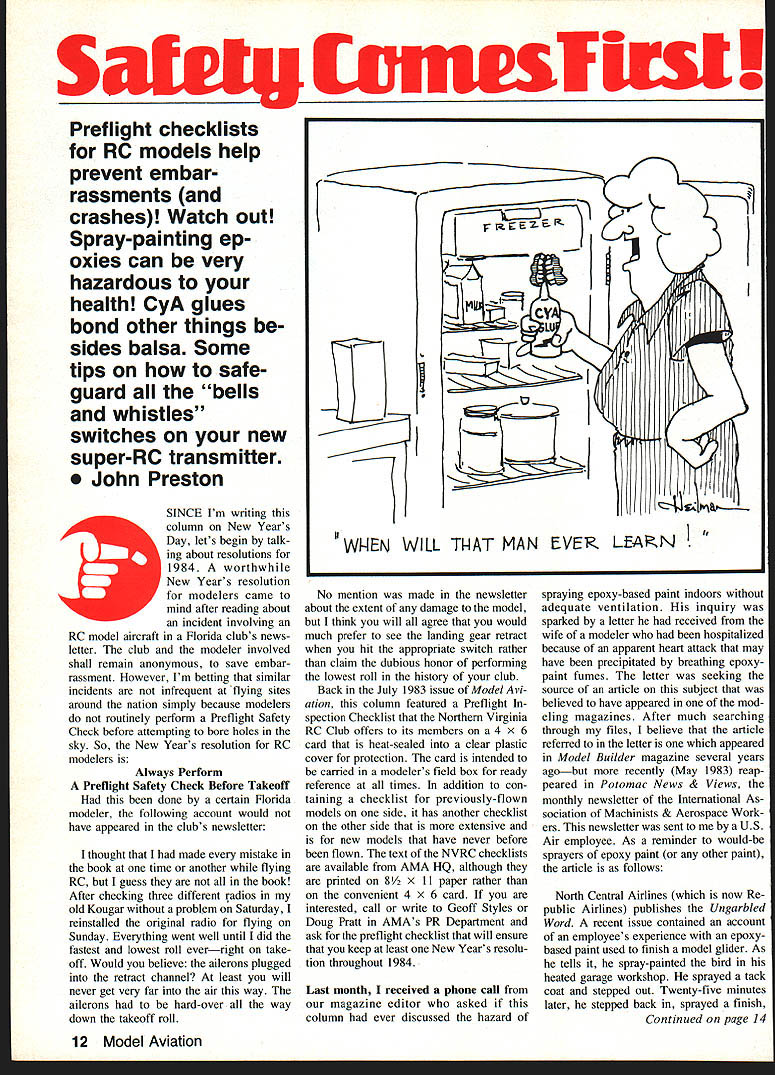
- A second caution concerns storing CyA frozen to preserve shelf life. One modeler described freezing a backup supply, then cutting the tip off a just-thawed bottle too soon. CyA shot out like being pumped and sprayed several feet. Fortunately no one was hurt, but the risk is real. Advice: do not open a formerly frozen CyA bottle until it has fully reached room temperature—leave it out overnight—and be careful to keep the tip pointed away from people.
A note on eye exposure: CyA in the eye does not typically cause blindness but can glue eyelids together and will generally require medical attention to separate lids safely. Do not confuse this with methyl ethyl ketone peroxide (MEKP), a catalyst for polyester resins; MEKP is an extremely powerful oxidizer and a single drop in the eye can cause serious damage or blindness unless flushed immediately.
Transmitter safety and modifications
For modelers who received a fancy new radio with dual-rate and mixer options, here are suggestions from Jef Raskin (reprinted with permission) to reduce error-prone controls on modern transmitters. As a designer of human interfaces and an experienced RC pilot, Raskin implemented modifications that solved many practical problems:
- All servo direction-reversing switches, servo-throw, and trim-authority controls are under a hinged flap. These are never used in flight. (Putting them inside the case is excessive; you might forget to adjust something like throttle trim.)
- All external switches, such as dual-rate and exotic mixer options, use locking-lever switches. These have arms that must be pulled out before they can be moved. Accidental bumps cannot change them, yet they are easy to change deliberately.
- Controls are logically laid out. For example, rudder trim on a single-stick system should be a circular knob rotated the same way as the rudder control. Many systems use a lever that looks identical to the aileron trim lever, causing confusion.
- Auxiliary channels, such as flaps and spoilers, are on large slide-pots rather than tiny trim levers. These slide two inches from stop to stop and have calibrated scales underneath. When I want 15° of flap, I can get 15°—not guess a tiny lever position.
- For a European-style (neck-strap) system, I made a strap from two leather camera straps; it is comfortable and holds the transmitter at all four corners quite rigidly. I cannot accidentally drop the transmitter, and a firm strap prevents loss of control if bumped.
A young flier, Brad Mortensen, suggested a throttle gate like on some prototype aircraft: a gate at the low end of the throttle lever so you must push through it to reach full throttle. To kill the engine, you would pull the throttle past the gate. This would be quick and natural; current designs often require pulling the throttle fully back and then operating the throttle trim lever—impractical in an emergency.
Locking-lever switches can be purchased to replace non-locking ones; some electronic supply houses carry them and they are often direct replacements. A few moments with a wrench and soldering iron can save many hours repairing an airframe. If you are not comfortable doing the work yourself, any competent service person should be able to handle it.
Better transmitter design is a significant part of accident prevention. I would encourage the AMA to suggest standards, for example, using hidden or locking-lever switches for mixing and servo-reversing functions.
Another letter (August 1983) from Nick Fiorentino noted that he replaced his mixer switch with a lockable one—brand Alco, model MTL-106—which should be available from most large electronic supply houses.
Lastly, remember to check all aircraft functions before taking off—this single habit will prevent more problems than most other measures.
Final notes
- Watch out: spray-painting epoxy-based paints can be very hazardous to your health.
- CyA glues bond other things besides balsa—handle with care.
- Safeguard the bells and whistles (switches) on your transmitter.
Have a safe month.
John Preston c/o Model Aviation 1810 Samuel Morse Dr. Reston, VA 22090
Transcribed from original scans by AI. Minor OCR errors may remain.

