

Safety Comes First!
History of the propeller; why you shouldn't fly either CL or RC near high‑tension power lines; safety considerations for Indoor RC; are field‑repaired models really safe to fly? Flying (or running) model engines indoors may not be a good idea. Learn about AWTH.
- John Preston
"Little Known Facts" — A Humorous History of the Propeller
This month's offering to safety‑conscious modelers begins in a humorous vein with a history of the propeller. If you believe it, you will believe anything and may even wish to purchase the bridge I have for sale. Titled "Little Known Facts," the following was extracted from Incidence, newsletter of the Charles River Radio Controllers of Winchester, MA. However, it appears the editor, R. M. Kosmala, stole the story from an AMA District VI AVP Report.
Prop is actually a slang term derived from the full Latin word — propeller, meaning "that which breaks on landing." The study of props has been going on for many years, dating back to long before the Wright Brothers. Ancient Greeks were one of the first civilized peoples to appreciate the importance of props, and it was they who discovered that birds don't use them.
Not much happened in prop development for the next thousand years, until the early 1900s when a pilot by the name of Charles C. Contact discovered that props made convenient handles for hand‑starting aircraft engines. This was a big innovation back in days before electric starters, and pilots throughout the world honored this man by saying his name every time an engine was started.
Early in the 1920s, modelers discovered another new use for props — to cut fingers. Many conservatives at that time predicted that this would be a short‑lived fad; however, finger‑cutting has not only persisted for 60 years, but has grown to such widespread popularity that just about every modeler has tried it at least once.
Finally, toward the middle of the twentieth century, man could no longer figure out any more uses for props, so scientists finally gave up and invented the jet!
I think you will all agree that the message in the above historical account of props is self‑evident. Despite the switch to jet propulsion for full‑scale aircraft, we modelers still favor the prop and actively participate in the sport of finger‑cutting. This writer is not a fan of the sport.
Accident at Callahan Field
From the same newsletter as the previous article comes the following accident report:
A serious accident occurred at Callahan Field on October 16. Fortunately, no one was injured. It appears that an aircraft experienced radio failure during takeoff and crashed into a spectator's car, making a hole right through the hood.
No mention is made of the cost of the repair. Some of you may recall an account in this column about a year ago of typical insurance claims that had been submitted to AMA for settlement. The most prevalent of those claims involved models striking automobiles. Are we parking our cars too close to the active flying area?
One school of thought says "No" to this question. Better to have the cars parked up close to the flight line where they can be used for protection when a model gets out of control and heads towards the spectators. While this philosophy does have some merit, it can be expensive to repair the "barrier." It should be struck by a model. Better to provide a chain‑link fence to protect the onlookers.
High‑Tension Power Lines and Radio Interference
Staying on the subject of out‑of‑control model aircraft, I came across the following in The Shakey Thumb, newsletter of the Statesville RC Club in North Carolina:
John Franke recapped several unexplained radio failures resulting in smashed airplanes. He determined from the local power people that the high‑tension line parallel to the runway carries up to 100,000 volts. Such high voltage creates an electromagnetic field of considerable diameter. Plan on at least 100 feet. It is ample to cause radio interference. He suggested staying well clear of the darn thing.
In a footnote to the above, the newsletter also stated: "To add to the above, Red, who heads up maintenance and installation for Crescent Electric, says temperature and humidity will affect the size and power of a magnetic field. When it's cool and damp, that sucker is gonna grow."
As a suggestion to any clubs who similarly have power lines in the vicinity of their flying fields, why not conduct some ground checks—preferably on a damp day. Have somebody carry a model to the proximity of the power lines and see how the receiver behaves when the transmitter is operated from the location normally occupied by pilots at the flying field. Are there any strange glitches that are not present when the model is carried a similar distance in a direction opposite to that of the power lines? If so, better stay away from the vicinity of the power lines when flying.
I assume that all readers would know better than to try and retrieve a model caught in high‑tension lines. Power companies are generally very responsive to calls when they involve something fouling their lines. A couple of years ago, I quoted a newspaper article about a modeler who tried to retrieve his model from a high‑voltage power line by climbing up one of the supporting poles himself. He didn't live to tell about it.
CL Models and Electrocution Hazard
It's been a while since I mentioned the hazard of flying CL (control‑line) models in the vicinity of overhead power lines. In fact, it was the column in the July 1981 issue of Model Aviation that last reported an electrocution death to a CL flier who was operating a model in the proximity of a 12,000‑volt overhead line. Remember that the model or its control lines do not have to touch the power lines to present the threat of electrocution. An arc may jump a much bigger gap than you might expect if the air is damp. Don't take a chance: stay well away from overhead power lines when flying CL models!
Weight of RC Models and Indoor RC
Two letters arrived in my mailbox during January that addressed the weight of RC models. One writer was unhappy that the March issue of Model Aviation contained photos and an account of the flight of a 204‑lb. model airplane, and the other was unhappy because RC models may be a safety hazard if they weigh "many ounces" or are flown indoors.
This latter correspondent is a noted indoor modeler, to whom a one‑ounce model may seem heavy. His letter, directed to AMA President John C. Grigg, with a copy to me, voiced some concern about the growing interest in Indoor RC events. Basically, his letter was addressed to persons who might consider "conventional" indoor events and those in which RC models will be flown which may be powered by rubber, electric, CO2, or even internal‑combustion engines.
While it is currently very difficult to find adequate indoor sites for conventional rubber models, the "careless" operation of RC indoor models could compound this problem. Although the letter's writer did not make the suggestion, it seems to me that we may be at a point in the development of RC indoor models where some basic safety rules (and/or other rules) need to be drafted. Not having participated in an Indoor RC event, I am not in a position to make any intelligent suggestions. However, if any readers who have more knowledge than I on this subject would like to drop me a line, I will see that their views reach the right people.
In regard to the letter concerning the 204‑lb. RC model, I hasten to point out that it is not covered by the AMA insurance policy. I understand that its builder has taken out a special policy to cover its flight operations. At the present time, the heaviest model that may be flown in an AMA‑sanctioned competition event is 40 lb. (Giant Scale), and for AMA insurance to cover non‑competitive flying of models, they cannot exceed 55 lb. and must be flown in accordance with the AMA Safety Code.
Field Repairs — Should They Be Done at the Field?
Another newsletter recently sent to me by AMA HQ was the Nov/Dec 1983 issue of Planetark, from the Amarillo, TX, Planesnark MAC. It contained an article titled "Think About It—Field Repairs?" The newsletter asks:
Should they be done then—or back at the shop? Minor repairs not associated with the control system or the motor‑bearing mounts can usually be done on the spot with proper field techniques and good joints. I have seen—during fun‑flys and especially at contests—repairs made on the spot and models returned to flight. However, repairs that are safety critical should be done in the shop.
I've seen brand new models brought to the flying field by inept builders that were in as bad a condition as those repaired at the field by more skillful modelers. How do you draw the line on what should and shouldn't be repaired at the field and by whom?
If you take a look at the AMA rule book, you will see that the rules for many events have a section titled "Safety and Model Requirements." In this section, there is a statement that says: "All models must pass a general safety inspection by the Event Director or his representatives before flying." In other words, at AMA‑sanctioned contests, there is someone (Event Director) who is charged with the task of ensuring that the models are airworthy. Although it isn't specifically stated in any of the rules that I looked at, this person should also reinspect any model that has been field‑repaired after having crashed. Perhaps we need to add a general safety note to the rule book that would address this omission.
Anyway, the point I'm trying to make is that sanctioned contests have a person who is responsible for the safety of the models that are being flown. Does this also apply to the operations at your club's flying field? I would venture to say that there are a significant number of clubs that have rules addressing RC frequency control, AMA membership, etc., but nothing about respecting the models for airworthiness. Any readers who hold the title of "Club Safety Officer" might think about this and consider a rules change to include model inspections if these are not already required.
Indoor Engine Emissions and Health Concerns
I recently had an inquiry referred to me by AMA HQ concerning the possible health hazard of operating a model airplane engine indoors. It seems that a group of Chicago‑area modelers, who fly RC helicopters, do not wish to "hang up" their transmitters for the winter and have found a large vehicle maintenance garage in which to pursue their activities. The garage is equipped with exhaust fans, but continuous running of the engines for long periods produced a noticeable blue haze from the exhaust emissions. The inquiry asked if there could be anything in the exhaust gases that could be hazardous.
Since I'm not a toxicologist, I consulted a co‑worker who is in this field and happens to also be a modeler. If we assume there is sufficient ventilation in the garage to dilute the exhaust, then the chances are that the concentrations of any carbon monoxide, particulates and unburned lubricant could possibly result in some symptoms of pneumoconiosis due to the oil coating the lungs. Whether this would actually happen in this particular case would be a function of the kinds and concentrations of the particulates in the air of the garage and the time of exposure. If any reader would care to comment further on the likely hazard of this indoor flying activity, I'd be glad to pass on the message.
Tip of the Month — Beware the AWTH
Since I began this column with a humorous story, it seems appropriate to end it in the same vein. The following is a Tip of the Month that appeared in a newsletter put out by a new club in Albuquerque, NM that has yet to be named. The anonymous club's president, Dick Cline, is the author of the thought‑provoking tip.
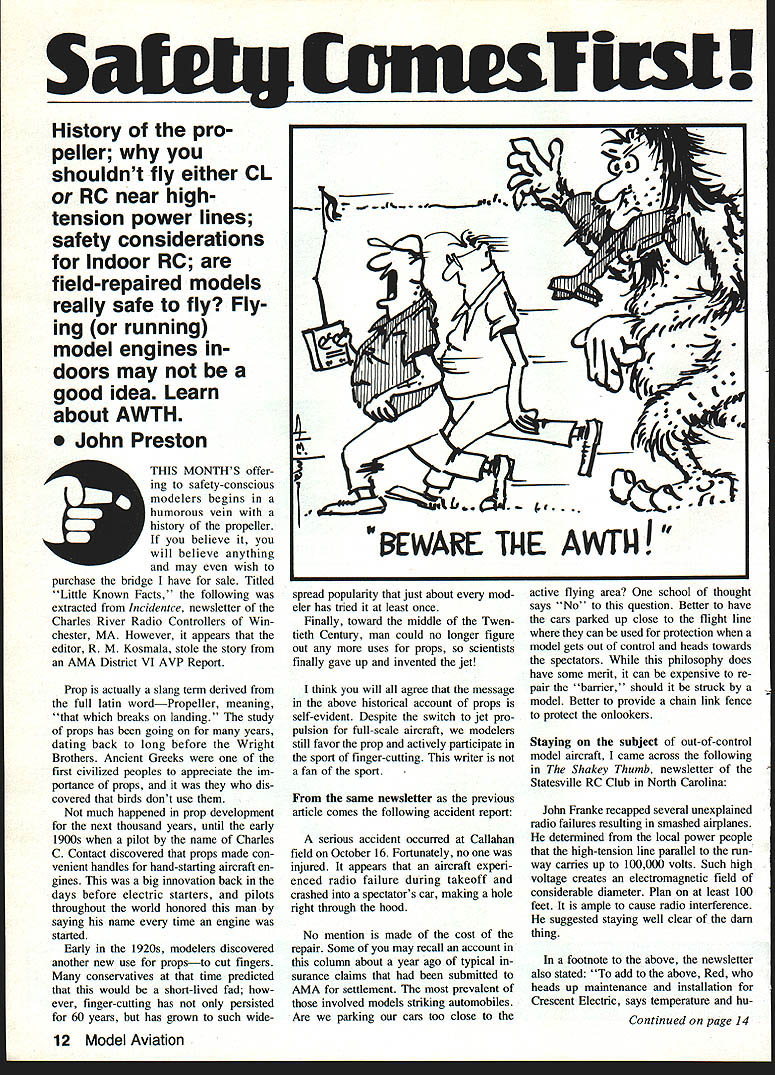
Since a lot of the attendees seemed new to RC flying, my first tip is "Beware the AWTH" — that last word is pronounced "AW" with "TH" added to it. The AWTH is what you hear when an airplane suddenly does something unexpected and you say "Aw, th..." Another way to look at it is that AWTH actually means "Accident‑Waiting‑To‑Happen." Fly safe — beware the AWTH, and your fun in the hobby should increase.
Have a safe month, and beware the AWTH!
John Preston c/o Model Aviation, 1810 Samuel Morse Dr., Reston, VA 22090.
Transcribed from original scans by AI. Minor OCR errors may remain.

