

Safety Comes First
John Preston
Ground Fault Circuit Interrupters (GFCIs)
If a home builder and a mortgage company are both telling the truth, by the time you read this column I should have moved into a new house! A recent inspection of this house triggered the subject for the first topic of discussion in this month's safety column—GFCIs. Readers who may also have moved into new homes in recent years will be familiar with what GFCIs are and what they do. However, for the benefit of others and for added safety in everybody's workshop (and perhaps the rest of the home, too), the following explanation is offered.
Ground Fault Circuit Interrupters (GFCIs) are electrical devices designed to shut off electrical current to a power tool (or other electric appliance) when a fault current to ground exceeds some predetermined value. For example, let's assume that you are working on your next model and, for some unknown reason, your electric drill develops some internal problem that causes electric current to leak to its metal case. If you were to pick up the drill, you could become a path for the electric current to travel to ground, and you could receive an electric shock. If you happened to be standing on a damp surface or were in contact with a well-grounded object (for example, a water pipe) at such a time, sufficient current could pass through your body to cause the shock to reach lethal proportions.
It only takes about 50 milliamperes (mA) to cause the heart to fibrillate, and a current as low as 10 mA can cause an involuntary contraction of the muscles, which may make it difficult or impossible for you to let go of the current source. Now, if your defective electric drill happened to be plugged into an outlet protected by a GFCI, within milliseconds of your grasping it the device would trip and interrupt the current flow. Since a lot of modelers use the basement utility room or a garage as a workshop, and since such areas usually have concrete floors, which make a better ground than a carpeted surface, acquiring electric-shock protection by means of a GFCI may be something worth considering.
For those who may think that an electrical outlet with a third (ground) wire is adequate protection (but it is not!), let's look further at GFCIs.
How they function:
- GFCIs sense a current imbalance between the hot (live) and neutral conductors supplying the electrical power.
- When a device operates correctly (no leakage to ground), the current flowing through the hot wire equals the current returning through the neutral wire.
- If the neutral current is less than the hot current, the difference represents leakage current flowing to ground—possibly through your body.
- A GFCI senses this difference and is designed to trip (shut off the flow) when the difference reaches between 4 and 6 milliamperes (Type A).
Type B GFCIs trip at around 20 milliamperes and are apparently used only in circuits that supply power to underground swimming pool lights.
What kinds of GFCIs are available?
- Portable GFCI: Plugs directly into an existing electrical receptacle and protects only devices plugged into it.
- Receptacle-type GFCI: Replaces an existing duplex outlet. It protects devices plugged into that outlet and can supply "feed-through" protection to other outlets further along the same circuit. This is the cheapest type and may be obtained for as little as $20.
- Circuit-breaker type: Combines a GFCI with a circuit breaker in one unit. It is installed in the panelboard and will protect all electrical receptacles on an entire circuit.
Unlike most of the safety tips in this column, the suggestion that you install GFCIs in your home will not only protect you in your modeling activities but will also increase the safety of others in your family. For example, a recent electrocution occurred when a baby, sitting on a floor heating vent, stuck a hairpin into an electrical receptacle. A GFCI in the circuit could have prevented the electrocution.
In summary, perhaps we can borrow some words from a popular TV and magazine advertisement and say, "How do you spell protection? G-F-C-I."
Spray-painting and Sensitization
Staying on the subject of safety in the workshop, a letter from Tom Kupferer, an industrial hygienist, offers important comments regarding spray-painting.
"I would like to offer a comment on your statements regarding spraying epoxy paints which appeared in the April, 1984 issue.
"As an industrial hygienist, I have had considerable experience with the problems posed by sensitizing agents. The incident which was described sounded like a classic case of respiratory sensitization. Epoxies contain substances which can induce an allergic response, which can take the form of a severe asthma attack. Once sensitized, a person can have such an attack after any exposure to the same substance. Overall, the hazard is similar to that posed by the isocyanates in polyurethane paints.
"I would not advise any hobbyist to attempt to spray either epoxies or polyurethanes, even with a respirator. In fact, a respirator may be worse than useless if it is of the wrong type, does not fit properly, or is inadequately maintained. Leave the spraying of these finishes to the pros."
I couldn't agree more with Tom's last statement. In fact, I think I have suggested (in a previous column) that polyurethane paints with isocyanates are really intended for professionals who have ventilated spray booths, air-fed respirators, etc.
Tom's comment about people becoming sensitized to epoxies brings to mind Bill Wimer's mention of his problems with epoxy glue made in his May 1984 "Just for the Fun of It" column. Bill stated: "For the past five years I've had increasing sensitivity to it. A whiff produces sneezing and itching that lasts for months." Bill and I have talked about this many times, and I can attest to the fact that his use of epoxy glue does bring about a very noticeable change in his complexion.
Cyanoacrylate (CyA) Incidents and Precautions
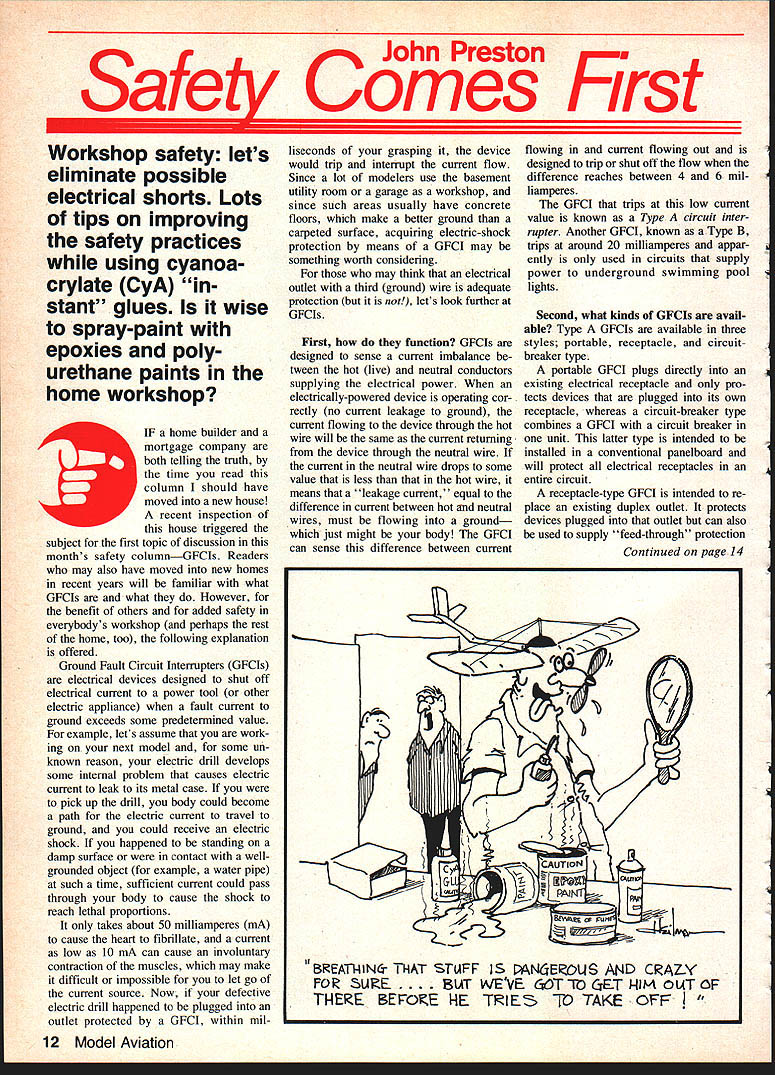
Another way the unwary can suffer a misfortune in the workshop comes from Peter Fraker of West Islip, NY. Peter was working on a Sig Cessna 150 and was using cyanoacrylate (CyA) glue in a bottle with a thin flexible applicator tube when the following happened:
"The tube stuck to the wood, I pulled the CyA bottle lightly, and when the tube broke free from the wood it acted like a catapult and shot a drop of glue into my eye. I immediately went to the sink and rinsed my eye with lukewarm water while keeping the eye open for about 15 minutes. I then proceeded to wake up my wife and have her drive me and the bottle of CyA to the emergency room at the hospital. After an examination, the doctor said the drop of CyA did not adhere to the eye itself but to the upper eyelid, and it now felt like a piece of sand. The only thing the doctor could do was to numb the area with an eyedrop solution, put a patch on the eye, and recommend an eye surgeon. I went home fearing that the eye surgeon would tell me that he would have to do.
"The next morning, my eyelids were lightly stuck (glued) together. I proceeded to remove a light crusty substance from my eyelids and lashes with my finger. I then opened my eye and felt none of the previous irritation. I still made the appointment with the eye surgeon and found out from him that the CyA had been dissolved by the normal eye secretions. The moral of the story is to always wear the proper eye-protecting safety glasses."
As a postscript to his letter, Peter said that the Sig Cessna 150 flies great. So, all's well that ends well in this case—but his suggestion to wear safety glasses is a good one for activities both in the workshop and when starting and tuning engines.
Another tale of woe concerning CyA glue comes from Carl Berg of Attica, NY. In this incident, the victim was Carl's wife. He writes:
"I had been working on a model, and my wife was helping me with a tricky piece of glue work. I was using low-setting cyanoacrylate, and some of it got on one of her fingers. She reached up to brush her hair away from her face, and some of the CyA got on her cheek. She was wearing makeup, and when the two made contact the CyA 'fired' and burned her cheek. If it makes any difference, she was wearing hypo-allergenic makeup. Not being a chemist, I wouldn't know what the reaction was, but I can report that it happened."
Since I'm not a chemist, either, I can only speculate that perhaps the makeup acted as a catalyst and sped up the cure time of the slow-setting CyA. All I can say is that I hope the incident didn't put an end to Carl's modeling activities. A lot of modelers' wives that I've met barely tolerate their husbands' hobby activities under any circumstances—without being burned on the cheek!
First Aid for Cyanoacrylate Incidents
I recently read an article on first aid treatments of incidents involving CyA glue. It appeared in El Torbellino, the newsletter of the San Diego Orbiteers Free Flight Club, edited by Howard Haupt. The source of the article is the Department of Preventive Medicine, DOD. Since most modelers use a considerable amount of CyA glue, the following first aid treatments might be worth clipping out and saving.
- Skin bonds:
- Do not try to pull the bonded surfaces apart with a direct opposing action.
- Immerse the surfaces in warm, soapy water.
- Peel or roll the surfaces apart using a blunt edge, such as a spoon handle.
- Wash adhesive off the skin with soap and water.
- Eyelid-to-eyelid or eyelid-to-eyeball bonds:
- Do not try to open the eyes by manipulation.
- If eyelids are stuck together or bonded to the eyeball, wash thoroughly with warm water and apply a gauze patch.
- The eye will typically open without further action in one to four days.
- Adhesive on the eyeball:
- CyA introduced into the eye will attach to eye protein and will dissociate within a matter of hours, even if gross contamination has occurred.
- During clearance, weeping will occur and double vision may be experienced.
- Mouth:
- If lips are accidentally stuck together, apply a stream of warm water to the lips and encourage maximum wetting and pressure from saliva inside the mouth.
- Peel or roll the lips apart gently—do not pull with a direct opposing action.
- It is almost impossible to swallow cyanoacrylate. The adhesive solidifies and adheres to the mouth; saliva will lift the adhesive in one-half to two days.
- If a lump forms in the mouth, position the patient to prevent ingestion of the lump when it detaches.
- Burns:
- CyA gives off heat on solidification; in rare cases, a larger drop may cause a burn.
- Treat burns normally after the lump of cyanoacrylate is released from the tissue, as described above.
Be a Safe "Un"
To wind up this month's column, Martin Kinney, editor of The Corsair, newsletter of the Joint Military RC Fliers club in Oceanside, CA, has the following advice for his fellow club members. I think you will agree there is a message here that should be heeded by all.
The prefix "un" has suddenly swept into prominence. First, we heard about the "un-cola," and soon it became "un" this and "un" that. But one uncool group that's been around for a long time is the "unsafe." Related to RC, this breed is generally the uncoordinated pilots with unpainted airplanes. Once in the air, the unsafe become the unifiers, because they have uncontrollable crashes. These people are unready, uninhibited and unworried about accidents and injury.
The prefix "un" is great when talking about the undamaged, the uninjured, the unimpaired, the unbandaged, the unsplintered, the unbewitched and the unsquashed. But it's rather frightening when talking about the unheeding, the uncareful, the undone and the unconscious.
I'm glad there are no unsafe "un"s at our field.
On that note I'll get back to packing and preparing for the move to the new house. One of these days, I'll find the time to build a model—perhaps!
Have a safe month.
John Preston 12235 Tildenwood Dr., Rockville, MD 20852.
Transcribed from original scans by AI. Minor OCR errors may remain.

