
Safety Comes First
Wind can be a safety consideration. Do not taxi an RC model in the pit area! More info on why engines backfire, and other safety tips, follow.
CREDIT for the subject of the first topic in this month's Safety column goes to the Lehigh Valley RC Society newsletter editor, Tom Bilheimer.
Wind and model flight characteristics
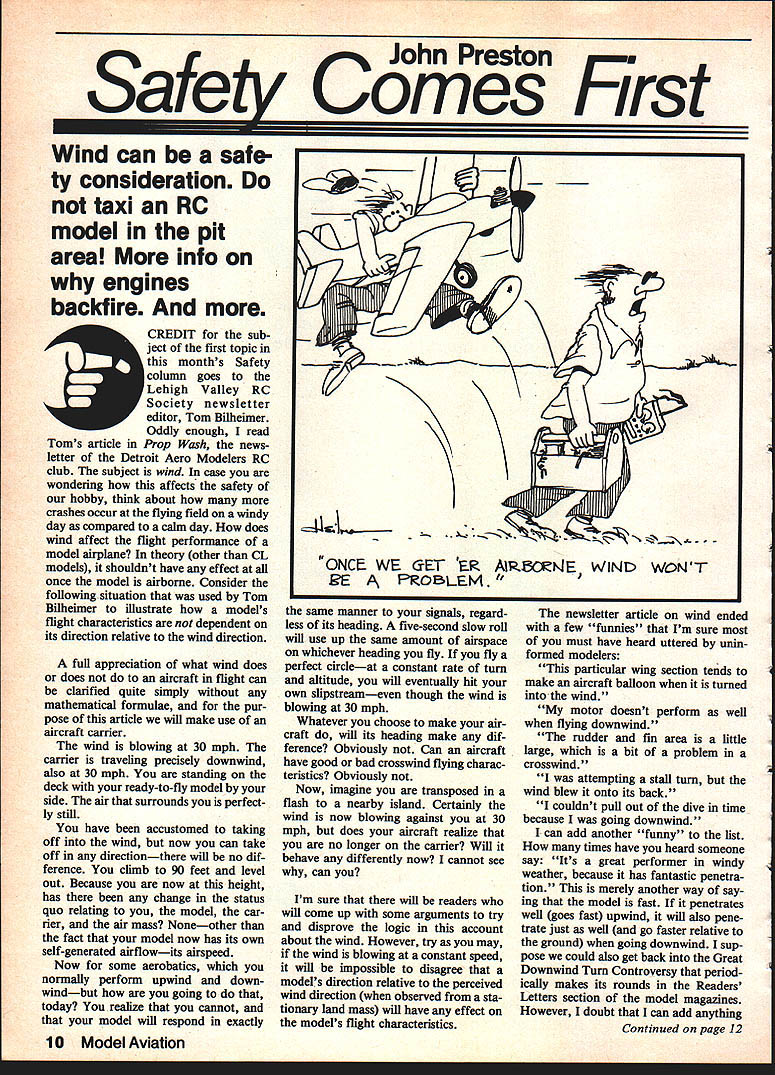
Oddly enough, I read Tom's article in Prop Wash, the newsletter of the Detroit Aero Modelers RC Club. The subject is wind. In case you are wondering how this affects the safety of our hobby, think about how many more crashes occur at the flying field on a windy day as compared to a calm day. How does wind affect the flight performance of a model airplane? In theory (other than CL models) it shouldn't have any effect at all once the model is airborne.
Consider the following situation used by Tom Bilheimer to illustrate how a model's flight characteristics are not dependent on its direction relative to the wind direction.
A full appreciation of what wind does or does not do to an aircraft in flight can be clarified quite simply without any mathematical formulae, and for the purpose of this example we will make use of an aircraft carrier.
The wind is blowing at 30 mph. The carrier is traveling precisely downwind, also at 30 mph. You are standing on the deck with your ready-to-fly model by your side. The air that surrounds you is perfectly still.
You have been accustomed to taking off into the wind, but now you can take off in any direction—there will be no difference. You climb to 90 feet and level out. Because you are now at this height, has there been any change in the status quo relating to you, the model, the carrier, and the air mass? None—other than the fact that your model now has its own self-generated airflow—its airspeed.
Now for some aerobatics, which you normally perform upwind and downwind—but how are you going to do that today? You realize that you cannot distinguish "upwind" or "downwind" in this situation, and that your model will respond in exactly the same manner to your signals, regardless of its heading. A five-second slow roll will use up the same amount of airspace on whichever heading you fly. If you fly a perfect circle—at a constant rate of turn and altitude—you will eventually hit your own slipstream—even though the wind is blowing at 30 mph.
Whatever you choose to make your aircraft do, will its heading make any difference? Obviously not. Can an aircraft have good or bad crosswind flying characteristics? Obviously not.
Now imagine you are transposed in a flash to a nearby island. Certainly the wind is now blowing against you at 30 mph, but does your aircraft realize that you are no longer on the carrier? Will it behave any differently now? I cannot see why, can you?
I'm sure there will be readers who will come up with arguments to try to disprove the logic in this account about the wind. However, try as you may, if the wind is blowing at a constant speed, it will be impossible to disagree that a model's direction relative to the perceived wind direction (when observed from a stationary land mass) will have any effect on the model's flight characteristics.
The newsletter article on wind ended with a few "funnies" that I'm sure most of you must have heard uttered by uninformed modelers:
- "This particular wing section tends to make an aircraft balloon when it is turned into the wind."
- "My motor doesn't perform as well when flying downwind."
- "The rudder and fin area is a little large, which is a bit of a problem in a crosswind."
- "I was attempting a stall turn, but the wind blew it onto its back."
- "I couldn't pull out of the dive in time because I was going downwind."
I can add another "funny" to the list. How many times have you heard someone say, "It's a great performer in windy weather, because it has fantastic penetration." This is merely another way of saying that the model is fast. If it penetrates well (goes fast) upwind, it will also penetrate just as well (and go faster relative to the ground) when going downwind.
We could also revisit the Great Downwind Turn Controversy that periodically makes its rounds in the Readers' Letters sections of the model magazines. However, I doubt that I can add anything to that which has not already been said many times before to convince the unbelievers. Models will turn just as well when going upwind as they will when going downwind. If you don't believe this, then go and rent an aircraft carrier and run your own tests.
Taxiing in the pit area
I guess we all like to complete a flight of our RC pride and joy by taxiing it back through the pits and parking it beside our field box without laying a hand on it. This column has previously discouraged such a practice, and an article in the December 1983 issue of Update, newsletter of the Santa Barbara RC Modelers, illustrates why this may be hazardous. Gordon Smith is the author.
Our radios are so good (usually) that they can lull us into a false sense of security. But we have all seen the times when a plane, a boat, or a car goes wild. It usually takes place a good way out from the transmitter and causes damage only to the model. Here is an incident that shows why we need to exercise caution at all times.
At the Labor Day Club Field Day, I was taxiing my Tiger Moth into the pits next to my field box. I had the plane stopped next to the box with the motor idling. Silently congratulating myself for a realistic performance, I moved the throttle trim to "low" to kill the motor. Suddenly, and unexpectedly, the engine came to life at full throttle. The plane lunged forward at a couple of ladies who were sitting and chatting. The Moth was heading for the leg of one of the ladies and only a miracle caused the plane to swerve to the left slightly so that the propeller hit against the chair leg instead of the lady's leg. Both of us had a bad scare.
Later, in the shop, I checked the radio fully and found nothing that could have caused the incident. Possibly it was interference from a nearby radio. The point is—don't taxi in the pit area. A plane taking off in the pits is a very scary thing, and all it takes is a throttle glitch to do it.
A similar message about the hazard of taxiing in the pit area was included in the Gold Coast Flyer, newsletter of the Gold Coast Radio Controllers, edited by Art and Charlotte Johnson. This newsletter reported that:
"At the last Board of Directors meeting, we discussed recent incidents where some R/C receivers can be overpowered by RF (radio frequency) from a transmitter not on that receiver's frequency if a model passes very close to the offending transmitter."
This does not happen to all receivers, but the problem happens often enough that you should never take a chance on taxiing directly towards people, cars, or models in the pit area. A sudden surge of full throttle as your model passes by a transmitter turned on in the pits can cause a disaster. The problem can be minimized by walking in the pits beside your taxiing model and shutting down before getting too close to (or pointing towards) something or someone you would not care to hit.
Prop hazards and four-stroke engines
A couple of issues ago, I reprinted a club newsletter article written by Orville Mills, an Oregon modeler, about the hazard of props on big four-stroke engines being thrown off when the engine backfires during starting. The article drew attention to the presence of two drive pins in the prop drive washer of the Enya .90 four-stroke that should prevent this from occurring.
Shortly after the magazine containing this article came out, I received a letter from Scott Fahnestock of World Engines. Scott had the following to say:
"All new OS FS-90s (plus FS-120s, .108 FSRS, and any forthcoming OS engines over .60 displacement) have four pins in the drive washer to hold the prop in place. OS strongly recommends their usage. Please pass this on to Orville Mills ("Safety Comes First," MA, June 1984, p. 14)."
Scott also sent the instructions that accompany the OS FS-90 four-stroke engine, which state: "It is advisable to use an electric starter for starting, although hand-starting is also possible." The instructions contained a very comprehensive description of how to go about starting the engine both with an electric starter and when using hand-starting techniques. The latter method is not recommended when using lightweight, wooden propellers, and owners are instructed to "be sure to wear a heavy glove or to use a 'chicken stick.'"
Staying on the subject of safety while starting and tuning engines, I continue to urge readers to move to a location behind the prop arc before making any fuel mixture adjustments. In the August 1983 issue of the Windy City newsletter, Al Brose wrote:
"Just recently, an RC flier, who makes it a good practice to adjust his needle valve from behind the engine, had a 3-in. plastic spinner shatter without warning. When the spinner broke apart, it also caused the propeller to break. The spinner broke into about 10 pieces and flew as far as 50 feet away. This flier was sure that he wasn't in front of the plane when this happened."
However, in case you think that stationing yourself right behind the prop arc puts you totally out of harm's way, consider what editor Lon Baczkowski had to say in the Sundown Gazette, newsletter of the Midwest Sundowners RC Club:
"A while back, I bought a model at the Suburban Aeroclub of Chicago's annual auction. The man I bought the model from was well-experienced in the hobby. As we got to talking, I noticed that two middle fingers on his left hand were somewhat shorter than normal. I was a little shocked and shaken to find out how it happened. He was adjusting the idle on his twin when the engine misfired and started running backwards. The model moved backwards, catching his fingers in the prop arc. The fingers were severed at the first joint."
A possible reason for big four-stroke engines backfiring and/or running backwards may be because their owners are not following the instructions that come with these engines. I had a letter from Al Alman, a well-known writer about "big bird" happenings, in which he discussed four-stroke backfirings. Al stated that he has had a number of letters and phone calls on this subject. He also stated that he had discussed it with Scott Fahnestock who had the following to say:
- The O.S. engines were designed to run on standard glow fuel, and one of the problems is trying to run them with too little oil.
- A second reason for the prop hazard is using too much nitro: 10% is maximum.
- A third reason is the inveterate tweaker who runs all of his engines too lean. This problem is compounded because four-stroke tuning is quite broad, and two-stroke-oriented people are prone to go right past the optimum setting. The lean run means elevated cylinder head temperature, which leads to detonation and prop-slinging.
Al's letter also mentioned another hazard associated with propellers: the bottom drawstrings found on warm-up jackets which we normally use as club jackets. This very potential hazard was mentioned at a club meeting and, whaddaya know, the next day I got a graphic illustration out at the field. The only other pilot was wearing one of these type jackets, and of course, the drawstrings were flapping in the breeze. His .60 four-stroke was hard to fire along, and all of a sudden, while he was kneeling and off balance, the engine started—sucking those loose string ends into the 14-in. prop and pulling him up against the engine. What saved him from a badly cut-up groin was the lousy idle setting on the engine. It was only too happy to quit. Had the idle been better, or the throttle been at some higher setting, it would have been a really bad scene.
The jacket-drawstring incident reminds me that a similar hazard exists if you use a neckstrap (saxophone style) to support your transmitter. Beware that, when unhooked from your transmitter and dangling free around your neck while starting, it may well get tangled with the prop.
Dremel and power-tool dust fire hazard
One last tip for this month concerns Dremel belt sanders and table saws. I previously pointed out the need to clean the balsa dust out of these tools after use to prevent a possible fire hazard. An article in the February 1984 issue of Flypaper, newsletter of the Milwaukee Flying Electrons (Russell Knetzer, editor), credits Dave Copeman of the Circumlators Flying Club as the author of the following account.
I don't know how many of you use Dremel tools, but I had an unusual occurrence happen while I was using my Dremel sander. After I've used it a couple of times, I clean it real good by vacuuming it inside and out, including the motor. This time, after I finished using it, I could smell wood smoldering. I checked inside the sander around the belt to see if a spark had started something, but everything looked OK. So, I continued on with my project. But every once in a while, I could smell smoldering wood.
I decided to vacuum out the sander to try and find the cause of the smell. What I discovered surprised and puzzled me. As I said before, I vacuum the motor when I'm cleaning it up. This time, I saw glowing embers inside the motor. I had already unplugged the sander, but I wasn't sure what I should do. I didn't want to use my fire extinguisher, and I didn't want to stick anything into the holes for fear of damaging the motor. I decided to gently blow on the embers until they were out. I kept the fire extinguisher handy just in case.
After they were out, I removed the motor from the sander to check the damage. I opened up the motor and completely cleaned out all the charred dust. I couldn't see any physical damage to the motor. All the wires were intact, and the insulation was not harmed. The only thing I found was the phenolic board had a couple of black smudges on it. I reassembled the motor and tested it—it ran perfectly. Evidently the vacuum cleaner can't reach all the dust that accumulates in the back of the motor, and the arcing of the brushes starts the dust smoldering.
But now I wanted to do something to prevent this from happening again. Adding a filter to the sander housing would not prevent the dust from entering the motor. So, I decided to put a filter on the motor. There is a series of holes in the end of the motor housing for cooling air to enter. Using a 3-M particle mask and cutting it to the proper size, I taped it to the back of the motor.
I also have a Dremel table saw and had noticed the same smell once in a while after using it, but I could never locate the problem. After removing the motor from the saw, the same condition was found. I cleaned and added a filter to this motor also. Now, when I vacuum these tools, the dust is on the outside of the filter and easily cleaned off. I also noticed an increase in the rpm of the motors of both the saw and the sander. If you have either of these tools, you might want to check them before a problem occurs.
Have a safe month—both on and off the flying field.
John Preston 12235 Tildenwood Dr. Rockville, MD 20852
Transcribed from original scans by AI. Minor OCR errors may remain.

