
Safety Comes First
John Preston
"Safety is no accident" means many things. Below are a few well‑chosen examples culled from club newsletters this month, followed by a discussion of flying‑field etiquette and a cautionary story about frequency mix‑ups.
Newsletter safety reports
- Hangar News — Lee Main: One of our members was working on his plane when an X‑Acto knife slipped. He had to get 34 stitches in his hand. Please be careful while you work.
- Brazoria City Modelers Association — Earl Veazey: Work with paints, solvents, polyester resins and some types of glue only in a well‑ventilated place. Vapors can damage lung tissue and, if an ignition source is present, can even cause an explosion.
- The Corsair — Marlin Kinning: It has been noted that someone or some people have been night‑flying at the Camp Horno field. This is unsafe, strictly prohibited aboard Camp Pendleton, and will not be tolerated by any member.
- Fast Flyer — George Beeler: Safety is no accident. Before flying, be sure to check anything that might be loose on your airplane. A range‑check of the receiver and transmitter made at the field, with the engine running, is the best way to ensure your flying will be fun instead of fatal.
- Flight Masters MAC — Joe Jamell: Do not use plain white plastic bottles (milk bottles, etc.) to mix and transfer gasoline‑based fuel for ignition engines. Static electricity can build up and cause a spark. Use only containers specifically marked for gasoline (red bottles) or metal cans. Needless to say, no smoking should be the rule.
- Prop Talk — Ted Midkiff: If the manufacturers had wanted us to adjust needle valves in front of running engines, don't you think they would have mounted them there? Jokes aside, think about what could happen the next time you start to adjust a needle valve from in front of an engine.
- AMA National Newsletter — Paul Samaris: Propellers are our No. 1 safety problem. Balance your props to isolate vibration. Be careful with plastic props—color the prop tips with a felt‑tip pen to increase visibility without adding weight.
- The Static Sheet — Wayne Carey: AMA rules require that your name and AMA number be on or in your aircraft if AMA insurance is to apply in the event of an accident. Please comply!
- The Static Sheet (additional): We are once again seeing a number of rattlesnakes in our area. Word of caution: do not run into the weeds after a downed aircraft—move slowly and make plenty of noise so the snakes will likely avoid you. Carrying a large stick might also be prudent.
Flying‑field etiquette (humorous reminders)
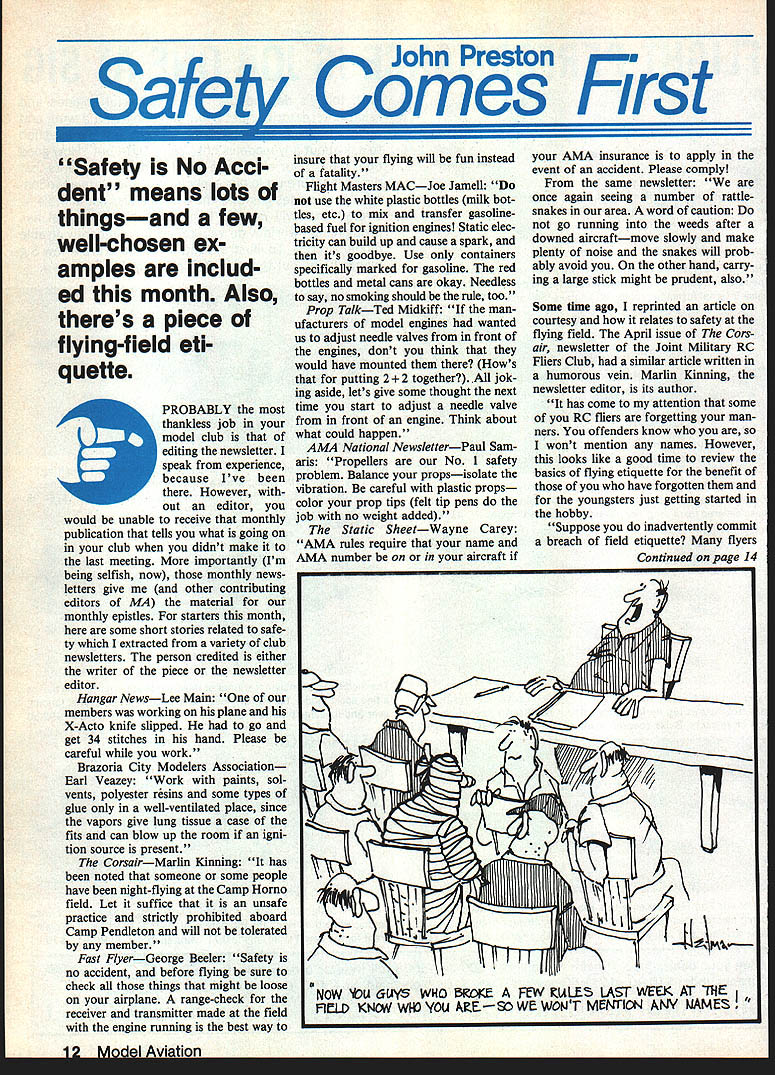
Marlin Kinning (The Corsair) notes that some RC fliers are forgetting manners. He recommends reviewing basic flying etiquette for the benefit of those who have forgotten and for newcomers. If you inadvertently commit a breach of etiquette, it’s often better to treat the mishap jovially rather than with abject apologies. Suggested lighthearted responses:
- "Great leap and somersault, Clyde! If I hadn't bumped into you and knocked the transmitter out of your hands, I'd never have known what a fine athlete you are. Need a little more practice in landing your airplane, though."
- "Four‑hundred‑dollar airplane, huh? Roy, it didn't feel like much more than $1.98 when I stepped on the tail assembly. Seriously, though, I've heard it improves the elevator action when you rebuild, because then it's tail‑heavy. Now, you just dry your eyes and see if that old plane doesn't actually fly better in a month or two."
- "Oh, I don't know, Frank. I think you look rather rakish with an antenna tip in your ear."
- "Hello, Bob. You won't believe what I did—prepare yourself for a laugh. I forgot I had your one‑third‑scale low‑winger still tied to the top of the car, and I started to back into the garage. What? A biplane? Yeah, I know it wasn't a low‑winger, but it is now! Get it, Bob?"
Kinning also discusses everyday courtesy, such as whether to help ladies in and out of vehicles. He notes that a small act of chivalry—offering a steadying hand—can prevent dropping equipment and make others feel secure.
Courtesy as safety — examples of inconsiderate behavior
Bill Buese, editor of the Roxbury Area Model Airplane Club (RAMAC) newsletter, links courtesy and common sense and lists dangerous, inconsiderate behaviors that threaten safety:
- Hand‑launching a plane behind other fliers — this endangers others and startles them into evasive action.
- Coming into the traffic pattern at excessive speed (e.g., entering at 100 mph believing you're doing 50 mph).
- Performing snap rolls at very low altitude (e.g., 90 feet) — displays bravado but shows a lack of manners and safety.
- Spraying exhaust or goo on someone else's car, flight box, or clothes — inconsiderate and unhygienic.
- Turning on your transmitter without going through the transmitter impound or otherwise coordinating frequency control.
Buese concludes: these examples don't happen often, but when they do they risk everyone. In this hobby, if we do ill to others first, we all may crash sooner or later.
Carelessness and safety
Bob Mayhercy (Hedge Hoppers), in "A View From The Rear Cockpit," equates many accidents to carelessness. He agrees that safety cannot be over‑emphasized but argues that the main reason accidents happen is simple carelessness. When a field safety officer points out a problem (loose wing, nicked prop, etc.), don’t grumble. Instead, be willing to ground the airplane until checks and repairs have been made, even if you feel experienced. A personal change in attitude—accepting checks and helping other members—is essential to reducing accidents.
Frequency mix‑ups — "The Chinese Fire Drill"
A common cause of crashes is frequency mix‑ups, often due to carelessness. The Knight Flier (Kansas City Northern Knights), edited by Mike Mockridge, published a true incident titled "The Chinese Fire Drill" (names omitted to protect the guilty).
One dark, cloudy afternoon Pat was flying his new, hot‑rod Swizzle Stick. Someone in the pits, trying to be helpful, shouted, "Red and white, red and white!" Pilots in the pit area echoed the call. The Swizzle Stick did not respond and fell from the sky, landing upside down.
Pat investigated. His radio had been working fine and the maneuvers indicated the radio itself had not failed. There were no known glitches at the field. It seemed like strong interference—someone had turned another transmitter on. Then Pat noticed the brown and white flags dangling from his transmitter antenna. In the excitement he had forgotten he was actually on brown and white and had thought he was on red and white. If the correct color had been called, Don (the other pilot) could have turned off and Pat might have avoided the crash.
Two morals:
- Murphy's Law is ever present.
- Even so, there can be a silver lining: Pat rebuilt his Swizzle Stick, and now it flies better than ever. Don received the Freddie Fudpucker trophy for "shooting down" Pat.
This incident underlines the need for strict, foolproof frequency control—especially important as radios evolve to allow synchronization of many frequencies.
Closing
Think carefully about safety, courtesy, and personal responsibility at the field. Small acts of consideration and a willingness to accept checks from fellow fliers go a long way toward preventing accidents.
John Preston 12235 Tildenwood Dr. Rockville, MD 20852
Transcribed from original scans by AI. Minor OCR errors may remain.

