


Safety Comes First
John Preston
Preflight inspection of your plane can save lots of embarrassment later. RC pilots would do well to stay near enough to each other to allow communication and coordination. Power fliers would do well to use hearing protectors. And more.
Preflight inspections — a recent crash
Some time ago I talked about the importance of conducting preflight inspections of models. An incident I witnessed just two days ago prompts me to mention this subject again.
One of the local RC clubs held a scale contest at a nearby full-scale aerodrome, and I served as one of the static judges. To start the flying portion of the contest as early as possible on Saturday, static judging began on Friday afternoon. While I was scrutinizing someone's pride and joy for accuracy of outline, I heard an extremely loud crunch — the unmistakable sound of a model ending its useful days by contact with terra firma. Looking up, I watched a wing lazily descend out of the blue.
A postmortem revealed that the owner, an experienced builder and flier who shall remain nameless, had brought a 1/4-scale Steen Skybolt powered by a Kawasaki engine to the contest to serve as a flight judge's "warmer-upper." In his haste to get in a quick flight before dinner, he failed to insert the pin that retains the upper wing to the cabane. After a normal takeoff, a remarkable amount of up-trim indicated something was wrong, and he elected to return immediately for a landing to determine the cause.
However, the stress in the fasteners between the upper wing and the interplane struts proved greater than their design could handle, and the upper wing separated from the rest of the model. The nose-up trim changed to violent nose-down trim that could not be overcome even with full up elevator. The 30-lb model struck the ground with such force that the entire engine was buried. The crash was uncomfortably close to a row of hangars housing several classic biplanes.
This incident underscores the importance of a preflight check — particularly when a model has complicated rigging that must be assembled at the field.
Preflight checklist cards
A few weeks ago I received an envelope from Charlie Spear, AMA District IV Associate Vice-President. It contained preflight checklists printed on a card about 6 x 9 inches and laminated for durability. Charlie noted that each new member of the Winston-Salem RC Club receives two of these cards — one for the workshop and one for the field box. One side is a "Maiden Flight Preflight" list and the other a "Routine Preflight" list.
According to the District IV VP's newsletter, these preflight inspection cards are available from Charlie for about $1.00. Contact: Charles Spear 253 Holly Lane Mocksville, NC 27028
I suggest you drop Charlie a note and get a set.
Close encounter at Mesquite field
The April issue of the North Dallas RC Club newsletter (edited by Dan Rau) reprinted an account by David Williford titled "Close Encounter of the Closest Kind." His story illustrates how quickly things can go wrong.
Summary of the incident:
- Date/location: Tuesday, March 20, Mesquite field. It had rained that morning; the sun was out and a light crosswind was blowing.
- The author was standing just off the runway. Another pilot was three-quarters of the way down on the left. A third pilot set his plane with the engine running on the runway three-quarters of the way to the right.
- The third pilot attempted a takeoff. The low-wing taildragger lifted off with the right wing high; the wind caught it and increased the left bank.
- The airplane failed to gain altitude and headed straight toward the pilot on the left, missing him by inches and taking the last fourth of his transmitter antenna in the wing. The impact knocked the transmitter to the ground. By the time the pilot retrieved his transmitter, his plane had crashed 10 feet behind the author.
- The first plane, with the frequency flag from the fallen antenna now waving from its wing, then banked and headed past the author and landed downwind.
- The author had lost sight of his own plane more than once but managed to remain in control and land.
After discussing the event with the kamikaze plane's pilot, the following causes were identified:
- The plane was out of trim.
- There was a bad crosswind, and the plane took off downwind relative to the crosswind.
- Most important: the three pilots made no attempt to stand together. They were too far apart. Fliers need to stand together.
In conclusion, the club has correctly defined a pilot area at Warren Field. Mesquite needs one as well to keep pilots from flying at either end of the runway and "playing chicken." Getting hit by a plane would be no fun.
On standing together vs. transmitter interference
I used to fully agree with David that RC pilots should stand close together while flying. However, I've become unsure. There are reports that transmitting on closely spaced antennas can produce interference (harmonics or other effects) that might disrupt a flier on a third frequency. Apparently this does not happen if the transmitters are spaced sufficiently far apart.
I'm not qualified to give technical advice on this phenomenon; I will contact George M. Myers, author of "Radio Technique," and seek his input. Meanwhile, for safety's sake there shouldn't be fliers stationed simultaneously at opposite ends of an active runway.
Pit-area restraint danger — Ugly Stick incident
From the Flightmasters Model Airplane Club newsletter (edited by Joe Jamell, Jr.):
Did you ever see an RC pilot standing astride his model, running up the engine while restraining it with his legs against the stabilizer? This is a no-no. I recently watched a .60-powered Ugly Stick part company with its stabilizer, bolt through the pit area, and damage several other models before coming to rest at my feet. Scratch one Ugly Stick and add a few disgruntled fliers. No one was hurt, fortunately.
If a model's stabilizer cannot withstand the thrust of its own engine, it isn't airworthy. Ugly Stick owners (and all modelers) should check the security of their stabilizers before running up engines.
Glue hazards — combination of adhesives
A letter from Ron Grosbach (Enders, NE) describes a worrying experience in his basement shop. Ron had been gluing short balsa strips on a wing using old cyanoacrylate glue and applied an accelerator to speed curing. After a minute or so he applied Ambroid liquid cement to seal the balsa strip and rubbed it in with his finger. Almost immediately he felt as if he were about to pass out; the Ambroid odor was the only thing he noticed. He left the room, felt nauseated that evening, and the next day experienced a mild headache, mild urinary irritation, and occasional pounding in his chest. A day later he felt better but still had a headache.
He asked: What effect does the combination of these glues produce?
I consulted chemists I work with; they could not provide an answer. If any readers have information, please write in. Meanwhile, exercise caution and avoid combining adhesives whose interactions you don't understand.
Slope-soaring warning — fatal glider retrieval
AMA District X VP Jim Scarborough forwarded two newspaper clippings reporting the death of a model sailplane flier near Rancho Palos Verdes, California.
Headline summary: Model Glider Flier Plunges to Death at Rancho P.V. A 58-year-old Torrance man plunged 400 feet down a cliff to his death while maneuvering his radio-controlled glider in Rancho Palos Verdes. Investigators theorize he lost his footing while watching his glider in the air currents off the ocean. Another report stated he "reportedly lost his footing and fell into a gully while trying to reach the glider after it landed down the hillside."
This is a sobering reminder to slope soarers: be careful both while flying and during retrieval operations on steep slopes. Apparently the victim was not an AMA member.
Hearing protection — tinnitus and permanent loss
I've previously warned about noise from two-stroke model airplane engines and cautioned that excessive exposure can cause hearing loss. A letter from Ed Guzick provides a firsthand account that reinforces the warning.
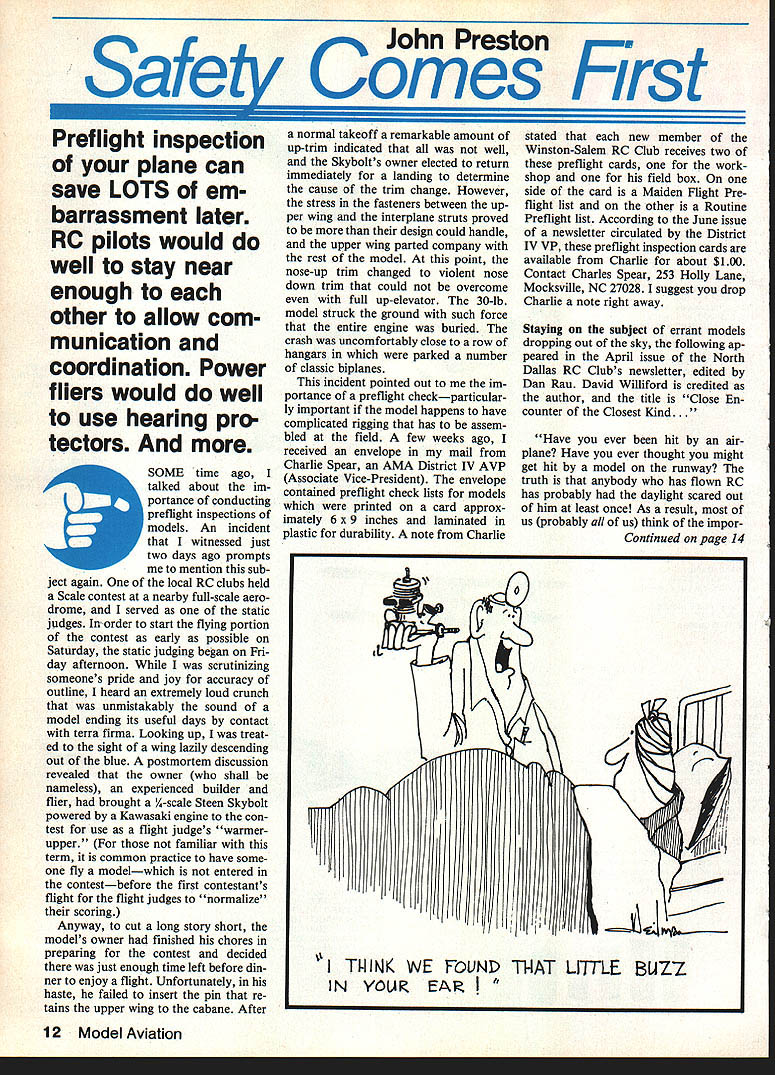
Ed defines tinnitus as "a sound in the ears, such as buzzing, ringing or whistling, caused by a defect in the auditory nerve." He reports that after repeated exposure to loud noises (skeet shooting, flying models) he used to hear a slight buzz that would go away by morning. One day at the field he stood next to a .60 engine with a poor muffler while it was started and developed a very loud buzz that did not go away. That was about 10 years ago; he still suffers from the problem.
Ed consulted three doctors and two audiologists, tried hearing aids and audio maskers, and contacted a tinnitus center. His hearing is down about 90 dB at 4 kHz, and he was told he'd "get used to it," but after 10 years he is not used to it. His advice: buy the best hearing protectors you can find, especially younger hobbyists. He has seen only one person using hearing protection while starting an engine.
All I can add is that you have been warned. Perhaps the increasing popularity of four-stroke engines will help save some flying sites — and some modelers' hearing.
Have a safe month.
John Preston 12235 Tildenwood Dr. Rockville, MD 20852
Transcribed from original scans by AI. Minor OCR errors may remain.

