
Safety Comes First
John Preston
The wind still blows, and models still fly—but do you really know what the wind is doing to the flight characteristics of your R/C model? Understanding the interaction may help avert a crash. Also discussed here: the "four-stroke kick-back" phenomenon and ways to keep your prop from coming off.
WIND, revisited
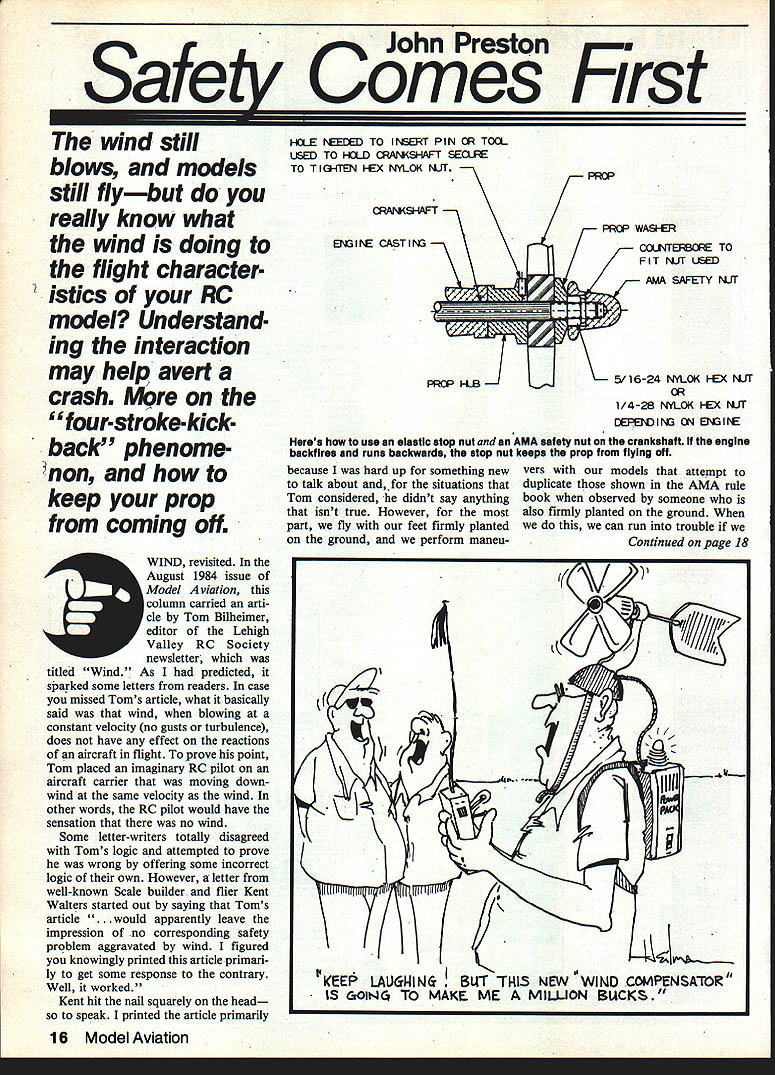
In the August 1984 issue of Model Aviation, Tom Bilheimer (editor of the Lehigh Valley R/C Society newsletter) wrote an article titled "Wind." Tom's basic point was that constant-velocity wind (no gusts or turbulence) does not change an aircraft's reactions in flight. To illustrate, he imagined an R/C pilot aboard an aircraft carrier moving downwind at the same speed as the wind; from that pilot's frame of reference, there would be no sensation of wind.
Many readers disagreed; some tried to refute Tom with flawed logic. Kent Walters, a well-known scale builder and flier, offered a clearer criticism: modelers do not fly with reference to the air mass alone, but with respect to the fixed ground position we stand on. Maneuvers are performed so they look correct to an observer on the ground; pilots apply control corrections to cancel wind drift and preserve the intended ground-referenced appearance of the maneuver. Those corrections change the model's attitude relative to the surrounding air, and that can create safety problems.
Kent offered this example from long experience. Suppose wind is blowing right to left at 30 mph and a model is put into a vertical dive from high altitude directly above the pilot, who intends to pull out downwind. During the dive the pilot keeps the dive vertical relative to his fixed ground position, compensating for wind drift. Now imagine watching the same dive from the "rented" carrier moving at 30 mph with the wind—there is no wind relative to that carrier. In that frame the dive will not appear vertical; instead it looks like the model has dived past vertical and is descending in a reversed direction from its entry. Thus the pullout required to achieve straight and level flight in the no-wind frame is much steeper than the pilot perceives from the ground.
The practical danger is that a pilot unaware of this can try to pull out as he would in calm air (for example, at 30 feet) and may have insufficient elevator margin when pulling out downwind. The pilot may only notice a reduced elevator response and, if unlucky, the model can be plunged into the runway. The same effect explains the "backside descent" of a downwind loop when the loop is flown fixed to the ground—severe wind or insufficient elevator can result in the classical "Figure 9."
Kent Walters is well known for precision vertical dive bombing runs with his Dauntless; his example is drawn from real contest experience and underscores the safety issue: flying and judging are normally ground-referenced, and wind changes how control inputs translate into the model's attitude relative to the air.
Control-line lines: length and strength
T. M. Jennings (Paducah, KY) reported safety problems with store-bought control-line sets. Two defects were found in a set labeled ".050–.060," meaning the lines were marked for that size and 60-foot length: first, the lines were actually 70 feet long; second—and more serious—the crimped brass tube end connections did not secure the stainless steel lines, allowing the lines to pull through.
Manufacturers should not ship defective lines, but contest and sport fliers can mitigate risk by following the AMA Safety Code. Item No. 1 under Control Line requires a preflight inspection and pull test of the complete control system (including safety thong, where applicable). Contest fliers normally measure lines before each official flight—the rulebook specifies how to measure line length (from the center of the handle grip to the fore-and-aft centerline of the model). Sport modelers may not routinely check. If you fly control-line models, measure line length and perform pull tests before flying, and inspect crimped fittings carefully.
Four-stroke kick-back and prop safety
In June 1984 Model Aviation I reprinted an article about four-stroke engine "kick-back" and the hazard of the propeller flying off. Orville Mills had suggested that manufacturers fit drive pins in prop backplates (as on larger engines). After that publication, Scott Fahnestock of World Engines wrote to say OS had begun equipping all OS four-strokes over .60 ci with drive pins. Around the same time, Bob Angel (SAM No. 26 newsletter editor) sent an account showing that pinned drive washers are not a guaranteed solution.
Bob's report: his OS .90 four-stroke arrived with the drive washer pinned. He broke it in with no trouble hand-starting, but when he ran the engine faster on a 12" prop (about 11,500 rpm) the prop literally exploded at the hub, shattering. One piece made a deep gash in the ground and other fragments flew some distance. A day later the same happened in flight—he landed with no prop left. He later removed the pins and so far had no more problems. Bob also noted that incorrect hand-starting direction can exacerbate kick-back; follow the engine instructions carefully (on many four-strokes you prop clockwise after priming, allowing the finger or chicken stick to slide off because the engine fires before top dead center).
I do not own four-stroke engines, so my advice is based on others' experience. Bob's backwards (clockwise) flip-start technique is in fact recommended by some manufacturers for hand-starting certain four-strokes. Scott Fahnestock provided operating instructions for the O.S. FS-90 and offered an analysis via World Engines' engine expert, Harry Roe.
Harry broke the problem into two parts:
- Prop mounting and wood compression: When the prop nut is tightened, wood fibers in the prop hub compress and the hub shrinks. Vibration can then loosen the nut, so Harry recommends re-tightening the prop nut before every flying season (and checking it regularly).
- Four-stroke detonation: Because of longer stroke and higher compression, four-strokes are more susceptible to detonation when the fuel mixture is too lean and rpm is too high. Detonation is a violent combustion event that can drive the piston back down before it reaches TDC, reversing the crank and loosening the prop. Prolonged detonation can overheat and seize the engine.
World Engines' practical recommendations:
- Do not lean the high-speed mixture excessively. Four-strokes are most comfortable in the 8,000–10,000 rpm range; on a 14x9 Davis prop the FS-90 peaked at about 10,200 rpm. If you want top-end rpm, a two-stroke is more suitable.
- Use a tachometer to ensure the high-speed mixture is set slightly rich of peak rpm rather than too lean.
Manufacturer break-in and starting guidance for the FS-90 (emphasized by World Engines):
- First, start the engine and run it for about 10 seconds with the needle-valve set for 6,000–7,000 rpm, then open the needle valve to reduce speed to approximately 4,000 rpm, and run for 20 seconds at this cooler setting. Keep the throttle fully open, using only the needle valve to reduce speed.
- Caution. Do not close the needle valve to "lean" a setting, as this will cause the engine to overheat and slow down. Set the needle valve very slightly to the "rich" side of the peak rpm setting. Make sure that the engine is fully "broken-in" (about one hour of total running time in short runs) before operating it continuously at full throttle.
All of this points to two needs: educate modelers switching from two-stroke to four-stroke engines about proper starting, break-in, and running procedures; and follow the manufacturer's instructions carefully.
Preventing prop loss: nuts, pins and assemblies
Several readers suggested retaining the prop with an elastic stop nut (Nylok) to prevent complete detachment if the engine kicks back or backfires. Jim Weatherly (Seattle Radio Aero Club) reported a .90 two-stroke that threw its prop about 40 feet; he now uses elastic stop nuts on his larger engines. These nuts are metal with plastic inserts that grip the threads; when they are jarred loose they typically back off only about half a turn and the prop then free-wheels to a stop on the shaft.
Bill Hoffmeister (Indy R/C South Flying Club) described a solution for a fellow flier with a four-stroke 1.20 that backfired and threw the prop. They tried two prop nuts (no help) and then bolts through the hub (failed when the prop split). Their final solution was:
- Use a hex Nylok nut under the AMA safety nut. The Nylok grips so that, when the engine backfires, the prop may slip a little but the nut stays secure; the assembly must be retightened but the prop does not fly off.
- Drill or counterbore the AMA safety nut slightly less than the thickness of the hex Nylok so the AMA nut locks in place.
Bill's letter included a drawing (shown on page 16 of the magazine) illustrating a typical assembly using the Nylok nut with the AMA safety nut and a hole in the prop drive plate for inserting a pin to hold the crankshaft while tightening. As an alternative to the hole, mill or file wrenching flats on the drive plate.
The elastic stop nut (Nylok) solution appears promising. Note that backfires and loose props are not confined to four-strokes; they can occur with two-strokes as well, often when starting under pressure. Perhaps hobby manufacturers should consider producing AMA safety nuts with built-in plastic locking inserts.
Recommended safety checklist
- Read and follow the manufacturer's starting, break-in, and running instructions for four-stroke engines.
- Use a tachometer to set the high-speed mixture slightly rich of peak rpm.
- Break in four-stroke engines per instructions (short runs totaling about one hour before continuous full-throttle operation).
- Tighten prop nuts and re-check before each flying season (and periodically during the season).
- Consider using an elastic stop (Nylok) nut under the AMA safety nut or the Nylok-plus-AMA nut assembly described above.
- Inspect and pull-test control-line systems before flying; measure line length if required by contest or local rules.
- Be mindful of wind: fly and judge maneuvers as ground-referenced; compensate early when necessary to avoid steep air-relative attitudes.
Have a safe month.
John Preston 12235 Tildenwood Dr. Rockville, MD 20852
Transcribed from original scans by AI. Minor OCR errors may remain.

