
Safety Comes First
John Preston
Who is accident-prone? Using a full-scale aircraft in searching for a lost model can also be hazardous. An RC gadget which increases safety. Much more.
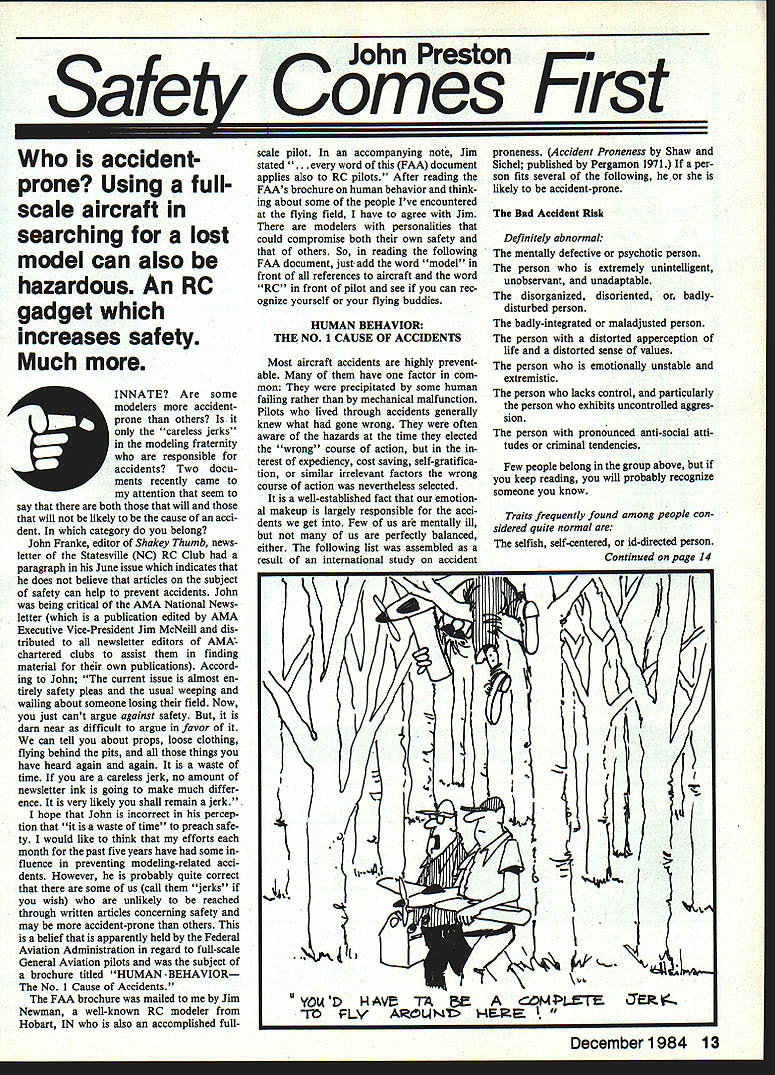
INNATE? Are some modelers more accident-prone than others? Is it only the "careless jerks" in the modeling fraternity who are responsible for accidents? Two documents recently came to my attention that seem to say that there are both those that will and those that will not be likely to be the cause of an accident. In which category do you belong?
John Franke, editor of Shakey Thumb, newsletter of the Statesville (NC) RC Club, had a paragraph in his June issue which indicates that he does not believe that articles on the subject of safety can help to prevent accidents. John was being critical of the AMA National Newsletter (edited by AMA Executive Vice-President Jim McNeill and distributed to all newsletter editors of AMA-chartered clubs to assist them in finding material for their own publications). According to John, "The current issue is almost entirely safety pleas and the usual weeping and wailing about someone losing their field. Now, you just can't argue against safety." But it is darn near as difficult to argue in favor of it. We can tell you about props, loose clothing, flying behind the pits, and all those things you have heard again and again. It is a waste of time. If you are a careless jerk, no amount of newsletter ink is going to make much difference. It is very likely you shall remain a jerk.
I hope that John is incorrect in his perception that "it is a waste of time" to preach safety. I would like to think that my efforts each month for the past five years have had some influence in preventing modeling-related accidents. However, he is probably quite correct that there are some of us (call them "jerks" if you wish) who are unlikely to be reached through written articles concerning safety and may be more accident-prone than others. This is a belief that is apparently held by the Federal Aviation Administration in regard to full-scale General Aviation pilots and was the subject of a brochure titled HUMAN BEHAVIOR—THE No. 1 CAUSE OF ACCIDENTS.
The FAA brochure was mailed to me by Jim Newman, a well-known RC modeler from Hobart, IN who is also an accomplished full-scale pilot. In an accompanying note, Jim stated "...every word of this (FAA) document applies also to RC pilots." After reading the FAA's brochure on human behavior and thinking about some of the people I've encountered at the flying field, I have to agree with Jim. There are modelers with personalities that could compromise both their own safety and that of others. So, in reading the following FAA document, just add the word "model" in front of all references to aircraft and the word "RC" in front of pilot and see if you can recognize yourself or your flying buddies.
HUMAN BEHAVIOR: THE NO. 1 CAUSE OF ACCIDENTS
Most aircraft accidents are highly preventable. Many of them have one factor in common: They were precipitated by some human failing rather than by mechanical malfunction. Pilots who lived through accidents generally knew what had gone wrong. They were often aware of the hazards at the time they elected the "wrong" course of action, but in the interest of expediency, cost saving, self-gratification, or similar irrelevant factors the wrong course of action was nevertheless selected. It is a well-established fact that our emotional makeup is largely responsible for the accidents we get into. Few of us are mentally ill, but not many of us are perfectly balanced, either. The following list was assembled as a result of an international study on accident proneness. (Accident Proneness by Shaw and Sichel; published by Pergamon, 1971.) If a person fits several of the following, he or she is likely to be accident-prone.
The Bad Accident Risk
Definitely abnormal:
- The mentally defective or psychotic person.
- The person who is extremely unintelligent, unobservant, and unadaptable.
- The disorganized, disoriented, or badly disturbed person.
- The badly integrated or maladjusted person.
- The person with a distorted apperception of life and a distorted sense of values.
- The person who is emotionally unstable and extremistic.
- The person who lacks control, and particularly the person who exhibits uncontrolled aggression.
- The person with pronounced anti-social attitudes or criminal tendencies.
Few people belong in the group above, but if you keep reading, you will probably recognize someone you know.
Traits frequently found among people considered quite normal:
- The selfish, self-centered, or id-directed person.
- The highly competitive person.
- The over-confident, self-assertive person.
- The irritable and cantankerous person.
- The person who harbors grudges, grievances, and resentment.
- The blame-avoidant person who is always ready with excuses.
- The intolerant and impatient person.
- The person with marked antagonism to and resistance against authority.
- The frustrated and discontented person.
- The inadequate person with a driving need to prove themselves.
- The extremely anxious, tension-ridden, and panicky person.
- The person who is unduly sensitive to criticism.
- The helpless and inadequate person who is constantly in need of guidance and support.
- The chronically indecisive person.
- The person who has difficulty in concentrating.
- The person who is easily influenced or intimidated.
- The careless and frivolous person.
- People who are very lacking in personal insight and an appreciation of their own limitations.
- People who have the sort of personality pattern that predisposes them to drink or drugs.
- The person who already gives evidence of addiction to alcohol or drugs.
- The person who has suicidal tendencies or who indulges in suicide fantasies.
- People who exhibit the personality characteristics commonly associated with immaturity, such as foolhardy impetuosity, irresponsibility, exhibitionism, inability to appreciate the consequences of their actions, hypersensitivity, easily aroused emotionalism, unrealistic goals, and a general lack of self-discipline, personal insight, worldly wisdom, and common sense.
A look at the words in the preceding list reveals many key causes of fatal aircraft accidents.
When a tragic accident occurs, people angrily ask why "someone" doesn't do something about the obvious risks certain pilots take. Well, "someone" has. There are some "do's" and "don'ts" available to pilots that, by statistical probabilities, could ensure the prevention of most accidents. On top of this list are the Federal Aviation Regulations and supporting Advisory Circulars. Born of a lot of know-how and practical experience, they are your checklist for survival. In addition, there are owner's manuals, the Airman's Information Manual, charts, operating limitations, Airworthiness Directives, and many other sources of safe operating procedures published by the Federal Aviation Administration and aircraft manufacturers. All this information serves only safety. Not to follow them is like going against your own doctor's or lawyer's advice.
So, why do we still break rules? It is mostly for immediate gratification of some emotional need, and the number of bad risks we take is large. It is common knowledge that a lot of things we often indulge in are not good for us: like smoking, speeding, overeating, gambling, etc. We know this, yet we still continue, often to the detriment of our health and lives. For whatever reason — it is usually our emotions, and this certainly holds true in aviation. The existing rules would go a long way to remedy this situation, but the same personality traits that cause irrational breach of safety also make a person prone to disregard the rules that would ensure a safe operation.
The study also came up with a model of a good accident risk. A look at this list could almost induce one to seek a whole new philosophy of life. According to this study, when you behave as a bad accident risk, you are showing your emotional weaknesses to everyone around you. The "good accident risk" model, however, portrays an entirely different person.
The Good Accident Risk
Traits found in people considered to be good accident risks are:
- The well-balanced person.
- The mature person.
- The well-controlled person.
- The person with a healthy and realistic outlook.
- The person with satisfactory interpersonal relations.
- The person with kindly and tolerant attitudes toward others.
- The person with a well-developed social and civic conscience.
- The person with an ingrained sense of responsibility.
- People who are essentially moderate individuals, able to exercise adequate control over their impulses and emotions.
- People with positive attitudes who are able to assess a situation as a whole and make decisions, provided they are not too aggressive.
- Contented people who are not outstanding, but who are friendly, cheerful, adaptable, and accepting—provided they are reasonably intelligent, realistic, and mature.
- People who have weaknesses and limitations, but are realistically aware of them and are careful, cautious, and moderate in their behavior, according to their limitations.
The decision is yours. You need not be a genius to be safe. You merely have to be an emotionally-stable individual and accept the notion that you are not in possession of all the facts for all situations and be willing to accept the recommendations of those who specialize in evaluating, assessing, and administering aviation procedures. One can always argue for different ways of doing things. In a large aviation community such as ours, consensus would be extremely difficult to reach. Our rules and procedures are designed to serve most of the people most of the time. A mature person can accept this gracefully and follow the rules for the benefit of all. The immature, emotionally immature person has to satisfy personal needs regardless of the consequences. The student carrying passengers, the non-instrument-rated pilot flying into weather conditions, and the local pilot buzzing the neighborhood are prime causes of accidents which often kill innocent bystanders.
It is easier to develop flying skills than good judgment. Good judgment may mean not flying when the weather is marginal (even if it is legal), grounding yourself after taking "over-the-counter" medication like antihistamines, or getting recurrent training after a long layoff. These are some of the decisions pilots make at the last minute. Unfortunately, many pilots fail to make the proper decisions. This is due partly to lack of knowledge and partly to human tendency to rationalize things until they look justifiable to us. In simple terms, when we really want to do something, we can generally make ourselves believe it is all right to do.
We can't make rules for every situation. Some of the decision-making is up to you. But you can decide on your personal limitations if you do it at a time when you are not involved in flying. Limitations to consider are fuel reserves, weather, drinking, fatigue, and others. Write them down. When you have a flight decision to make, re-read them and see whether you have enough character to stick with what you decided when you were conservative and not under emotional pressure to do something foolish.
The most important decision for you to make is to stick with the published rules, procedures, and recommendations. They are there for well-proven reasons and can take most hazards out of your flying. If you don't believe that, then you are really kidding yourself.
As a pilot, you hold human lives in your hands. You have a moral responsibility to operate in the safest way. If you are a bad accident risk, society would be better off if you didn't fly at all.
Full-Scale Aircraft Searches
Remaining on the subject of piloting full-scale aircraft, a recent letter from Claude ("Mac") McCullough, Product Engineer for Sig Manufacturing Company, suggested that I mention a word of warning to modelers who may use a full-scale aircraft to search for a downed model. On August 17, a veteran RC flyer from Oskaloosa, IA was flying in a Cessna 170 over a soybean field looking for a lost RC model. Both the modeler and the pilot of the Cessna were killed when the aircraft crashed and burned. Mac stated that this tragic accident was similar to a previous one that occurred in 1976 near Minneapolis. In that case, two modelers searching for a Free Flight model died when their Aeronca Chief crashed.
If you elect to try and recover a lost model by conducting an aerial search, the pilot of the aircraft should devote all of his attention to flying and let a passenger look for the downed model.
Electronic Aids and Safety Devices
A letter from Rich Muraldo (Freehold, NJ) tells of how he safeguards against the loss of models with a device that also can protect against RC frequency conflicts. Rich stated the following:
"For the past couple of years, I have been using a little electronic device in my airplane. It plugs into a receiver channel and emits a sound when the receiver is on and the transmitter is off. I purchased the device to serve as an aid in locating my airplane when (notice I didn't say if) it goes down in the woods surrounding our club field. However, use of this device yields other benefits more important than the use for which it was intended. It serves as a frequency monitor and a battery-saver.
"Although our club has (and uses) a frequency-control system (you must have the clothespin with your frequency before you turn on), we still do have an occasional accidental shoot-down. By using the device and turning on the receiver first (as one always should), you should hear the device sound off. If it doesn't, someone else will — your frequency is on the air!"
If they are flying, you will have prevented yourself from shooting them down. If a transmitter was just left on somewhere, you can locate it and make sure it is off and prevent yourself from being shot down. Secondly, if after flying you turn off your transmitter and forget to turn off your receiver, the device will remind you, thus saving your battery's charge and maybe preventing still another disaster.
Now, I realize that this device will not help prevent you from being shot down if someone on your frequency turns on while you are flying. Further, I don't mean to suggest that this device should substitute for field frequency control systems and a visual check around for other transmitters on your frequency. But it is great added insurance.
In summary, this little device is a frequency-monitor, battery-saver, and airplane-locator all rolled into one. It weighs less than one ounce and is very small. I bought mine at the WRAM show. It is called the Audio Direction Finder. Strobe-F-Light, 8405 Ave. N., Brooklyn, NY 11236 was selling them at a special show price of $13. There may be others on the market as well. The September 1978 issue of RC Modeler had a construction article for a similar device called the Sonic Locator.
While I am not aware of other commercial sources for the device described by Rich, there are some other electronic goodies available that are intended to improve the safety of RC operations. Radio Controlled Models, Inc. markets a personal frequency monitor, a transmitter switch alarm, and several devices to guard against battery failure and interference. For anyone interested the address and phone are:
- RCM, 4736 N. Milwaukee Ave., Chicago, IL 60630; (312) 282-1015.
Handling Materials and Chemicals
A recent issue of the newsletter of the San Diego Obiteers club contained some words of caution to those who may be contemplating the use of boron fibers to strengthen wing spars. Editor Howard Haupt had the following to say:
"Boron is a glass-like material and can be very brittle. Being brittle, it can shatter and cause small, sharp slivers. These slivers can penetrate the skin with ease but will not work themselves back to the surface. Once under the skin, they are at the least a minor irritant, at the worst a danger to the heart or lungs if they work their way into the bloodstream.
"Modern boron fiber is pretty well behaved, for it will break cleanly when bent sharply with pliers. One must take care to dispose of the scrap ends that are broken off. Little pieces of boron cannot be left laying about on the worktable or floor.
"Two ways were discussed to ensure proper disposal of boron scrap ends. One is to have a sealed bottle on your table which is the repository of all boron scrap as you work with the material. As you break the end off with pliers, continue to grip it with the pliers and drop it into the bottle. The second is to place masking tape on the end of the boron you are trimming. After breaking off the end, with the tape attached, dispose of it in a wastebasket."
Some precautions were discussed for the use of cyanoacrylate glues (CAs). CAs are superb adhesives and quite useful in many applications, but they will bond skin in seconds. If CA gets on the skin, soak the area in warm soapy water and use acetone (nail polish remover) to remove stubborn bits. CA fumes can irritate the eyes and respiratory tract; use CAs only in a well ventilated area. CAs can produce an exothermic reaction, particularly when bonding fabrics such as cotton or wool, and can cause burns; avoid using CA on such materials and keep them away from children.
According to an article by Chuck Furutani in the newsletter of the Soaring Union of Los Angeles (editor: Donna Gurski), we should also be careful if we handle graphite fibers (GF). Chuck writes:
"Do not play with GF, breaking small pieces, feeling surfaces, rubbing, etc. Small fibers can be embedded in your skin. Remember, GF is as dangerous as asbestos! Wash hands and examine them carefully, looking for fine black slivers before you go to the bathroom or handle the baby.
"Do not sand, plane, or grind GF laminates — or, if you must, use a good mask. Cut to size with sharp scissors, keeping track of all cuttings and disposing of them immediately."
Chuck's reference to the danger of asbestos (an alleged carcinogen if inhaled) brings to mind another newsletter article concerning lung irritants. The Winding Stoge, newsletter of the Nebraska Free Flighters (editor: Tom Winter), reminds us that balsa dust is not the best thing to breathe.
"What do you do with the buildup of balsa dust when you are sanding? The natural temptation is to say 'phoo' to it, and blow it away. Don't do it! Wipe the dust off. They will pack up pretty neatly. You can pick up the bunches, save them, and use them for fillets and bridging C/A glue gaps. Conclusion? Don't load the air with it; load storage bins! Wipe off the sanding dust."
I believe that in a previous safety column, I stated that our bodies function best when all we breathe into our lungs is air. Whenever you start filling your workshop atmosphere with particulates, be it from sanding or spraying paint, I urge you to use a mask.
Have a safe month.
John Preston 12235 Tildenwood Dr. Rockville, MD 20852
Transcribed from original scans by AI. Minor OCR errors may remain.

