
SAFETY COMES FIRST!
By John Preston
One of the pleasures of writing a monthly column is receiving letters of response from readers. Whether these are complimentary or derogatory really doesn't matter since either type shows that people are reading what we write and taking the time to respond. We do admit, however, that we prefer the compliments to the criticism. As it happens, most of the mail shows a positive reception to the column and we thank all of the writers of letters for the many interesting accounts of their safety-related experiences. Our apologies go to those who may not have received an acknowledgment to their letters. There are just so many hours in the day, and I like to build models, too.
Once in a while we have had a letter from a reader that disagreed with what we have said. Such a letter was received from K. L. McClenahan, an electrical engineer, who takes issue with the content of the column concerning electrocution hazards. Specifically, we are charged with making "several statements which are either false, misleading, or dangerous." We plead not guilty to the charge, but perhaps we did under-emphasize some points we were trying to make. For example, on the subject of how far an arc may jump from a high-voltage source to ground, he states:
"70,000 volts per inch represents about the maximum dielectric strength of dry air with D.C. voltage applied across a sphere-sphere gap with the air at standard temperature and pressure. With A.C. voltage applied or with different electrode shapes or with different atmospheric conditions, the dielectric strength of the gap may be much reduced. Power system engineers use clearances of about one inch per 1,000 volts for electrical equipment while accepting the fact that flashover will occur under some conditions.
"Under some conditions, such as a remote lightning strike on an overhead line, voltages far above nominal system voltage may occur on an electrical system."
We have to agree that the distance that an arc can occur between a source of high voltage and a grounded object could well be much greater than the 70,000 volts per inch figure that we quoted. Our figures were provided by an electrical engineer who also read over our finished column to check it for accuracy. So much for our choice of electrical engineers! We consulted the National Electrical Code to see if we could obtain further information on the clearances required for high-voltage power lines. We found this document to be almost totally useless for our purposes. There are just too many caveats attached to the figures that we found. Let us just say that if power lines either border or cross your flying field, keep well away from them, or better still, find another field. Under no circumstances ever get yourself or your model closer to the lines than you would be if you walked underneath them.
Thunderstorms and control-line (CL) models
On the subject of lightning strikes, we've had two other modelers mention the effects of thunderstorms in the vicinity of control-line flying. Perhaps the following excerpt from a letter sent to us by Bruce Denney of Ft. Smith, AR, best illustrates the phenomenon.
"I know enough not to fly right under a thunderstorm, but I learned a lesson about flying close to them. I was flying a stunter one day and there was a thunderstorm about four or five miles away. I could see a lot of lightning, but it was on the horizon, and there were clear skies above me and not too much wind yet. I figured I had about half an hour before the storm would reach where I was, so I fired it up and took off. The first couple of laps (about 20 ft. high) went OK. As the model went through a vertical (about 65 feet high) I got badly shocked. After that I kept it low, and after landing I packed up and went home for the day. I think there must be a lot of static electricity in the air even four or five miles away from a thunderstorm."
In a conversation we had with noted CL aerobatic and scale flier Keith Trostle, we heard a similar story of an electric shock being received through the lines and handle before there was any visible lightning or sounds of thunder. The lesson to be learned from these two "shocking" experiences is obvious: don't fly at any time that a thunderstorm threatens. This applies to R/C and free-flight (FF) fliers, too.
Battery chargers and isolation
Returning to the letter from K. L. McClenahan, the following is his comment on our warning regarding battery chargers that use dropping resistors instead of transformers:
"Anyone who has a battery charger which uses dropping resistors in lieu of an isolation transformer should stomp on it and throw the pieces in the trash can. Such devices are extremely hazardous and you (me) should never make any recommendation concerning them, except that they be destroyed."
We did ponder this subject for some time before giving our instructions regarding caution when using such a device. The reason that we didn't suggest you should stomp on them is simple economics. We theorized that our suggestions would be ignored and that people who decided to continue to use them might follow our safety instructions. The safest place for chargers with dropping resistors instead of transformers is indeed the trash can.
Model hits power lines — AP report
Before leaving the subject of electrical hazards we would like to quote from an AP wire story that was sent to us by Doug Dahlke. Doug read it in the January 1966 issue of Flying Models magazine.
"Watch those power lines. Take heed from the shores of jolly old England. From London comes this Associated Press release:
MODEL AIRPLANE HITS LIVE WIRES, COWS ELECTROCUTED
London (AP) — A model airplane got out of control Wednesday and nose-dived into farmer William Watt's cow pasture. On its way down it brought an 11,000-volt cable that ran across the farm. The live cable dropped on four pedigree cows feeding in the marshy pasture. The expensive quartet was electrocuted. All were expectant mothers. The broken cable blacked out Rainham village and Watt's Benwick Pond farm. Here is how it happened:
In the London suburb of Hornchurch, Andrew Burton, 14, was playing with his model plane. The model had a tiny gasoline motor and a four-foot wingspread. It climbed to 500 feet. Andrew lost control. The plane fell into a field and brought down an electrical cable. Four cows standing in the field were killed. Andrew's mother, Mrs. Sylvia Burton, said, "Andrew told me what had happened. I was amazed. I think the plane got out of control because the actuator that controlled the rudder was faulty. I'm changing the mechanism." Her husband went to see the farmer. He took it very well—considering. The farmer said Andrew and his father may not have heard the last of the freak accident.
So there you have it. I'm sure some may have seen the article when it originally appeared in FM magazine. We wonder if the Burtons did hear more from the farmer and if they carried liability insurance? We also wonder if Andrew finished "changing the mechanism," presumably the escapement of a single-channel radio. We feel the reader would agree you could buy a lot of radios for the price of a quartet of pregnant pedigree cows. The moral of this story is: should there be a requirement that all R/C models be equipped with a device (currently available) to retard the throttle upon loss of transmitter signal? If that doesn't generate some mail, nothing will.
Workshop fire hazards
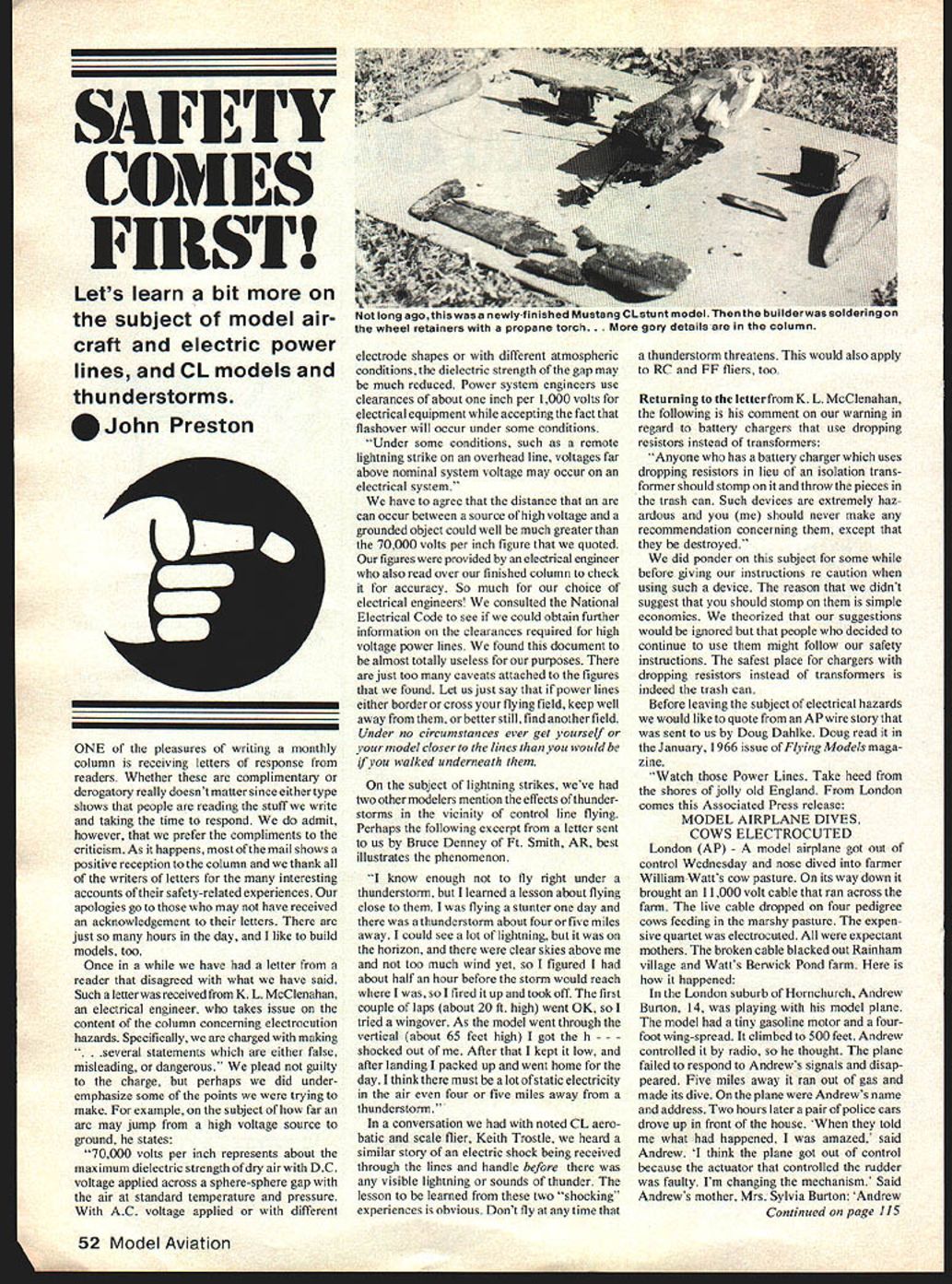
To wind up the safety column this month, we publish the story behind the picture of the charred little model, also from Doug Dahlke. A friend of Doug's was soldering the wheel retainers onto a model of a Mustang II using a propane torch/iron. The model had been recently finished with nitrate dope and was sitting on a balsa-dusted, covered workbench. The modeler "tilted the nozzle too far downward and the liquid (propane) ran forward causing it to 'burp' on his hand and airplane. Hand was quickly put out, but plane went up in seconds." Fortunately, it was only the model that burned up. But suppose a model had been hanging over the workbench or some cans of dope or fuel had been sitting close by? Modelers' work areas are often surrounded by combustible materials such as the balsa scrap box, cleaning rags, etc. Take a look around your shop and imagine what might happen if you accidentally started a fire. Is an extinguisher at hand? Perhaps it's time to perform your long overdue annual cleanup.
The Dissected Digit Award
Before signing off for this month we would like to announce a new award. Senator Proxmire has his Golden Fleece, and Laugh-In had its Fickle Finger. To be in harmony with our logo we are calling ours the Dissected Digit Award. The recipient will be someone who was involved in an incident or activity that, in our opinion, was not in the best interests of safety. We are unsure just who should receive the dubious honor of being the first upon whom this award is bestowed. If you turn to page 23 of the April issue of Model Aviation you will see, at the bottom left of the page, a photograph of a practice that appears to be less than prudent. Although the caption states that the model is being cleaned, the presence of the pump-equipped fuel can suggests a de-fueling operation. So, to either the father of the model's owner, to the columnist writer (sorry Ron), to the unobservant Assistant Editor, or to our noble publisher (it's a full gotcha, Carl) goes the first award of the Dissected Digit. May you do better in the future.
Who knows, you could be next on our honor roll. Have a safe month.
John Preston 7012 Elvira Court Falls Church, VA 22042
Transcribed from original scans by AI. Minor OCR errors may remain.

