
Safety Comes First
John Preston
Correction
In the November 1984 issue of the magazine, this column reprinted some advice from Harry Roe of World Engines concerning the safe operation of four-stroke engines. Unfortunately, due to a typographical error, it seems that Harry was telling you to tighten the prop nut not only once a year! In the middle of page 128 the statement by Harry should read:
"Harry recommends the prop nut be tightened before every flying session."
For the record, the word session got turned into season somewhere between my typewriter and the final copy in the magazine.
Five Years of Safety
This issue of Model Aviation marks my fifth anniversary as the author of this Safety column. Five years at the typewriter may not be as impressive an achievement as was recently claimed by Ron Van Putte, who has been writing his RC Pattern Aerobatics column since the very first issue of this magazine (June 1975). However, when Bill Winter, then the editor of MA, first asked me (in 1979) to consider writing the Safety column, I did not expect that I would be able to keep it going for five long years. The reason that it is still here is solely due to you, the readers of the magazine, and the many who have taken the time and trouble to write and report about potential safety problems which you have experienced or witnessed.
While most of my correspondence from readers has had favorable things to say about the column, there have been some letters from modelers upon whose toes I appear to have trodden. I consider this inevitable when, most of the time, I'm telling you not to do things that some of you have been doing for years without injury or incident. Such is life in the Safety business, which, in addition to this column, is how I earn my bread and butter.
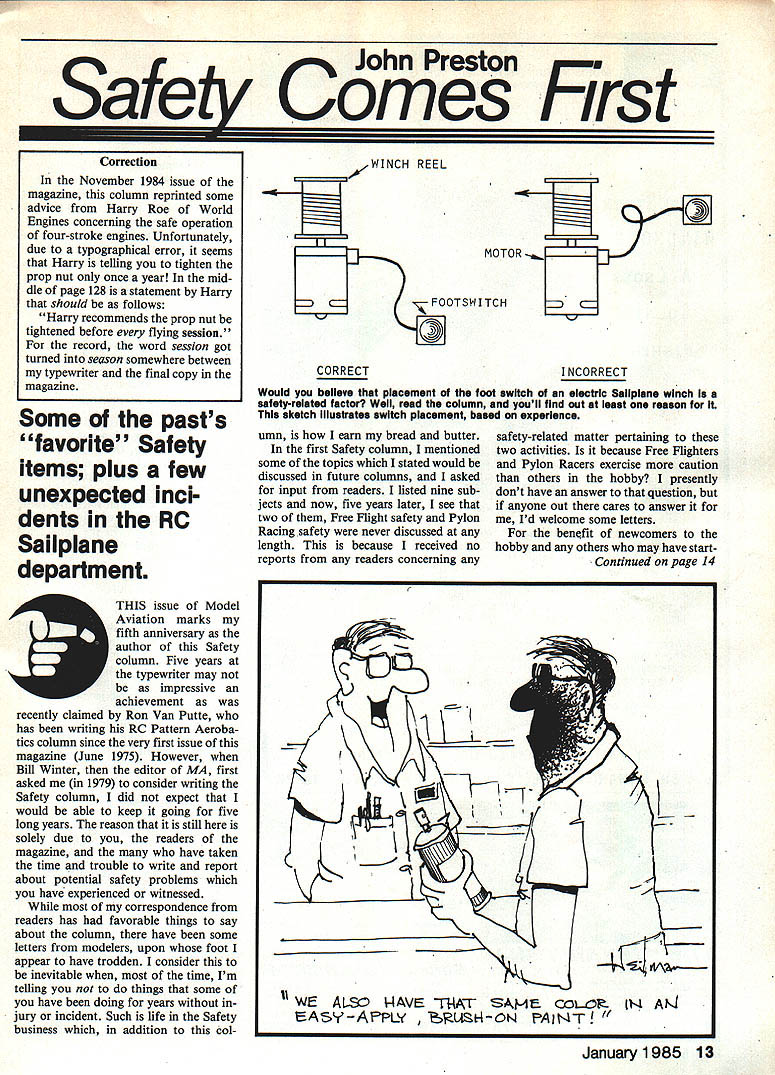
Would you believe that placement of the foot switch of an electric Sailplane winch is a safety-related factor? Read the column and you'll find at least one reason for it. (A sketch in the original column illustrates switch placement, based on experience.)
In the first Safety column I mentioned topics I planned to discuss in future columns and I asked for input from readers. I listed nine subjects and now, five years later, I see that two of them—Free Flight safety and Pylon Racing safety—were never discussed at any length. This is because I received no reports from any readers concerning safety-related matters pertaining to these two activities. Is it because Free Flighters and Pylon Racers exercise more caution than others in the hobby? I presently don't have an answer to that question, but if anyone out there cares to answer it for me, I'd welcome some letters.
For the benefit of newcomers to the hobby and any others who may have started reading this safety column only recently, I thought it might be worthwhile to summarize some of the more important safety messages which have appeared here from time to time over the past five years. I doubt it will come as a surprise to most of you that most of the safety messages are aimed at RC fliers. This is logical when you consider that the majority of AMA members are RC modelers. However, newcomers may not be aware that the most frequent deaths resulting from model-airplane-related activity were associated with Control Line flying and occurred when the model (or its control wires) contacted an overhead power line and electrocuted the pilot.
According to a 1980 statistic, there have been "43 electrocution deaths involving gasoline-powered model airplanes having handles and wires" since 1945. From 1980 to the present, I've received an additional two reports of such deaths, making the total 45 deaths over a 40-year time span—just over one per year. For CL fliers I'll repeat what I've said in several previous columns: Do not fly near overhead power lines!
Propeller Injuries
In the second Safety column I wrote for Model Aviation the principal topic was injuries caused by accidents with rotating propellers. I haven't done an exhaustive check, but I'll bet that in a majority of columns I've written since that issue there was a description of a prop-related injury of some kind. In the June 1984 issue I mentioned data on insurance claims that appeared on a computer printout obtained from AMA HQ. Of the claims for "bodily injury" listed, 69% mentioned that the injury was caused by a propeller.
I've said it before and I'll say it again: when starting and tuning an engine, be alert; don't be in a hurry; and tweak that needle valve from a position behind the propeller arc. A person in front of a running engine is in double jeopardy. First, reaching over or around the prop frequently results in a lacerated hand or a finger amputation. Second, if the prop or one of its blades comes off, the direction will be sideways or forward—but never backward.
Club Field Safety and Frequency Control
The subject of Safety Rules for an RC club flying field was covered in the May 1980 issue and drew some flak from a few readers. The column listed 43 different rules that I had collected from a variety of RC club newsletters. Some readers seemed to believe that all 43 should be observed at a given flying site. (That was not what I had intended.) The list was published so that individual clubs could compare their rules to those on the list and see if they were deficient in any area. I'm not going to reprint the entire list here, but if anyone wishes to receive a copy, send me an SASE (self-addressed, stamped envelope) and I'll be more than willing to oblige.
I will repeat one rule, the importance of which should be self-evident to RC fliers: No transmitter should be removed from the impound unless the appropriate frequency-control measures are observed. Frequency-control systems were discussed in another Safety column and were seen to vary from club to club. While there doesn't appear to be any system that is foolproof, the most common method of controlling frequency use appears to be one where a color-coded or channel-number marker is removed from a display board and attached to one's antenna prior to turning on the transmitter.
Paints, Solvents, and Aerosol Cans
A subject that provoked a lot of readers to write me was the toxicity hazard of paints, glues, etc. Not being a toxicologist, I have many times not been able to answer your questions. For example: how bad is it to breathe the fumes when you spray your model with epoxy paint? A paint manufacturer took exception to one story I printed in which it was alleged that a modeler experienced symptoms akin to a heart attack after such an activity.
Let me say that I know of no deaths that have been the result of breathing paint fumes, but the potential for a serious reaction—or maybe even death—is present if you insist on the super finish that can be obtained by using paints containing polyisocyanates. Probably the most common of these paints is DuPont Imron. This is a polyurethane enamel which requires mixing with an activator before use and shouldn't be confused with the type of polyurethane paint that can be used straight out of the can. In a DuPont brochure concerning Imron it states: "Danger, Vapor and Spray Mist Harmful. May Cause Lung Irritation and Allergic Respiratory Reaction. May Irritate Skin and Eyes. Flammable. Harmful or Fatal if Swallowed."
Theoretically, you shouldn't be able to purchase Imron for home use because it contains lead. Lead-containing paints are supposed to be available only for certain limited applications by professionals. Since DuPont suggests that those using Imron should wear an air-line respirator, I strongly discourage its use by modelers unless they have such a device.
Before leaving the subject of paint hazards, a story from the Gold Coast Flier (edited by Art and Charlotte Johnson) has a safety tip concerning that common product—the aerosol paint can.
Irv Allison encountered a problem worth passing along. He was painting a model with a Pactra spray can of urethane paint and, after shaking the spray, the nozzle came off. When Irv tried to replace it, he got a sudden blast of paint in his face and so did the garage. Fortunately, it missed his eyes, but Irv now has a nice, blue-striped shirt that matches his model. Apparently, when replacing the nozzle the spring-loaded valve inside the can either stuck down or blew completely out and the can emptied its contents rapidly. Changing spray nozzles or removing them for cleaning is common practice, but when you put them back Irv suggests that you make sure the can is pointed away from anything you do not want painted.
I know of other incidents in which people have spray-painted themselves because they were unaware of the direction in which the nozzle was pointing when they pressed the button. Several years ago the National Paint Coatings Association published a voluntary standard which contained requirements that addressed misdirection of the spray of aerosol paint cans. These requirements stated that the spray button should have a nozzle or collar that contrasts with the rest of the button, an arrow to indicate spray direction, and a contour on the top of the button that will permit the user to "feel" when the nozzle is pointing in the correct direction.
At the time the voluntary standard was published, I criticized the spray-misdirection requirements because I felt that the button contour requirement was not adequately defined. I don't believe that the slight slope on the top of the button enables you to tell, merely by touch, in which direction the nozzle is facing. So my tip to aerosol paint users is to always visually check for nozzle direction before pressing the spray button. Failure to do this could result in a shirt which, like Irv Allison's, is colored to match your model. It could also result in an eyelid full of paint, which would be a whole lot more serious.
Sailplane Incidents
I will finish this month's offering with a couple of incidents reported in recent letters, both involving model Sailplane activities.
The first incident was described in a letter from Ned Moss of Huntington, WV, a physician who required the services of another member of his profession as a result of a modeling accident. He wrote:
"Now that I'm at home, convalescing, I thought I'd write and tell you about an accident that happened to me while I was engaged in the safe and serene art of Sailplane flying. It must be one of the dumbest things I've done in my life (and I've committed some beauties), and also one of the weirdest—at least I've never heard tell of it before. In its potential consequences, it's also one of the most hazardous.
"I was out at the airstrip, alone, flying my Standard-size glider from an electric winch. On the flight in question, I launched the glider with insufficient airspeed, it stalled, lost directional stability and, while still on tow, dove into a nearby grove of trees and got hung up in the branches about 20–25 feet off the ground, the towline slipping off the hook.
"How to get it down? Climbing the tall, spindly tree was not possible, so I decided to try to snare it by looping a length of towline around it and hauling it down. I cut off about 40 feet of towline and tied a four-ounce lead ballast weight to one end. I then threw the lead weight, with line attached, up over the plane. Unfortunately, the lead weight (as I might have anticipated) got snagged in the branches as I began hauling back on the towline. The more I pulled, the tighter the weight seemed to get caught. I must have had about 80 lb. of pull on the line when the ballast weight tore free of the branches and came rifling out of the tree. I don't know at what velocity it was traveling, but it struck my leg with such force that it lacerated the soft tissue and fractured the tibia. I am, of course, fortunate that it didn't strike my face or head. I was also fortunate that a bystander was able to take me to the hospital.
"While this is not exactly an episode to be proud of, it must surely qualify for the idiot's prize of the month! Remember: Caveat Aviator!"
Although I have filed Ned's letter under "Sailplanes," it could equally well have happened to fliers of powered RC models or, more likely, to a Free Flight modeler. I doubt that there are any of us in this hobby (except CL modelers) who haven't, at some time, had a tree reach out and grab one of our models. And, like the tree Ned described, model-eating trees are almost never of the climbable variety. I'm sure you will join me in wishing Ned a speedy recovery.
Another incident involving RC Sailplane activity came to my attention in a newsletter article sent by Jim Scarborough, AMA VP for District X. The article appeared in the September 1984 issue of the North County Clouds Sailplane Club newsletter (editor Hugh Wagner) under the title "Winch Safety."
On Sunday, August 19, the club had another winch incident. Fortunately there was no injury. Al Doig was about to launch his Windsong; he stepped on the footswitch, the line broke, and the winch became a runaway. Al was left standing there with his Windsong in one hand and his transmitter in the other, looking bewildered. Fred Stahlehart was close by and yanked the negative power cable off the battery pack (the battery cable is purposely never tightened). After the dust settled, the club concluded the following:
- Al stepped on the switch and held his plane to build up tension on the line; the line snagged near the turnaround and broke. The sudden release of tension caused the line to whip behind the winch.
- Position the foot switch and power leads so they cannot be run over or pulled into the drum; stretch the switch cord out away from the plane of the spinning reel.
- Keep battery connections accessible so power can be removed quickly in an emergency (the club purposely avoids tightening the battery cable so it can be disconnected quickly).
- Always have someone available to cut power or stop the winch if the line behaves unpredictably.
Summary of Key Safety Points
Some of the points that have been covered repeatedly are obvious, but they bear repeating:
- Keep the flying site clear of spectators and nonparticipants. Establish a definite flight line and landing area, and see that everyone knows where to stand.
- Never fly over groups of people, automobiles, or buildings.
- Treat every engine as if it could start, and keep hands and loose clothing away from the propeller at all times. Secure the model on the bench or use a starter stick when starting engines.
- Use proper restraints (safety wire, locknuts, or thread-locking compounds) on throttle and carburetor linkages, and check them before each flying session.
- Inspect control linkages, pushrods, and clevises before flight; make sure all control surfaces are secure and hinges are in good condition.
- Check batteries, wiring, and switches for wear, secure connections, and correct polarity; replace or repair damaged components.
- Keep a well-stocked first-aid kit at the field and know the location of the nearest telephone and emergency services.
- When using winches or hi-starts, position the foot switch and power leads so they cannot be run over or pulled into the drum; stretch the switch cord out away from the plane of the spinning reel.
- Walk the landing area before flight operations to remove hazards and to be sure spectators are clear.
- If a model behaves unexpectedly in flight, shut off the engine or power and attempt to glide it to a safe landing; consider cutting throttle before entering a congested landing pattern.
Several readers have taken the time and trouble to write reports about potential safety problems they have experienced or witnessed. The correspondence has been encouraging; many readers have had favorable things to say about the column, and some have taken action to correct unsafe conditions at their clubs and flying sites. It is heartening to know that this exchange of information has resulted in safer flying for many.
Please continue to write with observations, incidents, and suggestions. Safety is everyone's responsibility, and the sharing of experience is one of the best ways to prevent accidents and injuries.
John Preston
Transcribed from original scans by AI. Minor OCR errors may remain.

