
Safety Comes First
John Preston
SAFETY ALERT
To: Owners of large, four-stroke engines Subject: Propeller drive pins
Several brands and models of four-stroke model airplane engines with displacements of 0.61 cu. in. and up are equipped with propeller drive pins in the prop drive washer. If you happen to own such an engine, it is strongly recommended that you do not use these drive pins.
Big four-stroke engines can be hard on props—especially plastic ones. Guard your eyes! A squirt of glow fuel can do them serious damage. Is there a cure for flyaway RC planes?
REVERSAL
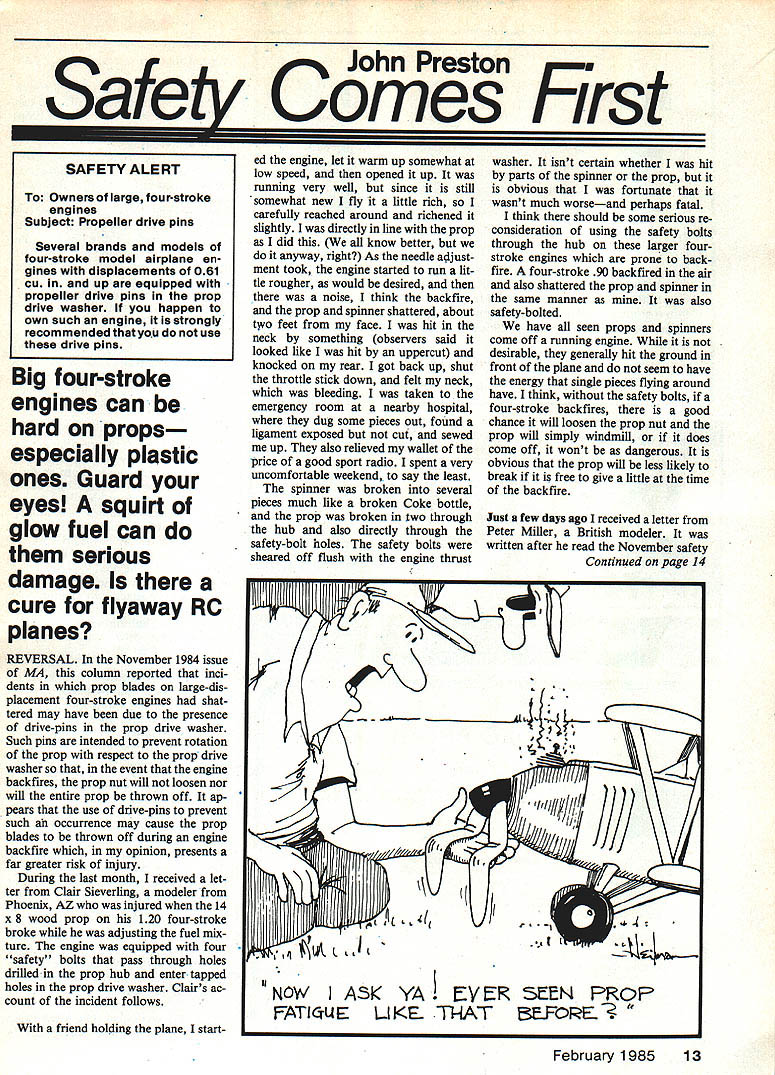
In the November 1984 issue of MA, this column reported incidents in which prop blades on large-displacement four-stroke engines had shattered. Those incidents may have been due to the presence of drive pins in the prop drive washer. Such pins are intended to prevent rotation of the prop with respect to the prop drive washer so that, in the event the engine backfires, the prop nut will not loosen nor will the entire prop be thrown off. It appears that the use of drive pins to prevent such an occurrence may cause the prop blades to be thrown off during an engine backfire which, in my opinion, presents a far greater risk of injury.
Incident: Clair Sieverling
During the last month I received a letter from Clair Sieverling, a modeler from Phoenix, AZ, who was injured when the 14 x 8 wood prop on his .120 four-stroke broke while he was adjusting the fuel mixture. The engine was equipped with four "safety" bolts that pass through holes drilled in the prop hub and enter tapped holes in the prop drive washer. Clair's account of the incident follows.
With a friend holding the plane, I started the engine, let it warm up somewhat at low speed, and then opened it up. It was running very well, but since it is still somewhat new I fly it a little rich, so I carefully reached around and richened it slightly. I was directly in line with the prop as I did this. (We all know better, but we do it anyway, right?) As the needle adjustment took, the engine started to run a little rougher, as would be desired, and then there was a noise. I think the backfire, and the prop and spinner shattered, about two feet from my face. I was hit in the neck by something (observers said it looked like I was hit by an uppercut) and knocked on my rear. I got back up, shut the throttle stick down, and felt my neck, which was bleeding. I was taken to the emergency room at a nearby hospital, where they dug some pieces out, found a ligament exposed but not cut, and sewed me up. They also relieved my wallet of the price of a good sport radio. I spent a very uncomfortable weekend, to say the least.
The spinner was broken into several pieces much like a broken Coke bottle, and the prop was broken in two through the hub and also directly through the safety-bolt holes. The safety bolts were sheared off flush with the engine thrust washer. It isn't certain whether I was hit by parts of the spinner or the prop, but it is obvious that I was fortunate that it wasn't much worse—and perhaps fatal.
I think there should be some serious reconsideration of using the safety bolts through the hub on these larger four-stroke engines which are prone to backfire. A four-stroke .90 backfired in the air and also shattered the prop and spinner in the same manner as mine. It was also safety-bolted.
We have all seen props and spinners come off a running engine. While it is not desirable, they generally hit the ground in front of the plane and do not seem to have the energy that single pieces flying around have. I think, without the safety bolts, if a four-stroke backfires there is a good chance it will loosen the prop nut and the prop will simply windmill, or if it does come off, it won't be as dangerous. It is obvious that the prop will be less likely to break if it is free to give a little at the time of the backfire.
Other reports and analysis
Just a few days ago I received a letter from Peter Miller, a British modeler, written after he read the November safety column concerning drive pins in the props of four-stroke engines.
Niel Tidey, designer of the very powerful Laser .61 four-cycle, tells me that modelers are using ordinary nylon props because of the lower rpm on four-cycles. This is dangerous.
Due to the powerful and long power stroke, the hub is accelerated and the prop tips tend to lag behind; then, as the engine comes up to compression, the hub is braked and the prop tips carry on due to flywheel effect. The prop is therefore flexing in a chordwise direction and, due to the shape, is probably twisting. This sets up fatigue very quickly and the prop fails. One chap had three brand-name 12 x 6 props fail one after the other. Glass-filled nylon ones seem OK, and wood ones are OK.
I can't help wondering if the failures of pinned props may be caused by this. The hub cannot move at all, so the flexing is more concentrated, while unpinned hubs allow slight movement of the prop hub. This is only my theory; the first part of the letter is fact.
I doubt that Pete's theory of fatigue being the reason for nylon prop failure also applies to pinned wooden props on four-strokes, since wood (to the best of my knowledge) is not subject to fatigue failure. However, I do believe in his suggestion that it is the inability of a pinned prop to move relative to the drive washer that is a leading cause of the reported failures. Perhaps we need a special design of prop for use on a four-stroke engine if it is going to be attached by multiple bolts or pins through the hub. A prop with a larger-diameter hub and a correspondingly larger-diameter drive washer may be what's called for.
Considering the quantity of fuel that must be burned each year by model airplane (and boat and car) enthusiasts, I hear of very few incidents in which fuel was associated with an injury. I'm sure that you all know that death could result if you drink it. That's why the Federal Government requires that it be sold in a container with a child-proof cap. However, I wonder how many of you are aware of the consequences of getting fuel in your eye?
FUEL IN THE EYE
Al Johnson, a member of the Cloud Kings RC club, recently wrote me and told me about a fuel-in-the-eye incident experienced by Henry Haffke (who should need no introduction to you, since he is so well-known for his many Gee Bee models, articles about which appear frequently in the modeling press). I recently wrote to Henry and asked him to drop me a line describing this incident. I think you will all agree that, based on the following extracts from Henry's response, fuel in the eye is to be avoided at all costs.
Henry Haffke's account
Our club was conducting a big Giant Scale Fly-In at the Millville airport on Sunday, and I took my three 1/4-scale Gee Bees (R-1, Model Y, and Model D) out to our field on Saturday to check them out and make sure they were flying right for the Sunday show. I had flown the R-1 and the Model D and was getting the Y ready to fly. I flew it once and made some adjustments and was in the process of refueling it for a second flight. I was using a powerful, hand-cranked rotary pump and, for some unknown reason, was not wearing my sunglasses (without which I never fly). I had my head over the pump, and the feed line came off and I got a good squirt of fuel directly in my right eye. Not a splash, but a direct stream right into the eye.
The pain was horrendous, and I thought of a bottle of water which I keep in my plane case in case of overheating trouble. One of the guys in the club poured the entire two-liter bottle into my eye. It didn't seem to help; my eye swelled and closed completely in just a couple of minutes. Another club member who lives near the field went home and brought back some Visine, which we put in the eye, and that didn't seem to do any good, either. The guys took my ships apart and put them in my station wagon and I drove home, about 10 miles, and immediately called my eye doctor. Though he was not immediately reachable, his office said they would try to get him and have him give me a call.
The pain was terrible, and after about 15 minutes I asked my daughter to take me to the hospital emergency room. Before we reached the counter at the emergency room, a nurse who is a very good friend saw me and asked what happened. As soon as she realized my trouble, she whisked me off to the treatment room and told my daughter to take care of the car. The nurse immediately flushed something into my eye (I believe it was saline solution), which immediately stopped the terrible pain. Meanwhile, my eye doctor had called my house and found I was on my way to the hospital, so he called there and gave them instructions as to what to do. By this time, I was much more comfortable, but I still couldn't see out of the eye. They put a patch over it and gave me some drops to put in periodically.
My doctor met me at his office on Sunday morning and, upon examination of the eye, told me that the entire surface had been burned away! He also said that the damage was done in the first three seconds, and even though I did everything I could at the time, nothing could have prevented the damage. He felt that, given the proper treatment and time, the eye would rejuvenate itself to its normal condition. He wanted a patch kept on it for a week or more, and I did just what he told me to do. My sight started to return in four or five days, but only fuzzy images. When I was able to remove the eye patch for good, the sight was poor, but improving slowly. Driving was a little problem, since I had sort of double vision which was multiplied by distance. For instance, the white line in the middle of the road started separating ahead of me and spread apart as I looked up the road. My doctor treated me for about two weeks before he released me and told me my eye would straighten out completely—but it would take some time. I was OK by then, but the vision was still distorted.
Back to the Fly-In the day after the eye accident. Since I was seeing out of only one eye, I couldn't fly, but each of my models was flown by my friend Sid for the thousands of people who had come to see models, full-scale aircraft, ultralights, and a balloon. It was a really big affair.
About a month later, I wanted to fly in a Scale contest, so a couple of days before I tried to fly a Kaos. I did sort of a foolish thing and took the model off without anyone else around. I immediately wished I hadn't, as I had two airplanes in the sky (which wasn't the best of situations). Fortunately, as the model is light, it could fly very slow, and I managed to land it OK. I wasn't ready to fly yet.
My eye continued to improve, and I would guess that after a period of about two months it was just about back to normal. One thing that was still noticeable at that time was the splitting apart of the white line down the road. It took about four months before that disappeared completely. Now the eye is completely back to normal, and I have had no further troubles. I'm sure that I would not have been so fortunate had I not immediately gotten in touch with my eye doctor, who is a top man.
I think Henry's account of his accident is sufficiently graphic that I really don't have to tell you to be careful when pumping fuel either into or out of your model. I've suggested the use of safety glasses previously. As Henry stated, he'd been wearing his usual pair of sunglasses; he could have saved himself a lot of pain and anguish.
RADIO FAILURE AND FLYAWAYS
A letter from Sam Hopkins, a modeler from Folsom, LA, related an unusual story concerning a flight of a Giant Scale plane powered by a .24 cu. in. Big Banger and weighing 22 lb. Generally speaking, the loss of radio command during flight is almost always fatal to the model. On the flight in question, however, when a radio fails in flight, the model will have sufficient inherent stability to continue to fly in a free-flight mode. Such was the case in the following account by Sam.
Sam Hopkins' account
Last Saturday (August 11), a friend and I went to our newly developed field to fly. We'd had scattered thunderstorms that day, so no one else was there. I usually use a 2 x 5 battery system, but had some corrosion problems and had substituted a regular switch harness with a single four-cell, four-amp pack. This pack didn't fit in the usual battery compartment under the cockpit (accessible with the wing removed). I have a hatch aft of the wing where the receiver and the 2 x 5 unit are secured. The substitute battery got stuffed into this compartment and not anchored down—just held in by the hatch. Big mistake!
On the second flight, with 25–28 oz. of fuel remaining, the hatch blew on takeoff. There was the plane, six or eight feet in the air, with full throttle and no radio. She banked gently to the left for 90°, then began a slow right climbing turn, then straight back over our heads at about 100 feet. It would fly straight, then turn right into the wind, then straight again for a while. This developed into a series of long ovals moving with the wind in an east-southeast direction. We packed up and dashed out onto the highway (I firmly believe in the Lord Jesus Christ, and I was busy telling others). My buddy kept the ship in sight for a mile or so but finally lost it in the overcast sky.
The immediate area was rural with a large lake about three miles to the south and several subdivisions plus a city (Covington) to the east. We hoped the plane would make it to the lake—I didn't want to see it again. I called the sheriff's department, but they had no report of it.
The next morning, a young lady called to say that the plane had crashed in her backyard. She lives immediately next to a shopping center and is flanked by a rental store and a "sonic" drive-in. It evidently flew in at a fairly gentle angle under a big power line and some pine trees. The lady wasn't too concerned and said her little ones usually played in the yard, but they weren't home at the time—about 6:00 p.m., we figure. Praise the Lord!
The ship was relatively intact: nose busted up, engine and firewall out, leading edge of left wing crushed. All electronics still work. John, what I'm praising the Lord about is that it evidently flew in circles over the city and just missed this big shopping center on a Saturday afternoon. It flew eight to ten minutes from flying field to impact.
I'm familiar with the Servo Guard—but how can it be utilized to retard the throttle if you have a total power failure? You may tell my story as an admonition not to "stuff" things together at the last minute. I did with the substitute battery. I would never have thought the plane would have kept on flying from takeoff like that. Heck, it flew smoother than when I'm controlling it—definitely a humbling experience.
Back in the days of "rudder-only," when RC models were really no more than Free Flight models with an ability (sometimes) to control the rudder, flyaways were more common. Today's models, many with neutral stability for superior aerobatic performance, generally bite the dust seconds after loss of radio signal. As Sam pointed out, there are devices currently on the market which will retard the throttle in the event of interference or loss of transmitter signal—but they require power from the on-board battery pack in order to function. If any readers have a simple solution on how to close the engine throttle upon loss of power from the on-board battery pack, please drop me a line. Meanwhile, please make sure that your airborne battery packs won't be ejected on takeoff. It could result in more than just embarrassment.
Have a safe month.
John Preston 12235 Tildenwood Dr. Rockville, MD 20852
Transcribed from original scans by AI. Minor OCR errors may remain.

