
Safety Comes First
John Preston
Beware boron filaments! Sullivan Products introduces non-metallic control lines. An unexpected problem with twin-engine models. More.
Boron filaments
The first topic this month may be of value to all modelers who are interested in building the strongest but lightest model on the block. The subject is boron filaments. It is wise to use this "space age" material, which I understand has a tensile strength of about 550,000 psi and a density similar to aluminum. A letter from noted Free Flight Scale modeler Bill Warner may cause you to think twice before you place your order. Bill had the following to say:
"In the latest issue of Model Aviation (November 1984), Bud Tenny mentions that the Indoor crowd is thinking of banning boron filament. Other columnists have cautioned modelers to exercise caution in its use. Well, I would like to add two cents and suggest that any modeler who has any sense will get rid of any he has by burying it in the back yard of someone he doesn't like. I am sorry I ever heard of the stuff!
"I have been limping since last July, thanks to that new marvel material. Despite exercising what I thought to be extreme caution, a few tiny, invisible bits, the size of human hair segments as long as a pencil lead is wide, got into the carpet between my building area and the bed. In an un-air-conditioned Southern California apartment in the summer, one goes barefoot a lot, and I soon found out how much fun boron could be when a couple of bits disappeared into my foot.
"How many are there, I do not know. Doctors tell me they can't locate the stuff, either. When one does work its way to the surface, a painful extraction session involving a magnifying glass, needle and tweezers wielded by my loving wife results. But it always retracts itself when you try to get it out, and breaks off a few times in the process.
"Re-carpeting would help, but that is expensive. I suspect that all the vacuuming in the world (and I've done plenty) would not get it out of the carpet. You can't see it. You can feel it up inside your foot, though. I have heard from an employee at Sikorsky that their policy, upon any of it getting into an employee, is to cut it out immediately. That's fine if you know where it is.
"Some modelers pooh-pooh the dangers of boron filament with the old 'X-Acto knives are dangerous and so is CyA. Do you want to ban everything?' Well, having just heard from a third friend who got CyA in his eye (a well-known columnist for Model Builder), I wonder about the latter. All three involved expensive and painful trips to the emergency room. X-Acto knives I can control with some expertise, and can keep away from my feet, fingers and eyes.
"I feel that the average modeler, like myself, is letting himself in for unnecessary grief with boron filament, due to the relative invisibility of the material coupled with its ability to puncture and maintain itself anonymously in the body at will, resisting attempts to remove it by breaking off and receding inwards when touched. It can cause discomfort and pain for an extended period of time. In addition, it stays in the environment of a carpet almost indefinitely, as you can't get it out with a vacuum or with a magnet (it's non-magnetic). Toxic fumes dissipate, X-Actos can be stored, CyA kicks off and has done with it, but that damned boron filament just sticks around and waits for the next time you pass by, barefoot. It can stick in the sole of a shoe and get you later, just in case you are thinking that you will just solve the problem by protecting your feet.
"My solution? Get rid of it! It's nice for lightening models, but the fiction that you are smarter than it is may backfire all too easily on you. I would not even give a model to a kid if he had boron filament in it for fear that he might break something and get the stuff into himself by accident. I'd almost as soon go to an RC pylon race as have boron in the house anymore..."
I have not used boron filaments, so I cannot give you any personal experiences that relate to its safe handling. However, since it seems that if "the Indoor crowd" is thinking about banning its use, they must be convinced that its use presents a relatively high risk of injury. An advertising flyer from a supplier of boron filament states that about 50% of their orders are shipped overseas. Apparently it is only made in the U.S.A. While a ban on its use in this country might save a lot of personal pain and anguish, it could also put our modelers at a competitive disadvantage when flying against foreign models at, say, a World Championships event. Any reader's opinions are welcome. Meanwhile, if you elect to use boron filament, handle it with extreme care, and don't say we didn't warn you if you get a piece in your finger or foot.
Kevlar (Aramid) control lines
So much for one "space age" material. Now, on to another one that, to the best of my knowledge, has no hazardous side effects. In fact, this one is specifically intended to prevent a hazard, namely, the electrocution hazard to control line fliers, some of whom seem to be oblivious to the danger of flying near overhead power lines. Four years ago, I had several letters from readers who suggested the use of aramid fibers for control lines to prevent electrocution of the pilot in the event the model or its lines touch an overhead power line. DuPont Kevlar is such a material and, in addition to being electrically non-conductive, it has a very high strength-to-weight ratio. I understand that Kevlar rigging cables were used on the pedal-powered Gossamer Condor and Albatross, and it is also used to fabricate bulletproof vests.
By the time you read this column, Sullivan Products should have introduced Kevlar control lines into the hobby marketplace. A couple of weeks ago, I talked to a friend who had tried out a pre-production sample of these lines, and he was very pleased with their performance. Even if your favorite control line flying site is free from overhead power lines, you might still want to switch to non-metallic lines. They should prevent that jolt of static electricity which I'm sure a number of fliers must have experienced when a thunderstorm is approaching. If control lines had always been non-conductive, at least 44 of our fellow fliers would still be with us today. Look for Sullivan's ad in the hobby magazines. You might just want to give this new product a try.
Safety Needle Valve Conversion Kit
Another new product which has recently been advertised in the hobby magazines is designed to keep your fingers out of the prop when you are adjusting the fuel mixture. World Engines has announced a Safety Needle Valve Conversion Kit which sells for $1.95 (retail) and can be ordered under Catalog No. 20550. The kit relocates the needle valve to the rear of the crankcase and will fit the following OS engines:
- .10 FS-R
- .15
- .20
- .25
- .30
- .35-20-FP
- .25-R / -FP
- .35-R / -FP
If any reader has already tried one of these conversion kits, I'd be interested to hear his opinion.
Propeller incident: Clancy Arnold
Staying on the subject of propellers, I recently received a report of a prop incident that happened to control line scale modeler Clancy Arnold. In the October 1984 issue of Model Aviation, Bill Boss's "Control Line Scale" column carried an article about Clancy's beautiful CL scale P-38. This model has an innovative control system to operate throttles, flaps, retracts, trim tabs, and brakes via digital proportional signals transmitted through the two control lines which operate the elevator by a standard bellcrank.
At a contest last year, Clancy had started the number one engine and, while in the process of starting number two, the glow plug jumped off the plug and "ticked" the propeller. Nevertheless, all appeared to be well, and Clancy took off.
Once in the air, the model behaved very sluggishly and, upon landing and shutting off the engines, Clancy found out the reason. The maple propeller on the number two engine was missing about a quarter of one of the blades. The erratic running and vibration that must have resulted from the missing piece of prop blade on that engine had been totally masked by the sound of the other engine. However, as you might expect, vibration caused by the out-of-balance prop on the "bad" engine had taken its toll. The engine carb had lost its retaining screw and had worked its way almost completely out of the crankcase, twisting around in the process, and jamming the throttle in the half-open position. In addition, the throttle servo arm had vibrated loose and three of the four engine mounting bolts were missing — their nuts were gone and the engine was flopping around loose inside the cowling.
Clancy called the magazine and related his experience to the Associate Editor because he thought that other modelers might benefit by hearing about it. Anytime something "ticks" your prop, the glow plug clip, the ground, or even the tip of your finger, stop the engine and make some checks. Better to be safe than sorry.
National Model Aviation Safety Month
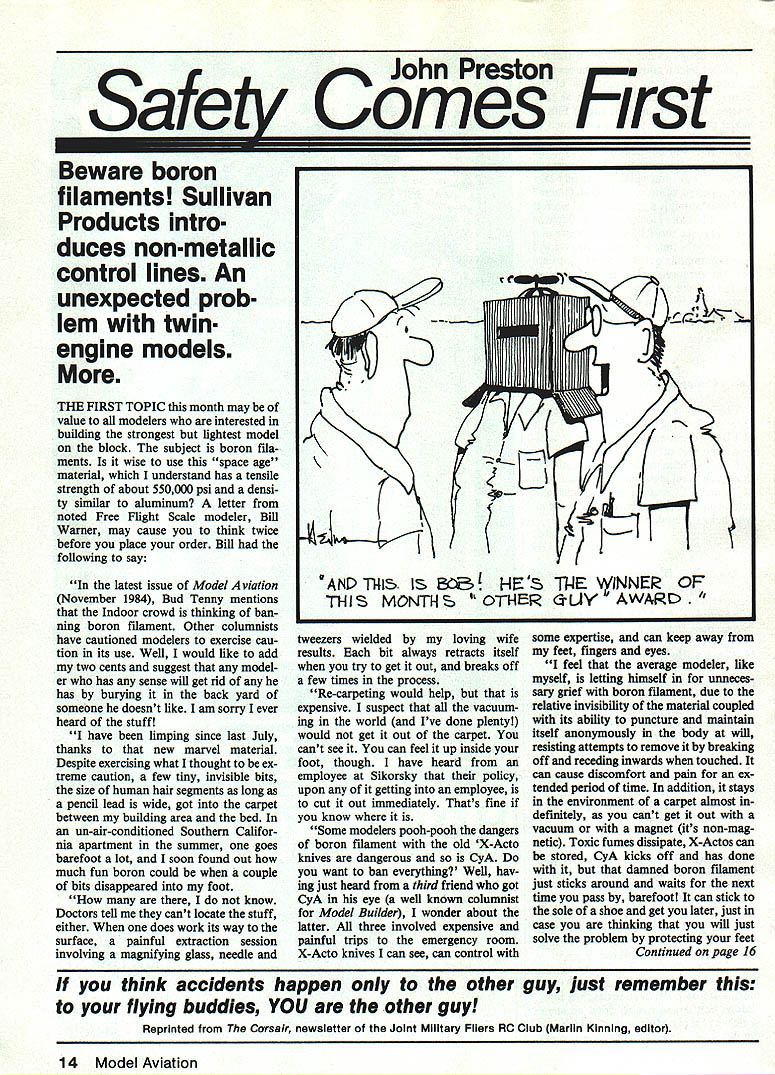
At the AMA Executive Council meeting held in Toronto on October 20–21, 1984, it was decided that May 1985 will be National Model Aviation Safety Month. I doubt you will be reading more about this in forthcoming issues of the magazine. When I heard of this Council decision, I started thinking about ways in which each and every one of you could, in some way, contribute to the obvious goals of this effort. Since I started this month's column with a safety hint concerning "the other guy," I'm going to finish on the same note by reprinting an article titled "Pardon Me!" which concerns "the other guy" who, to your fellow club members, just might be you. I suggest that, for National Model Aviation Safety Month, you all strive to avoid being "the other guy."
The following article was anonymously submitted to the editor of Tail Spinner, the newsletter of the Greater Southwest RC Club of Bedford, TX. I have Ron Van Putte to thank for forwarding it to me.
PARDON ME!
I've been meaning to write this letter for a long time now, but punctuality is not one of my strong points. I realize that you are all a patient bunch, you put up with a lot... you put up with me. I realize that I've been discourteous in many cases, downright rude in a few others, and in a couple of isolated instances, I've jeopardized your safety. Well, I'm here to say I'm sorry. That's not to say it won't happen again. After all, I'm apologizing, not foretelling the future! You already know you can't expect too much from me, so don't push.
You remember the time your airplane did that woofer-dill and you thought you were going to crash? Thought you had radio interference, didn't you? Well, you didn't. I just turned on without thinking, and then I was too embarrassed to admit I'd done it. Well, I'm sorry 'bout that. And, remember the time I ran my engine up in the pits and covered your airplane with dirt and dust? The reason I didn't say anything to you was that I was just a little embarrassed about doing such a careless thing. Well, I'm sorry about that, too. Next time I run up my engine, I'll try to move out away from the pits more; it should be safer, too, since I generally run old beat-up props on my larger engines (cheaper that way, you know).
I don't mean to wear you out, but do you remember the time that I flew that decrepit old yellow (or was it red?) airplane? That one everyone was sure would never stay together through the first flight? Remember how I really stopped everyone's heart when I flew it over the pits and dive-bombed those spectators? Well, I've been thinking about that, too. Guess I kinda lost my head. And as long as I'm bringing up the past, how 'bout that time I flew low and fast over you when you yelled "dead on the runway" and were out there retrieving your airplane... it kinda seemed funny at the time. But, I'm sorry. I sure do apologize.
Listen, just one other thing. There was that time I let time slip by and then had to rush home (my niece's birthday). I didn't mean to leave a mess behind; it wasn't as bad as the time I backed over the trash barrel and then pretended not to notice. I promise I'm going to be out there one of these Saturdays real soon and help out cleaning up the flying site to make up for my carelessness. And, I'm going to show up for one of those field work parties one of these weekends, too. Next Saturday? Uh, no, but real soon, I promise.
Dang. It sure feels great to get all this off my chest. You guys have really been tolerant of me. I hope you won't hold all this against me. Who am I? You know me... I'm the other guy!
Have a safe month.
John Preston 12235 Tildenwood Dr. Rockville, MD 20852
Transcribed from original scans by AI. Minor OCR errors may remain.

