
Safety Comes First
John Preston
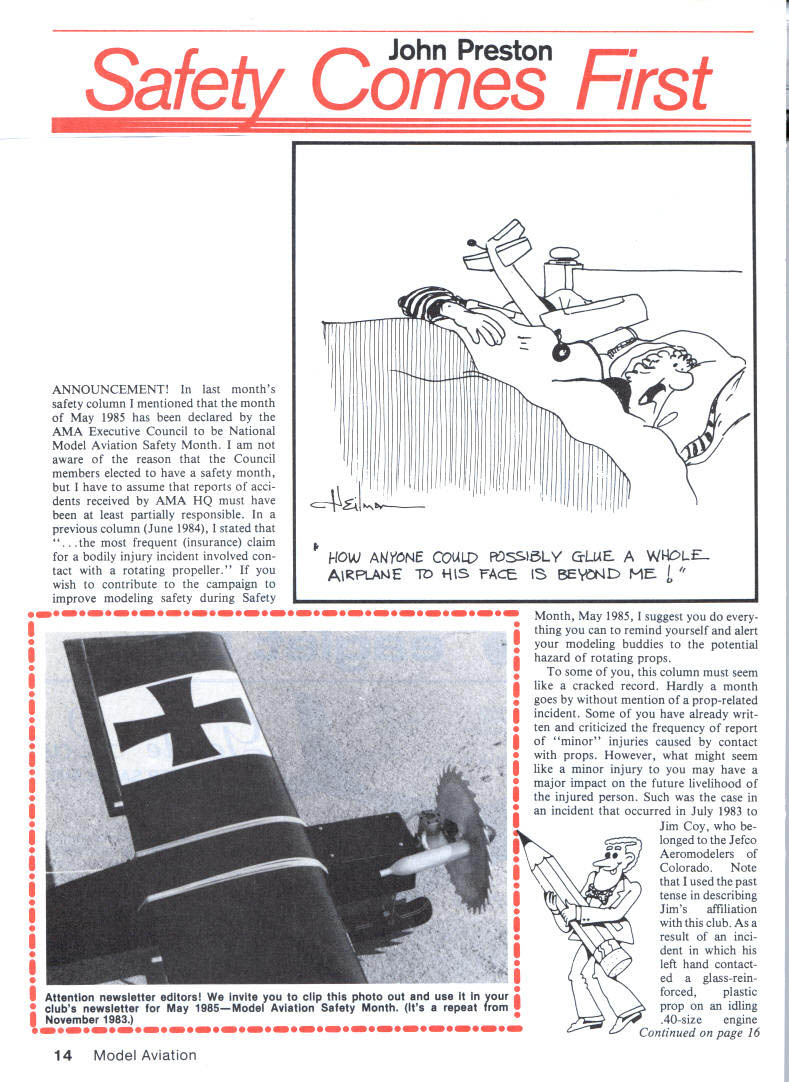
ANNOUNCEMENT! In last month's safety column I mentioned that the month of May 1985 has been declared by the AMA Executive Council to be National Model Aviation Safety Month. I am not aware of the reason the Council members elected to have a safety month, but I must assume that reports of accidents received by AMA HQ were at least partially responsible. In a previous column (June 1984), I stated that "... the most frequent (insurance) claim for a bodily injury incident involved contact with a rotating propeller." If you wish to contribute to the campaign to improve modeling safety during National Model Aviation Safety Month, May 1985, I suggest you do everything you can to remind yourself and alert your modeling buddies to the potential hazard of rotating props.
To some of you, this column must seem like a cracked record. Hardly a month goes by without mention of a prop-related incident. Some of you have already written and criticized the frequency of reports of "minor" injuries caused by contact with props. However, what might seem like a minor injury to you may have a major impact on the future livelihood of the injured person. Such was the case in an incident that occurred in July 1983 to Jim Coy, who belonged to the Jefco Aeromodelers of Colorado. Note that I used the past tense in describing Jim's affiliation with this club. As a result of an incident in which his left hand contacted a glass-reinforced plastic prop on an idling .40-size engine (described in the November 1983 Safety column), Jim has had to give up RC modeling as a hobby and, far more serious, is no longer able to pursue his profession as an instructor and player of guitar and banjo.
The following is excerpted from Jim's December 7, 1984 letter to AMA Headquarters.
Excerpt — paraphrase from Jim Coy's letter to his club safety director:
"My accident occurred on the morning of July 7, 1983 at the flying field while attempting to test fly a new plane.
"The airplane was sitting on the ground when it was being started and had a .40 engine that was running a standard 10x6 black plastic propeller.
"The engine was running at a slow idle, where the plane did not move under its own power. I was in front of the plane and on my right side was the radio transmitter. To my left was my flight field box, and I was on my hands and knees looking for a possible rudder misalignment. After not finding one, I leaned to my right to pick up the transmitter to fly, and, by so leaning, pulled my left hand into the blades of the propeller on the running engine."
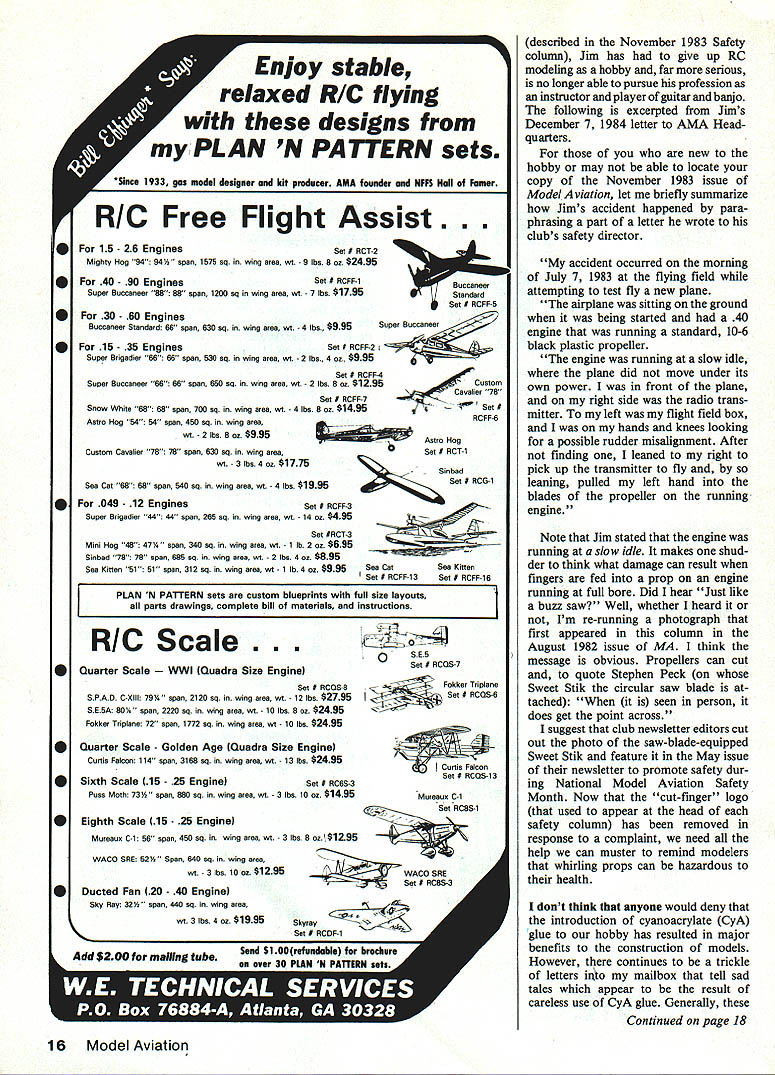
Note that Jim stated the engine was running at a slow idle. It makes one shudder to think what damage can result when fingers are fed into a prop on an engine running at full bore. Did I hear "Just like a buzz saw?" Well, whether I heard it or not, I'm re-running a photograph that first appeared in this column in the August 1982 issue of Model Aviation. I think the message is obvious. Propellers can cut, and, to quote Stephen Peck (on whose Sweet Stick the circular saw blade is attached), "When (it is) seen in person, it does get the point across."
I suggest that club newsletter editors put the photo of the saw-blade-equipped Sweet Stick and feature it in the May issue of their newsletter to promote safety during National Model Aviation Safety Month. Now that the "cut-finger" logo that used to appear at the head of each safety column has been removed in response to a complaint, we need all the help we can muster to remind modelers that whirling props can be hazardous to their health.
Cyanoacrylate (CYA) glue incidents
I don't think anyone would deny that the introduction of cyanoacrylate (CYA) glue to our hobby has resulted in major benefits to model construction. However, there continues to be a trickle of letters into my mailbox that tell sad tales appearing to be the result of careless use of CYA. Generally, these letters tell of body parts being inadvertently stuck together or to a model or the workbench.
A typical incident of this type recently appeared in The Satellite, newsletter of the San Valeers MAC (editor: Ralph Prey). I have to thank Jim Scarborough for sending me the newsletter, which contained three pages of safety-related material. Concerning CYA glue, the editor had the following to say:
"Then there's the time I (your editor) got CYA in my ear. Now, how the heck can you get it in your ear? You ask? 'Good question... Let me explain.
"'Very simple' is my answer. You've all used Hot Stuff, Zap, etc., and it all clogs up in the end of the nozzle, plastic tube, or whatever you use to act as a spout. I was in the habit of squeezing the bottle with my right hand and holding it up to my ear so I could hear the hiss of escaping air as I squeezed to determine if the tip was clogged or not. One time I squeezed and nothing happened—so I squeezed again and leaned more closely. Then it happened... POW, CYA shot out of the clogged tip and sprayed my right ear. It got all over my ear on the outside, and, luckily for me, it didn't get into my ear or on the eardrum. It was days and days before it all came off. I even used heptane or nitro but couldn't get the dried glue out of the folds in my ear. So, from now on, I don't listen for the hiss; I just try using it as it is.'"
Excerpt — further from Jim Coy's December 7, 1984 letter
"I am writing you this letter to resign my membership and return my AMA number, and to say thank you for your support after my accident with a prop in July of 1983.
"As you know, my hand was severely cut up in that accident. Since that time, it has been getting better to a point where I have 80% of the movement back, but unfortunately no grip. The joint from the thumb to the wrist was destroyed, and my doctor doesn't know any way to improve it, as there is no way to reattach the thumb to the wrist so that it is movable. Therefore, I have had to retire from professional playing and teaching of guitar and banjo, as I can no longer carry on without the left hand being able to grip the neck of the instrument. When you have done something for 20 years and are finally good enough to get paid well for doing it, to lose it is really hard!
"However, my main concern is for the people who are still able to do the RC hobby. To them, I would like to say something.
"Please be aware of what you are doing each second you are doing it. I think the one most important thing I have seen which contributes to the safe operation of RC aircraft is that the person doing it is either concentrating—or is not concentrating—on what they are doing. Also, be aware that you are not the only one at the flying field when you are caught up in preparing to fly. Just stop and look around you and think: 'I am truly responsible for their safety as well as my own.' Then take a long look at your plane to be sure it is safe and is not a potentially out-of-control, deadly weapon. Also, pay attention to the rules for your flying site—they are there for a reason!
"I am truly sorry and sad to have to give up a hobby that I dearly loved due to one accident which was caused by my own lack of concentration on what I was doing. Remember, hindsight is always 20/20."
Allergic reactions to CYA
Unfortunately, there are a few modelers who are unable to reap the benefits of CYA glue because they are allergic to it. Such an allergy may develop over a period of time, and it may not be immediately apparent that it is being caused by use of the glue coupled with the almost unavoidable problem of breathing the fumes that result when it cures. Roy McGuckin is such a modeler and has asked that I publish the following letter he wrote to me "as is."
"I have had severe problems with CYA glue and have had to stop using it. Two of my friends have had to give it up, also. My symptoms were hive-like itching all over my body. One friend had severe and long-lasting (eight weeks) sinus pain. The other had severe chest pains. My lungs were also congested. The X-ray report read 'severe congestion, possibly advanced emphysema.' Since I don't smoke and have always had good chest X-rays, this was kind of scary. My doctor made a literature search on CYA, but nothing is available.
"After my first attack, I stopped using it, and after two months my itching finally stopped. So, I started using it again—but without breathing extra fumes. No good. The itching is back as bad as ever. The main objective now is to find out the long-term effects of this chemical so that others can be warned, if needed."
In response to previous letters concerning allergies to CYA glues, I have attempted to find articles on this subject in the medical literature. My search proved fruitless. If there are any doctors or toxicologists among our readers, I would appreciate it if they could spend a few minutes thinking about this potential problem. If anyone discovers anything concerning the long-term effects that might result from breathing CYA fumes, please drop me a note.
Respiratory concerns from wood dust
Staying on the subject of respiratory problems, and at the risk of being accused of being a scaremonger, the following newspaper clipping, sent to me by Captain William G. Carson, USN, appeared in the March 14, 1980 issue of Pacific Stars and Stripes:
"Dearborn, MI—A study of nearly 1,300 death certificates shows that cancer deaths among wood-model builders and patternmakers are significantly higher than in the general population, federal researchers say."
Perhaps we should all give some thought to wearing a mask before we next fill the workshop with balsa wood dust in our quest to produce a perfect model.
Carbon fiber and other "space-age" materials
Returning to the previously mentioned three-page safety article in the San Valeers newsletter, I have another caution to modelers who may elect to use "space-age" materials to construct light but strong models. The article covered both boron filaments (discussed in this column last month) and carbon fiber. Again, I'll let the editor, Ralph Prey, do the talking.
"Carbon fiber is another high-tech, super-space-age product that can cause a tremendous amount of misery if you are not careful when working with the stuff. I'm talking about the sheet stuff that is .008 in. thick, not the flexible roving, which is like a rope or clothesline.
"After cutting the carbon fiber, do not, under any circumstance, run your fingers along the cut edges. There are very minute strands of carbon fiber you can't see which will be like slivers and go right into your flesh, and break off. Ask Mike Stern about the sliver of carbon fiber he got in his index finger. It entered his finger on the bottom fleshy surface and went right through the middle of his finger. That's enough to make you sick just looking at it, much less trying to get it out without its breaking up. He was lucky and pulled it out from the top without poking it...he hopes.
"Then there was the time that I had a sliver get into my middle finger on the bottom fleshy side, and all I could see was the black speck of the end of the strand, nothing sticking out to grab with tweezers. I took a needle, sterilized it and began to dig where the skin was still tiny and trying to stop the wound bleeding and still grab it with the tweezers, with it hurting all the while. I finally got a tiny sliver out and I thought I would throw up.
"It was a day or two after I had cursed my luck; the sliver had been in the finger two or three months and had worked its way in so far it had to be removed with a deep cut. The doctor told me that while I was under the anesthetic he had to remove the sliver which had run lengthwise, parallel with the bone. It's no wonder it hurt like the devil all the while I was trying to get it out."
You have been warned.
I think that's enough gore for this month. Have a safe one.
John Preston 12235 Tildenwood Dr. Rockville, MD 20852
Transcribed from original scans by AI. Minor OCR errors may remain.

