
Safety Comes First
John Preston
If there's anything that will promote safety at the RC flying field, it's to have a good set of flying rules and for everyone to abide by them.
HARK! In the January 1985 issue of Model Aviation I summarized some of the topics that have appeared in this column over the past five years. One such topic was flying field rules for R/C clubs. For the benefit of those who were not R/C'ers when that column appeared (May 1980), I have reprints available. All I ask is that you enclose a SASE with your request.
As with all rules that are established to control our lives, there will always be some who ignore them. I've recently seen a number of articles in club newsletters that concern violations of club flying field rules. So, the first topic this month is enforcement of rules at the flying field.
Enforcement of Rules
The Hedge Hoppers club of Arlington Heights, IL appears to have a straightforward solution to rules enforcement, as mentioned by their club's Secretary/Treasurer, Bob Mayhercy, in a recent newsletter. Under the title "A View from the Rear Cockpit," Bob wrote:
"Last Saturday, Dick Newford came up to me and handed me two dollars for the club treasury. Not that the treasurer doesn't like to accept money, but somehow I just didn't like to take this cash. Why? Because it's penalty money from two people who flew too close over the pits—and that means safety violations.
"It also means we are relaxing our watchfulness—or worse, getting careless—and this is when accidents happen. So, while money will never stop an accident, I hope it will bring home the point to all on how carefully we must fly. I can see how easy it is to keep our eyes on a plane in the sky so that ground orientation is lost, momentarily.
"Most of us remember how a former, well-qualified member crashed his high-speed aircraft on Garland Road right in front of Murphy's entrance. Crashing there with no injuries was pure luck, and it might not be so next time. Hate to keep saying this, but safety requires constant vigilance. There is no other way."
I feel the same way as Bob. Having a monetary penalty for lawbreakers might be a way to swell the balance in the club's checking account, but it's better to have members voluntarily abide by the rules that were established to ensure safe flying practices. I'm curious to know if the Hedge Hoppers have any problems collecting fines from the lawbreakers.
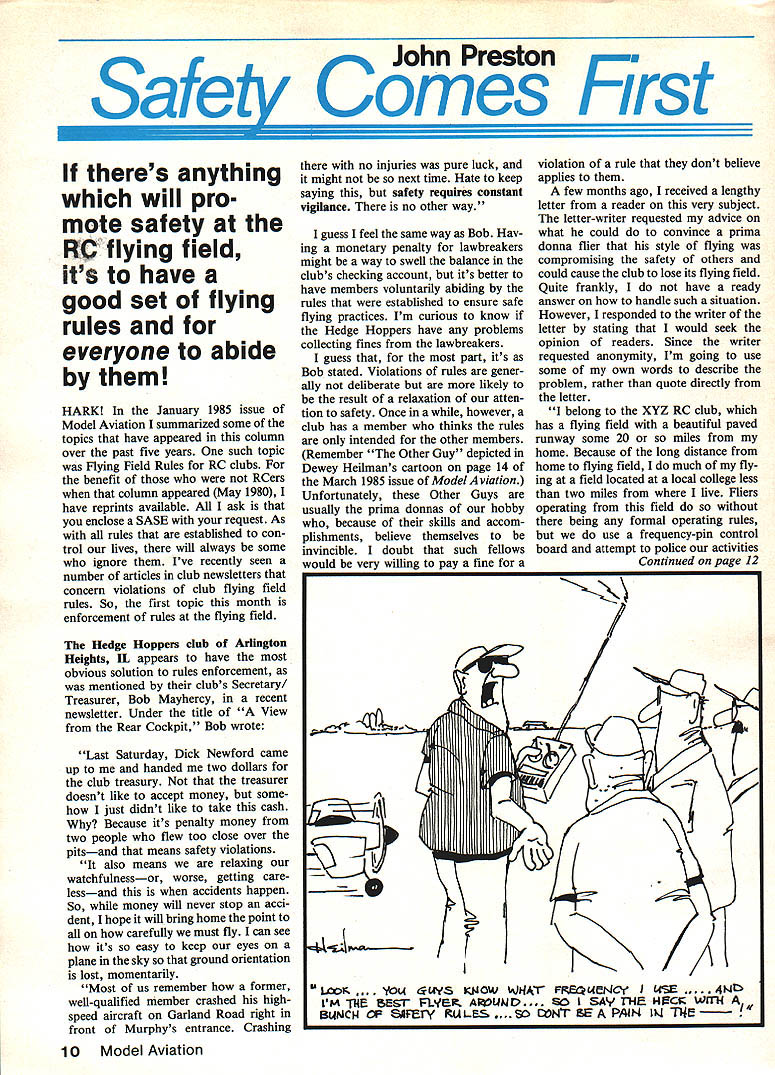
For the most part, as Bob stated, violations of rules are generally not deliberate but are more likely the result of a relaxation of our attention to safety. Once in a while, however, a club has a member who thinks the rules are only intended for other members.
The Prima Donna (the "Hot Dog") Problem
A few months ago I received a lengthy letter from a reader asking advice on how to convince a prima donna flier that his style of flying was compromising the safety of others and could cause the club to lose its flying field. The writer requested anonymity, so I'll describe the problem in my own words.
The writer belongs to the XYZ RC club, which has a flying field with a paved runway some 20 or so miles from his home. Because of the long distance, he does much of his flying at a college field less than two miles from home. Fliers operating from this field do so without formal operating rules, there is no use of a frequency-pin control board, and we attempt to police our activities informally.
In the 13 years the writer has flown at the college field there have been very few safety-related incidents; he feels the record is excellent considering the volume of flying. The bulk of the fliers are AMA members and do a good job of promoting the AMA and safety. The problem is one recurring individual.
"We have a recurring problem with one individual who is in his mid-twenties and has been flying RC since he was about five years old. To give credit where it is due, I must say that he is probably the best flier in the area. He flies Pattern with extreme proficiency and has won many contests over the years both in this state and a neighboring state. The only thing that prevents him from becoming a World-class flier is time and money. He can fly anything from gliders to helicopters, all very proficiently. The problem is the 'Oscar Mayer Syndrome.' He is a Hot Dog! He must be the king whenever he goes. He knows how good he is. Ask him, he'll tell you. Many of the newer fliers at the field 'ooh' and 'ah' at his ability. He is very impressive at first glance, possesses an unmatched air of confidence, and places 110% confidence in his equipment.
"Our problem flier has a group of cronies who tag along with him, but most of them are even less a fraction as good a pilot as he. But, they try. Oh, they try! We had one accident where one of his group was going to do a roll on takeoff as soon as the airplane was high enough for the wing tip to clear the ground. Well, the airplane got cattywampus and impacted the fender of a car. There was only about $200 damage to the car. The airplane narrowly missed several people standing near the car, including a four-year-old boy. This is only one incident, but there have been several other less-serious occurrences. I'm afraid the big one is yet to happen.
"A recent fad of this guy and his group is to not put frequency flags on their transmitters. Their rationale behind this is: 'Without frequency flags, the other fliers are forced to ask what frequency we are on.' When I received this reply, I just kept cool and walked away.
"The guy flies at this field partially because of the locale but mainly because there are no formal controls at the field. He has been censured at the XYZ field because of his incidents of non-conformity. We are under no formal agreement with the college, so at any time they could say, 'We don't want you here anymore.' The Hot Dog knows this, and he knows that we won't go to the college officials with the problem because of the possibility of losing the field. Therefore, other fliers walk around white-knuckled because of his antics. He is basically beyond reproach. There doesn't seem to be much that can be done to stop him. We have tried to talk to him but to no avail. How would you recommend we handle this situation?
Signed — A Concerned Club Member"
The letter-writer also noted that he had already talked to a fellow the Hot Dog respects, but that attempt had failed to change the Hot Dog's behavior. It is a shame, because if the Hot Dog's attitude would change he could be a positive influence in the hobby—but he appears unlikely to grow up. The writer closed by asking for advice and requested that his name not be mentioned because the Hot Dog had threatened in the past.
So, there you have it: the classic prima donna. How does one deal with such a situation without creating bitter feelings and repercussions? If any readers have an answer, I'd like to hear from them.
Beginner Complacency and Flight Line Conduct
Another newsletter article I read recently deals with both lack of attention to rules and beginner fliers who graduate too quickly to models beyond their capabilities. The writer was the editor of a club newsletter and was candid about the apparent lack of attention to safety. The club affiliation will remain anonymous.
"Once the summer show team season finished, I enjoyed the opportunity to return to the club flying field for some good old sport flying. What I noticed almost immediately was a transition from novice to beginner in a large number of fliers. Those who I had observed flying Eagles earlier in the season had progressed to exotic things like Quickie 500s.
"What I also observed was an increasing occurrence of the phenomenon I call 'beginner's complacency.' This dangerous phase in a flier's development occurs not long after solo and again after each transition to more-aerobatic, faster, and more-complex machines. In those stages, a beginner's coordination, reflexes, and experience are insufficient to cope with every situation encountered; yet, the flier doesn't completely accept that fact. Consequently, one of two things happens. Either the plane gets so far out in front of the pilot that he simply loses control at some unexpected moment, or he puts the aircraft in an attitude from which he can't recover. Both situations can—and do—result in crashes.
"Now, it's one thing to rekit a model out in the trees, but it's another to do so in the flying area or the pits. In my opinion, the most common cause of crashes, outside of equipment failure, is flying beyond the pilot's capability. It's this phenomenon that brings me to the point of my lecture.
"I'd like to see fewer fliers on the line—pure and simple. Now that we have fewer novices and more beginner/intermediate fliers flying faster planes, coupled with the greater number of radio frequencies, the flight line is generally filled both on Saturdays and Sundays. Standing amongst that group with four or five missiles darting up and down the field is, at best, terrifying. Of equal importance is an apparent trend toward bad manners which, I believe, is stimulated to some extent by competition for a space on the flight line. More specifically, I'm referring to six (I've seen seven) planes in the air, foot races to the flight line from the pits (Who checks out the control surfaces and tunes the engine in those situations?), and complete disregard for a fair approach landing and taking off.
"Recently, I set up my 3/4-scale Cub for an approach—it takes a regular pattern and some measure of air space to do so—only to see two blips dart in ahead of me on final. We did a neat bit of formation flying as we passed the flight line, one landing, one almost landing, and me putting the coals to the Quadra, trying mightily to gain altitude. I'm not pointing the finger here, just trying to emphasize the problems we're encountering at the field.
"I also see other bad manners: not checking the air traffic before racing onto the takeoff area; taking off across the landing strip; setting up a landing approach without checking the field for people or planes (No excuse!); not ground-checking aircraft before and between flights (Things do loosen up or break in the air, guys!); and last, but not least, no radio checks.
"I think we're heading for a disaster at the flying field if things continue to deteriorate. Maybe you're thinking that I'm a real alarmist, 'much ado about nothing,' but fellows, I watched a man die at this field with a model in his chest. I don't ever want to see that again."
As a first step in regaining sanity, the editor recommended reducing the limit on flight line operations from five to four fliers. He intended to raise this at a meeting. He also urged every club member to review the flying rules and to perform like grownups at the field—show some courtesy to fellow fliers.
As a postscript, the editor did raise the issue of reducing the number of models in the air from five to four and the club members rejected his proposal. From personal experience, if all fliers behave courteously, five models can be flown safely and simultaneously from most fields. However, if one or more fliers is oblivious to the presence of others on the flight line, two models in the air simultaneously could be too many. Treat others as you would like to be treated. One Hot Dodger at the field is one too many.
Recommendations
- Review and, if necessary, revise your club flying field rules.
- Enforce rules consistently—consider penalties, but first seek voluntary compliance through education and peer pressure.
- Limit flight line density if local conditions or pilot behavior warrant it.
- Emphasize courtesy, preflight checks, radio checks, and the use of frequency flags.
Since this column appears in the May issue and May has been declared National Safety Month, perhaps all clubs should take a look at their flying field rules and see if revisions are needed. More important, are your members observing these rules when flying at the club field? Have a safe month.
John Preston 12235 Tildenwood Dr., Rockville, MD 20852.
Transcribed from original scans by AI. Minor OCR errors may remain.

