
Safety Comes First
John Preston
Boron Filament: Ban Proposal and Reader Poll
Reader poll on boron filaments. Preflight inspections: who is qualified to do them? Always check out a new RC flight pack before installing it in a model!
After I wrote the Safety column that appeared in the March 1985 issue of MA, I've received a number of letters concerning the hazard of handling boron filaments, which may be used to strengthen models for a minimal gain in weight. In the March column, I reprinted excerpts from a letter I received from noted scale modeler Bill Warner, in which he stated that, according to Bud Tenny, "the Indoor crowd is thinking of banning boron."
I recently received a copy of another letter on the subject of a ban of boron in models that was sent to John Worth by a California modeler. In this letter, the modeler stated: "WE DON'T NEED IT! Let's ban it from all modeling. What does it take to get a ban in AMA or FAI?"
I don't believe that AMA has the power to ban boron from "all modeling." For example, AMA has no enforcement powers that control manufacturers and/or retailers. If someone wishes to market boron filaments for whatever use (modeling or for other purposes), I know of no laws or regulations, Federal or State, that prevent such practice. However, the AMA can prevent models containing boron filaments from being flown in AMA-sanctioned contests. Any AMA member is entitled to submit a proposal to change any or all of the rules in the AMA rule book, which is received by all members every other year. Under normal circumstances, the time between the submittal of a rules change proposal and the effective date of the change is quite lengthy. However, a rules change proposal that concerns safety can become effective much quicker, through an emergency procedure. Certainly, it would seem that a proposal to ban the use of boron in models entered in AMA-sanctioned contests would qualify for an emergency rules change procedure. The question is, should such a ban be enacted, and should it cover all AMA competition categories — or just some of them? That brings me to the point of this discussion.
I would like to solicit the opinions of readers on the issue of whether the competition rules should be changed to outlaw models reinforced with boron filaments. To simplify the task of expressing your opinion, please respond to the following two questions. A postcard with your answers is all that is necessary.
- Should a change be made to the General rules in Section 4 of the AMA rule book to prohibit models containing boron filaments from entering any AMA-sanctioned competition category?
- If you answered NO to Question No. 1, do you believe that boron filament should be prohibited from models entered in certain specified AMA-sanctioned competition events? If so, specify these events.
If you answered YES to Question No. 2 and you wish to see a ban on boron in all models entered in any Indoor event, you need only state "All Indoor." It isn't necessary to itemize all the Indoor events. Similarly, you may want to see the ban extend to both Indoor and Outdoor Free Flight events. If so, just state "All Free Flight." It seems to me that the use of boron filament to provide a model with a competitive advantage (lightweight and high strength) would be most likely in events where duration is the objective. In other words, a Free Flight modeler is the person most likely to use boron and thus to gain or lose if boron were banned. RC sailplane enthusiasts may also use boron in the fabrication of high-strength wing spars. If your interests fall into these categories, I'd like to have your answers to the two questions above.
Before responding to the two questions, bear in mind that a change to the AMA competition rules to prohibit boron-containing models would not extend to competition under FAI rules at a World Championships event. I think we need to ask ourselves if an AMA ban on boron would seriously disadvantage U.S. modelers when they pit their skills against modelers from other countries. In some events, modelers from other countries may not be subject to such bans, which could put U.S. competitors at a disadvantage.
Preflight Inspections
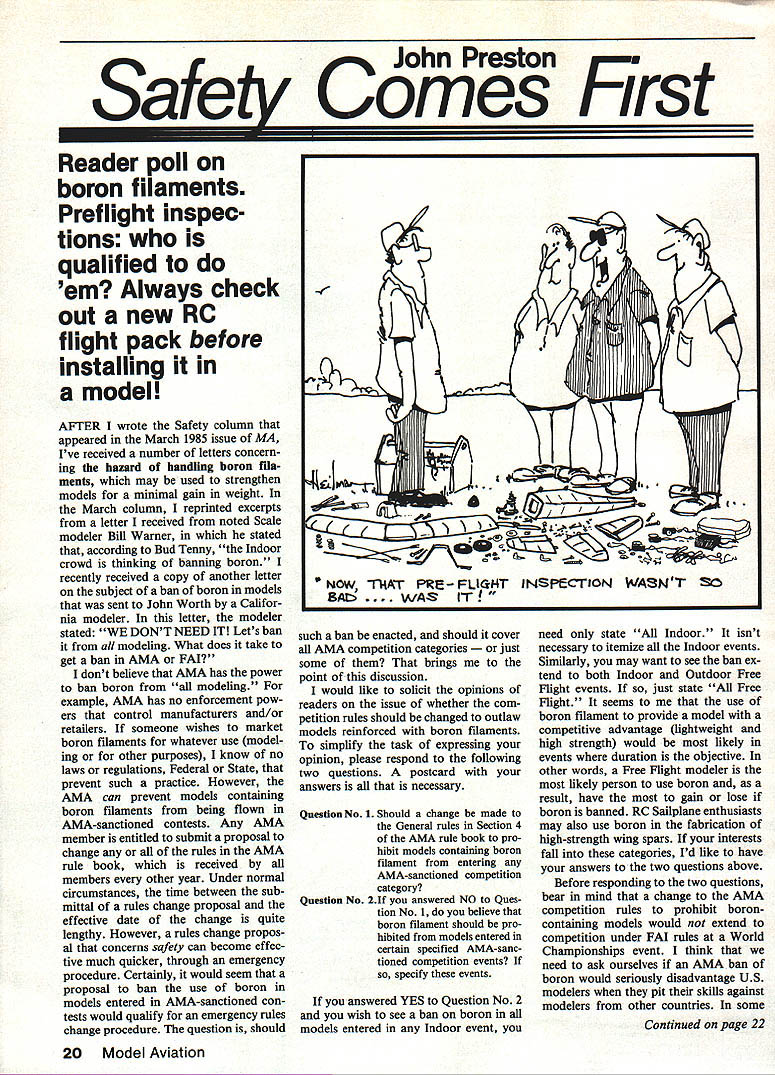
I've mentioned several times in the past the importance of conducting a preflight inspection of your latest pride and joy before taking off. Full-scale aircraft pilots routinely perform preflight inspections; model aircraft pilots should do the same. Human error is the most likely reason model aircraft seldom last forever.
A preflight safety check can both extend the life of a model and minimize the likelihood of an accident at the flying field. However, those who perform the inspection have to know what to look for. The following story concerns preflight inspections and, according to a letter from Les Hard to AMA HQ, by the time you read this Safety column, the story will have appeared in the IMAA newsletter, High Flight (edited by Les).
Citabria incident (Les Hard)
"It would be nice if you could always save face when mistakes are made, but that is not possible when safety is concerned. So, here I put myself into the sacrificial fire for the benefit of others.
"I attended a 1/4-scale fly-in recently with my Citabria and passed the safety inspection made by a very good friend. Not feeling comfortable with the way the engine ran, I asked my friend to fly the Citabria for me, and I would be the spotter. Let me point out that the Citabria had been flown on our home field at least 12 times. On one occasion (a very hot day), this plane experienced a couple of very short, unexplained, unwanted signals on 72.080 MHz that we passed off as foreign signals (hits). Flights later on proved to be very stable when made during calm early evenings.
"Back at the fly-in, control checks and a run-up were made after some fine-tuning on the engine, and we agreed everything was OK. My friend taxied the eager Citabria out onto the strip and 'powered out the coal.' The plane accomplished a smooth takeoff and, after it was six or seven feet in the air, veered slightly to the right into the 10–12 mph wind and toward the crowd, at which point its pilot discovered no control! His heart sank to his feet and then leaped into his throat—he exclaimed, 'I DON'T HAVE IT.' Fortunately, the 2° incidence in the wing and the velocity of the wind caused the plane to clear the crowd and the busy road behind the crowd before burying its nose in a bushy tree where the engine, a Quadra 35, busied itself tearing its props off and increasing its rpm to a chain-saw scream.
"After our shock subsided, the throttle was retarded, the receiver acknowledged the signal and the engine died. Thank God that was all—but now the point to be reckoned with was: what happened?
"After retrieving the plane from the tree (with the able assistance of a pickup driver and his high camper and a boost into the tree by a concerned attendant), the careful process of disassembly took place trying to discover the fault. A safety inspector was looking on. As the wing was removed, the inspector exclaimed, 'G—d—, was that all the foam you had around the receiver?' I retorted, 'Yes, and I've had 12 flights with it that way.' As we discussed the situation, I realized what must have happened: the receiver sat on a half-inch of foam, with plywood hooks on the sides where rubber bands were securing the receiver. The rubber bands had pulled the hooks into the side of the receiver, causing the vibrations from the Q35 engine to be transmitted into the receiver. Our suspicions are that I have a cracked crystal, component, or circuit board caused by the earlier flights' vibration transferred to the receiver. The trouble reared its ugly head, apparently, on that hot day at home and again (finally!) on this hot day at the fly-in. The main culprits being the vibration and the temperature.
"I would like to express my deep apologies to the fine club hosting that fly-in.
"Gentlemen, wrap your receivers in three layers of 1/2-in. soft rubber foam, tie them down snugly (but not too tightly!) with rubber bands, keep stray wiring (i.e., strobe circuitry, on-board starter wires, glow plug wires, and any other foreign wiring) away from the receiver. On ignition engines, all long wiring leads should be shielded and grounded back to the engine crankcase."
I guess the moral of this story is that preflight inspections should cover both the exterior and the interior of a model. Just how far one should probe into the innards of a model is debatable. Perhaps, since the builder knows best how the equipment was installed, some pointed questions concerning the installation and hook-up of controls might be sufficient. Another question that comes to mind concerning the effectiveness of an inspection is: who should be doing the inspecting?
Who should inspect?
The Citabria "passed the safety inspection made by a very good friend." While I'm not suggesting that the friend deliberately overlooked things that might otherwise have been checked, friends might assume that things were done right when, in fact, they were not.
I recently heard a tale about the qualifications of inspectors of models that is worth relating. Although it concerns an incident at a club of which I am a member, I wasn't at the field at the time. The following is an account related by an eyewitness.
"A beginner arrived at the field with a brand-new, never-been-flown model. The club in question has a written checklist for such new models and has designated certain members as qualified inspectors. On this occasion, three qualified inspectors spent about half an hour scrutinizing the model. Apparently, they found nothing out of order, and the model was approved for its first flight.
"The pilot for this flight was one of the club's instructors. After a check of engine operation, the instructor taxied out and attempted a takeoff. When the model broke ground, it banked towards the pits to the right, and the pilot tried to correct it by applying opposite aileron. This increased the bank and caused the model to strike a trash can that was located at the rear of the pit area near a fence that separates the pits from the parking area.
"Can you guess what was wrong? A postmortem discovered that the ailerons had been hooked up backwards! (Remember, three qualified inspectors had spent 30 minutes checking this model and had missed the builder's error.) Perhaps this is a case of 'too many cooks can spoil the broth.' It isn't sufficient to just check that the correct control surface wiggles when you wiggle the appropriate stick. It has to wiggle in the right direction, too!"
Manufacturing Errors and Bench-Checking Radios
Human error as a source of problems is not confined to builders and fliers of models. Sometimes, a manufacturing error can cause you some grief. Just last week, I received the fourth recall notice on my 1978 automobile. I don't believe I've ever heard of a recall concerning a hobby product, but that doesn't mean that everything you purchase from the local hobby store is perfect!
A few months ago, I received a letter from Paul Beretta, a modeler from Glen Cove, NY. The following are Paul's own words of his experience of a manufacturing error.
"I want to share with you an incident which I had the other day. Having purchased a new radio and charged the batteries, it was time to test it out in my airplane. The servos, receiver and switch harness had already been installed, so it was just a few moments' work to hook up the battery. Since my main purposes at this time were to be servo-travel setup and CG adjustment, I left the battery unwrapped.
"I flipped on the switch for the receiver and turned to pick up the transmitter. When I turned back to the airplane, smoke was billowing from the top of the fuselage! I managed to pull the battery loose from the switch harness with only minor burns and drop it, still smoking, on the floor. Investigation proved that the cause of the problem was a defective (shorted) switch. The result was the destruction of the switch harness, the receiver battery wiring, and the battery case and cells. I don't like to think of what could have happened if the battery had been foam-wrapped and stuffed deep inside the nose of the plane. Those wires were glowing red, like a big glow plug, and, although the materials of the wires and battery case merely melted and smoked, other materials inside the plane may have behaved differently.
"The manufacturer was most kind and cooperative about replacing the damaged components. So, aside from the loss of my 'new toy' for a week or so, I suffered no real loss. You can be sure, though, that in the future I will check out all electrical components, outside the aircraft, before installation! The important thing to be aware of is the tremendous heat-generating capacity of shorted Ni-Cads. I know that, until this incident, I was not aware of this."
Paul's letter jogged my memory about a similar incident I read about a number of years ago. In that one, a modeler had purchased a new radio at a hobby shop and, during the journey home, it allegedly set fire to his station wagon. At the time, my reaction was "Ho-hum, he's trying to get a new car out of the radio manufacturer's insurance company." Perhaps I was wrong and this was another case of a short somewhere in the radio's battery circuitry. Anyway, the moral of these stories is to do as Paul did: always bench-check a new radio before installation in a model. Nobody is perfect—not even hobby-equipment manufacturers.
Have a safe month.
John Preston 12235 Tildenwood Dr., Rockville, MD 20852.
Transcribed from original scans by AI. Minor OCR errors may remain.

