

Safety Comes First
John Preston
- Repair or replace? Consequences following a crash can be a nightmare!
- CyA binds again!
- Air rights: who has the right-of-way?
- More.
Accident report
Some readers may have seen an Associated Press report about a settlement in a lawsuit resulting from the death of a Virginia modeler who was struck by an R/C model in July 1982. A brief report of this accident appeared in the Safety column in the October 1982 issue of Model Aviation. A number of club newsletters received by AMA HQ shortly after the accident contained inaccurate accounts. I wish to set the record straight by reporting what actually happened, based on eyewitnesses, a government agency report, a police report, and my own observations of the involved model airplane after the accident.
The R/C model, an Aeromaster biplane, was being flown by an AMA member at a chartered club flying field in Virginia. The field, at the time of the accident, had a single grass runway oriented approximately east/west and was about 390 feet long by 130 feet wide. The pit area is on the south side of the runway and is set back about 25 feet from the edge of the active flying area. As is usual practice at R/C flying fields, pilots stand in an area off to the side of the runway — in this case, the south side. The pilot area at this field has two rows of small cedar bushes which separate it from the runway and the pit area, respectively.
Seven club members were present at the flying field, and only the model involved in the accident was in the air. The model's pilot was standing in the pilot area toward the west end of the runway. The victim was at the east end of the pit area, about 74 feet from the edge of the runway, and was erecting a sun canopy with another club member.
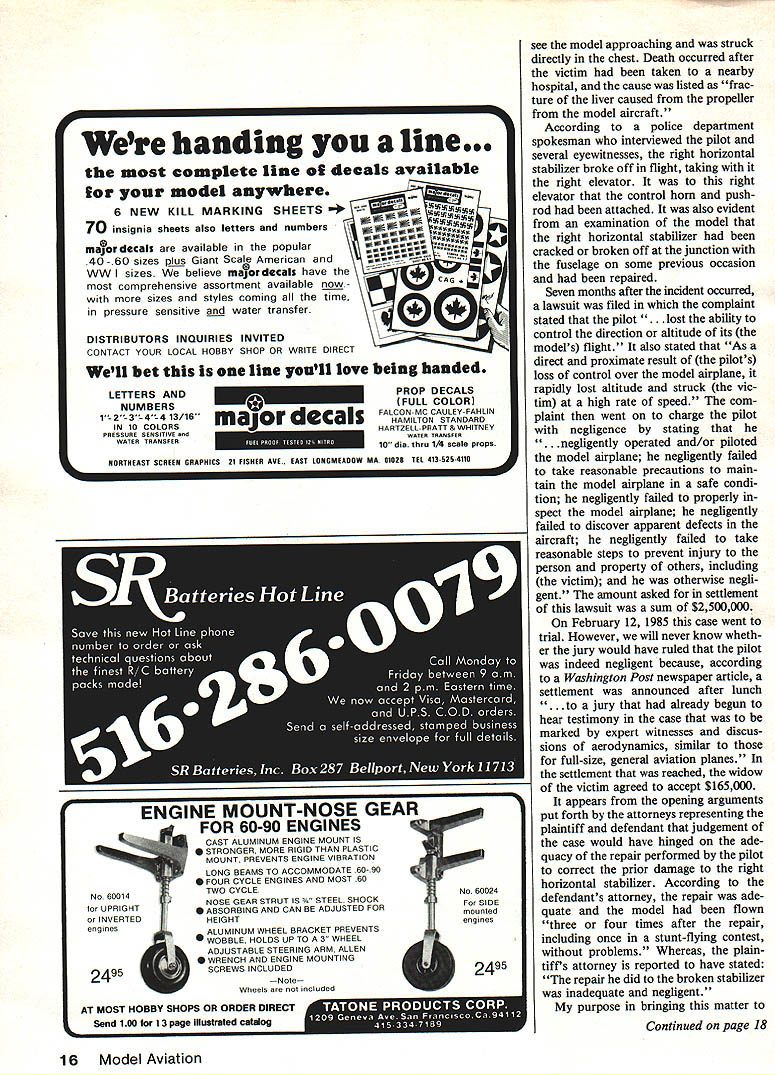
According to an eyewitness, the pilot was making a pass over the field from west to east when the plane suddenly veered to the right (south) and began losing altitude. One club member reportedly shouted "heads up" as the model approached the pit area. The victim did not see the model approaching and was struck directly in the chest. The victim died after being taken to a nearby hospital; the cause of death was listed as "fracture of the liver caused from the propeller from the model aircraft."
A police department spokesman who interviewed the pilot and several eyewitnesses reported that the right horizontal stabilizer broke off in flight, taking with it the right elevator. The control horn and pushrod had been attached to that right elevator. An examination of the model revealed that the right horizontal stabilizer had been cracked or broken off at the junction with the fuselage on some previous occasion and had been repaired.
The lawsuit and settlement
Seven months after the incident, a lawsuit was filed. The complaint stated that the pilot "... lost the ability to control the direction or altitude of its (the model's) flight," and that "As a direct and proximate result of (the pilot's) loss of control over the model airplane, it rapidly lost altitude and struck (the victim) at a high rate of speed." The complaint then charged the pilot with negligence, alleging that he:
- negligently operated and/or piloted the model airplane;
- negligently failed to take reasonable precautions to maintain the model airplane in a safe condition;
- negligently failed to properly inspect the model airplane;
- negligently failed to discover apparent defects in the aircraft;
- negligently failed to take reasonable steps to prevent injury to the person and property of others, including (the victim);
- and was otherwise negligent.
The amount asked for in settlement was $2,500,000.
On February 12, 1985 the case went to trial. According to a Washington Post article, a settlement was announced after luncheon. The jury had already begun to hear testimony that included expert witnesses and discussions of aerodynamics. In the settlement, the widow of the victim agreed to accept $165,000.
From opening statements, it appears the case would have hinged on the adequacy of the repair performed by the pilot on the right horizontal stabilizer. The defendant's attorney argued the repair was adequate and that the model had been flown after the repair "three or four times" with "no problems." The plaintiff's attorney asserted, "The repair he did to the broken stabilizer was inadequate and negligent."
Questions for modelers
My purpose in bringing this matter to your attention is to ask: Have you ever experienced a crash of one of your models that, had it caused an injury or death, might have placed you in the same situation as the defendant in this case? Could you respond to the charges of negligence contained in the complaint in a manner that would convince a jury you were not negligent? Better still, what can we do to minimize or eliminate incidents of this type altogether?
The most obvious and positive step we can take to avoid incidents that may result from "negligence" is to routinely perform a preflight inspection. The answer to the question "Did you perform a preflight inspection?" is simply "Yes" or "No." If you cannot answer "Yes," you can never be sure that your last mysterious crash was not the result of some structural or mechanical failure you might have discovered by inspection. Even the most thorough inspection can overlook a problem, but because I'm still receiving reports of crashes caused by modelers failing to notice obvious problems, a future column will again address preflight procedures.
The other two key allegations in the complaint are that the model was not maintained in a safe condition and that the pilot failed to discover apparent defects in the aircraft. The obvious questions that result are:
- What is a safe condition?
- What constitutes a defect in a model?
A third question arises from the plaintiff's assertion that the repair was "inadequate and negligent": How do you determine when a repair is adequate? There may be articles concerning model airplane maintenance that address correct and incorrect repair techniques; I haven't seen any recently. Meanwhile, my advice to those whose models suffer major component damage in a crash is this: If in doubt, replace the entire component with a new one of similar construction (wood type, thickness, etc.) to that supplied by the kit manufacturer or specified on the plans.
Correction: wind article attribution
In the Safety column that appeared in August 1984, I had an article concerning the effect of wind on a model's flight characteristics and credited Tom Bilheimer as the author. A recent letter from Len Salter (who resides in South Africa) correctly identified himself as the original author. Len's original wind article, which used a modeler standing on an aircraft carrier to show that wind has no effect on a model airplane once it is airborne, appeared in the October 1978 issue of the British magazine Radio Controlled Models & Electronics. I read Len's article in a club newsletter that had obtained it from another club's newsletter which, in turn, had reproduced the original R.C.M.&E. article. Plagiarism is alive and well in the U.S.A. My apologies, Len.
Cyanoacrylate (CyA) reactions and precautions
Some of you may remember the letter from Roy McGuckin that appeared in the April 1985 Safety column. Roy experienced a severe allergic reaction to cyanoacrylate (CyA) glue and had to stop using it. Since the April issue, I've received a number of letters from readers who, like Roy, have experienced health problems after using CyA glue. Reported symptoms vary but most often concern respiratory difficulties, coughing, chest pains, and severe skin irritation. Some letter-writers stated their problems began when they started using an accelerator to speed the setting time of a CyA joint.
I hope to have more to say on this subject after consulting manufacturers and toxicologists. Meanwhile, I suggest plenty of ventilation in your workshop if you are a frequent user of CyA glue!
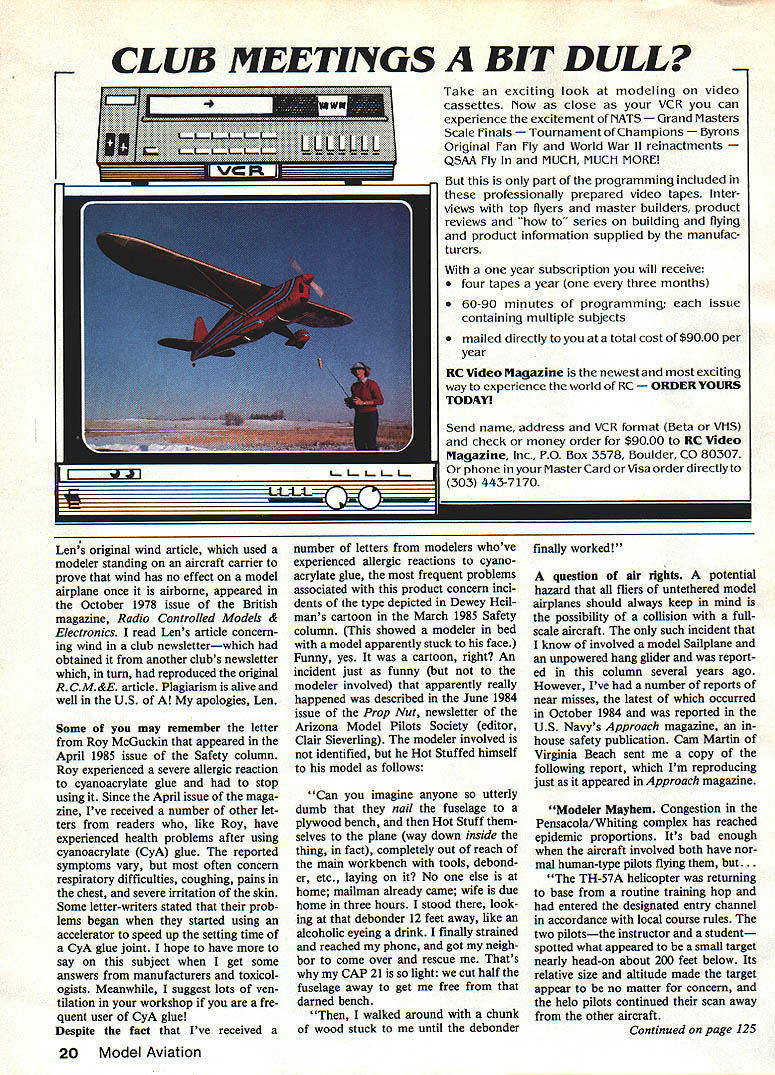
Despite the health problems reported, the most frequent incidents associated with CyA concern people getting the glue on themselves, as depicted in Dewey Heilman's cartoon in the March 1985 Safety column (a modeler in bed with a model apparently stuck to his face). That cartoon was funny — but a real incident in the June 1984 issue of Prop Nut (newsletter of the Arizona Model Pilots Society, editor Clair Siewertling) was less so. The anonymous modeler "Hot Stuffed" himself to his model as follows:
"Can you imagine anyone so utterly dumb that they nail the fuselage to the plywood bench, and then Hot Stuff themselves to the plane (way down inside the hinge, in fact), completely out of reach of the main workbench with tools, de-bonder, etc., laying on it? No one else at home; mailman already came; wife out on the town, etc. I stood there, looking at that de-bonder 12 feet away, like an alcoholic eyeing a drink. I finally strained and reached my phone, and got my neighbor to come over and rescue me. That's why my CAP 21 is so light: we cut half the fuselage away to get me free from that dumbed bench.
"Then, I walked around with a chunk of wood stuck to me until the de-bonder finally worked!"
Air rights — a near miss with a Navy helicopter
A potential hazard all fliers of unpowered and powered model airplanes should keep in mind is the possibility of a collision with full-scale aircraft. The only such incident I know of involved a model sailplane and an unpowered hang glider and was reported in this column several years ago. However, I've had a number of reports of near misses, the latest of which occurred in October 1984 and was reported in the U.S. Navy's Approach magazine. Cam Martin of Virginia Beach sent me a copy of the following report, which I'm reprinting as it appeared in Approach magazine:
"Modeler Mayhem. Congestion in the Pensacola/Whiting complex has reached epidemic proportions. It's bad enough when the aircraft involved both have normal human-type pilots flying them, but when the aircraft have both normal human-type pilots flying them, the problem is exacerbated.
"The TH-57A helicopter was returning to base from a routine training hop and had entered the designated entry channel in accordance with local course rules. The two pilots — the instructor and a student — spotted what appeared to be a small target roughly 150–200 feet below them. Its relative size and altitude made the target appear to be no matter for concern, and the helicopter pilots continued their scan away from the other aircraft.
"Approximately four seconds later, the second aircraft materialized into a radio-controlled model, passing at an estimated 10 feet (!) from the TH-57 before diving below the Navy helicopter. The startled Navy crew made a rapid right turn away from the model airplane.
"The pint-sized near midair had occurred because a local model club had established a miniature airstrip for their radio-controlled creations adjacent to the training airfield's entry channel. One point to consider is the small size of model aircraft. Pilots of most aircraft, military and civilian, use the size of the visual target as a cue denoting the relative closeness of the aircraft and the immediacy of evasive action being required.
"Although this method is fine in the 'real' world, it goes right out the window when confronting the 'little people' of the modeler's world. The small size of flying models makes their visual acquisition difficult and belated, at best. It would behoove squadron operations officers (and maybe a few intelligence briefers) to know the location of active model clubs and pass that information on to flight crews."
When I first read this report, the question that jumped to my mind was: "Was the model pilot deaf?" Unless the Navy's TH-57A is electric-powered (and it's not), the modeler must have been well forewarned that a helicopter was in the area. Even if his model was not equipped with an effective muffler, it's hard to believe he could have been oblivious to the sound of the approaching chopper.
A second question is: Are there modelers who believe they have "the right of way" if they are flying below the AMA's prescribed maximum altitude of 400 feet when flying near airports? When it comes to "who has the right of way," assume you, the modeler, have no such rights.
If this incident sounds familiar to anyone living in the Pensacola/Whiting area and you want to "fess up," please drop me a line telling your side of the story. I'll guarantee anonymity.
Beware of high-voltage power lines!
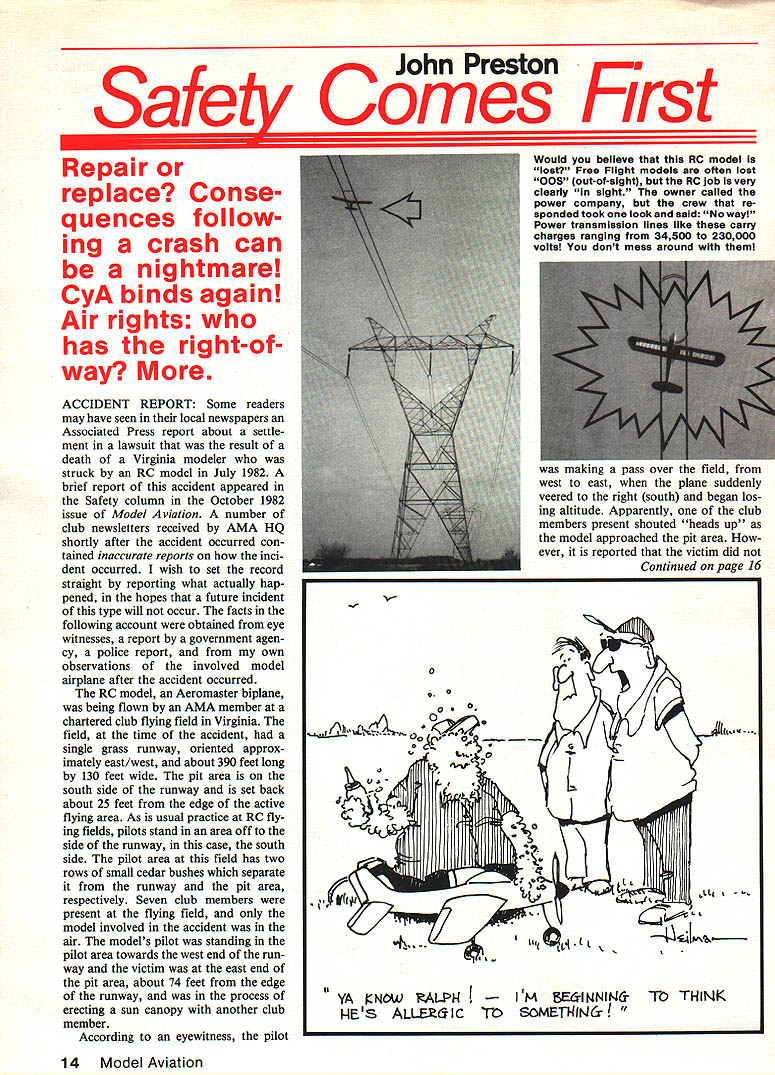
High-voltage overhead transmission lines can interfere with the flight of R/C models and present electrocution hazards when attempting retrievals. A local Virginia incident shows how serious the hazard can be. In July 1982 a Virginia modeler was struck by an R/C Aeromaster biplane when the model lost power and descended into the pit area (see the accident report above).
Another example involves reader Col. Bill Webb, who flies at the Columbus Aero Club field. Bill believes radio-frequency emissions from nearby high-voltage transmission lines caused interference to his radio, resulting in a loss of control:
“I was flying my 'Old Reliable,' which had a high-quality three-channel radio and a good .25 glow engine, in good weather (sunny, wind five to eight mph) and had just chopped the throttle to make my approach to land when I lost all control. The plane went into a slow, lazy left turn and fell into the power lines as if gripped by a big hand.
“I could not have lodged the plane any tighter, as you can see. We called the Ohio Power Company and sent a truck out. The crew said ‘no way;’ the wires were main lines and had an ultra-high voltage. With the ground being damp, they could not help. I talked to other club members who, in the past, have been hit by strange glitches at the same end of the field, and they think the theory of interference was correct.
“These wires are over 2,700 feet away at the closest point, and nothing like this has ever happened to me before. I feel bad about the loss of the plane, but it is not worth a life to try and retrieve it.”
In a previous Safety column, I reported the fatal result of a modeler trying to retrieve a model caught in overhead power lines. Do not, under any circumstances, attempt such a retrieval yourself. Call the power company and accept the loss of the model.
Workshop and field safety — a final word
One last, sobering story: a couple of weeks ago I received a phone call from Kevin Stone, a Massachusetts modeler, who told me about an incident that occurred while he was bending 1/4-inch music wire for a landing gear around a 3/16-inch diameter hardened steel mandrel. The mandrel snapped and struck Kevin in the face, resulting in the loss of an eye. A freak accident, perhaps, but it underscores the need to consider wearing safety glasses both in the workshop and at the flying field.
Till next month — have a safe one!
John Preston 12235 Tildenwood Dr., Rockville, MD 20852.
Transcribed from original scans by AI. Minor OCR errors may remain.

