
Safety Comes First
John Preston
Want to be safe? Then you've got to think safe—all the time. For instance: containers of model fuel must be treated with respect. Much more—including admonitions to hook up your RC plane's controls correctly—follows.
EAGLE-EYE COP
Saw 'burglar,' makes rescue instead.
A cop who ran into a West Side building after he thought he saw a burglar on a fire escape wound up rescuing a critically burned man from his blazing apartment.
The 23-year-old occupant was critically burned about 2:00 p.m. when a can of model airplane fuel exploded in his face as he was testing a small engine in his apartment, police said. The blast sent flames throughout the railroad flat and left the man unconscious.
Police Officer Michael Reingold, on routine patrol from the W. 82nd St. stationhouse, said he raced to the building after he saw a man run down a fire escape.
"He wasn't yelling 'fire,' so I thought he was a burglar."
The cop said he smelled smoke and traced it to a second-floor apartment, alerting tenants to flee the building as he went.
"When I got to the apartment, the floor and walls were burning," said Reingold. "I saw the guy lying against a wall and got him out and then I went upstairs to warn more people."
Firefighters arrived minutes later and quickly put out the blaze, which was confined to the one apartment. About 60 people were briefly evacuated from the building.
The victim was listed in stable condition in the burn unit of New York Hospital–Cornell Medical Center. Reingold was treated for smoke inhalation at St. Luke's–Roosevelt Hospital.
I have attempted to obtain more details concerning this incident but, so far, I've been unsuccessful. I did contact the AMA and found that the modeler was not a member. What caused the can of fuel to explode is anybody's guess at this point. However, the fact that the victim was attempting to run an engine in his apartment has to be a leading cause and is strongly discouraged.
Gasoline leak in a garage — Allan Holton
Coincidentally, I received a letter from Californian Allan Holton describing another incident involving fuel. While the type of fuel wasn't specified in the New York incident, Allan's letter concerns gasoline. The account was typed by Agnes Woodside, a third-grader at a private school where Allan teaches pupils to build models. I'm reproducing the account exactly as typed by Agnes:
"FLASH: Mike built a fine 1/2-scale bipe, was flying at local field, got fantastic headache, put Kavan-powered gasoline bipe in Ranchero, put car in garage, closed door, went to bed. Result: '47 Lincoln Ranchero, bipe, fine J-3 Cub, radio stuff and garage burned up. Cause: did not drain gasoline from bipe, leaked on floor. Gas-fired water heater did it again. Mike says: 'Put drain in lowest part of tank, pipe to bottom of fuselage, PUT drain valve on end of pipe.'"
I guess I'm going to have to add another suggestion to Mike's list: use the drain to empty the fuel tank before leaving the flying field.
Fuel-handling hazards and flight-box safety
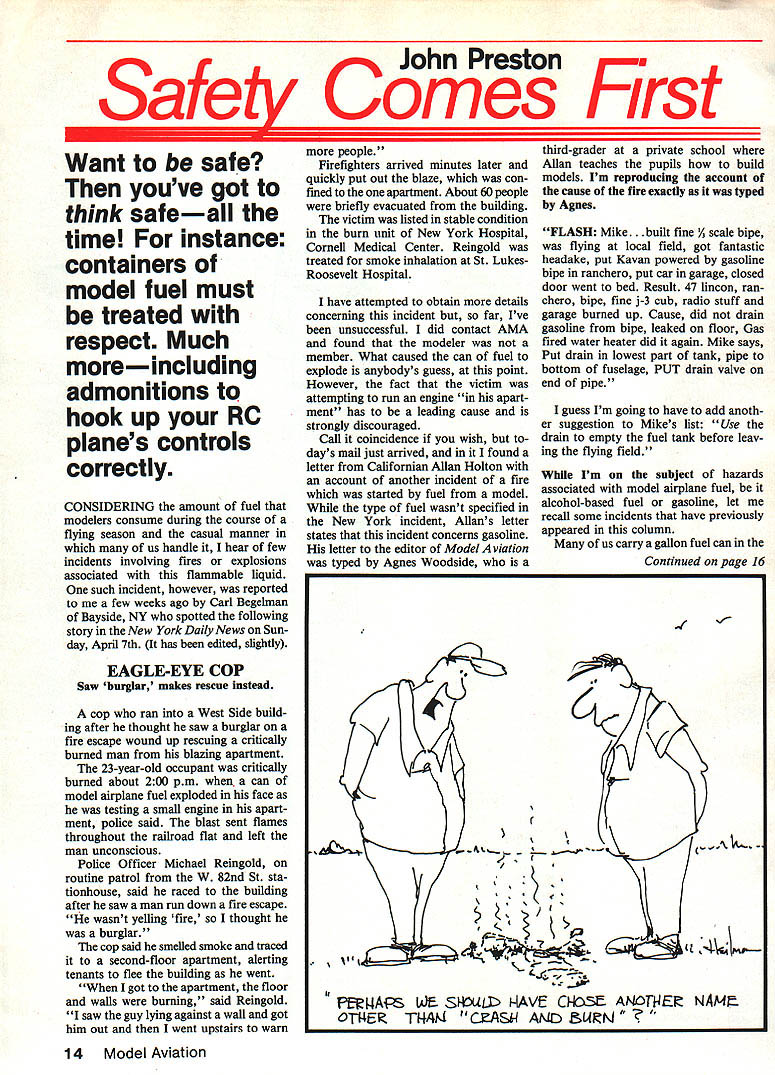
While I'm on the subject of hazards associated with model airplane fuel—be it alcohol-based fuel or gasoline—let me recall some incidents and precautions.
- Many of us carry a gallon fuel can in the same field box that accommodates a 12-volt battery for starter, fuel pump, and glow plug power panel. Be aware that the battery could become the source of ignition. Several years ago, a well-known scale modeler came very close to losing his eyesight when a can of fuel contacted the battery terminals and the resulting spark caused an explosion and fire.
- I noticed club members with electric fuel pumps hooked up recklessly: wires from pumps tied to 12-volt batteries, dangling beside metal fuel cans, with uninsulated connections. These flight boxes can be accidents waiting to happen.
- If you use gasoline, store and transport it in a safety can separate from your flight box and use a manually operated pump intended for gasoline. Remember flash points:
- Gasoline: -45°F (very volatile)
- Methanol: +52°F
- Never leave a can of gasoline in the trunk of a car on a hot day. I know of at least one incident where a can transported in a trunk exploded. The most likely explanation is vapor escape followed by ignition from some source (for example, an electrical fault), not chemical instability due to age.
Tape solder warning (field repairs)
I recently received a letter from Fred Marryott (LARKS club, Lake Charles, LA) referring to a "Helpful Hint" in Harry Murphy's "Free Flight Duration" column about tape solder (Archer brand, Radio Shack, Cat. No. 64-010) for field repairs. One suggested use was to fix a leak in a fuel tank. Harry did note that "one must take the proper precautions in" using an open flame around fuel tanks and in close proximity to the model.
Fred's warning:
"This could be very, very dangerous, since the only way to make a fuel tank safe for repair is to:
- Fill it with water, or
- Fill it with an inert gas and seal it prior to applying heat.
True, glow fuel is not quite as hazardous as gasoline, but under the right conditions it will react in the same way. I remember an incident several years ago that happened to a friend in which a fuel tank exploded while he was trying to solder it."
While tape solder is useful for field repairs, be extremely cautious about using it to repair fuel tanks. Empty and purge tanks before applying heat.
Brush fires, extinguishers, and glow-fuel fires
Back in my January 1983 Safety column I quoted a newspaper account alleging a brush fire consumed some 150 acres after a model crash. I was skeptical that alcohol-fueled models were the likely cause, but several readers wrote to say they had watched their models crash and burn.
A fire extinguisher is inexpensive—often no more than the price of a gallon of fuel. If you don't already carry one, give it serious consideration. I came close to losing my first RC model when an engine backfire ignited fuel spilled inside the cowling. With glow fuel you don't always see flames—you often see finishes turning dark brown very quickly.
"Hot-dog" flier and an AMA AVP's response
I received numerous letters in response to the "hot dog" flier story in the May 1985 column. Most responses were unprintable, but one from an AMA Assistant Vice President was measured and worth quoting in part:
- The AVP is a semi-regular flier at the community college field described in the May article and received calls supporting the author's viewpoint.
- He also contacted the subject of the article—someone he has known for nearly 20 years and who helped him get started in RC. The subject admitted only to the frequency flag issue and defended other points.
- The AVP explained that if several people can identify someone as the subject of complaints, they are perceiving a problem. He urged the individual to objectively review the article's points and consider whether a change in behavior is necessary.
The AVP concluded: "If you are not part of the solution, you are part of the problem."
Although he did not specifically request anonymity, I have withheld his name, district, area, and the name of the community college. I would, however, invite the hot-dogger to write to me with his side of the story; if his letter is printable, I would publish it and guarantee his anonymity.
Pylon racing and continued safety education
I received a letter from Art Arno (Ann Arbor, MI) in response to my January 1985 comment that I had not received reports of safety incidents in RC Pylon Racing. Art feels Pylon Racing may be safer than typical sport flying for several reasons:
- Strict adherence to Safety Guidelines drafted by an NMPRA Safety Committee.
- Use of an RC Pylon Safety Check List to inspect each model before flying in sanctioned competition.
Art included a copy of the checklist and emphasized that "human error" is the greatest threat to safety in our hobby. Continued education and emphasis on safety awareness are probably the best prevention.
I agree: many incidents at club fields are attributable to human error.
Common human errors — ailerons and hookups
Halfway through writing this column I visited the local club field. An old friend said, "You're too late, I already committed my safety violation for today." He had flown a bipe for the first time after installing a new lower wing. He performed a preflight check and everything appeared fine—but he didn't notice the ailerons were hooked up backwards. This is the sort of basic preflight oversight that causes avoidable accidents.
I've heard it said in full-scale pilot circles: "There are those that have and those that will—land with their gear retracted." In the model aircraft world, perhaps that saying should refer to aileron hookups.
Preflight checklist reminder
One last tip for those who own transmitters with switches for dual rate, mixers, servo reversing, etc. This comes from The Guy Wire (Daytona Beach RC Association): every month the club president includes "A Message From The Left Seat" and a preflight checklist. Item No. 3 on that list is:
- DOUBLE CHECK: All bells and whistles on your transmitter before flying.
You'd be surprised how many crashes are caused by inadvertent switching of one of those "bells and whistles" switches.
Don't be one of the humans who makes an error this month. Have a safe one.
John Preston 12235 Tildenwood Dr. Rockville, MD 20852
Transcribed from original scans by AI. Minor OCR errors may remain.

