
Safety Comes First
John Preston
I can think of several safety items to pass along:
- Airless paint sprayers
- Glow engines starting unexpectedly
- People "stealing" frequency pins
- Being sure the correct servo-reversing switch is used
First, read the directions — then read this column.
Airless Paint Sprayers
In previous safety columns I've mentioned the hazard of breathing vapors from certain paints used for spray-painting model aircraft. However, another hazard concerning airless paint-spray equipment can result in serious injury regardless of the paint used.
A friend of Howard Crispin (AMA District IV VP) ended up in the hospital and nearly lost a finger after he grasped a high-pressure hydraulic line that had a small leak and injected hydraulic fluid into his flesh. The treating doctor said he is seeing an increasing number of people in this situation with spray-painting equipment.
Airless paint sprayers do not use compressed air. They use a hydraulic pump driven by an electric motor or an electromagnetic linear motor (a vibrator). The big difference is operating pressure: a compressed-air spray gun works at about 25–50 psi, while some airless guns operate at around 2,500 psi. At that pressure a spray jet can inject paint or hydraulic fluid into the flesh, which can lead to blood poisoning and loss of a finger or hand.
About ten years ago the U.S. Consumer Product Safety Commission received reports of such injuries and worked with manufacturers on fixes. Current airless sprayers have warnings and a guard around the nozzle to discourage contact. However, those guards may still allow deliberate contact to clear a clog. Using a finger to unclog a nozzle is common with compressor-operated guns — never do this with an airless sprayer.
Imron Paint
Imron (a multi-component polyurethane) is popular for its durable, superior finish. A Washington Post article, "Firefighters' Reproductive Problems Probed," reported that DuPont is providing funds for a study to examine allegations that ethoxyethanol (a compound in Imron) may have caused reproductive problems among firefighters after they breathed vapors while touching up equipment.
Follow the manufacturer's safety precautions. Better still, use another paint if you can. If you must use Imron or similar multi-component polyurethanes, effective respiratory protection is essential. DuPont recommends an air-line respirator; an alternative is a vapor/particulate respirator the manufacturer states is suitable for isocyanate vapors and mists. After painting, leave the model in a well-ventilated area away from people until the paint cures — I know of at least one case of respiratory difficulty from exposure.
Glow Engines Starting Unexpectedly
A recent letter from Brian Kuehn of Peoria Heights, IL, described a near-accident that did not result in injury but is worth noting. Brian wrote:
"I would like to describe a near-accident. I was doing touch-and-goes with my Sweet-and-Low Stik (Enya .40 CV with standard muffler, 10 x 6 Power Prop, 10% Blue Flame fuel) when I noticed it was taxiing strangely. The tail wheel had broken off due to metal fatigue. I moved the model to the pit area and shut it down, then went in search of the missing tail wheel. It took about five minutes to find it. I decided to call it a day. I never leave fuel in the tank if I can help it. Since there was not much fuel left, I decided to start it up and run out the tank.
"The engine was warm but not particularly hot. I choked it and put on the Ni‑Starter. It ran out the prime and stopped, and the fuel ran back down the line to the tank. I took off the Ni‑Starter and laid it on the grass. I opened the throttle, put my thumb over the venturi, and gave it two sharp flips to prime it — as has been my usual procedure. On the second flip, with the Ni‑Starter lying in the grass, it started. It caught me totally unprepared. The throttle was wide open. The fingernails of my left hand (I'm a southpaw) were soundly rapped; fortunately they weren't lacerated. I pulled both hands back instinctively and got them away from the prop. I tried to step backwards, but the left wing hooked my leg before I could get away. For the next few seconds the model and I chased each other in circles until I finally got a solid grip on the left wing with both hands and dragged it back to the transmitter. If there hadn't been a broken and jagged piece of music wire in place of the tail wheel, I don't think I would have been fast enough to avoid serious injury.
"Since then I have talked to many people and found several others who have had glow engines start without a battery being hooked up. I was blissfully unaware of this possibility until it happened to me. I thought perhaps your readers should be warned of this potential danger."
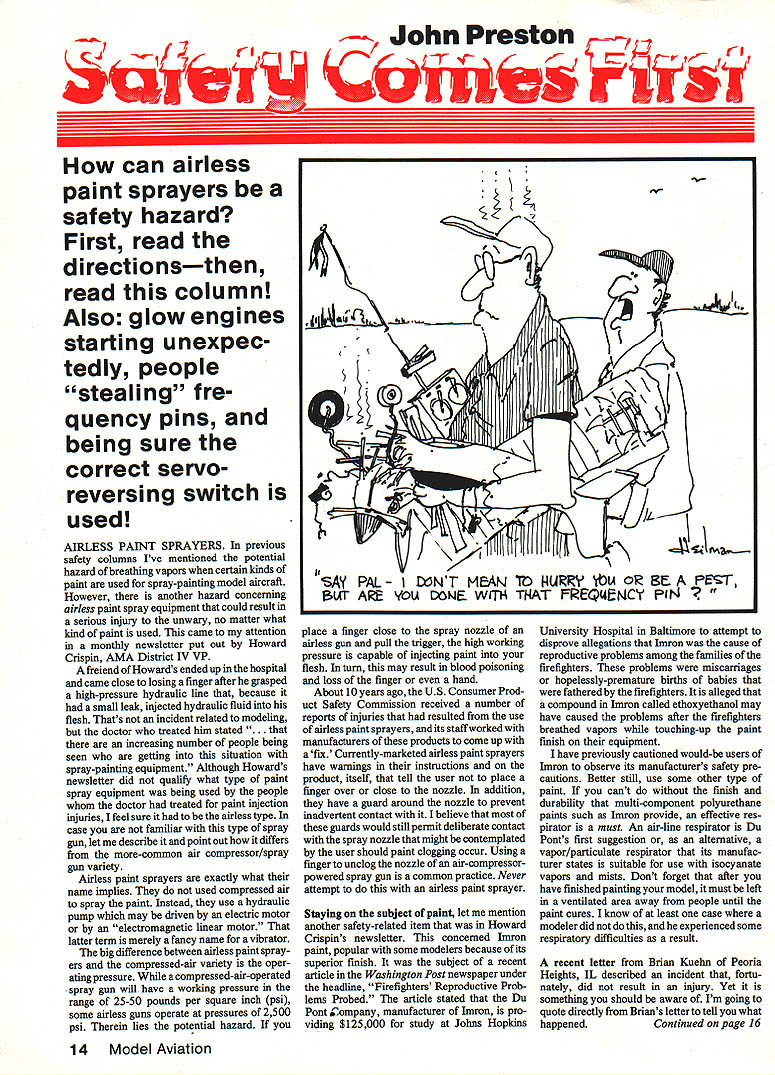
This is not the first report of glow engines surprising owners by starting without power to the glow plug. A cold engine is unlikely to start on its own, but it can happen even when the engine isn't very hot.
To reduce the risk when priming by pulling the prop through, grasp a prop blade between thumb and fingers and pull it through compression rather than holding your hands near the prop arc. Many modelers already do this after priming and before connecting the glow-battery to prevent kickback. This procedure is especially recommended if you prime by squirting a few drops of fuel into the exhaust port. It also helps prevent damage from a "hydraulic lock" caused by over-priming.
Some manufacturers and aftermarket kits relocate the needle valve assembly to the rear of the crankcase to keep fingers away from the prop when making mixture adjustments. A reader reported installing an O.S. remote needle valve to a Flash .35 engine for this purpose.
Servo-Reversing Switches — Wrong Switch Danger
A letter from Jerry Swain of Baldwin Park, CA, illustrates the danger of flipping the wrong reversing switch. Jerry wrote that while taxiing a .40-powered model he checked control surfaces and noticed the ailerons were working backwards. He planned to flip the appropriate reversing switch on the transmitter. His transmitter has six small reversing switches; when he flipped the one he thought was for the ailerons, things happened fast — the engine revved and the plane shot off the paved area into grass, which finally stopped it.
He had inadvertently flipped the throttle-reversing switch instead of the aileron switch. His letter closed with, "From now on, all control surfaces will be checked and, if necessary, corrected, before the engine is started."
That's sound advice for everyone: always check and correct control-surface direction before starting the engine.
Have a safe month.
John Preston 12235 Tildenwood Dr. Rockville, MD 20852
Transcribed from original scans by AI. Minor OCR errors may remain.

