
SAFETY COMES FIRST!
In the good old days we only had to beware of cutting a finger with a razor blade, being zapped by a breaking rubber motor, being struck by a dive-in flyer, or getting a good crack on the finger from a wooden prop. Today there are many more—many of them subtle—potential hazards associated with our hobby.
John Preston
Epoxy and paint hazards
We have received several communications pointing out the dangers of using epoxy paint. One worrying letter from Jim Larkin follows:
"I am recovering from a three-week illness, including an eight-day stay in the hospital, caused by damage and/or infection to my liver.
"After exhausting possible causes, my doctor has concluded that the most probable cause was epoxy paint (and thinner) vapor and contact with the skin. I have also used a fuel (in competition free flight) that contains nitrobenzene. I understand it is dangerous.
"Quite frankly, my doctor thought at first that I was probably a cancer victim. One test done on me was a liver scan, and it showed scattered liver damage. Conclusions of various other tests showed no cancer, so the epoxy poisoning is the most probable cause.
"I read Bob Meuser's column in the latest issue of Model Aviation and realized that I must change my building habits. It occurred to me that with all of the doctors that are AMA members, Headquarters could ask for help from these learned people. What is safe to use for paint, what is safe in fuels, is this truly a cumulative reaction in our bodies? When we paint, shouldn't we use disposable plastic film gloves, etc.? I sincerely recommend that you poll our doctor members.
"Please keep up the warnings about epoxy danger. It is very serious and very real."
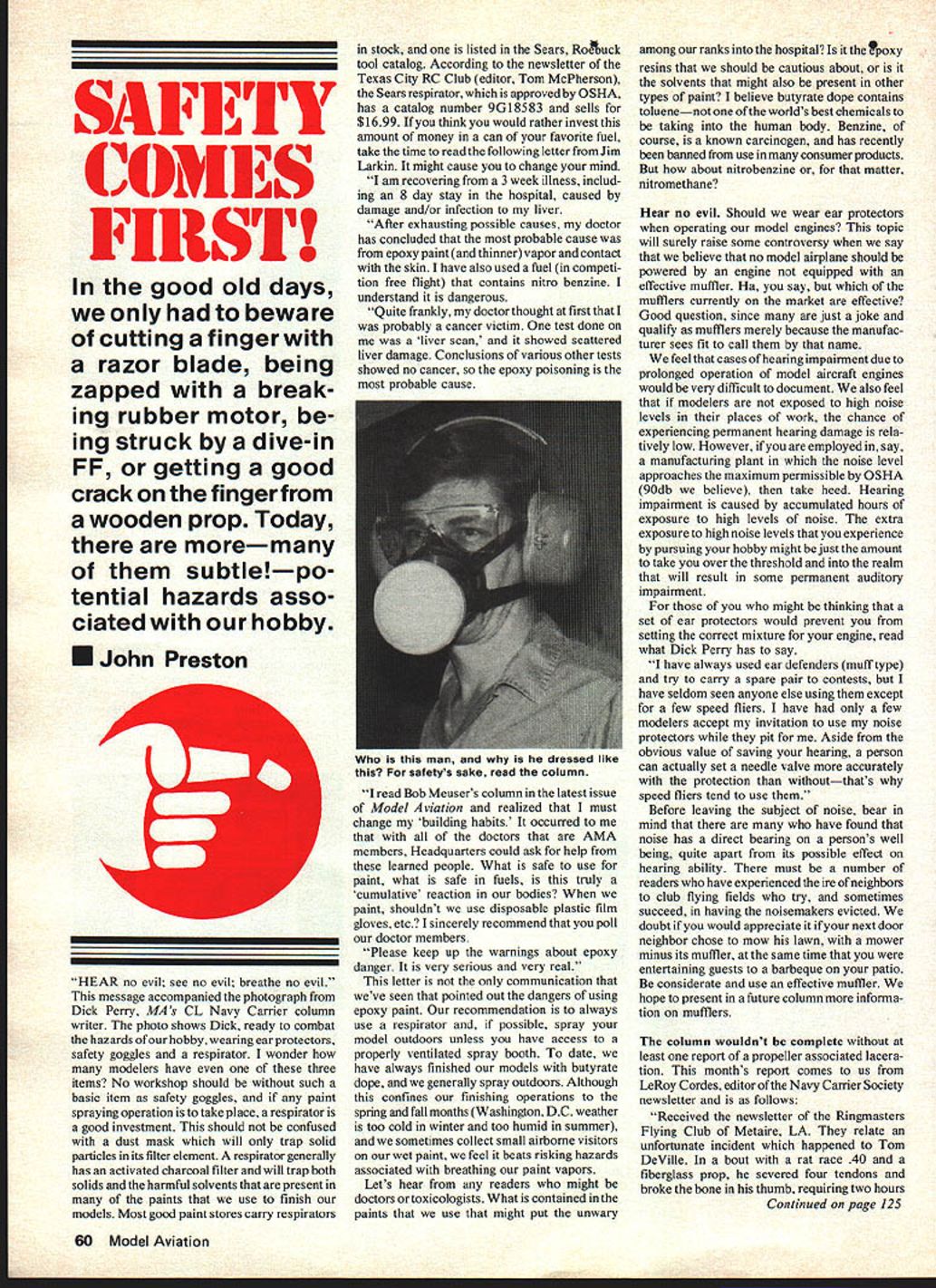
Our recommendation is to always use a respirator and, if possible, spray your model outdoors unless you have access to a properly ventilated spray booth. To date we have finished our models with butyrate dope and generally spray outdoors. Although that confines finishing operations to the spring and fall months (Washington, D.C. weather is too cold in winter and too humid in summer), we sometimes collect small airborne visitors on our wet paint—and we feel that beats risking hazards associated with breathing paint vapors.
Let's hear from any readers who might be doctors or toxicologists: what is contained in the paints that we use that might put the unwary among our ranks into the hospital? Is it the epoxy resins we should be cautious about, or the solvents that are also present in other types of paint? I believe butyrate dope contains toluene—not one of the world's best chemicals to be taking into the human body. Benzene, of course, is a known carcinogen and has recently been banned from use in many consumer products. But how about nitrobenzene or, for that matter, nitromethane?
Respirators and ventilation
One respirator that is in stock and listed in the Sears, Roebuck tool catalog is approved by OSHA: catalog number 9G18583, price listed at $16.99 (Texas City RC Club newsletter, editor Tom McPherson). If you think you would rather spend that amount on a can of fuel, please read Jim Larkin's letter again—it might change your mind.
- Always use a properly rated respirator when spraying paints or using solvents.
- Spray outdoors when possible, or use a commercially built, properly ventilated spray booth.
- Consider disposable plastic film gloves and protective clothing to reduce skin contact.
Hearing protection and mufflers
Should we wear ear protectors when operating our model engines? We believe that no model airplane should be powered by an engine not equipped with an effective muffler. Which mufflers on the market are truly effective is a good question—many are only nominally mufflers because the manufacturer calls them that.
Hearing impairment from operating model aircraft engines would be difficult to document, but hearing loss is caused by accumulated hours of exposure to high noise levels. If you are exposed to high noise levels at work (near OSHA limits, roughly 90 dB), the extra exposure from your hobby can push you over the threshold for permanent auditory damage.
If you worry that ear protectors will prevent you from setting the correct needle mixture, read what Dick Perry has to say:
"I have always used ear defenders (muff type) and try to carry a spare pair to contests, but I have seldom seen anyone else using them except for a few speed fliers. I have had only a few modelers accept my invitation to use my noise protectors while they pit for me. Aside from the obvious value of saving your hearing, a person can actually set a needle valve more accurately with the protection than without—that's why speed fliers tend to use them."
- Use effective ear protection when operating loud engines.
- Insist on effective mufflers for models flown at fields near neighbors.
- Be considerate: excessive noise can lead to complaints and even eviction from flying sites.
We hope to present more information on mufflers in a future column.
Propeller injuries
The column wouldn't be complete without at least one report of a propeller-associated laceration. This month's report comes from LeRoy Cordero, editor of the Navy Carrier Society newsletter, who reprinted an incident from the Ringmasters Flying Club of Metairie, LA:
In a bout with a rat-race .40 and a fiberglass prop, Tom DeVille severed four tendons and broke the bone in his thumb, requiring two hours of surgery and a stainless steel pin. With a wood or nylon prop the injury probably would not have been so severe. Their editor compared a racing .40 with a glass prop to a Skilsaw or table saw—and not without reason. Remember, these "toys" can be dangerous and should command a great deal of respect and care.
Fiberglass propeller hazards
Although not in the same league as broken bones or stainless pins, another hazard associated with at least one brand of fiberglass prop is sharp blade edges. The Radio Flyer (Western Michigan Radio Aircraft Flyers, editor Rod Osbeck) published a letter to a glass-reinforced prop manufacturer reporting seven club members who received nasty lacerations of the hand; at least one required sutures. These injuries occurred in a three-month period (June, July and August 1979).
It was not always clear whether injuries happened during normal contact while starting or through unintentional contact while the engine was running. A friend recently showed lacerations he received from such a prop during a hand-flip starting operation.
- Inspect fiberglass props for sharp edges before use.
- If edges are sharp, take a few swipes with a sanding block to dull them.
- Rebalance the prop after sanding.
- Consider using wood or nylon props for starting or for engines likely to cause severe injuries.
Recommendations and closing
- Use respirators and proper ventilation when painting or working with solvents and epoxies.
- Wear disposable gloves and protective clothing to reduce skin exposure.
- Use effective mufflers and ear protection to limit hearing damage and neighbor complaints.
- Treat propellers—especially fiberglass—with caution; inspect, file, sand, and rebalance as needed.
- AMA members who are doctors or toxicologists: please share knowledge on safe paints, fuels, solvents, and cumulative exposure risks.
John D. Preston 7012 Elvira Court, Falls Church, VA 22042
Transcribed from original scans by AI. Minor OCR errors may remain.

