
Safety Comes First
John Preston
RC safety rules; order at the flying field; flying on public land; a CYA horror story. Kids eat small things — like button batteries! Are self-tapping screws in servos safe?
The RC Modeler's 10 Commandments
A recent letter from Frank Wood, President of Meade Modelers (Ft. Meade, MD), enclosed a copy of 10 commandments which, if observed, should help avoid accidents related to our modeling activities. Although aimed primarily at the RC flier, many also apply to CL and FF activities. They are as follows:
- Thou shall never absent thy gaze from thy aircraft while the engine is running — be it motionless or in motion, on the ground or in the air — on pain of death or injury to thyself, thy fellows, or thy aircraft.
- Thou shall maintain thy aircraft with meticulous care, for the integrity of the whole dependeth on the smallest as well as the greatest of the parts, and failure to do so may cause thy creation of grace and beauty to become a ravening beast capable of great destruction.
- Thou shall treat thy propeller with the greatest of respect, for it is a device of great power for both good and evil, and it is intolerant of abuse or disregard and may turn upon thee and inflict grievous harm as penance.
- Thou shall not fly thy aircraft between thyself and the great orb of the Sun, for to do so will cause thee to violate the first commandment.
- Thou shall avoid all association with thy aircraft's full-size brethren when in flight, as the twain are by nature incompatible, and accidental contact will raise up great havoc.
- Thou shall give grave consideration to the lands, peoples, and properties over which they fly, and give no cause for complaint; for, to do so may transform thee into a goat of great disrepute among thy fellows.
- Thou shall never ascend into the heavens without adequate care for the state of thy batteries, for to do so is to tempt thy aircraft to cast off thy control and become an avenging angel.
- Thou shall treat building products and materials as two-edged swords, for what benefiteth a person to gain a superior aircraft only to lose his own well-being?
- Thou shall regard the AMA Safety Code as the Law, and abide by it faithfully, for its words are of great wisdom and hold the promise of salvation for thy continued health and activity.
- Thou shall, in all things, consider the effect of thy activities on thy friends, neighbors, and loved ones, for they are thy world, and abuse of their regard will bring thee great woe and misery.
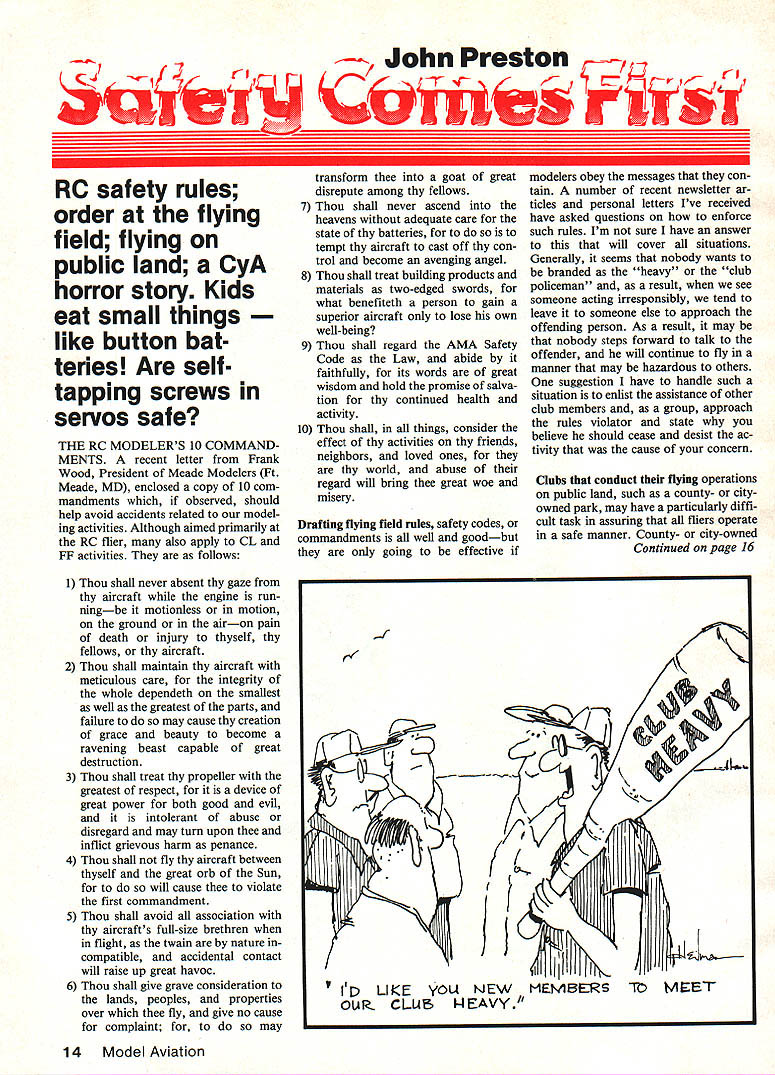
Drafting flying field rules, safety codes, or commandments is all well and good — but they are only going to be effective if modelers obey the messages that they contain. A number of recent newsletter articles and personal letters I've received have asked questions on how to enforce such rules. I'm not sure I have an answer that will cover all situations. Generally, it seems that nobody wants to be branded as the "heavy" or the "club policeman" and, as a result, when we see someone acting irresponsibly, we tend to leave it to someone else to approach the offending person. As a result, it may be that nobody steps forward to talk to the offender, and he will continue to fly in a manner that may be hazardous to others.
One suggestion I have to handle such a situation is to enlist the assistance of other club members and, as a group, approach the rules violator and state why you believe he should cease and desist the activity that was the cause of your concern.
Flying on Public Land
Clubs that conduct their flying operations on public land, such as a county- or city-owned park, may have a particularly difficult task in assuring that all fliers operate in a safe manner. County- or city-owned flying facilities are generally open to all comers, not just members of the local club.
A letter from Jim Cianciolo, President of the Kansas City RC Association (KCRC), asked for assistance in resolving a problem at the club's flying field which is in a county park and has been in use for over 25 years. The KCRC has posted a simple set of rules at the flying field, one of which is "Current AMA license required." The benefit of conforming to this rule is obvious — it ensures that all fliers are covered by the liability insurance that comes with AMA membership. Jim's concerns are as follows:
"Because of the growing trend in our society to 'sue unto others,' both the County and KCRC realize that the enforcement of this rule is more important today than ever. This is not a problem for our club members, because proof of AMA membership is required when applying for club membership. What may be becoming a problem are those who use the field and are not club members. Presently we have no effective way to check and enforce that all fliers are AMA members. We are aware that if there was a serious accident by a non-insured party, KCRC and the County might possibly be named in a lawsuit, and we could conceivably lose our field and all that we have built these last 25 years.
"In trying to find a solution to the problem, KCRC's first question to the County was, 'Can the Park Rangers check fliers for their AMA license, just as they can for a fishing license or boating registration?'
"The County answered 'No,' simply because they could not enforce something that is not a County ordinance."
Jim wound up his letter by asking if I knew of any other clubs that have faced a similar problem and, if so, how it was resolved. I guess that one solution to KCRC's problem would be to lobby the County into approving an ordinance that would require AMA membership for all fliers at the park flying site. Maybe this isn't possible for legal reasons. I would like to ask any readers who might have an answer to Jim's question to contact me. My address is at the end of the column.
Servo Case Screws — A Potential Hazard
Another question that I'm asking readers to respond to concerns servos held together by self-tapping screws, which may work loose in flight. A letter from Peter Young (Algonac, MI) described the circumstances of a crash of a Byron CAP 21 which had only logged four flights. Peter stated that vibration caused the self-tapping screws that held the aileron servo together to loosen, which resulted in loss of aileron control during a low-level pass and the loss of his model, in which he had an investment of some $600 and six months of building time. According to Peter's letter, three of his fellow fliers also found the self-tapping screws that held their servos together (same brand) had loosened 1/8 to 1/4 of a turn.
A response to a letter Peter wrote to the manufacturer of the servo stated that most fliers of models the size of the Byron CAP 21 elect to use bigger servos than the ones that he was using. I would like to ask if any other readers have experienced loosening of self-tapping screws that were used to hold servo cases together. Peter's solution to the problem is to put a dab of epoxy on the heads of the screws.
A Cyanoacrylate (CYA) Horror Story
Just days after I had mailed the October column (concerning CYA glue) to Model Aviation, I received a letter from Bill Laskar that described an incident concerning cyanoacrylate glue that I think you should be aware of. Bill has two grandsons, Gerry, age two, and Tommy, age nine. Tommy had a new "space-age monster toy" that had been broken by a friend and, because the toy was expensive, the boy believed he would get into trouble from his parents if they found out it was broken. Although he had been warned by his father about the hazards of cyanoacrylate glue and had been forbidden to use it, he ignored the warnings and went to his room to attempt repairs.
During the course of the repair operation, he had to go to the bathroom. While he was obeying the call of nature, his two-year-old brother Gerry walked in, saw the bottle of super glue on the table, popped off the top and drank the entire contents. Bill's letter tells us about the events that followed:
"He immediately started gasping, coughing, and crying, all at the same time. His mother heard the commotion, ran into the room and found Gerry on the floor, struggling to breathe. She picked him up and forced open his mouth to see if he had choked on something. All she saw were tiny white particles sticking to his tongue and teeth. He was still gasping for air and not responding to anything my daughter tried while attempting to restore his breathing. She reached into his throat, but there was no obstruction. Had he swallowed something? She didn't know. She was near panic when Tommy rushed back into the room and confessed that maybe Gerry had swallowed the super glue that was left on the table. The empty bottle was found on the floor.
"My daughter called Poison Control, and they told her that, generally, super glue is non-toxic, but she should get Gerry to a doctor as soon as possible.
"By the time they arrived at the hospital, Gerry was breathing normally but still crying, which probably kept the glue from reacting with the tissue in his throat.
"The doctor ran a complete check on Gerry and said he appeared to be fine, but that he was a very lucky young boy."
As I stated in the October safety column, cyanoacrylate glue is not considered a toxic substance under the regulations of the Federal Hazardous Substances Act. However, because polymerization of the glue is very rapid upon contact with moisture, there is a possibility that, if swallowed, it could form a plug in the back of the throat which could block off the airway and cause suffocation. In a report by Food and Drug Research Laboratories, Inc., it was observed "...that when a few drops of liquid cyanoacrylate were placed into the posterior oral pharynx, it was capable of sealing the tracheal and esophageal apertures in test rats." I would be the first to agree that a rat's throat is smaller even than that of a small child, but I think that we should all observe the message that is stated on our bottles of CYA glue, which states: "Keep away from children."
Button Batteries — A Hidden Danger
While on the subject of keeping things away from small children, let me say a few words of warning about "button batteries." I can't think of any product that is directly related to our modeling activities that uses the wafer-thin batteries commonly found in watches, calculators, and cameras. However, in the September 1985 issue of Model Builder magazine, Eloy Marez included a warning in his "Electronics Corner" column to keep button batteries away from small children. Eloy picked up the warning from World Radio, a publication for amateur radio operators, and he suggested that club newsletter editors should reproduce it in their publications. Although MA is not a club newsletter, I'm going to pick up on Eloy's suggestion, anyway. Here's what it said:
KEEP BATTERIES AWAY FROM CHILDREN. Wafer-thin batteries used in calculators, watches, and cameras spell danger for young children.
Because those batteries are bright and shiny, they are easily discovered by children and can be fatal if swallowed. Even "dead" batteries can be harmful because of their chemical composition.
In a recent incident, a young boy's parents were unaware of the danger when their child swallowed one of these batteries. Several days later, they sought medical help.
Unfortunately, it was too late. The alkaline chemicals had destroyed their son's esophagus. Four other children in Dallas received emergency surgery after swallowing the same type of batteries. Two other toddlers died because their parents were unaware of battery ingestion.
To protect your children from the potential killer, treat these batteries like you would any other poison ... out of the reach of children.
If you look on the display carton in which button batteries are sold, you will notice that it now contains a warning to keep them away from small children and, if swallowed, to promptly see a doctor. This warning may have been the result of the interest taken by the U.S. Consumer Product Safety Commission on this battery issue several years ago. At that time, it seems that "the experts" were divided on whether to operate to retrieve a swallowed battery or to just let it pass through the digestive system. There were some who believed that corrosion of the case and release of the electrolyte would be unlikely to take place during the few days it might take to pass the battery through the digestive tract. So, if you have small children in your household, be alert that they have a natural urge to put all small objects in their mouths. Keep these cells and liquids that aren't intended to be drunk well away from youngsters.
Prop Accidents — A Final Word
To conclude this month's Safety column, let me state that the absence of "fingers-in-the-prop" incidents in the last few columns is not an indication that they are not happening! I still see frequent reference to prop accidents in club newsletters. An unusual one that was reported in several newsletters concerned a .90 engine that jumped out of a test stand and removed a modeler's fingertip before it hit the floor. Many stitches and a skin graft were apparently needed to repair the damage. It was reported that the cause of this incident was that the cradle on the engine test stand was not deep enough to receive the bottom of the engine crankcase. This prevented the engine-mounting lugs from seating firmly on the mounting surfaces of the test stand. In this incident report, it was also stated that the prop blades sheared off when the still-spinning engine hit the floor and were thrown some 50–70 feet out of an open garage door.
As usual, let me wish you a safe month.
John Preston 12235 Tildenwood Dr. Rockville, MD 20852
Transcribed from original scans by AI. Minor OCR errors may remain.

