
Safety Comes First
John Preston
Some aspects of safety-of-flight in operating an RC model are discussed below, along with considerations for flying models on publicly owned land.
AMA Safety Code
Item number three of the Radio Control section of the Safety Code states:
"I will perform my initial turn after takeoff away from the pit, spectator, and parking areas, and I will not thereafter perform maneuvers, flights of any sort, or landing approaches over a pit, spectator, or parking area."
Several letters (and even some club rules) indicate that this directive is not always followed. Its intention is obvious: if you avoid flying over people, you minimize the possibility of hitting someone with your model should it get out of control.
Bill Zimmer, an AMA AVP for District VI, sent a copy of a letter he wrote to AMA President John Grigg describing a situation he witnessed at a Control Line contest sponsored by the Chicago Circle Cutters CL Club. The Control Line circles were adjacent to an RC flying site. Portions of Bill's letter follow:
"Before the CL contest began, the RC fliers were continuously flying over the CL area. Not only over the area, but at low altitude. One missed hitting a CL stunter in a wing-over maneuver by only five to eight feet. Just as the contest was to begin, a quarter-scale (Laser 200 or CAP 21) flew over my head at no more than 20 feet off the deck as I stood in the CL pit area. Scared the hell out of me. I walked down to the RC area, politely explained that the CL club was having a contest, and asked if they would please refrain from flying over the CL area. What I got was a bunch of crap from the guy who was flying the Q-Scale, such as, 'I didn't know I was over the CL area—I didn't—I didn't know I was that low—The wind changed, and I had to change my approach to land.'"
It wasn't until Bill stated he was an AMA AVP that cooperation was received and the RCers moved their pits and changed their flight pattern.
There is no excuse for flying over Control Line circles during landing approaches. Contest or no contest, operating in violation of the AMA safety code negates AMA liability insurance protection and endangers other modelers.
Traffic-pattern approaches
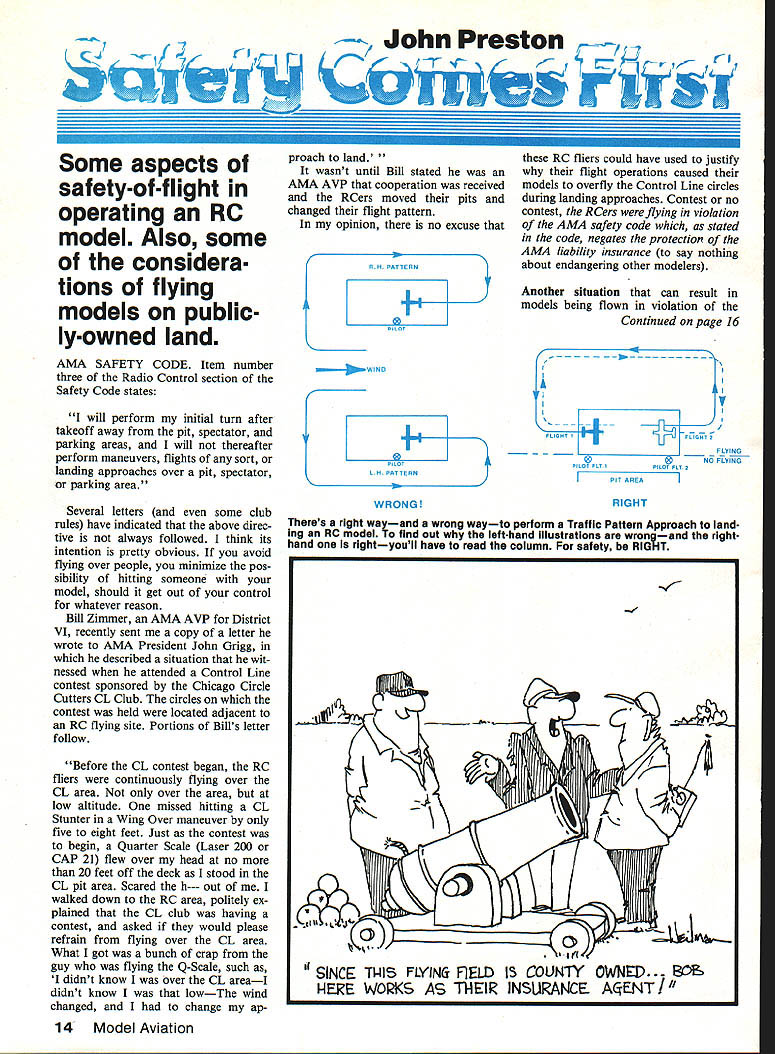
There's a right way—and a wrong way—to perform a traffic-pattern approach to land. One common training illustration shows both right- and left-hand patterns crossing to both sides of the runway. That is wrong for two reasons:
- Safety: The illustrated path has the model flying on both sides of the runway centerline. If the pit and spectator areas are behind the pilot (as is typical), a left-hand approach in the pictured wind would force the model behind the pilot and over the likely pit/spectator area.
- Competency: A pilot should be able to make landings equally well when approaching from either the pilot's left or right. Wind changes; pilots must be competent from both directions.
A correct traffic pattern never crosses to the "no flying" side of the infinite line that marks the near edge of the runway. Pilot positions should differ for left- and right-hand approaches—many pilots prefer to stand toward the downwind end of the runway, behind the model during takeoff. For beginners, this makes steering corrections during takeoff easier and reduces the chance of a pilot being struck if another model veers over the near edge and enters the pilot zone.
Mixing sailplanes, electric, and engine-powered models
Mixing sailplanes and electric-powered models with liquid-fueled, engine-powered models at a single site can create safety conflicts. AMA Special Services Director Carl Maroney responded to a club inquiry with guidance useful to clubs running mixed-model operations:
- Powered airplanes (sport and pattern types) should adhere to the practice of flying on one side of the infinite line as shown in the voluntary flying-field standard.
- Sailplanes and electric-powered gliders may seek thermals to the rear of that same line, provided they also adhere to the Safety Code and do not overfly people or vehicles.
- Pattern-type electric-powered planes should follow the same rules as gasoline- and glow-fuel airplanes because they typically do not have the same gliding capability as electric sailplanes.
- Most clubs find separate fields preferable. Large clubs often break into special-interest groups using fields separated widely enough to avoid radio interference while meeting monthly to discuss common issues.
- A glow- or gas-engined plane making a deadstick landing is not to be considered a glider with the motor stopped.
- Common sense, the Safety Code, and the voluntary field standard are the primary criteria for safe field operations.
The voluntary flying-site specifications standard Carl referred to can be found on page 130 of the 1984–85 AMA rule book (and page 130 of the 1986–87 rule book). If you need a copy of the standard and have misplaced your rule book, send a SASE and a copy can be mailed to you. The standard provides guidelines for RC field layout intended to prevent flying over people and parked cars.
Club flight training programs
Despite the Safety Code and voluntary field standard, some clubs still condone flying over people. Several club training programs require student pilots to demonstrate figure-of-eight or rectangular flight patterns that include both left- and right-hand turns. Some of these program illustrations show the model's path passing over areas where other modelers and spectators must stand. Those illustrations are unsafe and should be corrected so that training patterns keep models on the safe side of the flight-line.
Publicly-owned flying sites
In December 1985 this column asked for input from clubs operating on publicly owned land. Jim Cianciolo, president of the Kansas City RC Association, asked how to handle non-AMA-member modelers flying at a public-park field, since they would not be covered by AMA liability insurance. Russell Knetzger, secretary of the Milwaukee RC Association, replied with the Milwaukee experience:
"We have the identical situation here in Milwaukee, in which one of our RC fields is on Milwaukee County park land. Milwaukee County decided, in giving up the use of the land, that they did not want AMA to be able to have day-to-day park employees regulate the use of the field. So, they required the modelers petitioning for use of the land to create some kind of organization that would develop and enforce field rules. We created the Milwaukee RC Association. It has a land-use permit from the county to operate the field on behalf of the public."
Key points of the Milwaukee arrangement:
- A pilot must buy an annual license from the Association to use the field; the fee is used for maintenance (current example fee: $15).
- The license is the method for claiming frequency use at the field: you sign your card under a clip denoting your frequency. No card, no frequency.
- Field rules are posted as required by the County; having a license lets the club know who is flying and provides a way to send periodic safety mailings.
- AMA membership is not required, but equivalent insurance is. Attempts to buy a homeowner's-policy rider for the required $1,000,000 coverage typically cost more than AMA membership, so most choose AMA membership.
Russell's suggested steps to address the Kansas City situation:
- Go back to the County and explain the essential need for enforceable field rules, since RC aircraft can be deadly.
- Ask for individual insurance coverage to mitigate County liability in case of an accident to persons or property.
- Ask for a user-identification license.
Additional notes from Russell:
- The County lawyer will usually support those points because accidents are more likely without rules, and lack of posted rules increases County liability exposure.
- If the County charges a fee (as with golf course green fees), the County can purchase the extra insurance and include it in the fee. If the County charges no fee, the modeler can be required to provide insurance coverage instead.
- If these steps fail, you and the other modeler are on County land and can sue the County if the other modeler damages you or your property; public bodies carry substantial general-liability insurance.
- Chicago-area clubs that fly on Forest Preserves may find slightly different arrangements—some Forest Preserves cover the situation with their own general coverage and do not require modeler insurance.
If other clubs operating on publicly owned land have different systems, please report them so others can learn from those experiences.
Have a safe month.
John Preston 12235 Tildenwood Dr. Rockville, MD 20852
Transcribed from original scans by AI. Minor OCR errors may remain.

