
John Preston
Safety Comes First
For RC flying: how safe is safe? A modeler shares his concerns and a reader survey on his proposals is solicited. Also: more on flying on publicly owned sites.
RC SAFETY
The November 1985 issue of Model Builder magazine contained a letter (see "Bill Northrop's Workbench," page 6) to the publisher from Dave Abbe expressing concerns about the safety of RC model aircraft operation. Dave cited a number of criticisms aimed at RC equipment manufacturers, the news media, and our national organization. His letter concluded with the following recommendations:
"I strongly recommend that the following steps be taken: A national radio control safety effort be launched with a committee of representatives from the national clubs (modelers), manufacturers (suppliers), and insurers to develop and maintain acceptable standards for the RC hobby as sanctioned in a publicly-organized fashion and targeted on the 1991 frequency rules implementation.
These standards must include:
1) More uniform and informative manufacturer's operating instructions.
2) Standardization of manufacturer's interchangeability of parts wherever possible, covering servos, batteries, switch harnesses, RC format, etc.
3) Maintenance of mandatory safety checks at sanctioned flying sites for loaded ESV measurement of transmitter and receiver batteries, before flight or use.
4) Contest range checks and control flutter certification added to the battery-quality test. Requirement that aircraft over a certain size/weight have adequate safety redundancy built in to assure minimum risk in the event of control/battery failure.
5) Proper stationing of 'flier's points' to prevent harmonic interference between transmitters."
Before asking readers for input on Dave's recommendations, I would like to voice some personal thoughts on his five items.
1) Manufacturer operating instructions
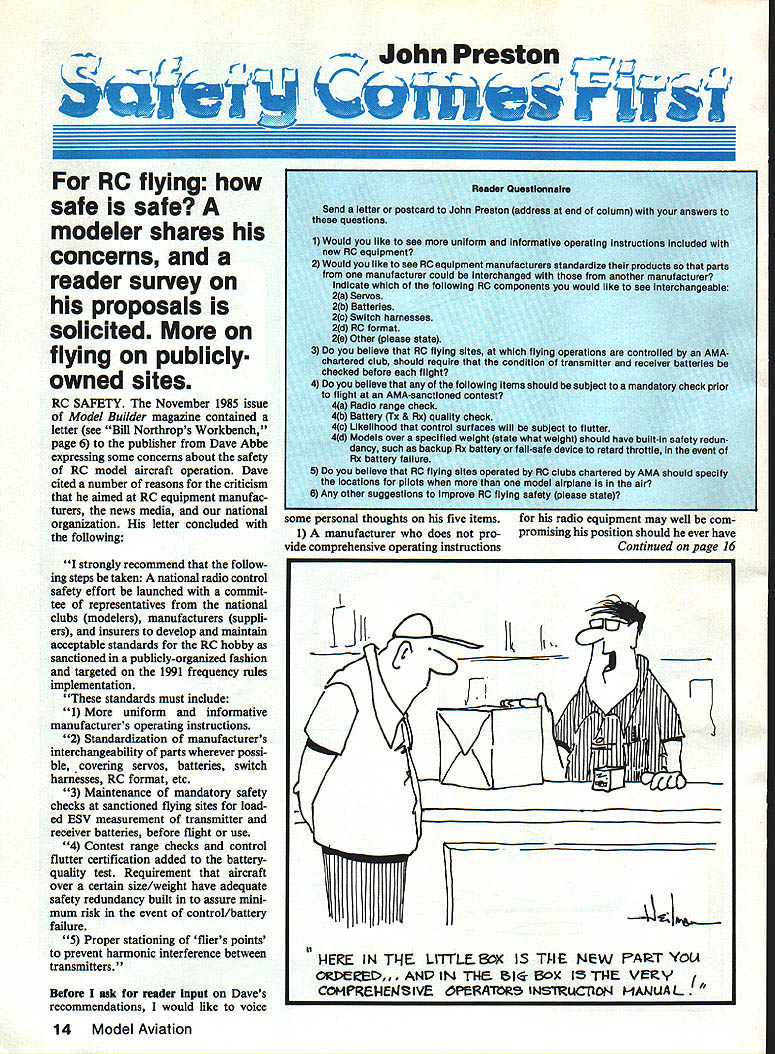
A manufacturer who does not provide comprehensive operating instructions for radio equipment may compromise his position should he ever have to defend a product-liability suit stemming from a model-airplane-related accident. Several lawsuits involving non-model products have hinged on whether the manufacturer provided sufficient instructional material and adequate warnings about potential hazards if instructions were not followed.
In my regular job I have had considerable involvement in developing safety standards for products. Most standards include sections concerning instructions and user cautionary statements to alert users to hazards that may not be obvious to persons of average skill and experience. The development of such standards is most often spearheaded by a trade association. Since a trade association exists for RC equipment manufacturers, it might be the appropriate body to consider guidelines for essential elements in operating and maintenance instructions. AMA should have a voice on any committee that undertakes this work because AMA represents users of the products. I do not think AMA is the appropriate association to lead such an effort.
2) Standardization and interchangeability
Dave Abbe is not alone in wanting standardization of components to assure interchangeability. S. J. Cased expressed similar feelings in a letter to Model Aviation (January 1986). This issue would also be best addressed by a trade association representing manufacturers. Standardizing connectors, switch harnesses, and servos may be desirable to users, but manufacturers may have good technical and economic reasons for not standardizing. For example, gold-plated connector pins might be desirable to some but not vital to reliable operation.
3) Mandatory safety checks at sanctioned flying sites
A requirement for mandatory safety checks at sanctioned flying sites could reduce accident probability by catching maintenance issues such as weak batteries. However, it depends on what is meant by "sanctioned flying sites." I assume Dave means flying fields operated by AMA-chartered clubs. Some clubs have difficulty enforcing even basic rules such as AMA membership; enforcing mandatory equipment checks might be difficult or impossible.
Batteries are more likely to be checked if the procedure is quick and simple. In the September 1984 safety column I mentioned an on-board device for checking receiver batteries at the push of a button: the Batt-Chek RX-1, manufactured by Pro-Tune Corp. (See Pro-Tune advertisement on page 14 or call (914) 462-6452.)
4) Contest checks and redundancy
Dave has two suggestions in item No. 4; I will address them separately.
- Requiring a radio range check, control-flutter check, and battery-quality test at contests is a good and feasible suggestion. Nats contestants are already familiar with transmitter processing procedures that ensure outputs are on the stated frequency. Range and battery checks could be included with the right manpower, time, and equipment.
- Checks of control surfaces and associated linkage to minimize flutter likelihood are already a requirement prior to flight at contests sanctioned by the International Miniature Aircraft Association (IMAA) and could be similarly required at AMA-sanctioned contests. I believe loss of control due to radio equipment problems is more common than loss due solely to batteries.
Dave's suggestion that aircraft over a certain size/weight should have redundancy in the event of control or battery failure is already a recommendation in the IMAA "Aircraft Size & Safety Guidelines." Alternatives include fail-safe devices that will close the engine throttle if the receiver batteries become weak during flight.
5) Proper stationing of pilots
Pilot placement (too close to one another) when several models fly simultaneously has been cited as a source of self-generated radio interference. In the January 1986 issue of R/C Technique, George Meyers published extensive test data on this subject. Although I am not an electronics expert, I urge all RCers to read George's column, consider conducting tests of their own, and report results to him.
Reader Questionnaire
Send a letter or postcard to John Preston (address at end of column) with your answers to these questions.
- Would you like to see more uniform and informative operating instructions included with new RC equipment?
- Would you like to see RC equipment manufacturers standardize their products so parts from one manufacturer are interchangeable with those of another? Indicate which components you would like to see interchangeable:
- 2(a) Servos
- 2(b) Batteries
- 2(c) Switch harnesses
- 2(d) RC format
- 2(e) Other (please state)
- Do you believe RC flying sites, where flying is controlled by an AMA‑chartered club, should require that the condition of transmitter and receiver batteries be checked before each flight?
- Do you believe any of the following should be mandatory checks prior to flight at an AMA‑sanctioned contest?
- 4(a) Radio range check
- 4(b) Battery (Tx & Rx) quality check
- 4(c) Likelihood that control surfaces will be subject to flutter
- 4(d) Models over a specified weight (state what weight) should have built-in safety redundancy such as a backup Rx battery or fail-safe device to retard throttle in the event of Rx battery failure
- Do you believe RC flying sites operated by AMA‑chartered clubs should specify pilot locations when more than one model airplane is in the air?
- Any other suggestions to improve RC flying safety? (Please state.)
To simplify responses, a postcard with a simple Yes or No opposite the question number will suffice. Those with strong feelings are welcome to submit a letter. I will forward a summary of responses to the AMA Safety Committee for their consideration and will publish poll results in a future Safety column.
Implementation and committees
If implementation is believed necessary, a trade association may be the appropriate body to improve the current situation. Dan Lieberman is president of RCHTA (the RC equipment manufacturers' association) and Donald Reisman is president of the Hobby Industry Association (HIA), which represents hobby product manufacturers. If there is sentiment to improve operating instructions and standardization, RCHTA and/or HIA could coordinate manufacturers with users selected by AMA.
AMA Safety Committee
There is already an AMA Safety Committee composed of three Executive Council members—Jim McNeill, Dave Brown, and Johnny Clements—and an advisory board of 17 members. Thirteen of the advisory board members represent RC model-flying activities. In other words, we already have a means to examine the merits of Dave Abbe's suggestions for improving RC flight safety.
Publicly‑owned flying sites and insurance
In December 1985 I asked readers for input on ensuring that municipal- or city-owned flying sites are adequately covered by liability insurance. Since then I have received several letters.
Albert Powell of the Long Island R/C Society enclosed the rules for flying at parks supervised by the Long Island State Park & Recreation Commission. These rules require a permit costing $7.50 per month or $45.00 annually and proof of liability insurance in the amount of $500,000. AMA membership provides double this coverage, and a certificate can be obtained by any AMA‑chartered club or chapter from AMA HQ.
It seems the solution to the "non‑insured flier" problem at park flying sites is either to lobby the park commission to raise the minimum insurance requirement to $1,000,000 and require AMA membership, or for AMA to offer a liability policy that members who fly at public sites can purchase. Under either proposal, responsibility for ensuring rules are observed should lie with the site sponsor (city, county, etc.) or the club permitted to fly there.
Controlling operations at public sites
A related problem is the presence of unauthorized fliers who use a site without the permit‑issuing agency's permission. Enforcement is difficult because the club or city official often has little authority. When flying is permitted by permit only, there must be a means to determine who has a permit.
Suggested methods:
- Use a daily permit or pass the flier must display on person or transmitter.
- Have the club issue a colored card or badge to be displayed while flying; change the color monthly to deter forgeries.
- Have police enforce the rules (effective but expensive and police may avoid minor disputes).
- Best: have the club actively police the site and revoke privileges of repeat offenders.
Determining AMA membership
Most letters on this subject addressed how to determine if a flier is an AMA member. All suggested requiring AMA membership as a condition for flying on club sites. One frequency-control method shown in the AMA rule book (page 128 of the 1986–87 book) requires inserting your AMA membership card into a pocket on the frequency-control board when you remove the frequency-control clip. For those concerned about losing their AMA cards, the system could be amended to permit using a copy of the card.
The Northern Virginia RC Club (NVRC) system is worth considering: upon payment of annual dues, the club issues colored stickers for attachment to members’ transmitters. The color changes each year and the year of issue is printed on the sticker. Proof of AMA membership is required when NVRC members renew. The sticker on a transmitter signifies both current club and AMA membership; a quick check of the transmitter impound rack readily identifies those delinquent in dues.
Servo‑screw integrity
A few issues ago I ran a letter from Peter Young alleging that self‑tapping screws holding together servo case halves may work loose because of engine vibration. Another reader, Jay Stevens, experienced the same problem and uses a dab of epoxy on the screws to keep them from loosening.
As an alternative to epoxy, Glen Grady (Port St. Lucie, FL) suggests fingernail polish. Glen has used nail polish to secure screws in cameras recording data from jet engines on full‑scale aircraft. He thinks nail polish will be as effective as epoxy while permitting easier screw removal for servicing.
Electric starters — safety warning
A caution to those who use electric starters on engines without a spinner. Glen Grady witnessed an accident in which a club member required hospital treatment to remove a prop fragment from his chest. The modeler was starting a .40 four‑stroke with a wooden prop but no spinner. When the starter was used, it spun off‑center, throwing the rubber cone out. On one attempt the cone flew out and the engine fired with the throttle wide open. The plane lurched forward into the starter because the cone had come out and vibration loosened his grip. The prop hit the starter and shattered, sending a piece of wood into his chest.
Fortunately, the injury was not serious. Glen suggests:
- Do not use starters on an engine unless a spinner is installed.
- Never start an engine with the throttle wide open (applies to throttle‑equipped engines).
Have a safe month.
John Preston 12235 Tildenwood Dr. Rockville, MD 20852
Transcribed from original scans by AI. Minor OCR errors may remain.

