

John Preston
Safety Comes First
More on weighted blades in RC helicopters; safety hints for propellers; the "legal RC frequencies" problem surfaces again; eliminating flutter and buzz.
Correction (Glenn Scillian)
I recently received a letter from Glenn Scillian concerning a report of an accident he had while flying an RC helicopter that I reported in this column in the January 1986 issue of Model Aviation. My previous report was wrong and may have been a disservice to RC helicopter builders and fliers. I apologize and, to set the record straight, I am using Glenn's own words to describe what really happened.
"In the summer of 1983, I suffered a serious accident when I was struck by a lead weight from one blade of my helicopter. I found that when I added one ounce of lead, in the shape of a disk about one inch in diameter and about 1/4-inch thick, to each blade, my model flew beautifully—much better than with unweighted blades. As far as I can recall, these blades had never touched the ground or the tail boom. The slugs were epoxied in a cavity about three inches from the outside end of the blade. The cavity was half in the hardwood and half in the balsa. (I grant that a long slender slug resting entirely in the hardwood would have been safer, but the disk shape was the one recommended by one manufacturer for use in one of its helicopters.)
"On this day, I was revving the engine up as the helicopter was sitting on the ground about 12 feet in front of me with the tail toward me. Just at the moment of lift-off, the slug (with a chunk of the foam from one blade) let go and struck me in the right shin two inches below the kneecap and knocked me down. I still held the transmitter and shut the throttle down, but the now-unbalanced 'copter thrashed violently on the ground and literally tore off the tail boom. A friend finally stopped the blades and pulled off the fuel line. Other friends applied some clean towels to my wound, which was bleeding moderately and draining bone-marrow oil. I was driven to the nearest hospital, about five miles away, and was treated as an outpatient. Examination showed a chipped tibia but, fortunately, no damage to the patella ligament.
"I had to wear a soft cast for about three weeks, and healing was complete in four or five weeks. Before I returned to flying, all my weighted blades were discarded and replaced by Jeff Urcan's heavy blades. As far as I can see, they fly as well as the lead-weighted blades."
Glenn also described another incident in which a friend hovering a helicopter at about eye level had a lead weight in one of the blades let go. Nobody was struck in that case, but the helicopter suffered damage due to its unbalanced main rotor blades.
Before leaving this subject, note that an emergency competition rule published in the September 1984 issue of Model Aviation outlawed metal blades, knife-edged leading edges on blades, and any metal in or on blades beyond a point two inches from the blade root attachment. That emergency rule was enacted under AMA contest board procedures allowing the AMA president (with concurrence of the appropriate Contest Board chairman) to take emergency action. To make such a change permanent it must be ratified by a vote of the entire Contest Board within four to six weeks after publication. The Helicopter Contest Board members voted against the rule concerning helicopter blades, so weighted blades remain permitted in AMA‑sanctioned helicopter contests. Note, however, that FAI rules for RC helicopters (page 106 of the 1986–87 rule book) do not permit metal blades, metal weights in blades, or knife-like leading edges on blades.
Propellers
Switching from helicopter rotor hazards to fixed-wing propellers: two readers contacted me about blade separation from propellers. One was a phone call from Paul Geders (St. Louis, MO) asking whether a particular non-wood prop had been involved in more blade-separating incidents than others. My correspondence records do not show enough documented incidents to draw statistically valid conclusions, though I did find more reports of blades separating from wooden props than from plastic props. Please do not interpret that as meaning plastic props are inherently safer — blades may separate from props regardless of material.
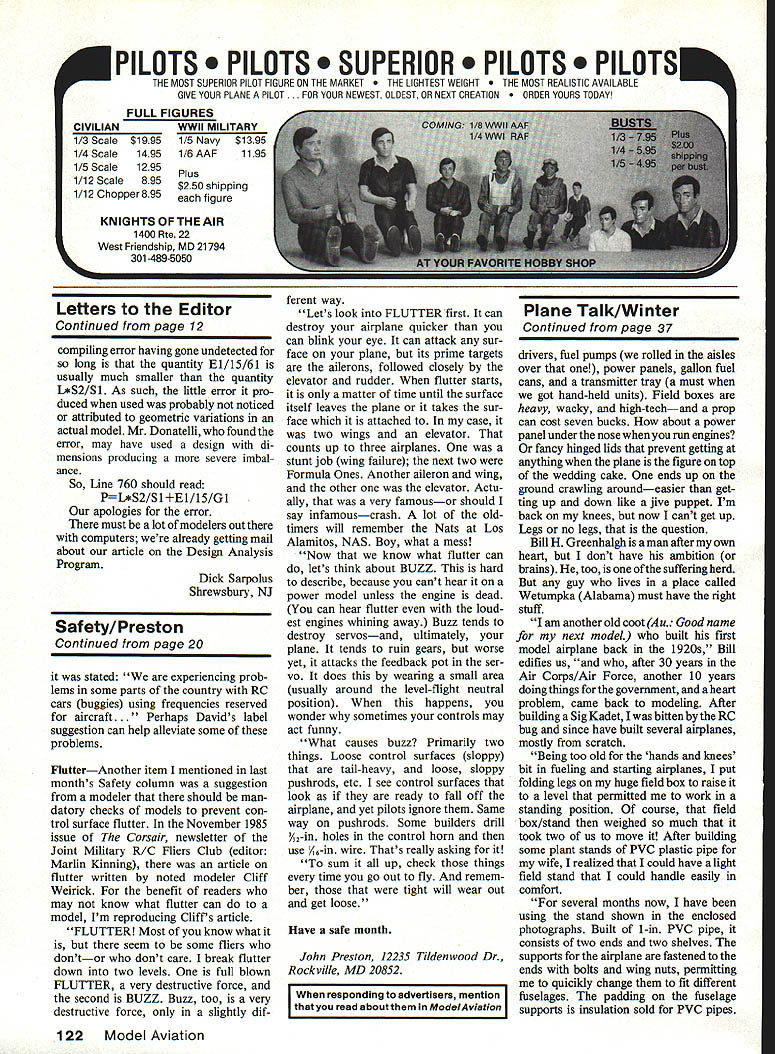
A letter from A.E. Richt (Scott Depot, W.Va.) enclosed the instructions that accompanied some Graupner "Super" fiberglass-reinforced nylon props he purchased. The instructions were in German and appeared to warn users to avoid letting the props "dry out" — recommending periodic boiling or storing them in a wet rag. Another warning stated the prop tip velocity should not exceed 180 meters per second. A.E. supplied this table of maximum RPMs for various prop diameters for a 180 m/s tip speed:
- 6 in — 27,000 RPM
- 7 in — 22,000 RPM
- 8 in — 19,300 RPM
- 9 in — 16,600 RPM
- 10 in — 15,000 RPM
- 11 in — 14,200 RPM
- 12 in — 13,200 RPM
- 13 in — 12,300 RPM
- 14 in — 11,300 RPM
- 15 in — 10,400 RPM
- 16 in — 9,600 RPM
- 17 in — 8,900 RPM
- 18 in — 8,000 RPM
I have sent the Graupner instructions to a German-born engineer friend for translation. If anything important appears in his translation, I'll include it in the next Safety column. Meanwhile, by the time this is in print I should have the translated instructions; I will forward them to any reader sending an S.A.S.E. to my address at the end of this column.
Which frequency for which model?
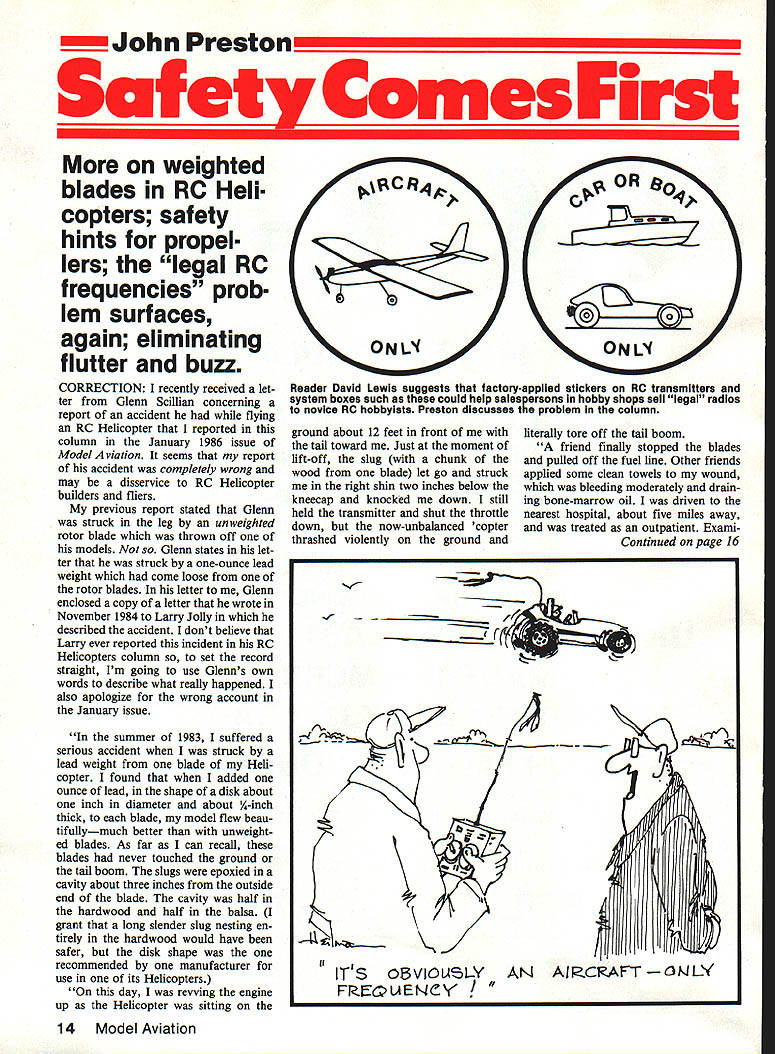
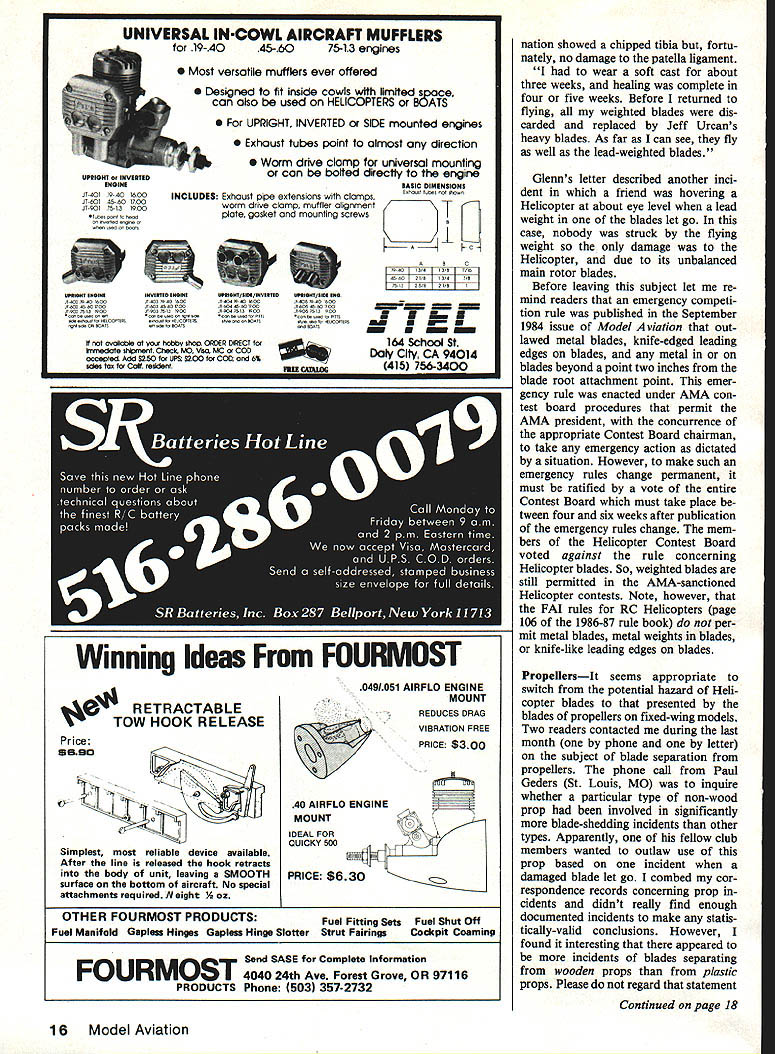
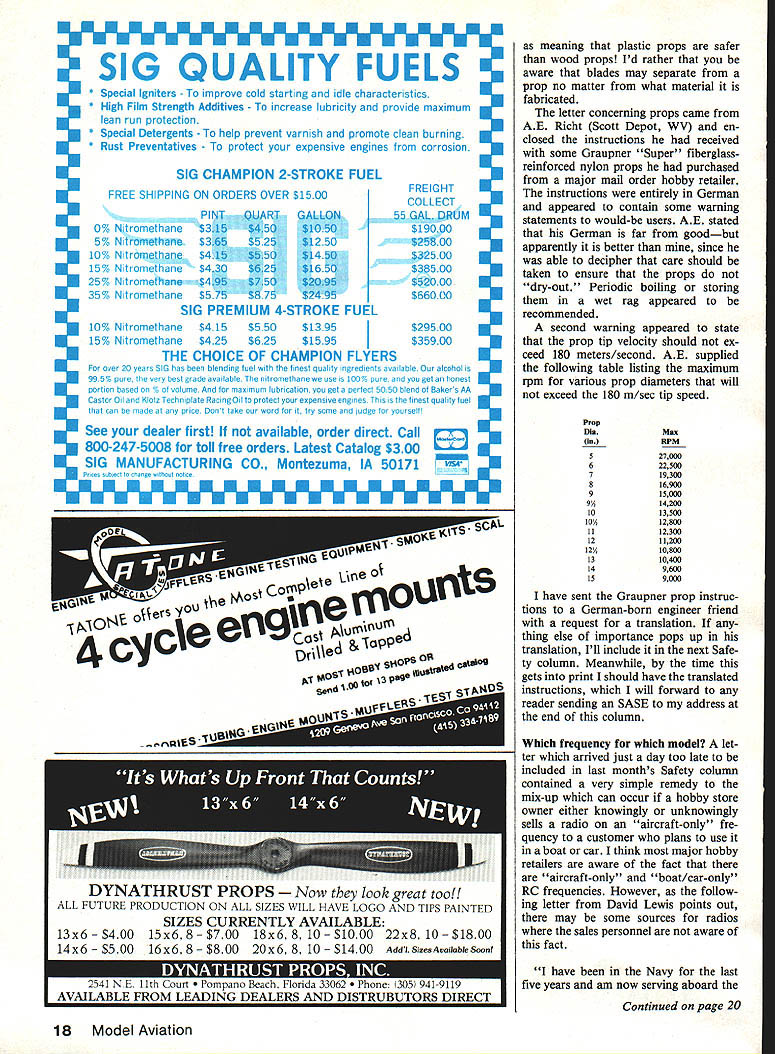
A letter from David Lewis suggested a simple remedy for the mix-up that occurs when a radio intended for "aircraft-only" frequencies is sold to someone who plans to use it in a car or boat. Hobby shop personnel who are not involved in the RC hobby often cannot tell which radios are aircraft-only and which are boat/car-only. David wrote from aboard the destroyer U.S.S. Hoel and noted that Navy Exchange stores often sell any radio on any frequency to anyone, because the radios lack clear identification.
David's suggestion: mark radios at the factory with an ID label (e.g., "aircraft-only" or "boat/car-only"). For transmitters that use interchangeable RF modules, the modules themselves could bear such labels. As multi-frequency radios become more common (for example, synthesizer-based systems), manufacturers of flags and channel markers could include labels indicating permitted use (aircraft or boat/car).
All radio systems should include clear, uniform instructions listing frequencies designated for aircraft-only and those for boat/car-only. The AMA rule book (1986–87), page 129, states: USE OF A RADIO TUNED TO AN AIRCRAFT-ONLY FREQUENCY IN A CAR OR BOAT IS AGAINST THE LAW. That "law" refers to an FCC regulation.
I will pass David Lewis's suggestion for industry identification labels to the AMA Safety and Frequency Committee for consideration.
Flutter and Buzz
Flutter can destroy your airplane in an instant. It can affect any surface, but most commonly attacks ailerons first, then elevator and rudder. Once flutter starts, it is only a matter of time until the control surface leaves the plane — or takes part of the structure with it. I have seen flutter destroy two wings and an elevator: one stunt wing and two Formula One wings; another famous crash at the Nats at Los Alamitos involved flutter as well.
Buzz is harder to describe because you usually can't hear it on a powered model unless the engine is off. (You can hear flutter even with loud engines.) Buzz tends to destroy servos — particularly by wearing the feedback potentiometer around the neutral position — and it ruins gears. When the pot is worn, controls can act erratically.
Primary causes of buzz:
- Loose (sloppy) control surfaces, especially when tail‑heavy.
- Loose pushrods and linkages.
- Poorly sized or fitted hardware (for example, drilling 3/16-inch holes in a control horn and using 1/8-inch wire is asking for trouble).
To summarize: check hinges, linkages, and control surfaces every time you go flying. Tight connections will wear and become loose with use. Maintain them before they cause buzz or flutter.
Have a safe month.
John Preston 12235 Tildenwood Dr. Rockville, MD 20852
Transcribed from original scans by AI. Minor OCR errors may remain.

