
John Preston
Safety Comes First
Watch it: there may be a screw loose! What's a good RC basic trainer? Be extra careful when you're using an electric starter.
Togetherness
On a number of occasions in the past few months I've read newspaper accounts concerning parts of full-scale aircraft falling off in flight. I don't believe that any of these incidents involved any loss of life or even any injuries, but certainly the potential for injury exists when a critical component such as part of a wing flap separates, as was reported in one case. I believe that a potential for injury could also result if a vital component of a model airplane is shed during flight.
Back in the December 1985 issue I described an incident which resulted in the crash of a modeler's CAP 21 and which was allegedly due to engine vibration causing self-tapping screws holding the aileron servo together to loosen during flight. In the December column I asked if any readers had experienced a similar problem, and I received only one letter of response. However, a letter arrived just this week which mentioned a different screw-loosening problem associated with servos which, the writers believe, is much more likely to occur. The letter was from Bob and Dolly Wischer, who write the "RC Scale" column for Model Aviation. They said:
"In several columns you have mentioned that servos have become disassembled because self-tapping screws have loosened. I don't know if you are aware of the true situation. We have never heard of servo cases coming apart. The really hazardous point to watch is the tiny screw that holds the output arm to the servo output shaft.
"In the past year, there have been several accidents—or near-accidents—at our club field because these screws either were never installed or were loosely inserted. The worst offenders were self-tapping Phillips-head screws with crossed slots in the head for Phillips-type screwdrivers. The driver lifts out of the slot before the screw is really tight because the modeler doesn't want to place excessive force downward on the mechanism. He is correct in his assumption that it can be damaging. The cure is simple—don't use a Phillips screwdriver, which cams its way upward out of the slots. Use, instead, a small jeweler's screwdriver, preferably one with sharp corners on the blade tip. It won't lift out of the slot, even with much less downward pressure, and the screw can then be made sufficiently tight so that it will not back out from engine vibration or servo action.
"One club member's laser scale model crashed, and we found afterward that the elevator servo had no (arm-retaining) screw installed. A few weeks later, another modeler experienced erratic action of his control surfaces on the ground, and when the wing was removed to search for the cause, he found that these same screws were loose on several servos. Another modeler found the screw lying in the fuselage bottom, completely out of the servo arm. If tightened properly, these screws will never come loose. I have made it practice to securely tighten the screw the very instant that it is first inserted. If I think of doing it at a later time, there is a good chance that it will be forgotten. Just before the first flight of a new model, take another look at these screws. After that, they can be forgotten."
Servo-output-arm-retaining screws
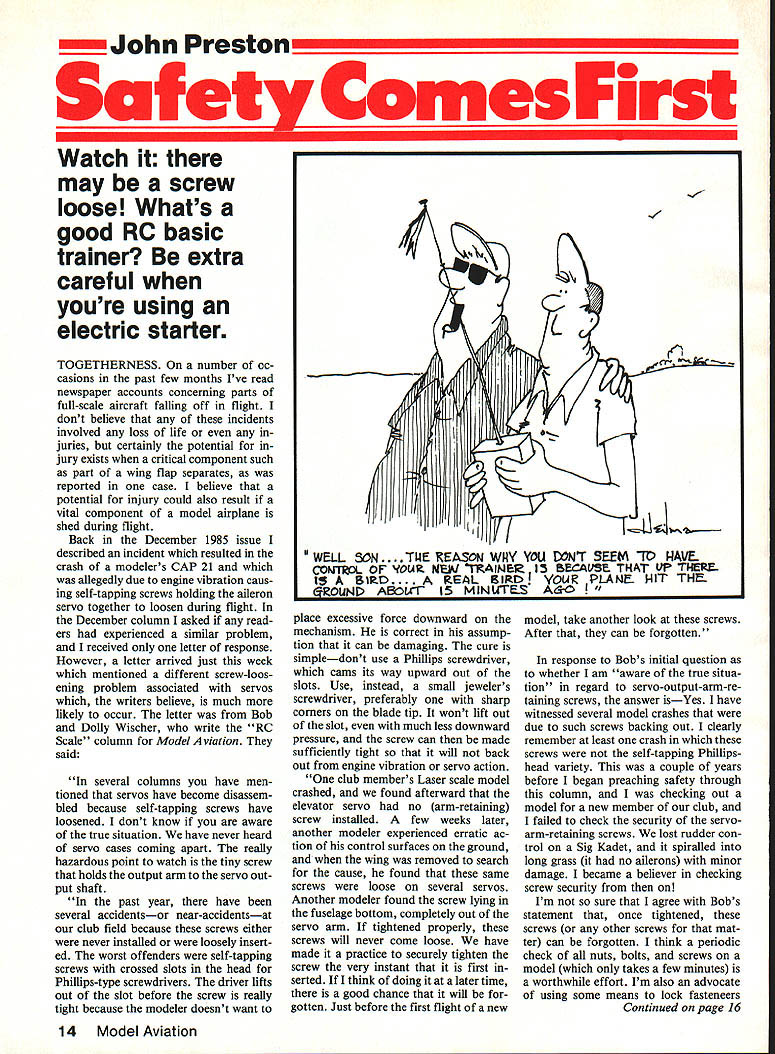
In response to Bob's initial question as to whether I am "aware of the true situation" regarding the servo-output-arm-retaining screws, the answer is yes. I have witnessed several model crashes that were due to such screws backing out. I clearly remember at least one crash in which these screws were not the self-tapping Phillips-head variety. This was a couple of years before I began preaching safety through this column, and I was checking out a new member of our club, and I failed to check the security of the servo-arm-retaining screws. We lost rudder control on a Sig Kadet and it spiraled into long grass (it had no ailerons) with minor damage. I became a believer in checking screw security from then on.
I'm not so sure that I agree with Bob's statement that, once tightened, these screws can be forgotten. I think a periodic check of all nuts, bolts, and screws on a model (which only takes a few minutes) is a worthwhile effort. I'm also an advocate of using some means to lock fasteners that are buried within the model and cannot be checked after it is covered. The screws (or nuts and bolts) that serve as the pivot for aileron bellcranks are a prime example of "hidden fasteners" that cannot be periodically checked and should therefore be locked in some manner. I prefer a dab of epoxy or a self-locking (Nylock or other brand) nut.
Hinge pins
While on the subject of shedding parts in flight, don't forget to secure the hinge pins in the control surface hinges. Many of these are non-removable, so you don't have to worry about them falling out, but there are some that are not. Again, I can recall a time when I was asked to perform a check and first flight on a beginner's model (this was also a Sig Kadet). During the check, I told the builder that I wasn't impressed with the security of the hinge pins that he had installed on the elevator and rudder hinges. After he assured me that he had them secure, I attempted a first flight. You guessed it: the hinge pins on the rudder fell out. For a second time I watched a Kadet spiral into long grass with essentially no damage.
What makes a good trainer?
In case you are wondering: yes, I do recommend a Sig Kadet as a first model for the newcomer to our hobby. Which brings me to another subject: what models are good trainers for beginners?
I got into the RC part of our hobby as a result of bumping into Hurst Bowers, the AMA museum curator, in a local hobby store back in 1968. My trip to this hobby store was to purchase balsa and covering tissue for a Free Flight model that I had built for my son who, at that time, was only four years old. OK, I admit that I built the Comet kit for myself, using my son as the excuse.
Anyway, to cut a long story short, I found that Hurst was "Mr. Scale" of the Washington, DC area at that time. As a result, my first RC model was a scale model—an Aeronca Tandem. Did I hear someone say that this was a bad choice for a first RC model? Actually, since the planes that Hurst lent me to build were intended for it to be a Class B Gas Scale model (Free Flight) for Ohlsson .23 power, it was a perfect choice. I soloed this model during the second trip to the flying field. Perhaps the word "solo" is a misnomer. My technique for flying it was to treat it as a Free Flight model, using the radio only to keep it from flying away. A Galloping Ghost radio by Controllaire (now World Engines) meant that it had to be hand-launched, and I wouldn't touch the stick (GG radios only had one stick) until it had enough altitude to prevent a mistaken command by the pilot from causing its demise. Landings were always made dead-stick, since the throttle control never worked worth a hoot.
The Aeronca had a Clark-Y airfoil and lots of dihedral. It was also a slow flier (Cox .09 power), which gave its pilot time to think. These are the attributes that I feel make a good trainer for a beginning modeler. Unfortunately, there are a multitude of so-called "trainers" on the market that do not have these qualities. In other words, there are basic trainers and advanced trainers. Again, unfortunately, some of these latter models are peddled by their designers/manufacturers as "perfect for the beginner."
A couple of years ago, I received a letter from Jim Connor, a modeler from Horseheads, NY. Jim had spotted advertisements for so-called RC trainer models with engines up to .35 cu. in. in the Christmas catalogs of two major national retail department stores. The advertisements were not accompanied by any warnings or statements about seeking the help of an experienced flier before attempting a first flight. Jim also enclosed an advertisement clipped from a model magazine that was captioned "...an RC trainer which can be flown by a beginner without an instructor." The ad went on to say that the model "...will take off, fly itself, and land itself." If you are a beginner, build it fairly well, and do some imaginary flights before the actual first flight, you will probably have no problems soloing the model on your first RC flight. From the picture that accompanied the ad, it is possible that this model would be capable of flying by itself—if it were rigged correctly. Jim and his fellow modelers feel that this ad is "a slap in the face for safety and is in poor taste."
Another modeler, Jim Waterman (San Antonio, TX), expressed his opinions concerning trainer models in a "Guest Editorial" in the April 1985 issue of Model Aviation. Many of you must have read this, because the editor had a note in the September 1985 issue that stated that Jim's guest editorial "kicked off a flurry of mail to our offices." Apparently not all who wrote in agreed with Jim's views, which happen to be similar to the views I've just expressed in this column.
Perhaps some of you are questioning why I feel that selection of the right type of trainer as a first model has a bearing on flight safety. In response, it is my opinion that a number of crashes are due purely and simply to the fact that the model "got ahead of its pilot." By that statement I mean that the pilot lost control because the model required control responses which were beyond his capabilities.
Club training programs and model selection
Many clubs have a semi-formal flight training program for new members. In past Safety columns, I have discussed such programs and expressed my views on what basic features of those programs should be demonstrated before a beginner can be considered competent to fly solo without an instructor. However, I have yet to see any recommendations on the selection of the first model in any of those flight-training programs. I think you'd agree that it would be foolhardy for me to stick my neck out and, in this column, publish a list of trainers that I can recommend. I'd be sure to miss some good ones and have their manufacturers come after me with the proverbial axe.
I'm curious to learn whether there are any clubs that have information packets for beginners that mention suitable model choices. Many years ago, I participated in a number of shopping mall displays put on by my club which, at that time, was the Northern Virginia Radio Control Club. At the first of these displays, we found that the most common question was "How much does it cost to get started, and what model do you recommend?" At future displays, we had a preprinted information sheet to hand out in response to such questions. This sheet listed several models by brand name that the club members agreed were easy to fly.
Something that we did not do that I feel is also worthwhile was to suggest models of advanced trainers that are suitable for the recently-soloed club member. It is possible that there is a greater risk of an accident when a beginner solos and then considers himself qualified to fly any model—including the latest hot Pattern ship. Your thoughts on these ramblings would be appreciated.
Cyanoacrylate (CyA) fumes — personal protection
You may have seen an advertisement in recent issues of Model Aviation for a new company that goes by the name of Pelican Enterprises, Inc. The owner of this company, Terrence Sumrue, recently sent me a catalog of the items he is selling, most of which concern safety. One which particularly caught my eye is a "CyA" Mask. Pelican claims that this mask "...provides dependable filtering of concentrations (of fumes from cyanoacrylate glue) up to 1,000 ppm." I know that there are a number of readers who have experienced discomfort and, in some cases, ill health when they used cyanoacrylate (CyA) glue in areas with poor ventilation. If you are among these sufferers, you might want to contact Pelican and order their mask which sells for $12.47 plus $3.50 shipping. As they say in their ad for this mask, "It is cheaper than a hospital visit." Their catalog is free and can be obtained from Pelican Enterprises, Inc., 265 Oxford Lane, Bloomingdale, IL 60108. Tell them I sent you.
Electric starter hazards
A couple of issues back I mentioned an accident that occurred when a modeler attempted to use an electric starter on a model that was not equipped with a spinner. In this incident, the starter got off-center and shattered the prop, sending a piece of the blade into the modeler's chest.
Another rather unusual incident involving an electric starter was described in the December 1985 newsletter of the Amarillo Radio Kontrol Society (ARKS News). Under the title of "SAFETY," it read:
"I guess by now, most of us have heard about the accident to one of our members, but for those who haven't heard, here's the story as I heard it.
"A few weeks ago, this member and a friend were out flying. The weather was fairly cold. The member was standing at the wing tip of the friend's plane while the friend was attempting to start it. He was using a standard electric starter which had a plastic engagement cone.
"Somehow, when the engine started the friend was surprised, and the starter slipped off the spinner and hit the ground with the trigger still depressed (still spinning). The plastic cone exploded, sending fragments in all directions. The friend got a small piece through part of his ear, but a sliver hit our member in the corner of his eye and came out again. The doctor says there is a 50% chance that he will lose the eye, or he may have to have a cornea transplant.
"While this incident is tragic enough in itself, stop and think what could have happened if this had occurred at our field and the person hurt was an innocent bystander or his kid. We've got to keep spectators and their children out of the pit area. Friends or not..."
My only comment on this incident is to repeat something I've said several times previously: consider a pair of safety glasses when starting your model and when working in your shop.
Quick safety checklist
- Check and securely tighten servo output-arm-retaining screws with a proper jeweler's screwdriver.
- Lock or epoxy hidden fasteners (bellcrank pivots, buried screws).
- Secure removable hinge pins; verify all control-surface attachments before flight.
- Choose a trainer with forgiving handling: plenty of dihedral, a stable airfoil, and slow flight characteristics for beginners.
- Keep spectators, especially children, out of the pit area.
- Wear safety glasses when starting models or working with tools and adhesives.
- Use proper ventilation and consider a CyA mask if you work with cyanoacrylate glues.
Have a safe month.
John Preston 12235 Tildenwood Dr., Rockville, MD 20852.
Transcribed from original scans by AI. Minor OCR errors may remain.

