


John Preston
Safety Comes First
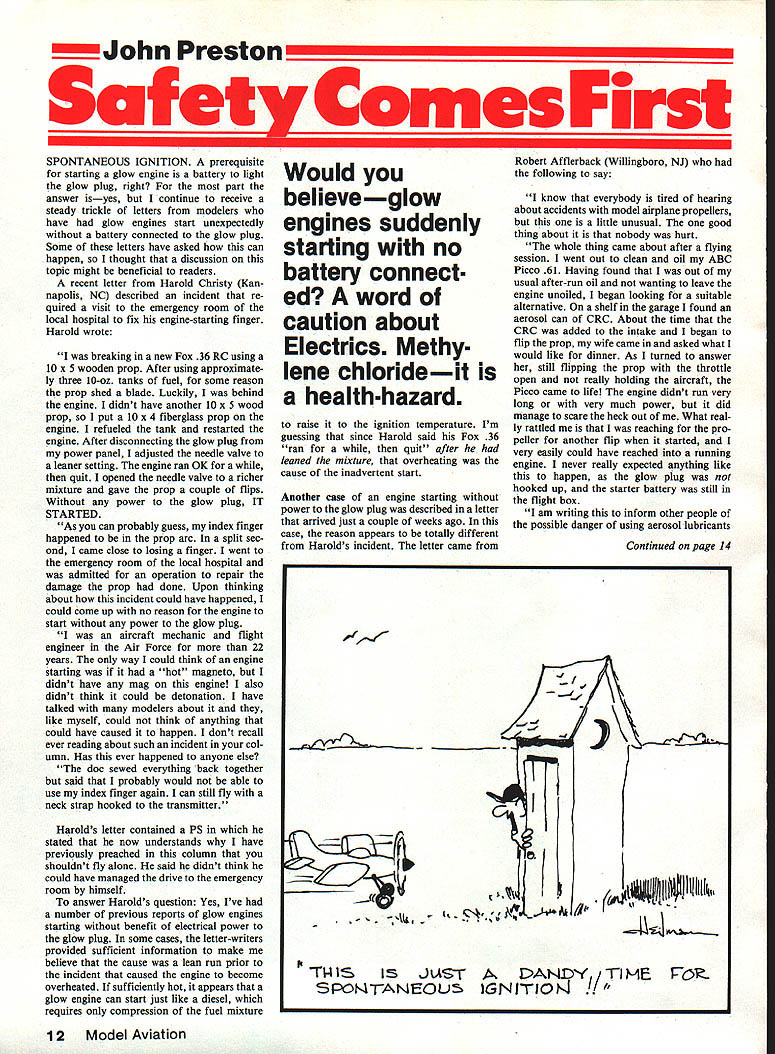
Spontaneous Ignition
A prerequisite for starting a glow engine is a battery to light the glow plug, right? For the most part the answer is yes, but I continue to receive a steady trickle of letters from modelers who have had glow engines start unexpectedly without a battery connected to the glow plug. Some of these letters have asked how this can happen, so I thought a discussion on this topic might be beneficial to readers.
Would you believe glow engines suddenly starting with no battery connected? Below are several incidents readers have sent me.
Harold Christy (Kannapolis, NC) described an incident that required a visit to the emergency room to fix his engine-starting finger. Harold wrote:
"I was breaking in a new Fox .36 RC using a 10 x 5 wooden prop. After using approximately three 10-oz tanks of fuel, for some reason the prop shed a blade. Luckily, I was behind the engine. I didn't have another 10 x 5 wood prop, so I put a 10 x 4 fiberglass prop on the engine. I refueled the tank and restarted the engine. After disconnecting the glow plug from my power panel, I adjusted the needle valve to a leaner setting. The engine ran OK for a while, then quit. I opened the needle valve to a richer mixture and gave the prop a couple of flips. Without any power to the glow plug, it started.
"As you can probably guess, my index finger happened to be in the prop arc. In a split second, I came close to losing a finger. I went to the emergency room of the local hospital and was admitted for an operation to repair the damage the prop had done. Upon thinking about how this incident could have happened, I could come up with no reason for the engine to start without any power to the glow plug.
"I was an aircraft mechanic and flight engineer in the Air Force for more than 22 years. The only way I could think of an engine starting was if it had a 'hot' magneto, but I didn't have any mag on this engine. I also didn't think it could be detonation. I have talked with many modelers about it and they, like myself, could not think of anything that could have caused it to happen. I don't recall ever reading about such an incident in your column. Has this ever happened to anyone else?
"The doc sewed everything back together but said that I probably would not be able to use my index finger again. I can still fly with a neck strap hooked to the transmitter."
Harold's PS noted that he now understands why I have previously preached that you shouldn't fly alone—he didn't think he could have managed the drive to the emergency room by himself.
To answer Harold's question: yes, I've had a number of previous reports of glow engines starting without electrical power to the glow plug. In some cases the cause appears to be a lean run prior to the incident that caused the engine to become overheated. If sufficiently hot, a glow engine can start much like a diesel engine, which requires only compression of the fuel mixture to raise it to ignition temperature. Since Harold said his Fox .36 ran for a while then quit after he had leaned the mixture, overheating is the most likely cause of the inadvertent start.
A different case came from Robert Afflerback (Willingboro, NJ):
"I know that everybody is tired of hearing about accidents with model airplane propellers, but this one is a little unusual. The one good thing about it is that nobody was hurt.
"The whole thing came about after a flying session. I went out to clean and oil my ABC Picco .61. Having found that I was out of my usual after-run oil and not wanting to leave the engine unoiled, I began looking for a suitable alternative. On a shelf in the garage I found an aerosol can of CRC. About the time that the CRC was added to the intake and I began to flip the prop, my wife came in and asked what I would like for dinner. As I turned to answer her, still flipping the prop with the throttle open and not really holding the aircraft, the Picco came to life! The engine didn't run very long or with very much power, but it did manage to scare the heck out of me. What really rattled me is that I was reaching for the propeller for another flip when it started, and very easily could have reached into a running engine. I never really expected anything like this to happen, as the glow plug was not hooked up and the starter battery was still in the flight box.
"I am writing this to inform other people of the possible danger of using aerosol lubricants."
I am assuming the aerosol CRC product Bob was using was a light oil known as "5-56," similar to WD-40. Both products are marked "DANGER—Extremely Flammable." I'm betting the propellant in the aerosol can caused Bob's Picco to start without aid from the glow plug.
A third incident came from Brian Kuehn (Peoria Heights, IL). I have no full explanation for Brian's experience, but the report adds to the evidence that engines can, sometimes, start unexpectedly.
"I was doing touch-and-goes with my Sweet-and-Low Stick (Enya .40 CV with standard muffler, 10 x 6 Power Prop, 10% Blue Flame fuel, K&B long RC plug) when I noticed that it was taxiing strangely. Upon examination, I found that the tail wheel had broken off due to metal fatigue. I moved the model to the side of the runway and shut it down. I went in search of the missing tail wheel, which took about five minutes to find. I decided to call it a day.
"I never leave fuel in the tank if I can help it. There wasn't much fuel left, so I decided to start it up and run out the tank. The engine was warm but not particularly hot. I choked it and put the Hi-Starter on it. It ran out the prime and stopped, and the fuel ran back down the line to the tank. I took off the Ni-Starter and laid it in the grass. I opened the throttle, put my thumb over the venturi, and gave the prop two sharp flips to prime the engine as had been my usual procedure. On the second flip, with the Ni-Starter still lying in the grass, it started!
"It caught me totally unprepared! The throttle was wide open. The fingernails of my left hand (I'm a southpaw) were severely split. Fortunately, they weren't lacerated. I pulled both hands back instinctively and got them away from the howling prop. I tried to step backward away from the model but the left wing hooked my leg before I could get away. It must have been a second or two, because for the next few seconds the model and I were chasing each other in circles until I finally got a solid grip on the left wing with both hands and dragged it back to the transmitter. If there hadn't been a broken and jagged piece of music wire in place of the tail wheel, I don't think I would have been fast enough to avoid serious injury.
"Since then, I've talked to many people and found several others who had glow engines start without a battery being hooked up. I was blissfully unaware of this possibility before it happened to me. I thought perhaps your readers should be warned of this potential danger."
Summary points on spontaneous ignition:
- Overheating from a lean run can allow compression ignition, similar to a diesel.
- Flammable aerosol propellants can provide ignitionable vapor and cause unexpected starts.
- Engines can sometimes start during routine handling — always assume a prop can move.
Electrics
Some months ago, scale modeler Don Srull suggested I mention a word of caution to those who fly electric-powered RC models: disconnect the motor battery when the model is not in use, because a mere flip of a switch will bring the motor and prop to full rpm in a split second.
Ken Holcomb (San Diego, CA) described an incident that illustrates the danger:
"I have been flying Electrics for about two years. We can fly at the local glider field without the noise problem of gas. However, there are uniquely dangerous hazards with Electrics which don't happen with gas.
"Last night, I was working on my Astroflight Porterfield in the workshop. I left the fuselage on the workbench. The transmitter was on charge after its batteries had discharged. The motor and receiver batteries were fully charged. My workshop is in the garage, and the neighborhood kids enjoy visiting. One of these kids is a boy of about 13 who has built and flown several gliders and 1/2 A RC models. He's starting some Electric projects but is not completely familiar with the equipment or its dangers. As you can imagine, this model was too much of a temptation for him not to experiment!
"Somehow, the RC equipment was switched on and also the motor battery was switched! The fuselage jumped down from the bench and slammed into a paper bag full of balsa scraps. Pieces of balsa were thrown all over the garage. The wooden prop broke before my friend could turn the motor switch off.
"Fortunately, no one was hurt, but it scared and embarrassed my friend. Had the fuselage been in another position on the bench, more damage or injury could have resulted.
"The danger of accidentally starting an Electric is much greater than it is with a gas engine, which needs fresh fuel, a prime, and ignition to start. The electric needs only to have the proper switches closed. The chances of a child or inexperienced adult being able to start an Electric accidentally is much greater. Please warn your readers of this hazard."
Readers, you have been warned: always disconnect motor batteries and make switches inaccessible when the model is unattended.
Methylene chloride — a carcinogen?
A couple of weeks ago I received a clipping from Popular Science (sent by Jim Newman, Hobart, IN) — a letter titled "Paint-Stripper Hazards." Many modelers use paint strippers to remove old paint or covering, especially from Free Flight models. The active ingredient in many strippers — methylene chloride — is believed to be toxic and a possible carcinogen.
Over four years ago (October 1981 issue), this column mentioned methylene chloride. At that time I had purchased a can of "Old Adhesive Remover" to remove old glue in a powder room. After reading the warnings and noting the methylene chloride content, I returned it and used a scraper instead. I'm glad I did, because methylene chloride has since been the focus of attention by three federal agencies: the Consumer Product Safety Commission (CPSC), the Occupational Safety and Health Administration (OSHA), and the Environmental Protection Agency (EPA). Inhaling its vapors may cause cancer.
Relevant points from agency releases:
- The CPSC has begun rulemaking that could result in products containing methylene chloride being labeled "hazardous substances." Substantial quantities of methylene chloride are found in aerosol spray paints and chemical paint strippers. The National Toxicology Program has found methylene chloride causes cancer in laboratory animals at air levels similar to those humans might encounter in occasional use without adequate ventilation.
- The U.S. Department of Labor (OSHA) issued guidelines on controlling workplace exposure to methylene chloride. The material is a skin, eye, and lung irritant, has a narcotic action, depresses the central nervous system, and some studies indicate it may be a carcinogen in animals. Other studies are inconclusive.
I don't know whether any aerosol paints distributed for our hobby contain methylene chloride. Check labels on aerosol paints and paint strippers; if methylene chloride is present, either consider an alternative product or use the product with lots of ventilation (for example, outdoors).
I think that's enough safety advice for this month. As usual, have a safe one.
John Preston 12235 Tildenwood Dr. Rockville, MD 20852
Transcribed from original scans by AI. Minor OCR errors may remain.

