
Safety Comes First
John Preston
RC Frequency Scanners
A couple of months ago I received a letter from Ben Trapnell, a modeler in Corpus Christi, TX, who also happens to be a full-scale aviation safety officer. Ben was interested in purchasing a frequency monitor that would scan the frequencies currently permitted for our use. He had seen only older monitors (World Engines, Airtronics) that scanned the old frequencies and asked whether any reasonably priced new monitors would pick up the new frequencies.
Not being the world's expert on RC equipment, I called Bill Hershberger, a member of the AMA Frequency Committee who lives nearby, and asked if he knew of a monitor suitable — and cheap enough — for club use at the local flying field. Bill knew of two monitors programmable to scan any desired band, available from stores that cater to ham radio operators. The less expensive is the ICOM R-200 (around $150–$250). A more costly, but still affordable, option is the Yaesu 9600 (around $300–$400). If your club wants a frequency monitor, visit your local ham radio store and see what they have to offer.
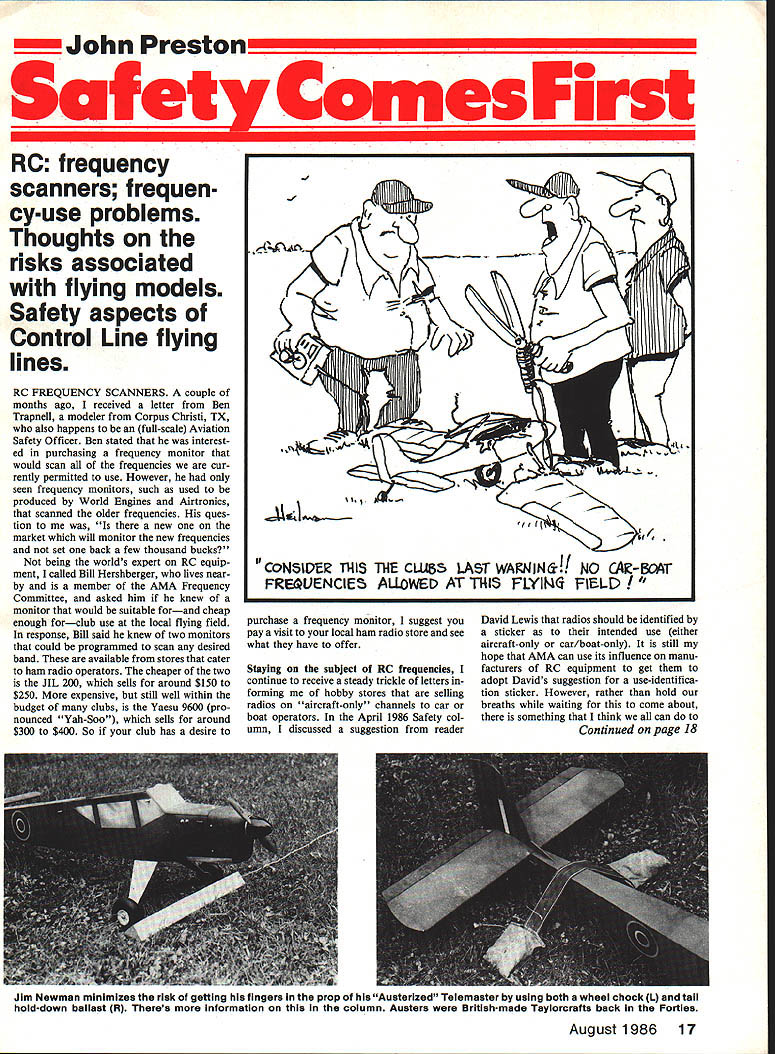
Staying on the subject of RC frequencies, I continue to receive letters reporting hobby stores that sell radios marked "aircraft-only" channels to car or boat operators. In the April 1986 Safety column I discussed David Lewis's suggestion that radios be identified by a sticker indicating intended use (aircraft-only or car/boat-only). I still hope the AMA can influence manufacturers to adopt such use-identification stickers. Meanwhile, we can educate local hobby store owners who may be unaware — or who just don’t care — that there are different frequencies for airborne models than for land/water models.
Michael Eberth (Arlington, TX) recently informed me of a hobby store with a “don’t care” attitude. He reported:
"A friend of mine in another city had tried (unsuccessfully) to become an RC pilot. Rather than leave RC completely, he decided to try boats. He already had a radio and needed the crystals changed to a non-aircraft frequency. His wife went to the hobby shop, bought the boat, motor, etc., and asked for new crystals. The salesperson told her that wasn’t necessary, since 'There won’t be any airplanes around a lake, anyway.' I advised him to change the crystals."
After learning of this episode, Michael wrote to the hobby store owner and informed him of the consequences that could result if a car or boat is operated on an aircraft-only channel. If you suspect hobby stores in your area are uninformed or indifferent about proper radio use, tell them there are specific uses for specific frequencies and that operating a radio tuned to an aircraft-only frequency in a car or boat is against the law (an FCC regulation).
"Risks and Risks" (excerpt)
The following is an excerpt from the "Scale News" column by Martin Fardell, originally published in the November 1985 issue of the British magazine Radio Control Models & Electronics (RCM&E). It was sent to me by Dr. Cyrus Stow of Conyers, GA. I reproduce it here for Scale modelers because it raises important safety concerns.
"This hobby of ours is becoming more dangerous, and the risks that are being taken just don't make sense. OK, so safety is boring. If we didn't take risks we would never get out of bed in the morning because of the risk of being attacked by a passing swarm of bees. But there are high risks and low risks, and we Scale modelers just don't seem to be able to tell the difference.
"If you are flying a small, light model in a country field miles from anywhere, it could just crash—and it just might hit an old lady who happened to be walking by with her dog at the time—and it just might injure her seriously. But the overall risk is small enough to be negligible.
"On the other hand, if you are flying a large, heavy model over or near a large number of people, the risk of a serious accident is certainly not negligible. How often does something go so badly wrong with radio, model, or pilot that the model crashes in a totally uncontrolled way? Say one flight in a thousand, certainly not better. So at meetings or displays, with 50 flights in each, at least one crash is pretty likely. If there are large numbers of people near or under the model, then a serious injury is also likely.
"The reason I am writing this in Scale News is because it is mainly we Scale modelers who are flying the potentially dangerous models."
"We are the builders of most of the Giant models, and we do most of the flying at displays and fly-ins where there are lots of spectators. I know a fast Aerobatic model or Pylon Racer can do as much damage as a big Scale model, but in general, Aerobatics and Pylon Racing are carried out miles away from spectators. There has already been one serious accident this year when one of our very best pilots lost control of his model at a display and a spectator was injured. The incident was not widely reported, but it should have been. If it can happen to the best pilots, it can happen to any of us, and we should face up to this. If you are flying a big model, then you must allow for the possibility of something going wrong and the model becoming uncontrollable. If there are spectators close to your flight path who would be in danger if your model did become uncontrollable, then you should not be flying.
"The primary responsibility for safety rests with the pilot, not the meetings' organizers or the insurance companies. I have seen flying this year that has been quite definitely dangerous, and unless we take steps to reduce the risks, the worst will happen."
At the risk of offending British modelers (I was one of them for 15 years of my life), Fardell added that, in his experience, organized model flying displays or fly-ins in the U.S. are generally conducted more safely than some he attended in the U.K. He acknowledged, however, that things may have changed since he left the U.K. in 1962.
Beware of the Prop!
By far the most common injury associated with model airplane flying results from getting fingers in a spinning prop. Such incidents generally occur during starting or fuel-mixture-adjustment procedures. One scenario involves the model jumping forward because the engine throttle is wide open during starting.
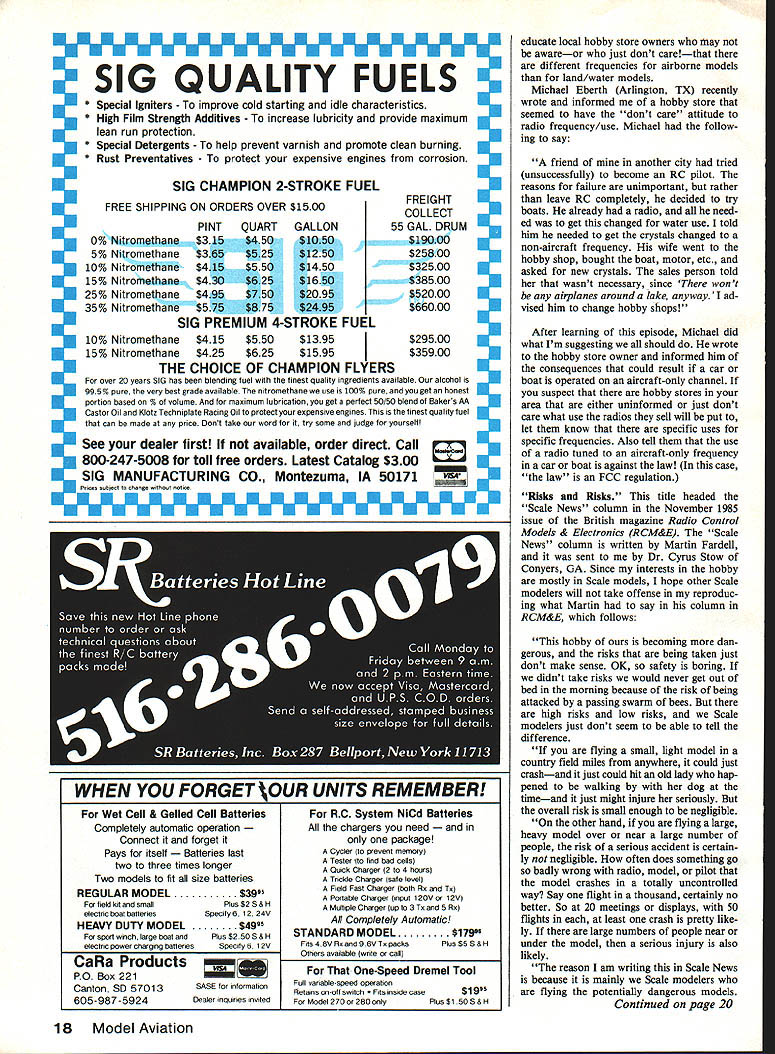
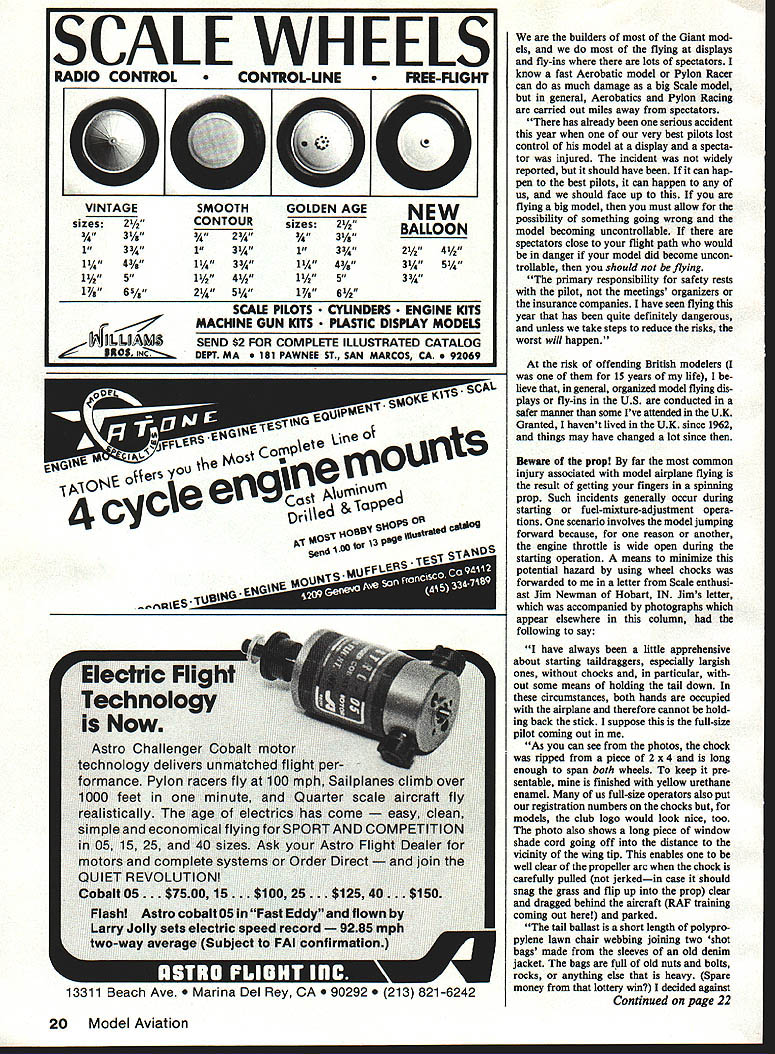
A useful means to minimize this hazard is using wheel chocks to hold the model. Scale stalwart Jim Newman of Hobart, IN, sent photos and this description of his chock arrangement:
- The chock is cut from a piece of 2 x 4 and is long enough to span both wheels. It can be finished with urethane enamel for appearance; a club logo could be painted on it.
- A length of window shade cord is tied to the chock and routed to the wing tip area. This allows the chock to be pulled clear of the propeller while the operator steps back out of the prop arc.
- The tail ballast consists of a short length of polypropylene lawn chair webbing joining two "shot bags" made from old denim sleeves and filled with heavy items (nuts, bolts, small rocks). Jim recommended against sand, which can leak through seams and contaminate flight gear.
- Instead of screwing an eye into the end of the chock, Jim drilled two holes to intersect at 90°. One end of the cord is knotted, the free end fed through the chock, and a large nut is tied to the cord's free end to prevent it being blown off by the slipstream.
Jim's model is a somewhat modified Telemaster (Hobby Lobby eight-foot-span version) powered by an inverted Fox Eagle .60. The excess power makes the model climb strongly, which he notes is useful in case of trouble.
Control Line Safety Issues
Control line fliers face their own safety concerns. Tom Dixon of Atlanta, GA, offered two useful tips regarding "ready-to-use" control lines:
- End connections and crimps:
- Crimped tubing used to secure the ends of ready-made lines can lead to strand fracture one strand at a time, ultimately causing line failure. Failure can also occur if the crimp is not tight enough.
- Prevention: visually inspect and perform a pull test each time lines are used. Better yet, make your own end-connections per the AMA rule book using soft wire binding to avoid localized pressure on individual strands.
- Line length accuracy:
- Many ready-made lines are overly long. Tom's experience was that lines were often 5 to 25 feet longer than the length stated on the box. This can lead to overlap outside the flying circle, loss of control, or injury to people in the pit area when newcomers assume the box length is accurate.
- Prevention: check actual line length with a tape measure and, if necessary, cut and redo the line ends per the AMA rule book.
Ready-made lines that are longer than advertised are as dangerous as an RC transmitter marked for one frequency but transmitting on another.
Closing
As I write this (May 1), I am listening to a report of the Soviet nuclear reactor disaster at Chernobyl. That's a disaster several magnitudes greater than anything I can visualize happening in the world of model airplanes. The purpose of this column, however, is to alert you to hazards in our hobby. Please take sensible precautions, inspect your gear, educate your local hobby stores, and have a safe month.
John Preston c/o Model Aviation 1810 Samuel Morse Dr. Reston, VA 22090
Transcribed from original scans by AI. Minor OCR errors may remain.

