
John Preston
Safety Comes First
Pterosaur Wrecked — Radio Interference
I'm sure most modelers have heard about the project sponsored by the Smithsonian Institution and Johnson's Wax to build and fly a radio-controlled replica of a giant prehistoric pterosaur (pterodactyl). With Paul MacCready in charge, success seemed likely. I became aware of the project over a year ago when several readers sent clippings announcing that the giant reptile model was to be flown on the Mall in Washington, D.C., in front of the Smithsonian. The general opinion of those readers was that attempting flight in that location was hazardous. At the time I tended to agree, and in retrospect I certainly do.
On Saturday, May 17, the replica attempted flight in front of a large crowd attending an Armed Forces Day Open House at Andrews Air Force Base just outside the District of Columbia. Although the pterosaur had on-board power to flap its wings, it was unable to take off unassisted or sustain level flight. A towline was used to pull it up to a launch height of about 400 feet. In addition to requiring the towline for takeoff, the bird required the addition of a tail boom with conventional vertical and horizontal stabilizers to provide sufficient stability during the tow. The appendage could be jettisoned by radio command; upon release of the towline, an on-board computer was supposed to take over and operate an autopilot to assist in flying the monster (44 lb., 18 ft. span).
Two flights had been scheduled as the opener to the Saturday airshow, but circumstances reduced this to one flight attempt. The jettisonable empennage mysteriously released prematurely—before the pilot had activated the autopilot. The pterosaur appeared to execute a snap roll while still on tow, and this resulted in the creature breaking its neck. At one point during the descent it appeared recovery might be likely; however, impact severed its head. There were no more flights that day—and maybe never again.
According to the Washington Post, the pilot later speculated that "competing radio signals may have caused some interference" which resulted in the premature release of the tail-boom assembly. An official paleontologist reportedly quipped, "Now you know why it's extinct."
The reason I'm reporting the demise of the pterosaur in this Safety column is this: I don't care who you are (raw beginner or club hot-shot), what you fly (trainer or humdinger Pattern ship), or what equipment you use for control (single-channel escapement or seven-channel digital with all the bells and whistles), you may all be subject to loss of control due to radio interference. I'm glad the pterosaur's demonstration did not take place over the Mall. I hope all readers who fly RC models never fly over people—you just never know when you could be a victim of radio interference.
Tales about Tails
Staying on the subject of tails parting company with models in flight, I relate an experience reported by Joseph Breda of Gahanna, Ohio. Joe had a very pretty P-51 (a picture appeared in Bill Winter's "Plane Talk" column in the January 1986 issue of Model Aviation). In a recent letter to Bill, Joe described how the model became past tense.
"Bill, I'm sorry to report that the Mustang is no longer airworthy. While playing cat and mouse when flying with a friend, we were doing a low pass at full throttle. He pulled up quickly and I followed. I would say that the horizontal stab and elevator became overstressed. The right side sheared off and fluttered to the ground—as did the Mustang—out at a higher velocity! Needless to say, it was 'instant toothpicks'! Luckily, we were at a safe distance from any spectators.
After I got over the disappointment of losing one of my favorite aircraft, I tried to evaluate the reasons for the mishap. In the first place, the plane was about three years old and I did ding it a couple of times. Secondly, I had recently changed the engine from an .05 to a .35 K&B .40. Third, and last, I made an abrupt change in flight direction. Conclusion: empennage may have been weakened which, in turn, sheared off the stab and elevator when the direction was abruptly changed."
In a subsequent letter to me that responded to some questions about his reinforced stab, Joe described what he thinks caused the stab failure on his first P-51. He calls this the "guillotine effect." Consider that the P-51 is a taildragger and that these tend to nose over more often (in my experience) than models with tricycle landing gear. In such a situation, Joe feels the vertical stab (fin) acts like a guillotine and strikes a downward blow (upward when the model is on its back) to the center of the horizontal stab on which it rests on many models. In other words, according to Joe's theory, the horizontal stab becomes a chopping block which must resist the blows of the guillotine (vertical stab) whenever the model noses over. Joe thinks this may have been a factor contributing to the in-flight failure of his P-51 sheet-balsa stabilizer. Comments from readers would be welcome.
The only time I ever suffered an in-flight failure of a model's tail surface(s) was the result of a mid-air collision between my Falcon 56 and another during a pylon race my club staged. In that case, the entire empennage was lifted off the fuselage by the other model—but I managed to land safely because the pushrods to rudder and elevator were sufficient to prevent it from parting company entirely.
This incident relates to failures of sheet-wood stabilizers because the Falcon 56 has a built-up balsa structure (spars and ribs) covered with a material. In my case it was pure silk with about 16 coats of Randolph butyrate dope. I don't have that Falcon anymore, but as I remember, the stab thickness was about 1/2 in. at the root, and the model was powered by a Super Tiger .23. Falcon 56s are typically powered by engines up to about .40 cu. in. and I don't recall the engine size alone causing in-flight stab failures. This leads to my point: a thin, open-framework structure covered with a high-tensile-strength material may be stronger than a piece of sheet balsa. So an alternative to Joe's suggestion to reinforce his P-51 sheet-balsa stab with Light Ply would be to cover it with silk, taffeta, or other material.
Joe's reinforcement method (from his letter) included:
- Reinforce with a 1/8-in.-thick sheet-balsa stabilizer.
- Add 7-in.-long 3/32-in. pieces on either side of the centerline.
- Epoxy a 1-in. wide x 1/8-in. thick Light Ply strip in place.
Glitch Preventer
In a recent issue of the Chicagoland RC Modelers newsletter (editor Ken Stencel), an article by Rich Frost described a device intended to isolate RC receivers from interference and glitches—promising a "glitch-proof" receiver and prevention of spurious radio operation. Favorable reports about the device appeared in some hobby magazines, but after a few months a technical editor reviewed the product and found it didn't perform as expected.
Rich relates this experience: a four-scale modeler installed one of these units in an absolutely beautiful Sopwith Pup. The aircraft had a number of flights prior to installing the unit. Upon installation and first flight at a fly-in in the Milwaukee area, the model wrecked on that first flight.
I obtained a similar unit for evaluation and found it amplified all sorts of signals outside the RC band and made the receiver respond to unwanted signals. I removed the unit and the model flew fine.
Lesson: be cautious about aftermarket "glitch preventers"—they can make interference worse if they amplify out-of-band signals.
More on Propeller Incidents
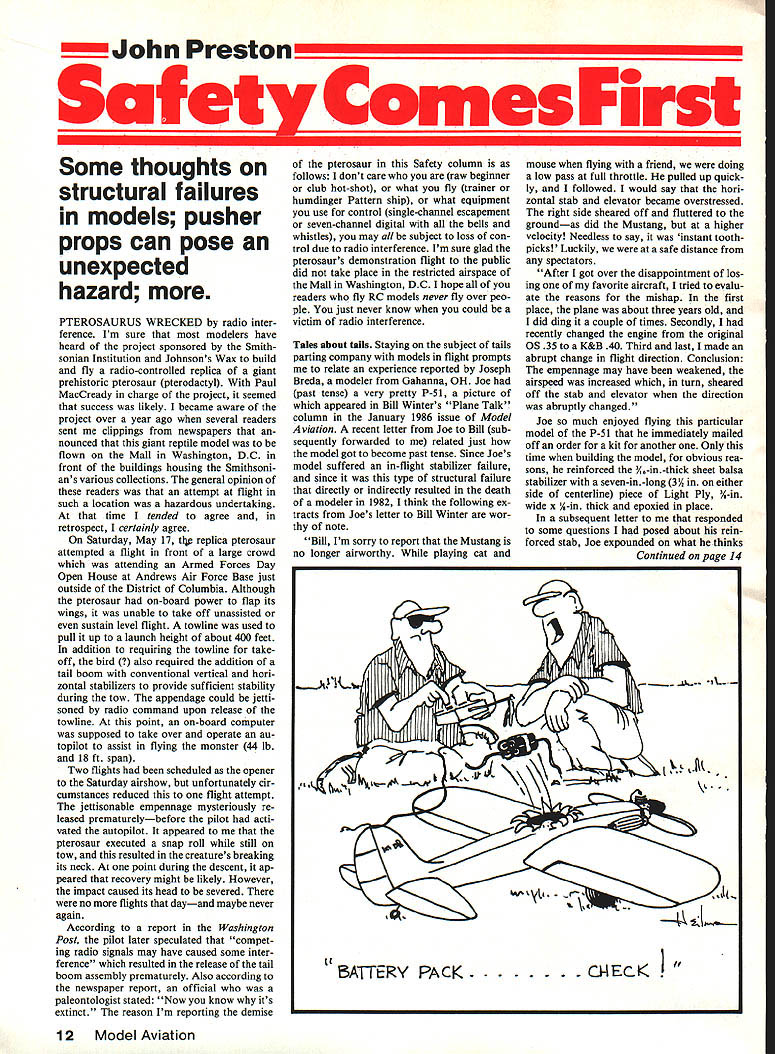
You may be tired of reports of modelers getting fingers or hands in the path of rotating props, but I continue to print them because you might be the next victim. A recent letter from William Norfleet, M.D., of Kenmore, N.Y., related his personal experience with a pusher prop:
"While setting the needle valve on a pusher-driven model equipped with a fiberglass-reinforced plastic prop, my index finger strayed too near the prop arc. A 'puller' would have brushed back such stupidity, but the pusher arrangement seemed to suck my finger into the blade, slicing it three times and nearly amputating it. This all happened very fast. Two hours after, surgery saved the finger, but its most distal joint is completely fused. Beware of pusher props when setting a needle valve."
This reminded me of a similar incident years ago on an RPV project. The vehicle was powered by a .60-size engine in a twin-boom, pusher-prop arrangement to carry a TV camera in the nose. Circumstances were essentially the same: while adjusting the needle valve, a finger got too close to the prop and was pulled into the blades rather than brushed aside, requiring surgery to reattach parts.
I suggest those flying models with pusher props consider using a flexible extension to the needle valve to keep your fingers well away from the prop arc. Getting struck by the leading side of prop blades is infinitely worse than being struck by the trailing side.
Cyanoacrylate Glue
Another tidbit from the Chicagoland newsletter concerned cyanoacrylate (CA) glues. The writer noted CA glues caused skin irritation in laboratory rats and concluded, "You be the judge as to whether you want to use the glue or not." For the record, I have no further information that substantiates this statement. If any readers can supply such information, I would appreciate hearing from you.
John Preston c/o Model Aviation 1810 Samuel Morse Dr. Reston, Virginia 22090
Transcribed from original scans by AI. Minor OCR errors may remain.

