
John Preston
Safety Comes First
I received three letters concerning fuel-can explosions or ignitions. Two described actual incidents and the third warned of potential hazards. Two of the letters arrived simultaneously.
Explosion at the field
One letter forwarded an account from Al Alman’s "Big Birds" column describing a serious accident that could have been avoided.
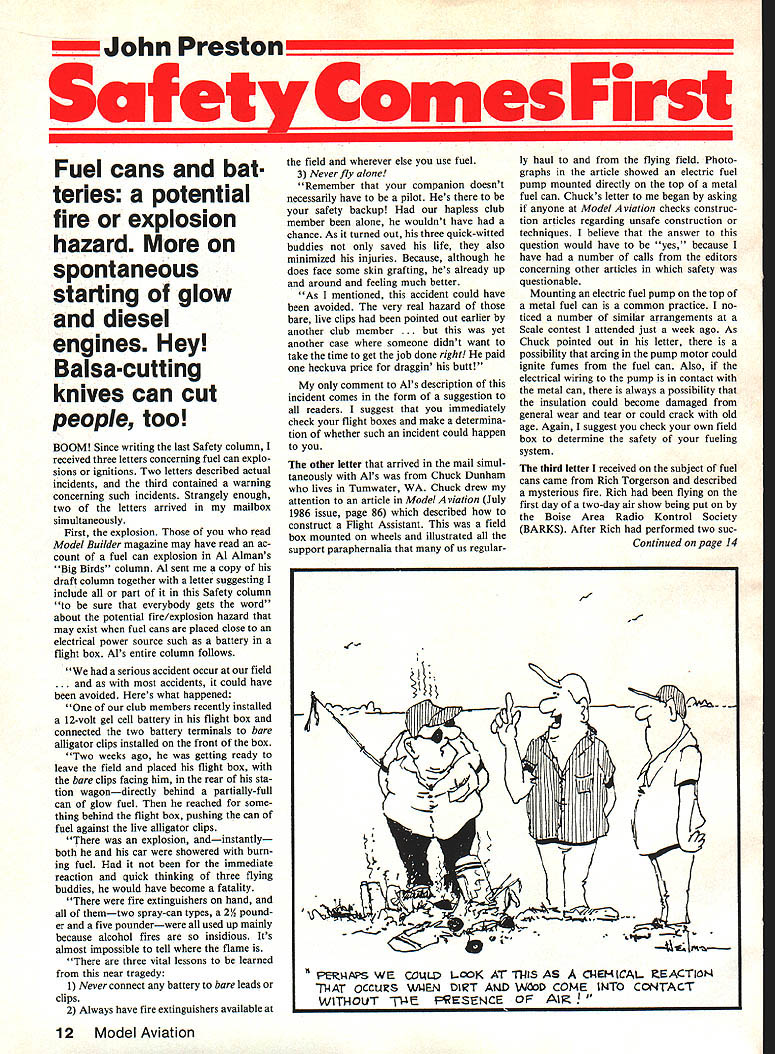
A club member installed a 12-volt gel-cell battery in his flight box and connected the two battery terminals to bare alligator clips on the front of the box. Two weeks later, while preparing to leave the field, he placed the flight box (clips facing him) in the rear of his station wagon directly behind a partially full can of glow fuel. Reaching for something behind the box, he pushed the fuel can against the live alligator clips.
There was an explosion. Instantly both he and his car were showered with burning fuel. Three flying buddies reacted quickly and used fire extinguishers that were on hand; their immediate action likely prevented a fatality. Alcohol fires are insidious and hard to see, and several extinguishers (two spray-can types, a 2½-pounder, and a five-pounder) were used up.
Three vital lessons from this near tragedy:
- Never connect any battery to bare leads or clips.
- Always have fire extinguishers available at the field and wherever fuels are used.
- Never fly alone — a companion serves as your safety backup.
Check your flight boxes now to determine whether a similar incident could happen to you.
Electric pumps and metal cans
A second letter, from Chuck Dunham (Tumwater, WA), pointed out an article in Model Aviation (July 1986) showing a field box ("Flight Assistant") with an electric fuel pump mounted directly on top of a metal fuel can. Mounting a pump that way is common, but it creates hazards:
- Arcing in the pump motor could ignite fuel fumes inside the can.
- Wiring in contact with the metal can may have damaged or aged insulation, allowing shorting or sparks.
Inspect your fueling system and field box for unsafe arrangements and wiring that could put fuel fumes at risk.
Mysterious static ignition
Rich Torgerson (Boise Area Radio Kontrol Society — BARKS) described an incident after the first day of a two-day air show. After two successful flights he returned home, set his plane and field box on his workbench, and refilled a one-gallon metal fuel can with 10% nitro fuel. He had not run his engine for nearly two hours. When he started to screw the metal cap off, something ignited the fumes in the can. His left hand was upside down gripping the cap; the fill and supply lines had been disconnected. Within one second he suffered severe second-degree burns over about 50% of the back of his hand and thumb.
From discussions with other BARKS members, the most probable source of ignition was a static discharge between the metal can and the carpet in front of the workbench. The nearby thunderstorm and higher ambient static may have contributed. The flame protruded from underneath the cap (not the fittings), and the remaining fuel in the can did not explode; the flame was extinguished almost as fast as it was ignited.
Recommendation: be aware that static discharge can act as a spark with metal cans. Burns are extremely painful and slow to heal.
If readers have theories about why the remaining fuel didn't explode, feedback is welcome.
Inadvertent engine starts
Staying with fuel-related hazards but shifting to engines: several readers reported glow-plug engines starting when the prop was flipped even though no battery was connected to the glow plug.
Tony LaVardera (and others) offered a physical explanation: the platinum or platinum-coated wire in glow plugs can catalyze a chemical reaction with alcohol fumes in the presence of air, heating the wire and producing a near-invisible flame. If an engine stops with the exhaust port open and fuel remains in the engine case, this reaction can heat the glow element enough that a single flip of the propeller will start the engine. Because alcohol flames are colorless and hard to see, especially with a muffler installed, the ignition can be unnoticed until the engine runs.
Advice: be alert — your glow plug may heat or ignite without battery power if fuel or fumes are present.
A separate letter from Jim Smith (Clementon, N.J.) emphasized diesels:
- Treat any diesel like a loaded gun; it can start any time the prop is flipped.
- Diesels will start on unburnt fuel, residual fuel, fumes, or seemingly spontaneous causes.
- Always use finger protection; a diesel can bite harder than a glow engine.
- Never over-prime the head. A diesel with a hydraulic lock is an accident waiting to happen. If you must prime, close the exhaust port and rest the piston.
Make others aware of these engine characteristics to help prevent injury.
Have a safe month.
John Preston c/o Model Aviation, 1810 Samuel Morse Drive, Reston, Virginia 22090.
Transcribed from original scans by AI. Minor OCR errors may remain.

